EV Charger Installation Cost: What You’ll Pay in 2026

EV charger installation cost is one of the least predictable numbers in EV ownership. Two neighbors can buy the same $500 wall unit and receive quotes of $900 and $6,000. The charger is rarely the reason. The price is set by your electrical panel, the distance from that panel to your parking spot, and the rules of your local building department.
This guide breaks a home Level 2 installation into its parts, shows what each part costs in the United States in 2026, and explains how to avoid the most expensive item on the list, a panel upgrade.
Short answer
A standard home Level 2 installation in the US costs roughly $1,000 to $2,600 in 2026, including the charger, electrician labor, materials and permit. Qmerit, a large US installer network, reports an average installation price of $1,700. A long wire run, trenching to a detached garage or a panel upgrade can each add $500 to $4,500. The federal tax credit for home chargers ended on June 30, 2026, so utility and state rebates are now the main way to cut the bill.
Key takeaways
- The charger is the small part. Hardware runs $300 to $900. Labor, materials and the permit usually cost more than the unit.
- Two facts set most of the price: the spare capacity in your electrical panel and the distance from the panel to the charger.
- A panel upgrade is the big-ticket item, at $1,500 to $4,500 or more. A lower-power charger or a load management device often avoids it.
- Permits are normal. A new 240-volt circuit needs one almost everywhere. Fees range from $50 to $800.
- The 30% federal tax credit is gone for chargers installed after June 30, 2026. Check your utility for rebates before you buy.
What a Level 2 EV charger installation costs
A Level 2 charger runs on a dedicated 240-volt circuit, the same kind of supply that feeds an electric dryer or oven. Installing one means buying the unit, running a new circuit from the electrical panel, and having the work inspected. If you are still deciding whether you need one at all, start with our guide to Level 1 vs Level 2 EV chargers.
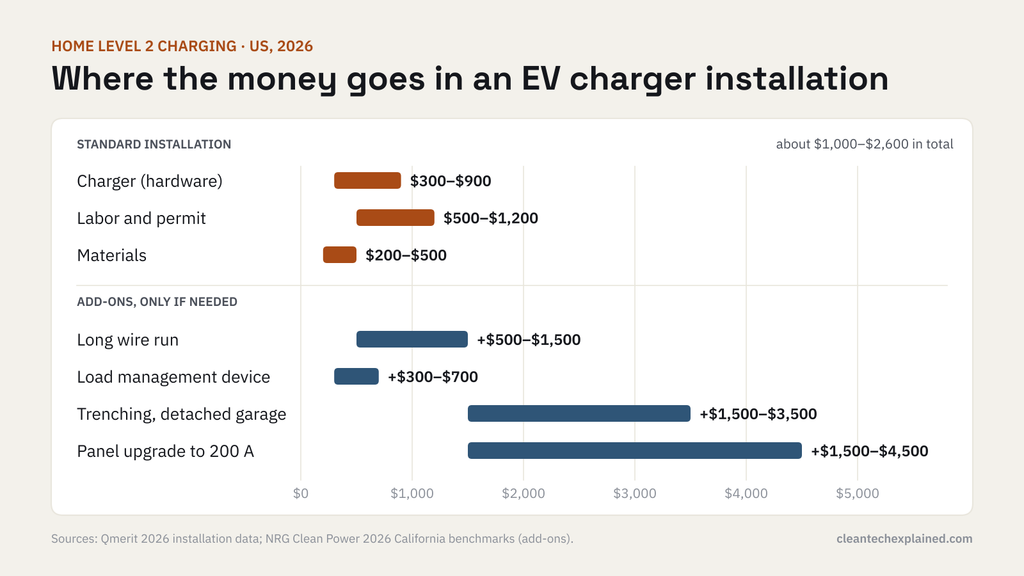
Qmerit’s breakdown, based on its 2026 installation data, is a good picture of a standard job:
| Line item | Typical cost | What it covers |
|---|---|---|
| Level 2 charger (hardware) | $300–$900 | The wall unit and its cable |
| Electrician labor and permit | $500–$1,200 | Half a day of work in most homes, plus the permit and inspection |
| Materials | $200–$500 | Circuit breaker, copper wire, conduit, fittings |
| Standard installation, total | $1,000–$2,600 | Panel has spare capacity, charger is near the panel |
Qmerit reports that the installations it handled in 2026 ranged from $749 to $2,500, with an average of $1,700. Prices in high-cost states sit toward the top of the range. One California installer, NRG Clean Power, puts a straightforward job there at $1,200 to $2,000 including the permit.
“Standard” is doing a lot of work in that table. It assumes the panel can take the new load and the charger sits within a short cable run of it. When either assumption fails, extra items appear on the quote.
Add-on costs
| Extra work | Typical added cost | When it applies |
|---|---|---|
| Long wire run or outdoor mount | +$500–$1,500 | Charger is 40 to 80 feet from the panel |
| Load management device | +$300–$700 | Panel is nearly full but an upgrade can be avoided |
| Trenching to a detached garage | +$1,500–$3,500 | Cable has to run underground |
| Panel upgrade to 200 amps | +$1,500–$4,500 | Panel cannot carry the charger even with load management |
| Utility service upgrade | Can push the panel work to $5,000–$7,000 | The line or meter socket feeding the house must also change |
Add-on figures are from NRG Clean Power’s 2026 California benchmarks, except the low end of the panel upgrade range, which is Qmerit’s national figure. California labor is more expensive than the US average, so treat the upper ends as high-cost-area prices.
Three worked examples
The examples below use mid-range figures from the two tables above. They are illustrations, not quotes.
| A. Easy garage | B. Tight panel | C. Panel upgrade | |
|---|---|---|---|
| Situation | 200 A panel in the garage, 15 ft run | 100 A panel, charger set to 32 A, load management | 100 A panel, all-electric home, 48 A charger |
| Charger | $500 | $500 | $500 |
| Labor and permit | $800 | $900 | $800 |
| Materials | $250 | $350 | $250 |
| Load management device | – | $500 | – |
| Panel upgrade | – | – | $3,000 |
| Total | $1,550 | $2,250 | $4,550 |
Homes B and C start with the same 100-amp panel. The $2,300 difference comes from one decision: whether to fit the charger into the capacity the house already has, or to enlarge the supply.
What drives the price
1. Panel capacity
The number on your main breaker is your service size. Most newer homes have 200 amps. Many older ones have 100 or 125. An electrician runs a load calculation that adds up the home’s existing demand and the new charger. If the total fits, the job is simple. If it does not, you need one of the fixes described in the next section.
2. Distance from panel to charger
Copper is expensive, and EV circuits use thick wire. NRG Clean Power puts installed wire at $10 to $20 per foot in California. A charger on the wall next to the panel needs a few feet. A charger on the far side of the house, with the cable routed through an attic or crawlspace, can need 60 feet or more. If the garage is detached, the cable goes underground and trenching becomes the largest line on the quote.
3. Charger amperage
A more powerful charger needs a larger breaker and thicker wire. EV charging is a continuous load, so the circuit must be rated for 125% of the charging current.
| Charging current | Circuit breaker | Power | Range added per hour |
|---|---|---|---|
| 24 A | 30 A | 5.8 kW | About 18 miles |
| 32 A | 40 A | 7.7 kW | About 25 miles |
| 40 A | 50 A | 9.6 kW | About 30 miles |
| 48 A | 60 A (hardwired only) | 11.5 kW | About 36 miles |
Range per hour assumes about 3.5 miles per kWh and 90% charging efficiency. A large truck or SUV gains fewer miles.
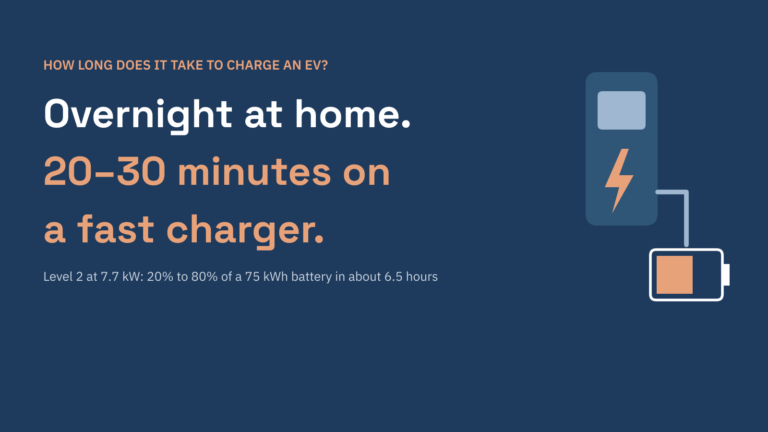
Most drivers do not need the top row. A 32-amp charger refills a 40-mile commute in under two hours. Choosing 32 amps instead of 48 saves on wire and breaker, and more importantly it can be the difference between passing and failing the load calculation.
4. Permit and inspection
A new 240-volt circuit requires an electrical permit in almost every US jurisdiction. Qmerit reports permit fees from $50 to $800, with an average around $310. The electrician normally applies for it and includes it in the quote. Be cautious of any installer who says a permit is unnecessary for a new circuit. Unpermitted electrical work can cause problems with insurance claims and when you sell the house.
5. Where you live
Electrician rates vary widely. NRG Clean Power cites $95 to $150 per hour for licensed contractors in California. Rural and lower-cost regions charge less. This is the reason national averages are only a starting point.
Do you need a panel upgrade?
Often not, even with a 100-amp panel. Before you accept a quote that includes one, ask the electrician about three cheaper routes.
- Turn the charger down. Most wall units can be set to a lower current during installation. A 24-amp or 32-amp setting needs a smaller circuit and still covers typical daily driving overnight.
- Add a load management device. Also called an energy management system, this monitors the home’s total draw and pauses or slows charging when the oven, dryer and air conditioner are all running. The device costs roughly $300 to $700. In NRG Clean Power’s California example, it turns a job of about $6,200 with a panel upgrade into one of about $2,600.
- Share an existing 240-volt circuit. A circuit-sharing device, sometimes called a smart splitter, lets the charger use a dryer or range circuit when that appliance is off. It suits homes where the dryer outlet is close to the parking spot.
A panel upgrade makes sense when the house is being electrified anyway. If a heat pump, an induction range, a home battery or a second EV is planned in the next few years, a 200-amp panel will be needed sooner or later, and doing it once is cheaper than doing it twice.
Hardwired or plug-in?
A Level 2 charger connects in one of two ways. A hardwired unit is wired directly into the circuit. A plug-in unit uses a 240-volt receptacle, usually a NEMA 14-50.
| Hardwired | Plug-in (NEMA 14-50) | |
|---|---|---|
| Maximum charging current | 48 A | 40 A |
| Upfront cost | Slightly higher | About $200–$400 lower, by one installer’s estimate |
| Outdoor use | Better suited | Depends on the enclosure |
| Take it with you | Needs an electrician to remove | Unplug and go |
| Main drawback | Less flexible | Receptacle wear and nuisance trips |
The plug-in route looks cheaper, but two details narrow the gap. Electrical codes require ground-fault (GFCI) protection on receptacles used for EV charging, and a GFCI breaker combined with the charger’s own protection is a known cause of nuisance trips. The receptacle also has to be a heavy-duty type. Cheap ones can overheat under hours of continuous current.
For a permanent home installation, hardwiring is usually the better choice. Plug-in suits renters and people who expect to move.
If you already have a suitable 240-volt outlet where you park, the cheapest installation is none at all: a plug-in charger or the portable 240-volt cord that came with the car. Have an electrician confirm the outlet and its circuit are in good condition first.
Installing a Tesla Wall Connector
The Tesla Wall Connector is one of the most popular home chargers, and the same cost rules apply to it as to any Level 2 unit. Tesla sells it for about $585 in the US, after a price increase in September 2026. The Universal Wall Connector, which adds a J1772 adapter for non-Tesla cars, costs about $660.
To get its full 48 amps (11.5 kW), the Wall Connector must be hardwired on a 60-amp circuit. Tesla says that adds up to about 44 miles of range per hour to a Model 3 or Model Y. If your panel has less spare capacity, the installer can set it to a lower current during setup, down to 12 amps on a 15-amp breaker, which can avoid a panel upgrade. Our guide to how long it takes to charge an electric car compares charging times for other circuit sizes.
Installation itself costs the same as for other hardwired chargers: typically about $700 to $1,700 for labor, permit and materials on a straightforward job, which puts the total at roughly $1,300 to $2,300 including the unit. Long cable runs, a detached garage or a panel upgrade add to that, as described above. Tesla does not install the unit itself; it points buyers to independent electricians, and the installer finishes setup in the Tesla One app.
Many newer non-Tesla EVs now come with the same NACS charging port as Teslas, so they can use the standard Wall Connector directly. Older cars with a J1772 port need the Universal version or an adapter.
Can you install an EV charger yourself?
Plugging a unit into an existing 240-volt outlet is something any owner can do. Adding a new circuit is different. It needs a permit and, in most places, a licensed electrician.
The 2026 edition of the National Electrical Code makes this explicit. A new section, 625.4, states that permanently installed EV charging equipment must be installed by qualified persons. The code only applies once a state or city adopts it. According to the installer Treehouse, eight states had adopted the 2026 edition by July 2026, including Colorado, Massachusetts, Oregon and Washington, and others are following.
The federal tax credit has ended
Until mid-2026, homeowners in eligible areas could claim a federal credit of 30% of the cost of a home charger and its installation, up to $1,000. Under legislation passed in 2025, the credit is not available for equipment placed in service after June 30, 2026. If your charger was installed and working by that date, you can still claim it on IRS Form 8911 with your 2026 tax return.
If a quote or a product page still subtracts the federal credit from the price of a new installation, the number is out of date.
Rebates that still exist
State and utility programs are now the main source of help. They vary a great deal, and most have conditions such as an approved charger list or enrollment in an off-peak rate plan. Some examples from 2026:
- Rhode Island (PowerUpRI): up to $800 toward a Level 2 charger and up to $1,000, or 50%, of installation costs.
- Los Angeles (LADWP): up to $1,000 for residential customers.
- Sacramento (SMUD): up to $600, including an amount for a load management device.
- Southern California Edison: up to $4,200 toward a panel upgrade for income-qualified customers, with applications open through December 31, 2026.
Check with your electricity provider before buying the charger, because many programs only pay for specific models. The US Department of Energy’s Alternative Fuels Data Center keeps a searchable list of state and utility incentives.
An off-peak electricity rate is often worth more than any rebate over the life of the car. Ask your utility whether it has an EV or time-of-use plan.
How to compare quotes
Get two or three quotes, and make sure each one answers the same questions:
- Is the charger included, or is the quote for installation only?
- What breaker size and charging current is the circuit designed for?
- Was a load calculation done, and what did it show?
- Is the permit fee included, and who schedules the inspection?
- How many feet of wire does the quote assume, and is the cable run on the surface or inside walls?
- If a panel upgrade is quoted, were a lower charging current and load management considered?
- Is the installer licensed, insured and familiar with your charger brand?
You can prepare before anyone visits. Photograph your panel with the door open, note the number on the main breaker, and measure the distance from the panel to where the car parks. Most installers can give a close estimate from those three things.
Is a Level 2 charger worth the cost?
It depends on your driving, not on the price alone. A standard outlet adds about 5 miles of range per hour, which is enough for a short commute. If you drive more than about 40 to 50 miles a day, own a large-battery EV or share a charger between two cars, Level 2 is the comfortable choice. Our Level 1 vs Level 2 comparison has a five-question checklist. To estimate your running costs, use our EV charging cost calculator.
If you also plan to add solar, mention it to the electrician. Doing both under one permit can save a visit, and our solar panel calculator shows how many extra panels an EV requires.
FAQ
How much does it cost to install a Level 2 charger at home?
About $1,000 to $2,600 for a standard installation in the US in 2026, including the charger, labor, materials and permit. Qmerit reports an average installation price of $1,700. Long wire runs, trenching and panel upgrades cost extra.
How much does it cost to install a 240-volt outlet for an EV?
A NEMA 14-50 outlet needs the same dedicated circuit as a hardwired charger, so the electrical work costs nearly the same. One installer puts the saving at about $200 to $400. You still need a charger or a portable 240-volt cord to plug into it.
Can I install a Level 2 charger on a 100-amp panel?
Often yes. A charger set to 24 or 32 amps, or a load management device, lets many 100-amp homes add charging without an upgrade. An electrician’s load calculation will confirm it. Homes with electric heating, an electric range and an electric dryer are the most likely to need a larger panel.
Do I need a permit to install an EV charger?
For a new 240-volt circuit, yes, in almost every US jurisdiction. Fees range from $50 to $800 and average about $310. You do not need a permit to plug a charger into an existing, suitable outlet.
How long does installation take?
The work itself usually takes half a day when the panel has capacity and the run is short. Permits, scheduling and inspection add days to the calendar. A panel upgrade adds a day of work and, if the utility is involved, sometimes several weeks of waiting.
Is there still a tax credit for home EV chargers?
Not for new installations. The federal credit of 30%, up to $1,000, ended for chargers placed in service after June 30, 2026. Some states and many utilities still offer rebates.
Is a 48-amp charger worth the extra cost?
Only if your car can accept 11.5 kW and you regularly need a fast turnaround. A 32-amp charger adds about 25 miles of range per hour, which refills most daily driving in two to three hours.
How much does it cost to install a Tesla Wall Connector?
About $1,300 to $2,300 in total for a typical installation, including the $585 unit. The installation alone usually costs $700 to $1,700, more if you need a long wire run or a panel upgrade.
Sources
- Tesla, Wall Connector support and specifications
- TeslaNorth, Tesla home chargers just got more expensive in Canada and the US, September 2026
This article is general information, not electrical or tax advice. Prices are US estimates and vary by home and region. Always use a licensed electrician and follow your local code.