How Long Does It Take to Charge an Electric Car?

How long it takes to charge an electric car depends on three things: how much energy you need to add, how much power the charger supplies, and how much power the car will accept. Plug into a regular wall outlet and a big battery can take a day and a half. Plug into a fast charger on a road trip and most new EVs add hundreds of miles in about 20 to 30 minutes. This guide gives real charging times for each type of charger, explains why the last 20% is the slowest, and includes a calculator for your own car.
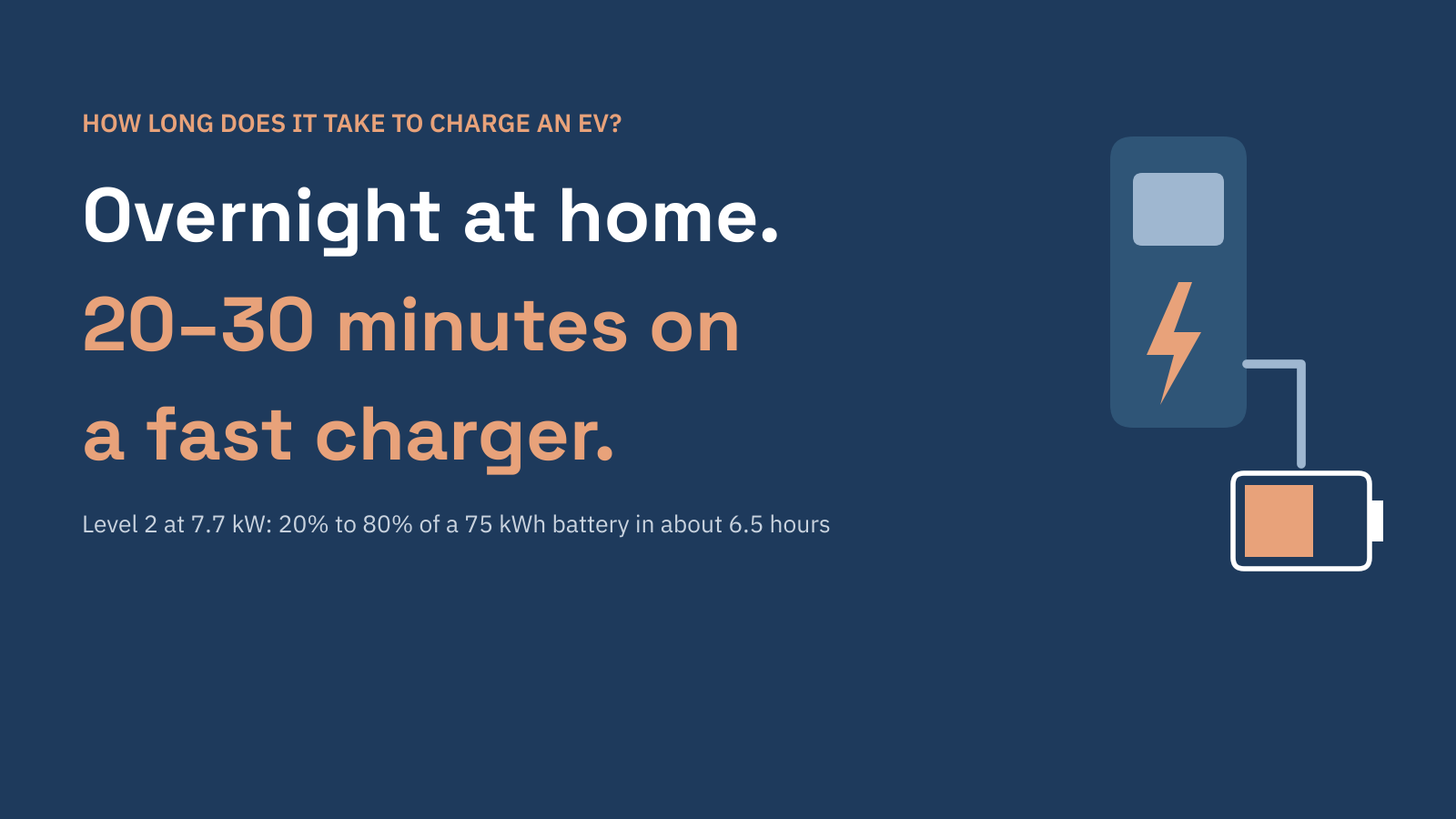
Short answer: On a Level 2 home charger, most EVs charge from 20% to 80% in about 4 to 7 hours, so an overnight charge is enough for almost everyone. A standard 120-volt outlet (Level 1) adds only 3 to 5 miles of range per hour and needs well over a day for a large battery. A DC fast charger takes most recent EVs from 10% to 80% in about 18 to 30 minutes.
Key takeaways
- Charging time is roughly the energy you need to add divided by the charging power, plus about 10% for losses.
- Level 1 (120 V, about 1.4 kW) adds about 4 to 5 miles per hour. Level 2 (240 V, 7 to 19 kW) adds about 25 to 60 miles per hour.
- At home, the car’s onboard charger sets the limit. Most 2026 EVs accept 11.5 kW, so a bigger wall charger will not make them charge faster.
- Fast charging slows sharply above about 80%. Going from 80% to 100% can take as long as going from 10% to 80%.
- Cold batteries charge slowly. Preconditioning the battery before a fast-charging stop makes the biggest difference in winter.
EV charging time at a glance
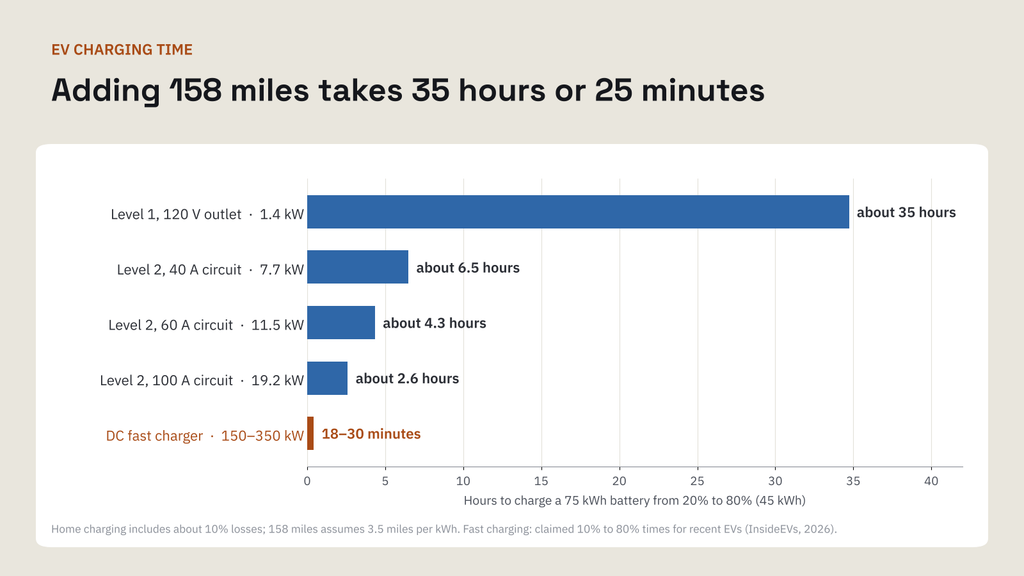
The table uses a typical 75 kWh battery charged from 20% to 80%, which adds 45 kWh, about 158 miles for an EV that goes 3.5 miles per kWh. Home charging times include about 10% for charging losses.
| Charger | Power | Miles added per hour | Time for 20% to 80% (75 kWh) |
|---|---|---|---|
| Level 1, 120 V outlet | 1.4 kW | 4 to 5 | About 35 hours |
| Level 2, 40 A circuit | 7.7 kW | About 24 | About 6.5 hours |
| Level 2, 60 A circuit | 11.5 kW | About 36 | About 4.3 hours |
| Level 2, 100 A circuit (few cars accept this) | 19.2 kW | About 60 | About 2.6 hours |
| DC fast charger | 50 to 350 kW | Several hundred | About 18 to 30 minutes (10% to 80%) |
The US Department of Transportation gives similar ranges for a 60 kWh battery: 40 to 50 hours from empty on Level 1, 4 to 10 hours on Level 2, and 20 minutes to an hour to reach 80% on a DC fast charger.
How to work out your own charging time
The basic formula is simple:
Charging time (hours) = energy to add (kWh) ÷ charging power (kW) ÷ 0.9
The energy to add is your battery size multiplied by the share you want to fill. Going from 20% to 80% on a 75 kWh battery is 60% of 75, or 45 kWh. The charging power is the lower of two numbers: what the charger can supply and what the car’s onboard charger can accept. The 0.9 accounts for the roughly 10% of energy lost as heat in the charger, cables and battery.
For a 7.7 kW Level 2 charger, that is 45 ÷ 7.7 ÷ 0.9 = about 6.5 hours. The same car on a 120-volt outlet at 1.4 kW needs about 35 hours. Use the calculator below with your own numbers. Your battery size is in the owner’s manual or on the manufacturer’s website; use the usable capacity if it is listed.
EV charging time calculator
For home and public Level 1 and Level 2 charging. DC fast charging follows a curve that this simple formula does not capture.
Charging time
6 h 30 min
45.0 kWh
158 miles
24 miles per hour
The charger sets the pace (7.7 kW).
Estimate only. Includes about 10% charging losses. Real times are longer in cold weather and if the battery is above about 90%.
Level 1 charging time
Level 1 means plugging the cable that came with the car into an ordinary 120-volt household outlet. On a 15 or 20 amp circuit it delivers about 1.4 kW, which adds roughly 4 to 5 miles of range per hour. Charging a large battery from low to full takes 40 hours or more.
That sounds hopeless, but it works for more people than you might expect. Twelve hours plugged in overnight adds about 50 miles, which covers a typical daily commute. Level 1 also suits plug-in hybrids, whose batteries are small enough to refill overnight. If you regularly drive more than 40 or 50 miles a day, or you want a full battery before a long trip, you will want Level 2. Our guide to Level 1 vs Level 2 EV chargers compares the two in detail.
Level 2 charging time
Level 2 chargers run on 240 volts, like an electric dryer, and supply about 7 to 19 kW. This is what most owners install at home and what you find at workplaces, hotels and shopping centers. A Level 2 charger on a 40 amp circuit (7.7 kW) adds about 24 miles per hour; on a 60 amp circuit (11.5 kW) it adds about 36. Either one refills a typical EV overnight.
There is a catch. The car converts alternating current from the wall into direct current for the battery using its own onboard charger, and that part has a maximum rating. Most 2026 EVs, including the Tesla Model Y and the Chevrolet Equinox EV, accept up to 11.5 kW. A few cars offer more: the Equinox EV RS AWD has an optional 19.2 kW onboard charger. Connecting an 11.5 kW car to a 19.2 kW wall unit still charges at 11.5 kW, so check your car’s rating before paying for a bigger charger or a heavier circuit. Our guide to EV charger installation cost explains what each circuit size costs to install.
DC fast charging time
DC fast chargers bypass the onboard charger and feed direct current straight into the battery at 50 to 350 kW. Automakers usually quote the time from 10% to 80%, because that is the part of the battery that accepts the most power. Claimed times for some EVs sold in the US:
| Model | Peak DC power | Claimed 10% to 80% |
|---|---|---|
| Kia EV6 | 240 kW | 17 to 18 minutes |
| Hyundai Ioniq 5 | 233 kW | 18 minutes |
| Kia EV9 (76.1 kWh) | 235 kW | 20 minutes |
| Porsche Macan Electric | 270 kW | 21 minutes |
| Lucid Air Grand Touring | 300 kW | 22 minutes |
| Polestar 4 | 200 kW | 30 minutes |
| BMW i4 | 205 kW | Just over 30 minutes |
Tesla and GM quote miles rather than percentages. Tesla says a Model Y can regain about half its EPA range in 15 minutes at a Supercharger. GM says the Equinox EV, which charges at up to about 150 kW, can add up to 80 miles in 10 minutes.
Treat these as best cases. They assume a warm battery, a charger that can deliver the car’s full power and, for many stations, no other car sharing the cabinet. A 50 kW charger, still common at older sites, will take an hour or more to do the same job.
Why the last 20% takes so long
A lithium-ion battery accepts high power when it is fairly empty and less and less as it fills. On a fast charger, power usually peaks somewhere between 10% and 50% and then tapers. Above about 80%, the car cuts power steeply to protect the cells, and the last 20% can take as long as the 70% before it.
That is why the fastest way through a road trip is usually several short stops from about 10% to 60% or 70%, rather than one long stop to 100%. At home, where the charger supplies far less power than the battery could take, the taper matters much less. Level 2 charging stays close to full speed until the battery is nearly full.
Cold weather makes charging slower
A cold battery cannot safely accept full power, so the car limits charging until the cells warm up. Idaho National Laboratory analyzed about 500 fast-charging sessions from a fleet of Nissan Leaf taxis. A session that brought a warm battery to 80% in about 30 minutes at 77 °F delivered 36% less energy in the same time at 32 °F. At the coldest temperatures in the study, charging was roughly three times slower.
Newer cars handle this better, but the effect has not gone away. Recurrent’s analysis of more than 224,000 fast-charging visits by Tesla Model 3 drivers found that sessions at 0 °F took about 9 minutes longer on average. Recurrent also warns that without warming the battery first, the first 30 to 45 minutes at a fast charger in very cold weather may add little charge.
Two habits help. Use the car’s navigation to route to a fast charger, which tells most EVs to precondition the battery on the way. And when you can, charge right after driving, while the battery is still warm. At home in winter, Level 2 charging is slower to start but still finishes overnight.
How to charge faster
- Install Level 2 at home if you rely on a 120-volt outlet and drive more than about 40 miles a day.
- Match the charger to the car. A 48 A charger on a 60 A circuit suits a car with an 11.5 kW onboard charger; anything bigger is wasted unless the car accepts more.
- Arrive low and leave at 70% to 80% on road trips, where the battery charges fastest.
- Precondition before fast charging in cold weather, and charge soon after driving.
- Pick chargers rated above your car’s peak and, at busy sites, avoid stalls that share power with a neighbor.
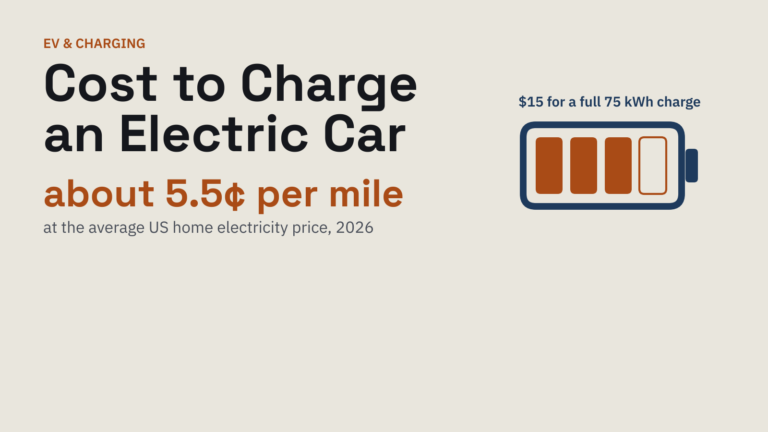
Charging time and charging cost are linked: home charging is slow but cheap, and fast charging is quick but costs about three times as much per kWh. Our guide to the cost to charge an electric car has a calculator for that side of the question.
Frequently asked questions
How long does it take to charge an electric car at home?
On a Level 2 charger, about 4 to 7 hours to go from 20% to 80% on a typical 75 kWh battery, and longer from nearly empty to full. On a standard 120-volt outlet, the same top-up takes about 35 hours.
How long does it take to charge a Tesla?
A Model Y with an 11.5 kW onboard charger fills from low to full in roughly eight hours on a 48 A home charger. At a Supercharger, it can regain about half its range in around 15 minutes.
How many miles do you get per hour of charging?
About 4 to 5 miles on Level 1, 24 miles on a 7.7 kW Level 2 charger and 36 miles at 11.5 kW, for an EV that travels 3.5 miles per kWh. Less efficient vehicles such as large trucks add fewer miles per hour.
Is it bad to fast charge every day?
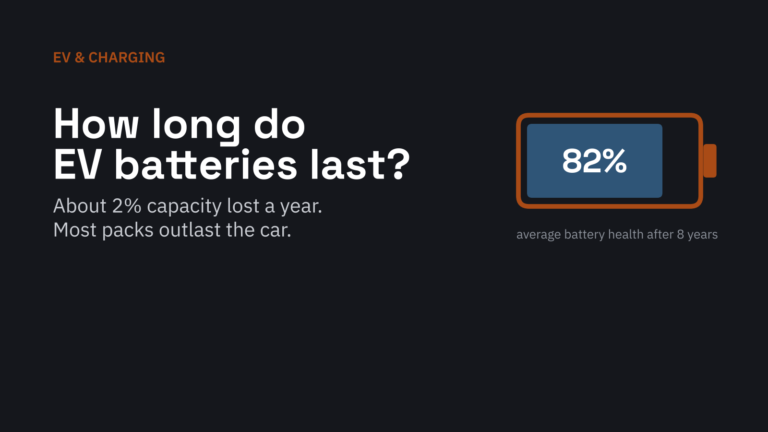
Frequent fast charging does wear batteries somewhat faster. Fleet data shows cars that rely heavily on chargers above 100 kW lose capacity about twice as quickly as cars that rarely use them. Occasional fast charging on trips is fine. See how long EV batteries last for the numbers.
Should I charge my EV to 100%?
For daily driving, many automakers recommend a limit of about 80% for nickel-based batteries, and charging to 100% only before long trips. Cars with LFP batteries are often designed to be charged to 100% regularly. Follow the advice in your owner’s manual; our guide to LFP vs NMC batteries explains the difference.
Why does my EV charge slower than the charger’s rating?
Usually because the car accepts less power than the charger can supply, the battery is cold or nearly full, or the station is sharing power between two cars. At home, the car’s onboard charger rating is the most common limit.
Sources
- US Department of Transportation: Charger types and speeds
- InsideEVs: These EVs have the highest claimed charging power in 2026
- EVChargingStations.com: Tesla Model Y vs Chevrolet Equinox EV charging (August 2026)
- EVChargingStations.com: Chevrolet Equinox EV optional 19.2 kW onboard charger (January 2025)
- InsideEVs: Idaho National Laboratory study on fast charging in cold temperatures (2018)
- Recurrent: EV charging speeds in cold temperatures (January 2024)