Cost to Charge an Electric Car: Calculator and 2026 Prices

The cost to charge an electric car depends on three numbers: how far you drive, how much electricity your car uses per mile, and what you pay for that electricity. At home, the answer is usually a few cents per mile. At a public fast charger, it can be three times as much. This guide gives the current US figures, shows the math, and includes a calculator for your own numbers.
Short answer
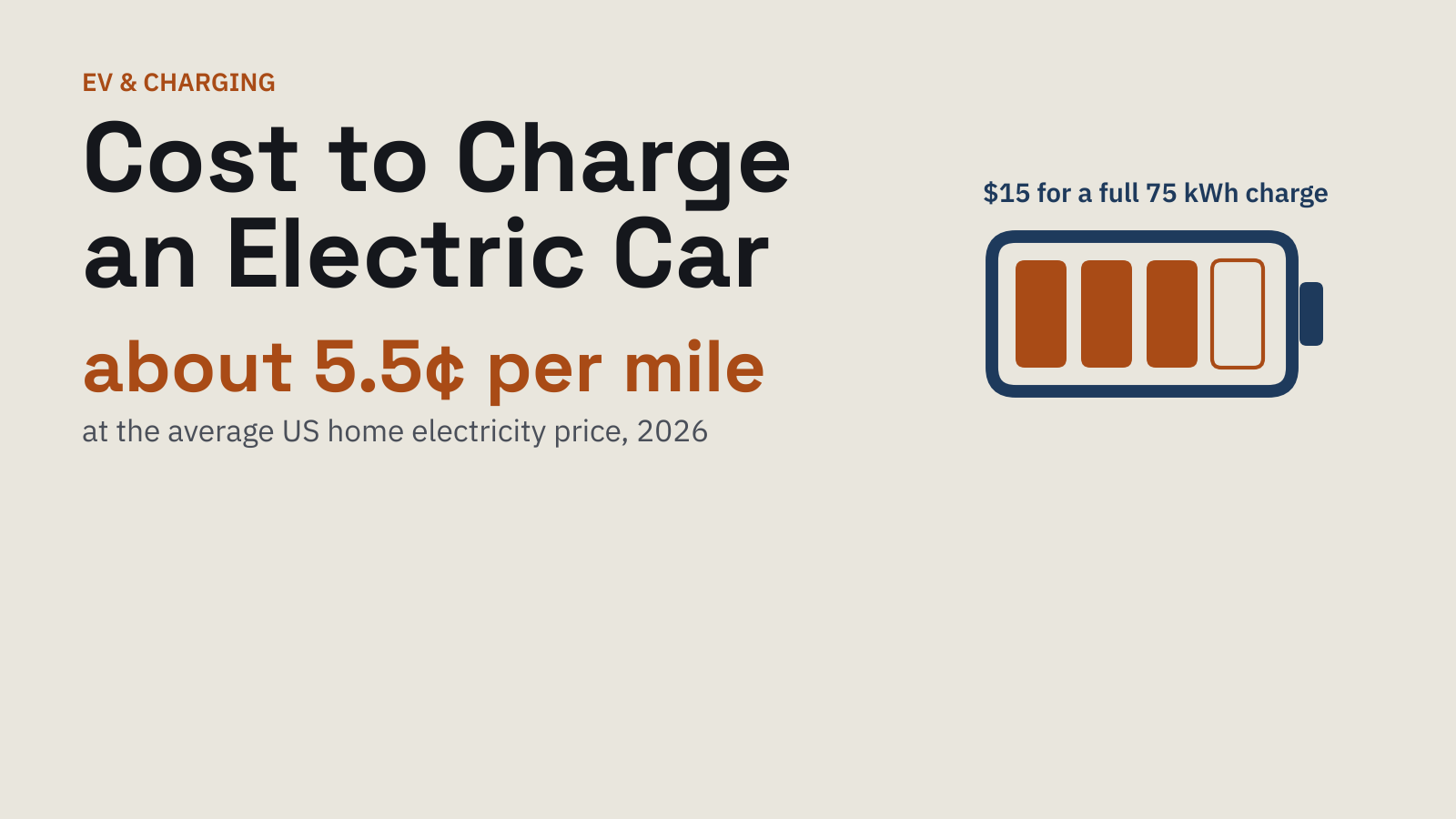
At the average US home electricity price of 18.3 cents per kWh, a typical electric car costs about $5.50 per 100 miles to charge, or roughly $55 a month for 1,000 miles. A full charge of a 75 kWh battery costs about $15 at home. Public DC fast charging averages about 54 cents per kWh, which works out to about $16 per 100 miles, close to the cost of gasoline in a 30 mpg car.
Calculator
EV charging cost calculator
Your driving
Your electricity
Compare with a gas car
$76per month to charge
- Cost per mile
- 7.6¢
- Cost per year
- $916
- Electricity used per month
- 300 kWh
- Gas car, per month
- $146
- Saving vs gas, per year
- $832
- If you charged only at home, per month
- $55
Estimate only. kWh per 100 miles is the EPA figure, which already includes charging losses. Real consumption rises in cold weather and at highway speeds.
Key takeaways
- Home charging costs about 5 to 6 cents per mile at the average US electricity price, for a typical EV.
- Where you charge matters more than which EV you drive. Public fast charging costs about three times as much per kWh as home electricity.
- Against a 30 mpg gas car, home charging costs well under half as much per mile at October 2026 prices. Fast charging alone saves little or nothing.
- Your state changes the answer. Home electricity prices range from about 13 cents per kWh in the cheapest states to more than 30 cents in the most expensive.
- Off-peak rate plans are the easiest saving. Many utilities charge much less for overnight electricity.
How to calculate the cost to charge an electric car
The formula is short:
Cost = miles driven × (kWh per 100 miles ÷ 100) × price per kWh
Each part is easy to find.
- Miles driven. The average American driver covers roughly 1,000 miles a month. Use your own figure if you know it.
- kWh per 100 miles. This is the EV equivalent of miles per gallon, and lower is better. It is printed on the window sticker and listed on the US government’s fueleconomy.gov site. Efficient cars use about 25, typical crossovers about 30, and large trucks 40 or more. The EPA figure is measured at the wall, so it already includes the energy lost during charging.
- Price per kWh. Your electricity bill shows it. Divide the total bill by the kWh used to get your real all-in rate.
Here is the worked example behind the short answer. A car that uses 30 kWh per 100 miles, driven 1,000 miles, needs 300 kWh. At 18.31 cents per kWh, that is 300 × $0.1831 = $54.93 a month, or about $660 a year.
Cost to charge at home
Most EV owners do most of their charging at home, and it is the cheapest option almost everywhere. The US average residential electricity price was 18.31 cents per kWh in July 2026, according to the Energy Information Administration. That was 4.9% higher than a year earlier.
The national average hides a wide spread. The table shows what 1,000 miles costs in a car using 30 kWh per 100 miles at different electricity prices.
| Home electricity price | Cost per 100 miles | Cost per month (1,000 miles) | Where you see prices like this |
|---|---|---|---|
| 13¢ per kWh | $3.90 | $39 | Lowest-cost states |
| 18.3¢ per kWh | $5.49 | $55 | US average, July 2026 |
| 30¢ per kWh | $9.00 | $90 | California, New York, much of New England |
| 48¢ per kWh | $14.40 | $144 | Hawaii |
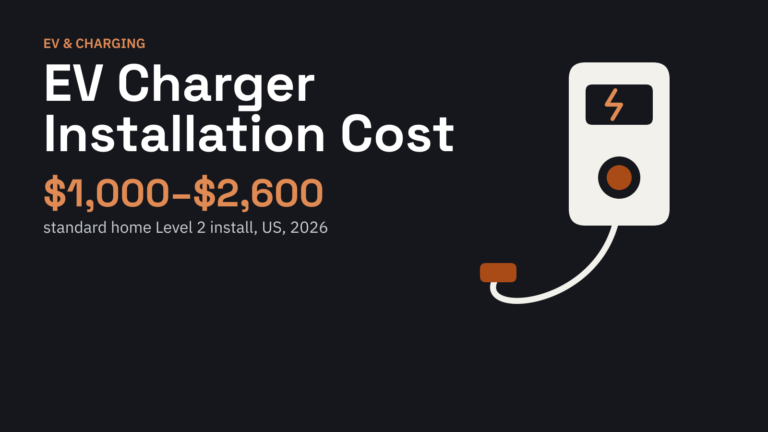
It makes no difference to the price per kWh whether you use a standard outlet or a 240-volt wall unit. Level 2 charging wastes slightly less energy, but the main difference is speed, not cost. See our comparison of Level 1 vs Level 2 EV chargers for the details, and our guide to EV charger installation cost if you are pricing a wall unit.
Cost of a full charge
People often ask what it costs to “fill up”. The answer depends on battery size. The home column assumes a charge from empty to full with 10% charging losses, at 18.31 cents per kWh. The fast-charging column assumes a typical road-trip stop from 10% to 80% at 53.8 cents per kWh.
| Battery size | Typical vehicle | Full charge at home | Fast charge, 10% to 80% |
|---|---|---|---|
| 60 kWh | Compact car | About $12 | About $23 |
| 75 kWh | Midsize car or crossover | About $15 | About $28 |
| 100 kWh | Large SUV | About $20 | About $38 |
| 130 kWh | Full-size pickup | About $26 | About $49 |
In practice you rarely charge from empty. Daily charging replaces what you drove that day, so cost per mile is the more useful number.
Cost to charge at public stations
Public charging comes in two kinds, and their prices are very different.
- Public Level 2 chargers are the slower units found at workplaces, hotels, shops and car parks. Some are free. Others bill by the kWh or by the hour, usually somewhere between home prices and fast-charging prices.
- DC fast chargers are the high-power stations along highways. They add hundreds of miles of range per hour and charge a premium for it.
The average US price for DC fast charging was 53.8 cents per kWh in the second quarter of 2026, according to the charging data firm Paren. Most stations fell between 45 and 55 cents. Hawaii was the most expensive state at about 86 cents, followed by New Jersey at about 65 cents.
At 53.8 cents per kWh, the same 30 kWh per 100 miles car costs $16.14 per 100 miles. That is about three times the cost of charging at home.
Three things can raise or lower what you pay at a fast charger:
- Membership plans. Most networks sell a monthly subscription that lowers the price per kWh. It pays off only if you fast charge often.
- Time of day. Many stations charge more at busy hours.
- Idle fees. Networks bill by the minute if you leave the car plugged in after it finishes.
If you cannot charge at home and rely on fast chargers, your running costs will be much closer to a gas car’s. That is the single biggest factor in whether an EV saves you money on fuel.
EV charging cost vs gas
The fair comparison is cost per 100 miles. The US average price of regular gasoline was $4.37 per gallon on October 10, 2026, according to AAA.
| How you fuel | Assumption | Cost per 100 miles |
|---|---|---|
| EV, home charging | 30 kWh per 100 miles, 18.3¢ per kWh | $5.49 |
| EV, DC fast charging | 30 kWh per 100 miles, 53.8¢ per kWh | $16.14 |
| Gas car, 30 mpg | $4.37 per gallon | $14.57 |
| Gas car, 25 mpg | $4.37 per gallon | $17.48 |
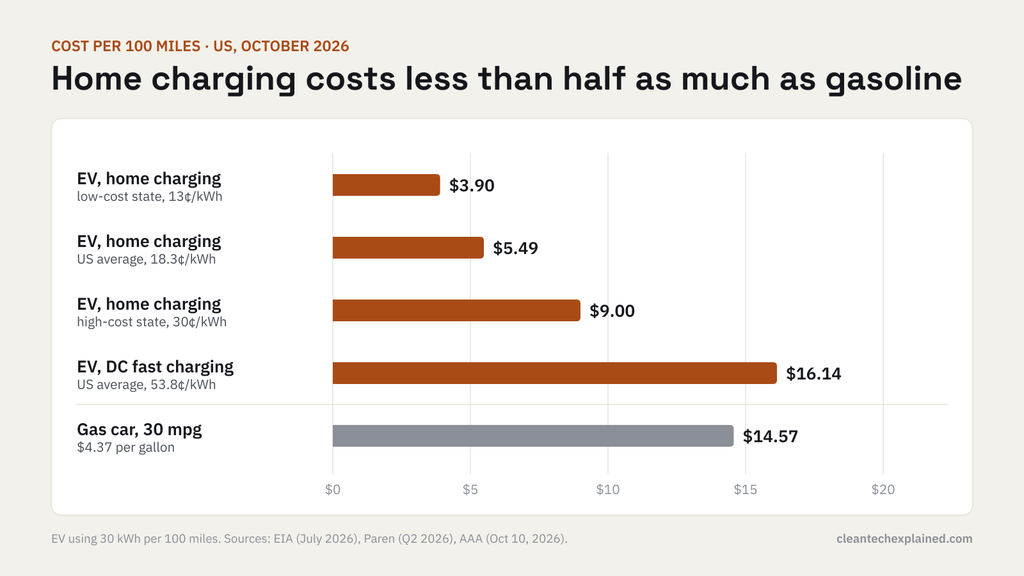
On home electricity, the EV costs about $9 less per 100 miles than a 30 mpg gas car. Over 12,000 miles a year, that is roughly $1,090.
Two cautions keep the comparison honest. Gas prices move faster than electricity prices. At $3.50 per gallon, the 30 mpg car costs $11.67 per 100 miles, and the EV’s advantage on home charging narrows to about $6. And an EV charged mainly at fast chargers has no fuel-cost advantage over an efficient gas car at these prices.
Cost to charge popular electric cars
Efficiency varies a lot between models. The table uses consumption figures reported to the EPA for 2026 models, as compiled by Recurrent, and the US average home electricity price.
| Model (2026) | kWh per 100 miles | Home cost per 100 miles | Home cost per month (1,000 miles) |
|---|---|---|---|
| Lucid Air | 23 | $4.21 | $42 |
| Hyundai Ioniq 6 | 25 | $4.58 | $46 |
| Tesla Model 3 | 25 | $4.58 | $46 |
| Tesla Model Y | 26 | $4.76 | $48 |
| Nissan Leaf | 28 | $5.13 | $51 |
| Hyundai Ioniq 5 | 29 | $5.31 | $53 |
| Average of all 2026 EVs | 37.5 | $6.87 | $69 |
Figures are for the most efficient version of each model. Other trims, larger wheels and all-wheel drive use more.
The average is well above the popular cars because it includes large SUVs and pickups, which can use 40 to 50 kWh per 100 miles or more. Check the exact figure for your trim on fueleconomy.gov.
What changes your real-world cost
- Cold weather. Heating the cabin and battery uses energy. Expect noticeably higher consumption in freezing temperatures, especially on short trips.
- Speed. Air resistance rises quickly at highway speeds. An EV uses much more energy at 75 mph than at 60 mph.
- Your real electricity rate. Some utilities charge a higher price once you pass a monthly usage threshold. Adding an EV can push part of your use into that higher tier.
- Charging level. A standard 120-volt outlet loses a little more energy than a 240-volt charger, which adds a few percent to the cost.
How to lower your charging cost
- Ask your utility about an EV or time-of-use rate. Many utilities sell overnight electricity at a large discount. Every EV can be set to start charging at a chosen time, so using the cheap window takes one setting in the car or its app.
- Charge at home whenever you can. Save fast chargers for road trips.
- Use free charging where it exists. Some workplaces, hotels and shops offer it.
- Compare fast-charging memberships if you road-trip often. A subscription can pay for itself in one or two long drives a month.
- Consider solar. Rooftop panels can cover an EV’s electricity. Our solar panel calculator shows how many extra panels 300 kWh a month would take.
FAQ
How much does it cost to charge an electric car at home?
About $5.50 per 100 miles at the average US electricity price of 18.3 cents per kWh, for a car using 30 kWh per 100 miles. For 1,000 miles a month, that is about $55.
How much does a full charge cost?
At the US average home price, about $12 for a 60 kWh battery, $15 for 75 kWh and $20 for 100 kWh, including charging losses. A 10% to 80% session at a fast charger costs roughly $23 to $38 for the same batteries.
Is it cheaper to charge an EV than to buy gas?
At home, yes, by a wide margin in most of the US. At October 2026 prices, home charging costs about $5.50 per 100 miles against about $14.60 for a 30 mpg gas car. Public fast charging costs about $16 per 100 miles, so it is not cheaper than an efficient gas car.
How much will an EV add to my electricity bill?
A typical EV driven 1,000 miles a month uses about 300 kWh. At the US average price that adds about $55 to the monthly bill. The average US home uses roughly 900 kWh a month, so an EV raises household use by about a third.
Why is fast charging so much more expensive?
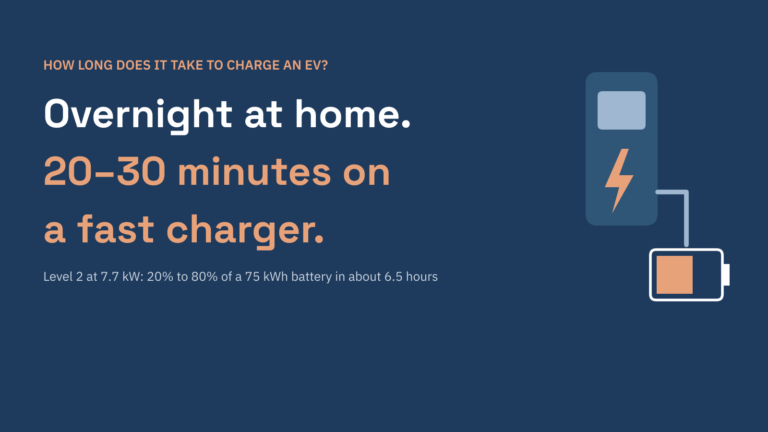
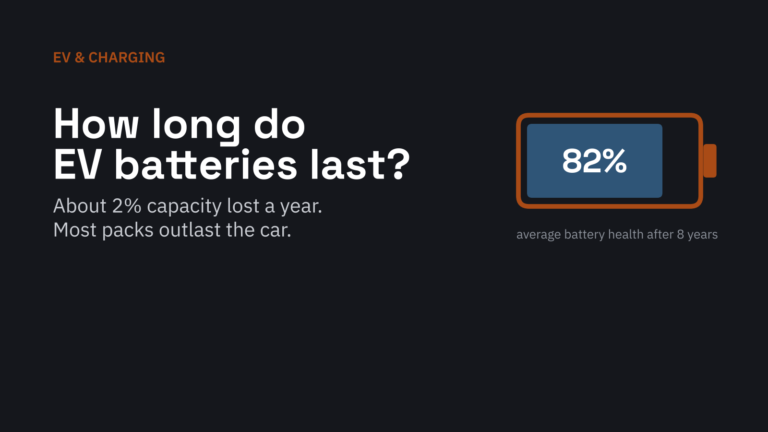
The price covers more than electricity. Station owners pay for high-power equipment, grid connections, land, maintenance and utility charges based on peak power demand, and many stations are used only a few hours a day. Frequent high-power fast charging also wears the battery a little faster; see how long EV batteries last. For charging times by charger type, see how long it takes to charge an electric car.
Is charging at a Tesla Supercharger cheaper?
Prices vary by location and time of day, as on other networks. Check the price in the car’s screen or the network’s app before you plug in, because rates at stations a few miles apart can differ.
Does charging overnight cost less?
Only if you are on a time-of-use or EV rate plan. On a standard flat rate, a kWh costs the same at any hour.
Sources
- US Energy Information Administration: Electric Power Monthly, average price of electricity by state (July 2026 data)
- EVChargingStations.com: Paren’s Q2 2026 US fast-charging report
- AAA: National average gas prices
- Recurrent: The most efficient EVs
- US Department of Energy and EPA: fueleconomy.gov, electric vehicles
- US Department of Energy, Alternative Fuels Data Center: Vehicle Cost Calculator
This article is general information, not financial advice. Prices are US averages on the dates shown and change often. Use your own electricity rate for an accurate estimate.