Praseodymium: Uses, Properties and Why Magnets Need It

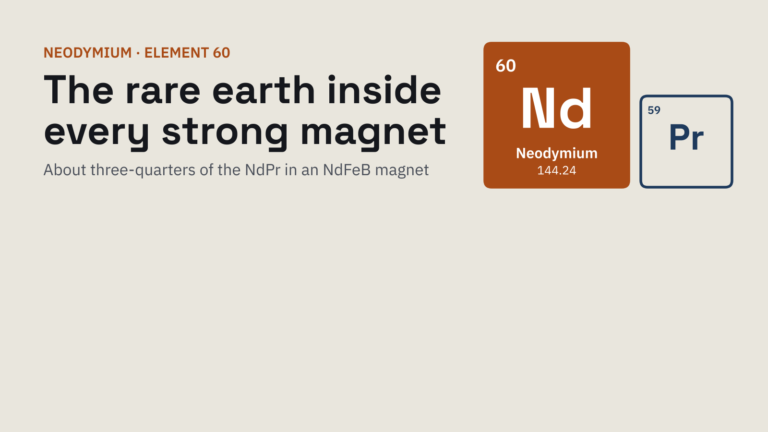
Praseodymium (chemical symbol Pr, atomic number 59) is the rare earth element hiding inside almost every “neodymium” magnet. Roughly a quarter of the rare earth content in a typical magnet is praseodymium rather than neodymium, because the two metals occur together, behave almost identically, and are usually sold as one blended product called NdPr. This guide explains what praseodymium is, what it is used for, why magnet makers rarely bother to separate it from neodymium, and where the supply comes from.
Short answer: Praseodymium is a soft, silvery light rare earth metal. More than 90% of the praseodymium and neodymium consumed worldwide goes into NdFeB permanent magnets for electric motors, wind turbines and electronics. Smaller amounts color glass and ceramics yellow-green, protect welders’ eyes, and strengthen magnesium alloys. China produces about 84% of the world’s NdPr oxide, and the main producers elsewhere are Lynas in Australia and Malaysia and MP Materials in the United States.
Key takeaways
- It is neodymium’s twin. The two were thought to be a single element, “didymium”, until an Austrian chemist split them in 1885.
- Magnets dominate demand. Praseodymium is traded mostly as NdPr oxide, typically about 75% neodymium and 25% praseodymium, and that blend goes straight into magnets.
- It is a light rare earth, not a scarce one. Praseodymium is far more plentiful than heavy rare earths such as dysprosium and terbium.
- Supply is concentrated. China accounts for about 84% of NdPr oxide production. Output outside China is growing but still small.
- Prices roughly doubled in a year. NdPr oxide went from about $55 per kilogram in mid-2025 to about $100 in mid-2026, and long-term contracts for producers outside China now include a $110 price floor.
What is praseodymium?
Praseodymium is one of the 17 rare earth elements and the third member of the lanthanide series, sitting between cerium and neodymium on the periodic table. It is a soft, silvery metal that can be cut with a knife. Left in air, it slowly develops a flaky green oxide coating, so the pure metal is stored under oil or in an inert gas.
| Property | Value |
|---|---|
| Symbol | Pr |
| Atomic number | 59 |
| Atomic weight | 140.91 |
| Group | Lanthanide, light rare earth |
| Density | 6.77 g/cm³ |
| Melting point | 931 °C |
| Stable isotopes | One (praseodymium-141) |
| Usual form in compounds | Pr³⁺, which gives yellow-green salts |
| Discovered | 1885, Carl Auer von Welsbach |
Despite the “rare earth” label, praseodymium is not especially rare. Estimates of its abundance in the Earth’s crust range from about 4 to 9 parts per million. That is far more than silver or gold. What is uncommon is a deposit rich enough to mine at a profit.
The green twin: how praseodymium was discovered
In 1841 the Swedish chemist Carl Gustaf Mosander extracted a new “earth” from lanthanum ores and named it didymium, from the Greek word for twin, because it kept turning up alongside lanthanum. Didymium was accepted as an element for more than 40 years and even had its own symbol, Di, in early periodic tables.
Doubts grew in the 1870s and 1880s, when chemists noticed that the spectrum and atomic weight of didymium changed depending on how it was prepared. The Austrian chemist Carl Auer von Welsbach settled the question in Vienna in 1885. By crystallizing didymium salts over and over again, more than a hundred times, he separated two fractions with different colors. He named the green one praseodymium, the “green twin”, and the pinkish one neodymium, the “new twin”.
The story explains a lot about the modern industry. The two elements were hard to tell apart in 1885, and they are still expensive to pull apart today. Reasonably pure praseodymium metal was not produced until 1931.
What is praseodymium used for?
Permanent magnets
Magnets are by far the largest use. S&P Global estimates that the world consumed about 108,000 tonnes of NdPr oxide in 2025, and that only about 7% of it went to uses other than magnets. The rest ended up in neodymium-iron-boron magnets inside motors and generators.
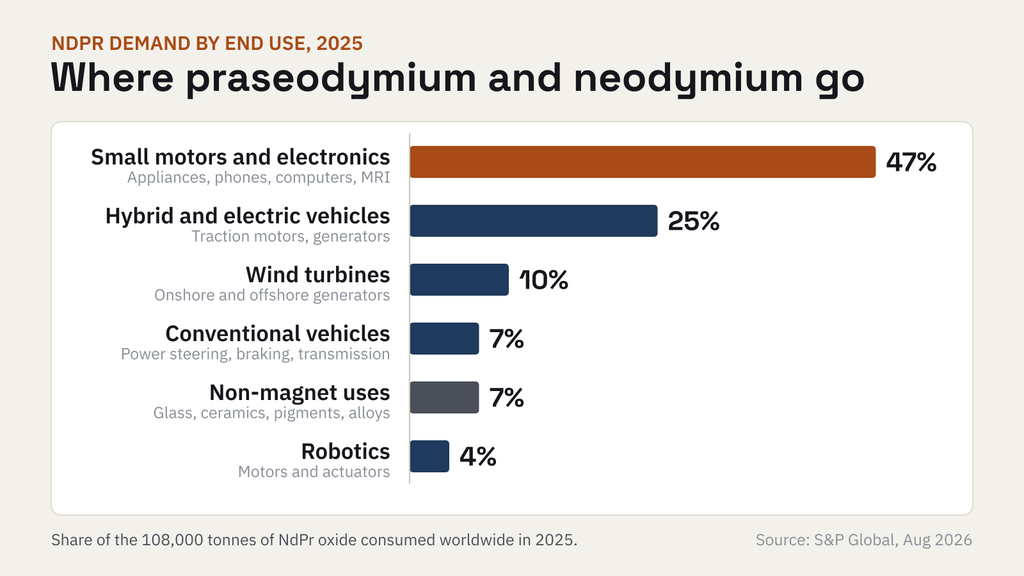
Small motors and electronics are still the biggest market: air conditioners, washing machines, phones, computers and MRI machines. Hybrid and electric vehicles take about a quarter, and wind turbines about a tenth. Robotics is small today but is the fastest-growing category.
Glass, goggles and ceramics
Praseodymium compounds give glass and enamel a clean yellow-green color. Mixed with neodymium, they make didymium glass, which absorbs the bright yellow-orange glare of hot sodium. Glassblowers and welders wear didymium goggles so they can see the work through the flame.
In ceramics, praseodymium locked into zircon produces “praseodymium yellow”, a pigment that survives kiln temperatures and is widely used on tiles and tableware.
Alloys
A small addition of praseodymium makes magnesium alloys stronger at high temperatures, which is useful in aircraft engine parts. Praseodymium is also one of the ingredients of mischmetal, the mixed rare earth alloy used in lighter flints and, historically, in nickel-metal hydride batteries.
Specialist uses
- Carbon arc lamps for studio lighting and film projection used rare earth cores that included praseodymium.
- Lasers and fiber optics. Praseodymium-doped crystals and glass fibers emit visible laser light and can amplify signals near 1.3 microns.
- Catalysts. Praseodymium added to cerium oxide improves how the material stores and releases oxygen, which matters in exhaust treatment.
- Ultra-low temperatures. A praseodymium-nickel compound, PrNi5, is used in laboratory refrigerators that reach below one thousandth of a degree above absolute zero.
Why magnets use praseodymium and neodymium together
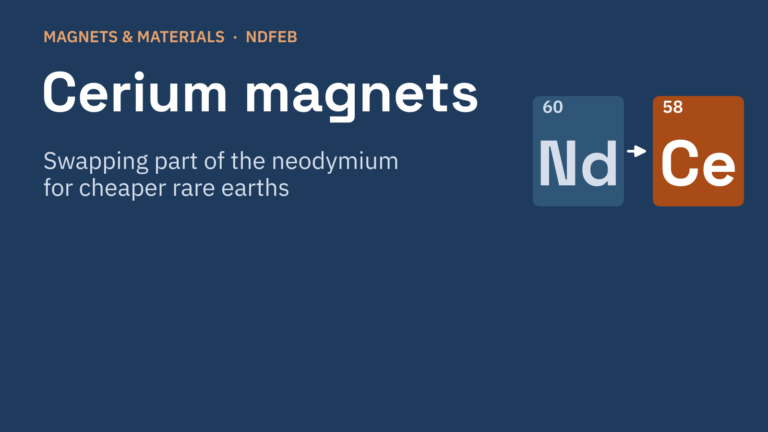
A neodymium magnet is built around the compound Nd2Fe14B. Praseodymium forms the same crystal structure, Pr2Fe14B, with very similar magnetic properties. In practice the magnet’s main phase is a mix of the two, written (Nd,Pr)2Fe14B. Some lower-cost grades replace part of the neodymium with cerium; see our guide to cerium magnets.
There are three reasons the industry uses the blend instead of pure neodymium.
- They come out of the ground together. In typical ore there is roughly one part praseodymium for every three or four parts neodymium.
- Separating them is the hardest step. Neighbors in the lanthanide series are the most difficult to split, and praseodymium and neodymium sit side by side. Leaving them together saves many stages of solvent extraction.
- The magnet does not suffer. Pr2Fe14B has slightly lower magnetization than Nd2Fe14B but resists demagnetization a little better, so a blend performs about the same as pure neodymium.
The standard traded product is NdPr oxide with about 75% neodymium and 25% praseodymium. Since rare earths make up roughly 30% of a magnet by weight, praseodymium typically accounts for something like 5 to 8% of the finished magnet. An electric car motor with one to two kilograms of magnets therefore carries on the order of 100 grams of praseodymium.
Praseodymium does not replace the heavy rare earths. Magnets that run hot still need dysprosium or terbium, which are much scarcer.
Where pure praseodymium magnets win: extreme cold
There is one place where praseodymium beats neodymium outright. Below about 135 kelvin (around −140 °C), the magnetization inside Nd2Fe14B tilts away from its preferred direction and the magnet loses part of its field. Pr2Fe14B does not do this. Its field keeps rising as it gets colder.
Synchrotron light sources take advantage of that. Facilities such as SOLEIL in France and the Taiwan Photon Source use praseodymium-iron-boron magnets cooled with liquid nitrogen to about 77 to 80 kelvin in devices called undulators, which wiggle an electron beam to produce intense X-rays.
Where praseodymium comes from
Praseodymium is never mined on its own. It is recovered with the other light rare earths from two main minerals, bastnäsite and monazite. Both are dominated by cerium and lanthanum. Praseodymium is typically around 4 to 5% of the rare earth content, and neodymium around 12 to 18%.
The largest sources are Bayan Obo in Inner Mongolia, Mountain Pass in California and Mount Weld in Western Australia. The ionic clays of southern China and Myanmar, which supply most heavy rare earths, contain smaller amounts.
After mining, the ore is concentrated, dissolved, and passed through long chains of solvent extraction tanks that sort the elements into groups. The NdPr fraction is precipitated and roasted into oxide, then converted to metal by electrolysis in molten salt before it goes to a magnet maker. Cerium and lanthanum, which make up most of the ore, sell for very little, so the economics of a rare earth mine depend heavily on its NdPr output.
Who produces praseodymium?
Production statistics almost always combine praseodymium with neodymium. According to S&P Global, China accounted for about 61% of rare earth mining and about 84% of NdPr oxide production in 2025. The International Energy Agency puts China’s share of refining for the four magnet rare earths (neodymium, praseodymium, dysprosium and terbium) at about 91% in 2024. China also makes about 94% of the world’s sintered rare earth magnets.
If a quarter of the 108,000 tonnes of NdPr oxide used in 2025 was praseodymium, world consumption was very roughly 25,000 to 30,000 tonnes of praseodymium oxide.
| Producer | Operations | Recent NdPr output |
|---|---|---|
| Chinese producers (China Northern Rare Earth and others) | Bayan Obo, Sichuan, southern ionic clays | About 84% of world NdPr oxide |
| Lynas Rare Earths | Mount Weld mine and Kalgoorlie plant in Australia; refinery in Kuantan, Malaysia | 7,260 tonnes in the year to June 2026 |
| MP Materials | Mountain Pass, California | 2,599 tonnes in 2025; 840 tonnes in the second quarter of 2026 |
More is coming. S&P Global counts more than 20 projects that could add about 44,000 tonnes of NdPr refining capacity outside China by 2030, mostly in Australia and the United States. It also expects actual production to lag well behind announced capacity, because new plants take years to commission and many lack secure ore supplies.
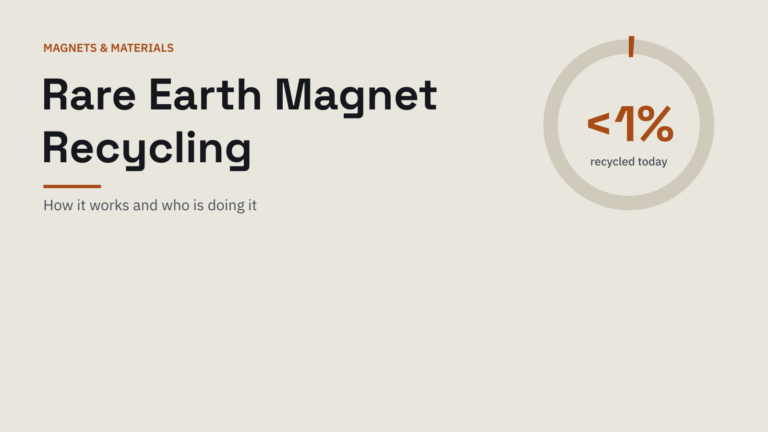
Recycling is a second source. Most of what is recycled today is scrap from magnet factories, largely inside China. Recovery from old motors and electronics is still small. Our guide to rare earth magnet recycling covers the plants now starting up.
Praseodymium price and supply risk
Because it is sold as NdPr, praseodymium follows the NdPr oxide price. That price has been volatile. Lynas reports that the average price inside China, excluding tax, rose from $55.0 per kilogram in June 2025 to $100.8 in June 2026. S&P Global, using a different benchmark, saw an increase from about $74 in December 2025 to about $120 in mid-2026.
Two things stand out in this market.
- Governments now set a floor. In July 2025 the US government agreed a price floor of $110 per kilogram of NdPr with MP Materials. Lynas’s 2026 results describe an offtake agreement for 5,000 tonnes of NdPr a year with the same $110 floor. Both are meant to keep non-Chinese producers alive when Chinese prices fall.
- The cost of new supply is high. S&P Global estimates that NdPr oxide needs to sell for about $75 to $80 per kilogram for most projects outside China to earn a return.
Praseodymium and neodymium were not among the seven rare earths that China placed under export licensing in April 2025. The risk reaches them indirectly: the same licensing rules cover rare earth magnets, and most NdPr is turned into magnets in China. A broader package announced in October 2025 is suspended until November 10, 2026. Praseodymium is on the US critical minerals list along with the other rare earths, as our critical minerals guide explains.
Demand is expected to keep growing. S&P Global projects NdPr consumption of about 143,000 tonnes by 2030, up roughly a third from 2025. The main way to use less is to avoid the magnet altogether, as in rare earth free electric motors, or to switch to one of the rare earth magnet alternatives now in development.
Is praseodymium dangerous?
Praseodymium has no known biological role and is considered to have low toxicity, although data are limited. It is not radioactive. The practical hazards are those of a reactive metal: fine powder can ignite in air, and the metal reacts with water to release hydrogen. Solid pieces are stable enough to handle but are kept away from moisture.
Frequently asked questions
What is praseodymium used for?
Mostly permanent magnets, blended with neodymium. Smaller uses include yellow-green glass and ceramic pigments, didymium goggles for welders and glassblowers, magnesium alloys, lighter flints and lasers.
Is praseodymium a rare earth element?
Yes. It is a lanthanide and is classed as a light rare earth, together with lanthanum, cerium and neodymium.
What is NdPr?
NdPr is a blend of neodymium and praseodymium, usually about 75% neodymium and 25% praseodymium, sold as oxide or metal. It is the main raw material for NdFeB magnets and the benchmark product of the rare earth market.
Is praseodymium magnetic?
The pure metal is only weakly attracted to a magnet at room temperature. It becomes useful when alloyed with iron and boron, where it helps hold the iron’s magnetization in one direction.
Why is it called praseodymium?
The name comes from the Greek words for “leek-green” and “twin”. Its salts are green, and it was separated from didymium, the supposed twin of lanthanum.
Is praseodymium radioactive?
No. Natural praseodymium consists of a single stable isotope, praseodymium-141.
Which countries produce praseodymium?
China produces most of it. Outside China, the main sources are Australia, with refining in Malaysia, and the United States. New projects are planned in Australia, North America, Brazil and Africa.
Sources
- Royal Society of Chemistry, Praseodymium: element information, properties and uses
- S&P Global, NdPr Market Report, August 2026
- US Geological Survey, Mineral Commodity Summaries 2026: Rare Earths, February 2026
- Lynas Rare Earths, Results for the year ending 30 June 2026, August 2026
- MP Materials, Second Quarter 2026 Results, August 2026
- Fastmarkets, Chinese rare earth prices continue to fall amid low demand (NdPr oxide 75:25 specification)
- Benabderrahmane et al., Development and operation of a Pr2Fe14B based cryogenic permanent magnet undulator
- Wikipedia, Praseodymium (history, magnet properties and applications, with primary references)
Featured image and diagram: original graphics by CleanTech Explained. This article reflects the author’s personal views and publicly available information as of October 2026. It is general information, not investment or purchasing advice.