How Long Do EV Batteries Last? Lifespan, Degradation and Warranty

How long do EV batteries last? It is the question almost every EV shopper asks, and a fair one: the battery is the most expensive part of an electric car. The good news is that there is now real-world data from tens of thousands of cars, not just lab tests and promises. This guide explains how long EV batteries last, how fast they lose capacity, what speeds that up, what the warranty covers, and what a replacement costs if you ever need one.
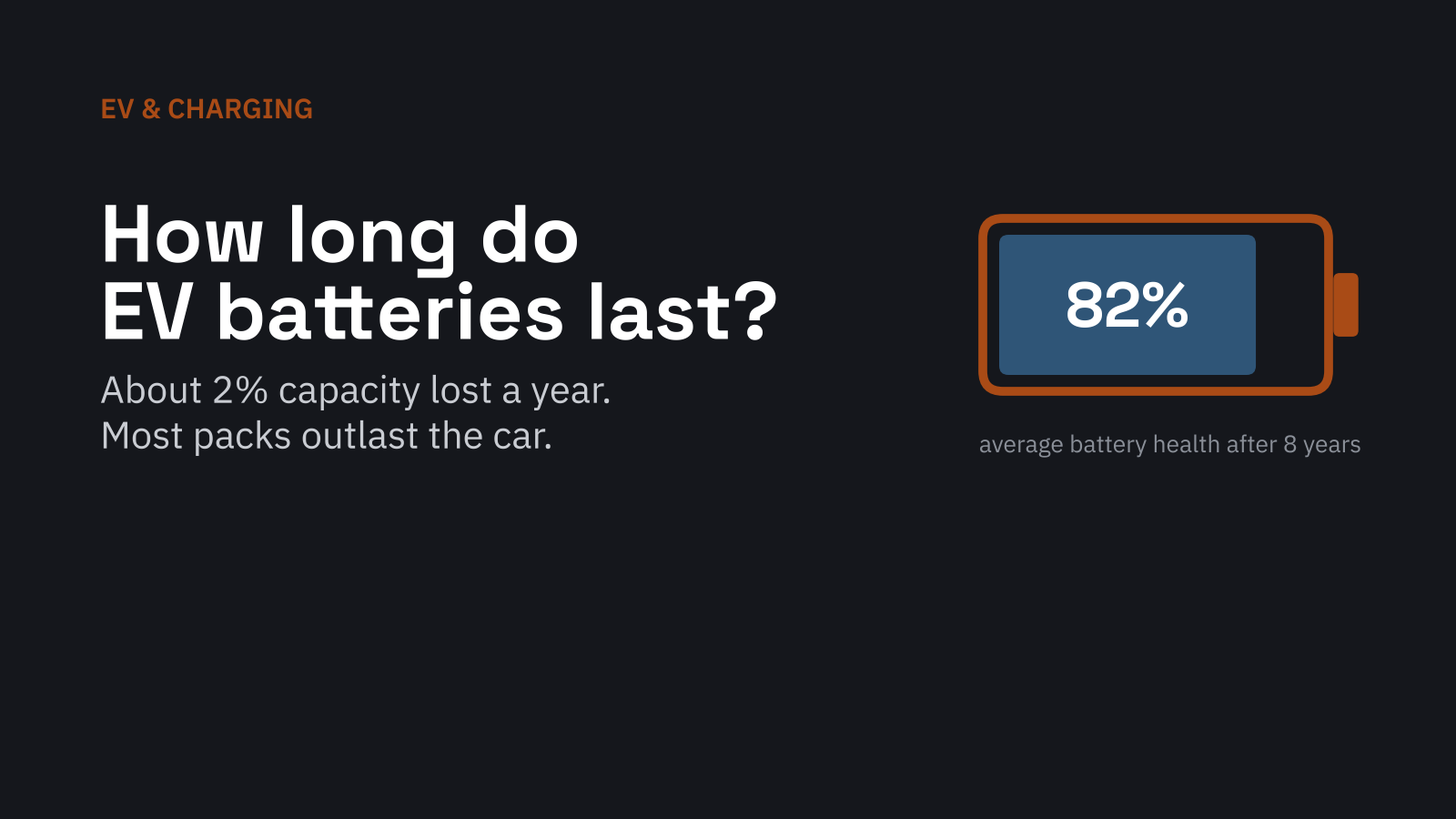
Short answer: Most EV batteries lose about 1.5–3% of their capacity a year, with a fleet average of about 2.3%. At that rate a battery still holds around 80% of its original capacity after eight years, and most packs are expected to outlast the car itself, somewhere between 12 and 20 years. Outright battery failure is rare: about 0.3% of 2022-and-newer EVs in one large dataset have needed a new pack outside of recalls. In the US, batteries are usually warranted for 8 years or 100,000 miles.
Key takeaways
- Geotab’s 2025 study of more than 22,700 EVs found an average capacity loss of 2.3% a year, or about 82% left after eight years.
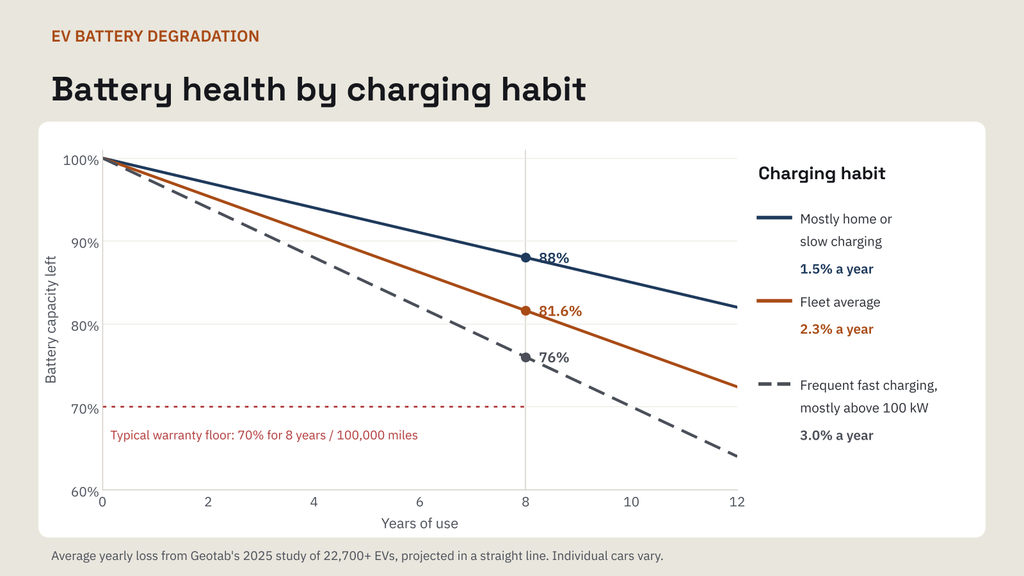
- Charging habits matter most: cars that rarely fast charge lost about 1.5% a year; cars that often used chargers above 100 kW lost about 3.0%.
- Battery replacements are rare and getting rarer: about 8.5% for first-generation EVs, 2% for the second generation, and 0.3% for 2022-and-newer models (Recurrent).
- The usual US battery warranty is 8 years or 100,000 miles, typically guaranteeing at least 70% of original capacity.
- Out-of-warranty replacements have typically cost $5,000–$16,000, but EV battery pack prices fell below $100/kWh in 2025.
How long do EV batteries last? What the data says
EVs have not been on the road in large numbers long enough to know their full lifespan, partly because the batteries are lasting longer than expected. What we can measure is how fast they lose capacity, and how often they fail. Three large data sources point the same way.
Geotab: about 2.3% a year
Geotab, a telematics company, tracks battery health in fleet vehicles. Its latest analysis, published in January 2026, covered more than 22,700 EVs across 21 makes and models. The average annual capacity loss was 2.3%, which projects to 81.6% of original capacity after eight years. Geotab estimates that, at observed rates, the average EV battery will last about 13 years or more.
That 2.3% is slightly worse than Geotab’s 2023 figure of 1.8%, but not because batteries got worse. The newer study added more recent models, which often lose a few percent quickly in their first year or two before settling down, and it reflects much heavier use of fast charging. Eight of the 11 established models from the earlier study have settled at about 1.4% a year.
Recurrent: replacements are rare
Recurrent, which tracks battery health in a community of more than 30,000 EVs, looks at the question from the failure side. Excluding the big recalls (the Chevrolet Bolt and Hyundai Kona), fewer than 4% of batteries across all model years have been replaced, including cars more than 10 years old. The rate falls sharply with each generation:
| EV generation | Examples | Battery replacement rate |
|---|---|---|
| First generation (2016 and older) | Early Nissan Leaf and other pre-2017 EVs | About 8.5% |
| Second generation | Early Chevy Bolt EV, Tesla Model 3 | About 2% |
| 2022 and newer | Most EVs on sale today | About 0.3% |
Recurrent also notes that for modern EVs, replacements happen almost entirely because of manufacturing defects, not because the battery simply wore out from miles.
Tesla: 85–88% after 200,000 miles
Tesla publishes fleet data in its annual Impact Report. The 2023 report said Model 3 and Model Y Long Range batteries keep about 85% of their capacity after 200,000 miles, and Model S and Model X about 88%. Tesla estimates a car is scrapped after roughly 200,000 miles in the US, so on these numbers the battery is not what ends the car’s life.
EV battery degradation, explained
Degradation is the slow loss of how much energy a battery can store. Every time lithium moves in and out of the electrodes, a little is lost to side reactions, and the electrodes themselves wear. Heat and time do the same even when the car is parked. The result is measured as state of health (SOH): 100% when new, lower as the battery ages.
Lithium-ion batteries tend to age along an S-shaped curve:
- An early dip. A few percent in the first year or two as the cells settle.
- A long, slow, nearly straight decline. This is where almost every EV on the road is today.
- A late “knee”, when capacity falls faster. Most car batteries are expected to reach it only after the car is retired, if at all.
Two things can hide degradation from the driver. Automakers keep a hidden buffer at the top and bottom of the battery, so “100%” on the screen is not a chemically full cell, and some release part of that buffer over time. Software updates can also improve efficiency. That is why Recurrent found several brands showing no visible range loss after three years even though their batteries had aged. Range on the dashboard and true battery health are not the same thing.
What 2.3% a year means for range
Take a car with 300 miles of range when new. At the average rate it has about 245 miles after eight years and about 220 miles after 12 years. At the 1.5% rate seen in gently charged cars, it would still have about 265 miles after eight years. Most owners notice winter range loss far more than battery aging.
What wears an EV battery out
Geotab grouped vehicles by how they were used. Charging power came out as the biggest single factor.
| How the car was charged | Average loss per year | Projected health after 8 years |
|---|---|---|
| DC fast charging under 12% of sessions | 1.5% | 88% |
| Frequent fast charging, mostly below 100 kW | 2.2% | About 82% |
| Frequent fast charging, often above 100 kW | 3.0% | 76% |
Other factors had smaller effects:
- Heat. Cars in hot climates (more than about a third of days above 25 °C / 77 °F) lost 0.4% a year more than cars in mild climates.
- Heavy use. Cars that cycled the equivalent of a full charge every one or two days lost about 2.3% a year, against 1.5% for lightly used cars. More miles do cost something, but less than most people expect.
- Sitting full or empty. Time spent above 80% or below 20% charge only mattered when it was habitual: cars that spent more than 80% of their time at those extremes lost about 2.0% a year, against 1.4–1.5% for the rest.
- Chemistry and design. LFP batteries generally handle more charge cycles than nickel-based NMC batteries, and good thermal management protects any chemistry. Our LFP vs NMC guide compares the two.
How many miles will an EV battery last?
A useful rule of thumb: miles ≈ range × full charge cycles. A car with 300 miles of range whose NMC battery lasts 1,500 full cycles covers about 450,000 miles before reaching around 80% capacity. An LFP pack, which typically lasts several thousand cycles, goes further still. Calendar aging, from time and heat, usually matters more than mileage for a typical driver who covers 12,000–15,000 miles a year.
That is also why batteries in older, short-range EVs wore out faster. A first-generation Nissan Leaf with about 80 miles of range needed many more full cycles to cover the same distance, and it had no liquid cooling. Today’s packs are bigger and better protected: Recurrent found average battery size grew 167% between 2015 and 2024.
EV battery warranty: what is covered
In the US, the standard high-voltage battery warranty is 8 years or 100,000 miles, whichever comes first. Most automakers also promise a minimum capacity, usually 70%; if the battery falls below that while under warranty, it is repaired or replaced. Some go further:
- Tesla covers the Model S and Model X battery for 8 years or 150,000 miles, and the Model 3 and Model Y for 8 years and 100,000–120,000 miles depending on the version, with at least 70% capacity.
- Hyundai has covered its EV batteries for 10 years or 100,000 miles, at 70% capacity, since 2020.
California’s Advanced Clean Cars II rules would require 2026-and-newer EVs sold in the state to carry an 8-year, 100,000-mile warranty at 70% battery health (75% from model year 2031), plus a battery health reading drivers can see. Congress revoked the federal waiver for those rules in June 2025, and California is challenging that in court, so treat the rules as uncertain and check the warranty booklet of the specific car.
Read the fine print. Warranties cover defects and excessive capacity loss, not damage from accidents or road debris; that is usually an insurance matter. Coverage that transfers to the next owner matters if you are buying used.
What does an EV battery replacement cost?
Out of warranty, a full pack replacement has typically cost $5,000–$16,000, depending on the pack size and the car, according to Recurrent’s collection of real quotes. Some examples it gathered:
- Nissan Leaf: about $4,000–$15,000 for used genuine packs from 24 to 62 kWh, plus labor.
- Tesla Model 3 Long Range: about $13,000 including labor in one 2023 owner report; refurbished packs from third parties for about $9,000.
- Discontinued models such as the BMW i3 and VW e-Golf can cost far more from dealers because packs are scarce.
Prices should keep falling. BloombergNEF found average EV battery pack prices of $99/kWh in 2025, the second year below $100/kWh, against more than $400/kWh in the early 2010s. Packs bought in the US cost more than the global average, and labor adds to the bill, but a 75 kWh pack at today’s prices is a much smaller number than the horror stories suggest. Many failures can also be fixed by replacing one module rather than the whole pack.
How to make an EV battery last longer
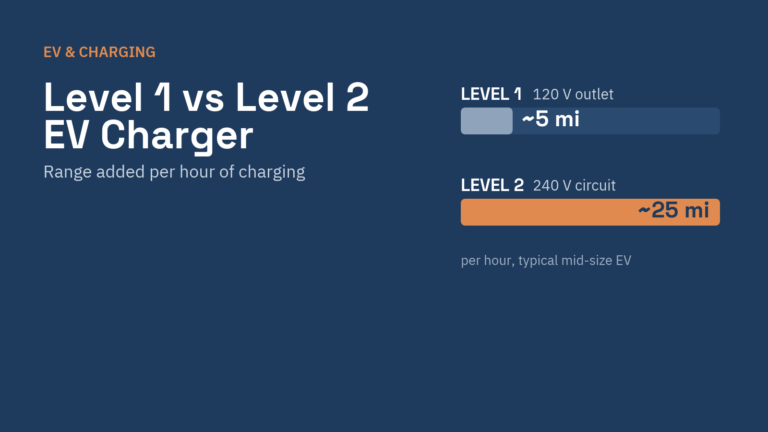
- Charge at home on AC when you can. A Level 1 or Level 2 charger is gentle on the battery, and it is much cheaper too: see our cost to charge an electric car calculator.
- Save high-power fast charging for road trips. Occasional fast charging is fine; making it your main way of charging is what speeds up aging.
- Set a sensible daily limit. For NMC batteries, about 80–90% for daily driving, 100% before long trips. For LFP batteries, charging to 100% is fine and often recommended. Follow your car’s own advice.
- Don’t leave the car parked full or nearly empty for weeks, especially in hot weather.
- Park in shade or a garage in summer and let the car keep its battery warm or cool while plugged in.
- Don’t obsess. Geotab’s data shows normal daily use across the full charge range does not measurably hurt the battery. The software buffers exist for exactly this reason.
Buying a used EV: check the battery
For a used EV, battery health matters more than mileage. Before you buy:
- Ask for a battery health reading. Some cars show state of health on screen; otherwise a dealer or a third-party battery report can provide one. Above 85–90% for a car under five years old is normal.
- Check the remaining warranty in years and miles, and whether it transfers.
- Check recall history, especially for the Chevy Bolt and Hyundai Kona, where many cars received new packs under recall, which can be a bonus.
- Ask how it was charged. A former rideshare car that lived on fast chargers in a hot city will usually have aged more than a commuter car charged in a garage.
What happens to old EV batteries?
A battery at 70% capacity is far from dead. Retired EV packs can get a second life as stationary storage, where weight and size matter less, much like the LFP systems in our home battery backup guide. After that, recyclers recover lithium, nickel, cobalt and copper for new batteries. Newer chemistries, including sodium-ion and, further out, solid-state batteries, are being developed partly to push lifespans and safety further. Using the car to power your home adds some cycles; see bidirectional charging.
Frequently asked questions
Do EV batteries last longer than gas engines?
For most cars, the battery now looks likely to last as long as the rest of the vehicle. Tesla estimates that US cars are scrapped at around 200,000 miles, and its fleet data shows batteries keeping 85–88% of their capacity at that mileage. A battery that has faded is also still usable, while a failed engine is not.
How many years does an EV battery last?
Typically 12 to 20 years. Geotab estimates about 13 years or more at the average degradation rate, and longer for cars charged mostly at home. Climate, charging habits and chemistry decide where in that range a given car lands.
Does fast charging ruin an EV battery?
No, but heavy use of high-power chargers speeds up aging. In Geotab’s data, cars that often used chargers above 100 kW lost about 3% a year, twice the rate of cars that rarely fast charged. Using fast chargers on road trips is what they are designed for.
Does cold weather damage an EV battery?
Cold mostly reduces range temporarily: the battery delivers less energy and the car spends energy on heating. That range comes back in warmer weather. Heat is what speeds up permanent aging, which is why parking in the shade in summer helps more than worrying about winter.
Is battery degradation covered by the warranty?
Only if capacity drops below the level the automaker guarantees, usually 70%, within the warranty period. Normal loss to, say, 85% after six years is expected and not covered.
Can you replace part of an EV battery?
Often, yes. Many packs are built from modules, and a repair shop can replace a faulty module instead of the whole pack, which can cut the bill to a fraction. Some newer cell-to-pack designs are harder to repair this way.
How long do solar panels last compared with an EV battery?
Longer. Solar panels lose about 0.5% of their output a year and usually last 25 to 30 years or more; see how long solar panels last.
Sources
- Geotab, How long do electric car batteries last? The updated guide to real-world EV battery health, 2026
- Geotab, New Geotab data shows EV battery health remains strong as fast charging use increases, January 13, 2026
- Recurrent, New Data: How Long Do Electric Car Batteries Last?, November 2025
- Recurrent, Electric Car Battery Replacement Costs, December 2024
- InsideEVs, Average Tesla Model 3, Model Y Battery Degradation After 200,000 Miles (Tesla 2023 Impact Report)
- Kelley Blue Book, Tesla: Our Batteries Lose Only 12% of Their Range After 200,000 Miles (warranty terms)
- California Air Resources Board, Section 1962.8, Warranty Requirements for 2026 and Subsequent Model Year ZEVs
- Hogan Lovells, Senate effectively blocks California’s “EV Mandate” and related waivers using Congressional Review Act, 2025
- BloombergNEF, Lithium-Ion Battery Pack Prices Fall to $108 per Kilowatt-Hour, December 2025
Featured image and diagram: original graphics by CleanTech Explained. This article is general information, not financial advice; always check the warranty terms for your specific vehicle.