How Many kWh Does a House Use? US Averages by Day and State

How many kWh does a house use? It is the first number you need before sizing solar panels, a home battery or a backup generator, and the easiest way to make sense of an electricity bill. This guide gives the US averages per day, month and year, shows how much homes use in different states, breaks down where the electricity goes, and explains how to find your own number.
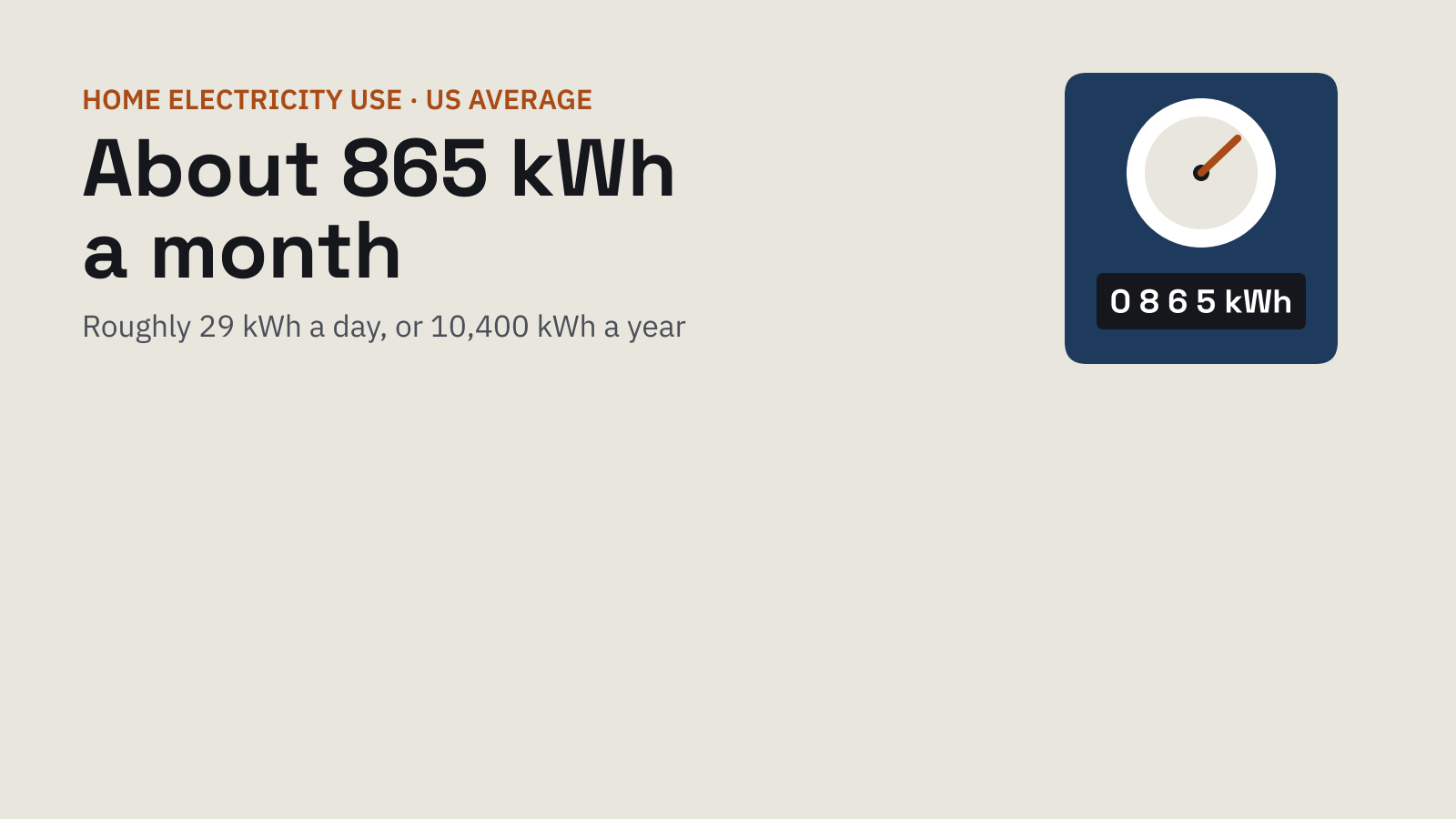
Short answer: The average US home uses about 865 kWh of electricity a month, according to the US Energy Information Administration (EIA). That is roughly 29 kWh a day or 10,400 kWh a year. Homes in the hot, all-electric South often use 1,100 to 1,200 kWh a month, while homes in California, New England and Hawaii typically use 500 to 600.
Key takeaways
- The average US residential customer used 865 kWh a month in 2024, about 2% more than in 2023. The average bill was $144.
- That is about 29 kWh a day and about 10,400 kWh a year.
- Louisiana homes use the most, at around 1,200 kWh a month. Hawaii and California use the least, at around 500.
- Air conditioning is the biggest single use of household electricity, followed by space heating and water heating.
- Your bill shows your real usage. Twelve months of bills give a far better number than any average.
- An electric car driven 1,000 miles a month adds about 300 kWh, roughly a third more for an average home.
How many kWh does the average house use?
The EIA reports that the average US residential customer bought 865 kWh of electricity a month in 2024, up about 2% from 2023. At the 2024 average price of 16.5 cents per kWh, that came to a bill of about $144 a month.
| Period | Average US home |
|---|---|
| Per day | About 29 kWh |
| Per week | About 200 kWh |
| Per month | 865 kWh |
| Per year | About 10,400 kWh |
Two things to keep in mind. First, this is electricity bought from the grid. Homes with rooftop solar use more than they buy, so averages in sunny states with lots of solar understate real consumption. Second, it is an average across apartments and large houses, all-electric homes and homes heated with gas. A detached house with electric heat can easily use twice the average.
Electricity use by state
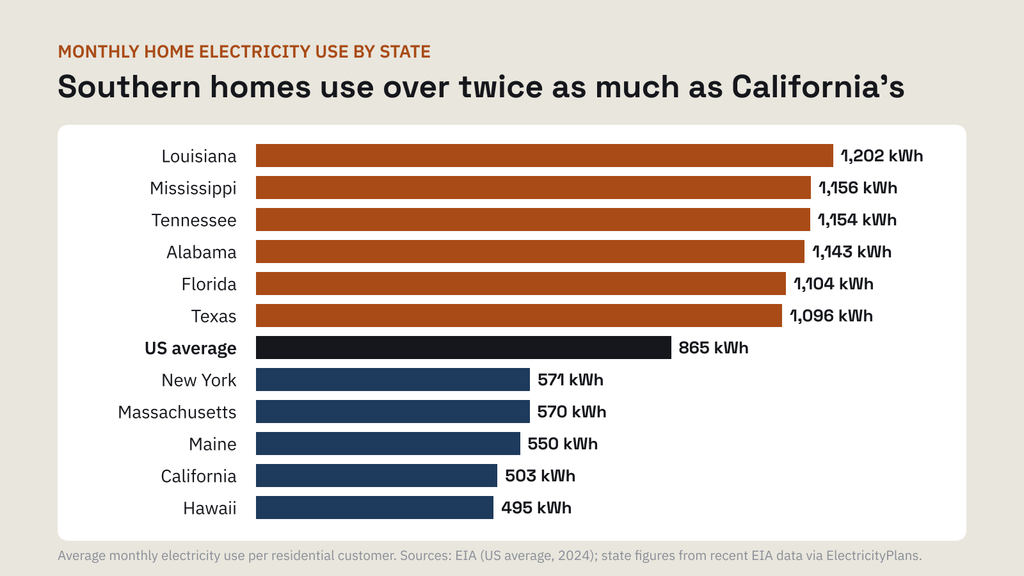
Where you live matters more than almost anything else. Homes in the Southeast use the most electricity because of long, humid summers that need air conditioning, and because many homes there use electric heat instead of gas. Homes in California, New England and Hawaii use the least, thanks to milder climates or gas heating, smaller homes, and in California and Hawaii, a lot of rooftop solar that reduces what households buy from the grid.
| State | Average monthly use |
|---|---|
| Louisiana | 1,202 kWh |
| Mississippi | 1,156 kWh |
| Tennessee | 1,154 kWh |
| Alabama | 1,143 kWh |
| Florida | 1,104 kWh |
| Texas | 1,096 kWh |
| Arizona | 1,075 kWh |
| Georgia | 1,074 kWh |
| Pennsylvania | 817 kWh |
| Illinois | 693 kWh |
| New Jersey | 662 kWh |
| New York | 571 kWh |
| Massachusetts | 570 kWh |
| California | 503 kWh |
| Hawaii | 495 kWh |
State figures are recent EIA averages per residential customer, as compiled by ElectricityPlans. They are not adjusted for season, so they can shift by a few percent from one release to the next.
Where does a home’s electricity go?
According to the EIA’s most recent household survey, the three largest uses of electricity in US homes are:
- Air conditioning: about 19%
- Space heating: about 12%
- Water heating: about 12%
Lighting and refrigerators come next, followed by a long tail of appliances, electronics and small devices. In an individual home the mix can look very different: a house with gas heating and a gas water heater may use almost nothing for those two, while an all-electric house in a cold climate can use more for heating than for everything else combined.
How much do common appliances use?
The table gives rough monthly figures for typical use. Your numbers will differ with the appliance’s age, size and how often you use it.
| Appliance | Typical use per month |
|---|---|
| Central air conditioning (summer) | 500 to 1,000 kWh |
| Electric heating or heat pump (winter) | 500 to 1,500 kWh |
| Electric water heater | 200 to 400 kWh |
| Electric car (1,000 miles) | About 300 kWh |
| Refrigerator | 30 to 60 kWh |
| Electric clothes dryer | 40 to 80 kWh |
| Electric oven and cooktop | 30 to 60 kWh |
| Lighting (LED) | 30 to 60 kWh |
| TV, computers and electronics | 30 to 80 kWh |
| Dishwasher | 15 to 30 kWh |
To estimate any appliance yourself, multiply its power in watts by the hours you use it, then divide by 1,000. A 1,500 W space heater running 4 hours a day uses 1,500 × 4 ÷ 1,000 = 6 kWh a day, or about 180 kWh a month.
What makes a home use more or less electricity?
- Climate. Hot summers and cold winters both raise use, especially where homes rely on electricity for cooling and heating.
- Heating and water heating fuel. Switching from gas to electric heat, or from a gas to an electric water heater, can add hundreds of kWh a month. A heat pump uses far less than resistance heaters for the same warmth.
- Home size and insulation. Larger and leakier homes need more energy to heat and cool.
- Number of people. More people means more hot water, laundry, cooking and devices.
- Electric vehicles, pools and hot tubs. Each can add a few hundred kWh a month.
How to find out how many kWh your house uses
- Check your bill. It lists the kWh used in the billing period, and many bills show a chart of the past 12 months.
- Log in to your utility account. Most utilities with smart meters show daily or even hourly use, and many let you download it with the “Green Button” option.
- Add up a full year. Use varies a lot between seasons, so total 12 months and divide by 12 for a reliable monthly average.
- Read the meter yourself. Note the reading, wait 24 hours, and subtract to get your daily use.
Using your number
Once you know your kWh, you can size most home energy projects.
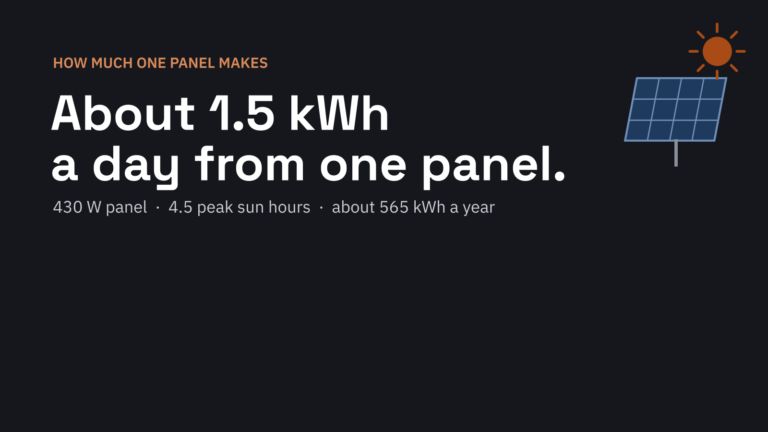
- Solar panels: An average home using 865 kWh a month needs roughly an 8 kW system, or about 20 to 21 panels, depending on sunshine. Our solar panel calculator works it out for your location, and our guide to solar panel cost turns that into a price.
- Home batteries: Backing up a whole home for a day takes about as many kWh as you use in a day, roughly 29 kWh for an average house. Covering only essential loads takes much less. See home battery backup.
- Electric cars: Our EV charging cost calculator shows how much an EV will add to your bill.
Frequently asked questions
How many kWh does a house use per day?
About 29 kWh on average in the US, based on 865 kWh a month. Many homes use 15 to 40 kWh a day depending on season, size and heating fuel.
Is 1,000 kWh a month a lot?
It is above the US average of 865 kWh but normal for homes in the South or for larger houses with electric heat or air conditioning. In California or New England it would be high.
How many kWh does a 2,000 square foot house use?
Often 900 to 1,200 kWh a month, but climate and heating fuel matter more than floor area. A 2,000 square foot home with gas heat in a mild climate can use far less than a smaller all-electric home in Texas.
How many kWh does a one-bedroom apartment use?
Typically 400 to 700 kWh a month. Apartments use less because they are smaller and share walls, which reduces heating and cooling.
How much does 1 kWh cost?
The US average residential price was about 18.3 cents per kWh in July 2026, ranging from around 13 cents in the cheapest states to more than 30 cents in California and parts of New England.
What is the difference between kW and kWh?
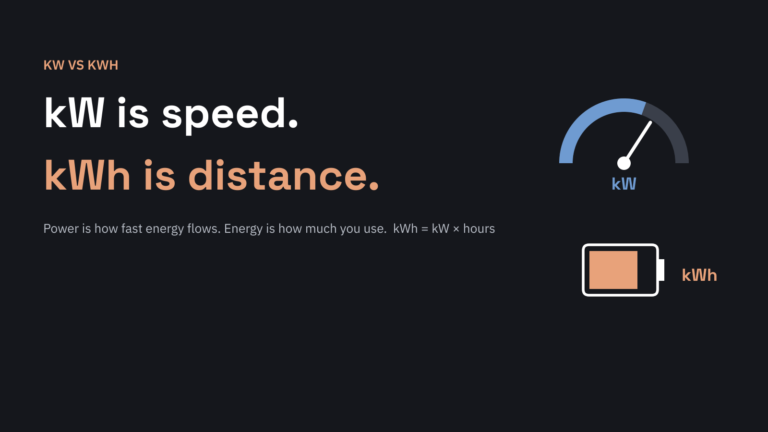
A kilowatt (kW) measures power, the rate at which electricity is used at a given moment. A kilowatt-hour (kWh) measures energy, the total used over time. A 1 kW heater running for one hour uses 1 kWh.
Sources
- US Energy Information Administration, Residential electricity bills and consumption in 2024, May 2025
- US Energy Information Administration, Electricity use in homes (Residential Energy Consumption Survey, 2020)
- US Energy Information Administration, How much electricity does an American home use?
- ElectricityPlans, Average electricity bill, usage and rate by state (EIA data, 2026)
- US Department of Energy, Estimating appliance and home electronic energy use
Featured image and diagram: original graphics by CleanTech Explained. This article reflects publicly available information as of October 2026. Appliance figures are typical ranges, not measurements of any specific product.