Solar Battery Guide: Cost, Sizing and Is It Worth It?

A solar battery stores electricity from your solar panels so you can use it later: in the evening, during expensive peak hours, or when the grid goes down. It is the most common add-on homeowners consider after installing solar, and one of the most expensive. This guide explains what a solar battery actually does, what it costs in 2026, how to size one, and when it makes financial sense now that the federal tax credit for homeowners has ended.
Short answer: A typical solar battery costs about $15,000 installed for 13.5 kWh of storage, before any state or local incentives. It is worth it if you face frequent outages, if your utility pays little for the solar power you export, or if you are on time-of-use rates with a big gap between peak and off-peak prices. If your utility offers full retail net metering and outages are rare, the numbers are much harder to justify.
Key takeaways
- Most grid-tied solar systems shut off during a power outage. A battery is what lets solar keep powering your home when the grid is down.
- Installed costs average roughly $1,100–$1,200 per kWh of storage in the US, but vary widely by brand and location.
- The 30% federal tax credit for homeowner-owned batteries (Section 25D) ended on December 31, 2025. Leased systems and state or utility programs may still lower the cost.
- Size the battery for what you want it to do: backing up essentials needs far less capacity than running the whole house.
- Almost all home solar batteries now use LiFePO4 (LFP) chemistry, which is safe and long-lasting.
What does a solar battery do?
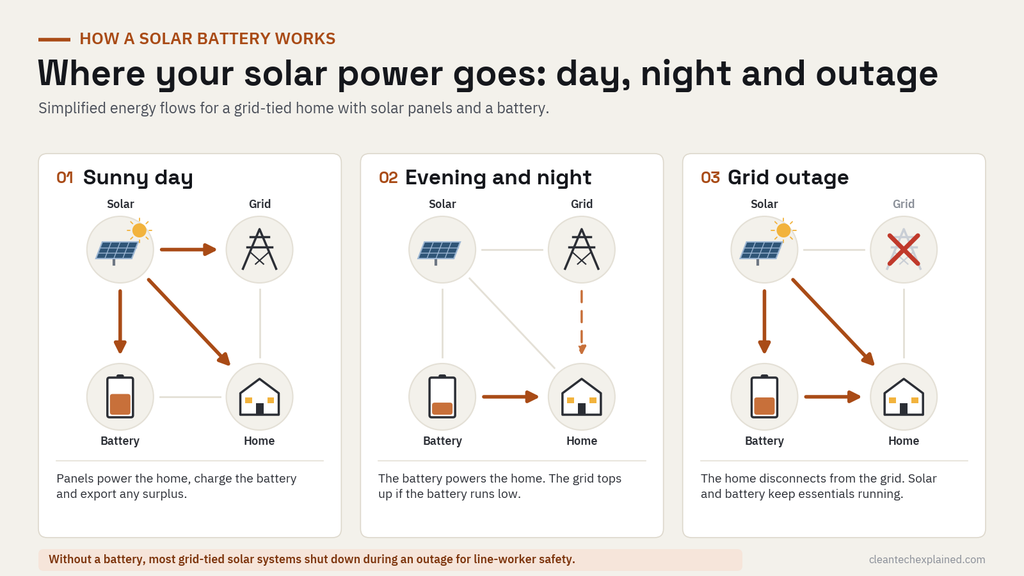
Solar panels produce most of their power around midday, while most homes use the most electricity in the morning and evening. A solar battery bridges that gap. It can do three jobs, and most batteries can do all three:
- Backup power during outages. Standard grid-tied solar systems are required to shut down when the grid fails, so they don’t send power into lines that utility crews are repairing. With a battery and the right equipment, your home can disconnect from the grid and keep running on stored and solar power.
- Self-consumption. Instead of exporting surplus solar to the grid for a low credit, you store it and use it yourself after sunset.
- Time-of-use savings. On time-of-use rates, the battery covers your usage during expensive peak hours, often late afternoon and evening.
How much does a solar battery cost?
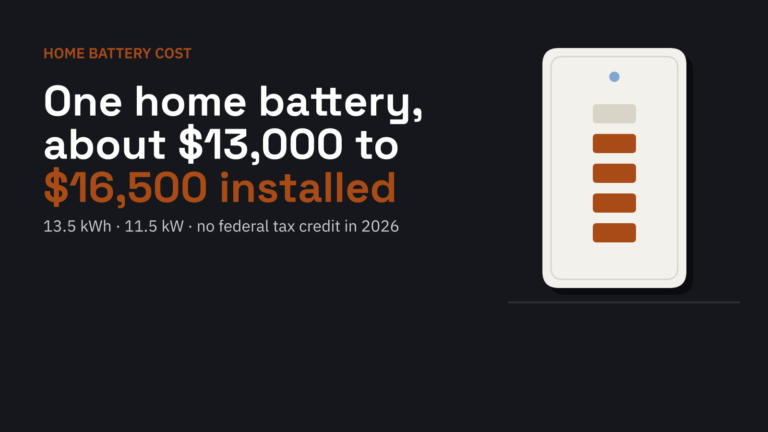
According to EnergySage marketplace data, the average installed home battery costs about $1,159 per kWh of storage, or roughly $15,650 for a 13.5 kWh system, the size of a Tesla Powerwall 3, before state or local incentives.
Prices vary much more than the average suggests. Depending on brand, EnergySage quotes range from a few hundred dollars per kWh for budget systems to well over $1,500 per kWh for premium ones. Location matters too, because labor, permitting and the typical system size differ by state. See how a battery changes the solar panel payback period.
| Battery size | Typical use | Rough installed cost at ~$1,150/kWh |
|---|---|---|
| 5–10 kWh | Essentials for part of a day, time-of-use shifting | $5,750–$11,500 |
| 13–16 kWh | Essentials for about a day, most homes’ evening use | $15,000–$18,400 |
| 25–30 kWh | Larger homes, longer outages, some central AC | $28,750–$34,500 |
| 40 kWh+ | Near whole-home backup for multi-day outages | $46,000+ |
These are planning figures, not quotes. Several things push the price up or down:
- Installing with solar: Adding a battery at the same time as new panels usually saves on labor and permitting.
- Electrical upgrades: An older main panel, a separate backup loads panel or a new transfer switch can add thousands of dollars.
- Whole-home vs partial backup: Backing up only critical circuits is cheaper and needs less capacity.
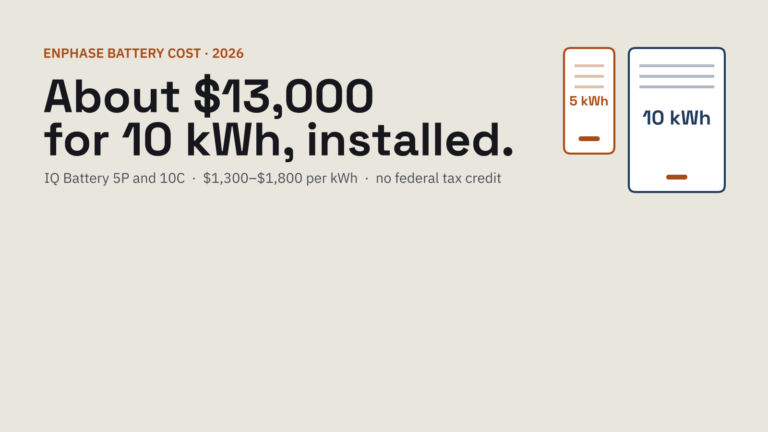
- Brand and power rating: Batteries that can deliver more power at once (more kW) cost more but can run heavier loads. Enphase batteries cost more per kWh; see Enphase battery cost for 5P and 10C prices.
Is there a tax credit for solar batteries in 2026?
Not for most homeowners. The One Big Beautiful Bill Act, signed in July 2025, ended the 30% Residential Clean Energy Credit (Section 25D) for homeowner-owned solar and battery systems after December 31, 2025. A battery you buy with cash or a loan in 2026 does not qualify for a federal credit.
Two routes can still reduce the cost:
- Leases and power purchase agreements (PPAs): When a company owns the system on your roof, it may claim the business-side Section 48E credit and pass some of the value on through lower payments. Read the contract carefully; you won’t own the equipment.
- State and utility programs: Some states and utilities offer rebates, or pay you to let them draw on your battery during peak demand (“bring your own battery” or virtual power plant programs). California’s Self-Generation Incentive Program is one well-known example. Check what is available at your address before getting quotes.
Some articles online still mention the 30% credit for new installations. If a quote assumes you’ll receive it, ask the installer to explain exactly which credit applies.
Do you need a solar battery?
A battery usually makes sense if:
- You live somewhere with frequent or long outages, from storms, wildfire shutoffs or an unreliable grid.
- Your utility pays far less for exported solar than it charges for grid power, as under California’s net billing rules.
- You are on a time-of-use plan with a large gap between peak and off-peak prices.
- Someone in your home relies on medical equipment, a well pump or a sump pump.
A battery may not be worth it if:
- Your utility offers full retail net metering, effectively letting the grid act as a free battery.
- Outages are rare and short where you live.
- You mainly want occasional backup for a fridge and a few lights. A portable power station or a generator costs far less.
How to size a solar battery
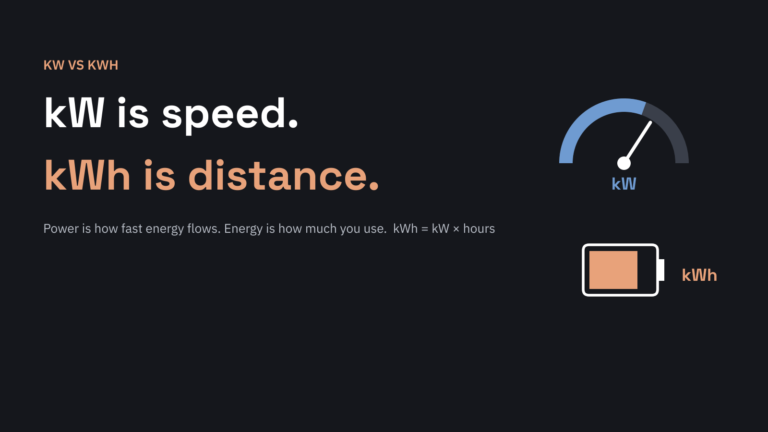
Battery size has two parts: energy capacity in kilowatt-hours (kWh), which is how long it can run, and power in kilowatts (kW), which is how much it can run at once.
Step 1: Decide what the battery is for
- Essential backup: fridge, lights, Wi-Fi, phone charging, a few outlets, maybe a furnace fan. Often 8–12 kWh per day.
- Evening self-consumption: what your home uses from sunset to bedtime, often 5–15 kWh.
- Whole-home backup: everything, including central air or electric heating. This can mean 30 kWh or more per day.
Step 2: Estimate daily energy
Check your utility bill for average daily use (monthly kWh divided by 30), or add up the appliances you want to back up. A modern fridge uses roughly 1–2 kWh a day. Our fridge runtime guide shows how to estimate this in detail.
Step 3: Match capacity and power
If your essentials use 10 kWh a day, one 13.5 kWh battery covers about a day without sun, and longer if your panels recharge it. Then check the battery’s continuous power rating: a well pump or central air conditioner can need a high surge of power to start, and some smaller batteries can’t deliver it.
If you are still planning the solar side, our solar panel calculator estimates how many panels you need to cover your usage. To recharge a battery fully each day, the system needs to produce more than your daytime use.
AC-coupled vs DC-coupled batteries
- AC-coupled batteries have their own inverter and connect to your home’s AC wiring. They are the easiest way to add a battery to an existing solar system.
- DC-coupled batteries share a hybrid inverter with the panels, so solar power is stored without converting from DC to AC and back. That saves a little energy and is common in new installations.
Both work well. If you already have solar, your installer will usually recommend whichever fits your existing inverter.
Which battery chemistry is best?
Nearly all current home solar batteries use lithium iron phosphate (LiFePO4, also called LFP), including the Tesla Powerwall 3 and Enphase IQ Battery range. LFP lasts thousands of cycles and is much more resistant to overheating than the nickel-based lithium-ion used in phones and many EVs, which matters for a battery mounted on a garage wall. Learn more in our LiFePO4 battery guide and our LFP vs NMC comparison.
How long does a solar battery last?
Most home batteries carry 10- to 15-year warranties. Warranties usually guarantee a minimum remaining capacity at the end, often 60–70%, and some also cap total energy throughput. In practice, a battery cycled once a day should keep working well beyond the point where its capacity drops to those levels. Keeping it in a garage or space that doesn’t get extremely hot helps. Solar panels last much longer; see how long solar panels last.
Cheaper alternatives for basic backup
- Portable power stations with plug-in solar panels can run a fridge, lights and devices for hours or days at a fraction of the cost, with no installation. They won’t power your whole house, but they cover the essentials many people care about most. See our power station runtime guide to size one.
- Standby or portable generators cost less per kWh of backup and can run for days on fuel, but they are noisy, need maintenance and fuel storage, and don’t help with your electricity bill on normal days.
- A smaller battery for critical circuits only often gives most of the peace of mind for half the price of whole-home backup.
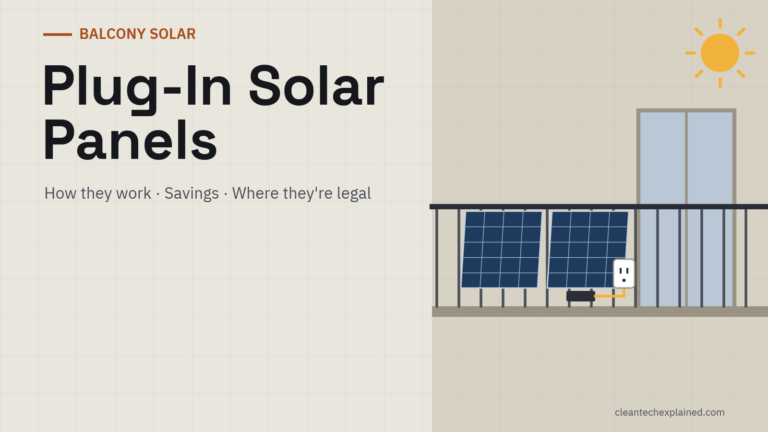
- Plug-in solar panels: a small kit that plugs into a wall outlet to cut daytime electricity use, popular with renters. See our guide to plug-in solar panels.
Questions to ask an installer
- What usable capacity (kWh) and continuous power (kW) does the quoted system provide?
- Which circuits will be backed up during an outage, and will solar keep recharging the battery when the grid is down?
- Does the quote include any electrical panel upgrades, permits and a backup gateway or transfer switch?
- What does the warranty guarantee: years, remaining capacity and energy throughput?
- Which state, local or utility incentives does the price assume, and are any of them conditional on joining a utility program?
- Is the system certified to UL 9540 as a complete energy storage system?
Get at least three quotes. Prices for the same battery can differ by thousands of dollars between installers.
Frequently asked questions
How much does a solar battery cost?
Most homeowners pay roughly $10,000 to $18,000 installed for a single home battery, with about $15,000 typical for 13.5 kWh of storage in 2026. Larger whole-home systems can cost $30,000 or more.
Do solar panels work during a power outage without a battery?
Usually not. Most grid-tied systems are designed to shut off automatically when the grid fails, for the safety of utility workers. You need a battery, or a special inverter with a limited backup outlet, to use solar power during an outage.
Can I add a battery to my existing solar system?
Yes. AC-coupled batteries are designed for exactly this and work with most existing solar systems. Your installer will check your inverter, main panel and available space.
Is there a federal tax credit for solar batteries in 2026?
Not for batteries that homeowners buy and own. The 30% Section 25D credit ended for systems installed after December 31, 2025. Leased or third-party-owned systems may still benefit indirectly through the Section 48E business credit, and some states and utilities offer their own incentives.
How many solar batteries do I need?
For backing up essentials, one battery of about 10–15 kWh is enough for most homes. For whole-home battery backup, including central air, or for multi-day outages, you may need two to three batteries or more. Start from your daily kWh use and decide what you want to keep running.
How long does a solar battery last?
Most come with 10- to 15-year warranties. Batteries using LiFePO4 chemistry often keep working well beyond that, with gradually reduced capacity.
Sources
- EnergySage, Your guide to home batteries in 2026
- EnergySage, Solar battery cost: Are they actually worth it in 2026?
- EnergySage, Best solar batteries for your home in 2026 (prices, chemistry and warranties by model)
- Solar.com, Trump and the Fate of the 30% Solar Tax Credit (Section 25D and 48E)
- GreenLancer, Federal Solar Tax Credit 2026: What Ended, What Remains
Featured image and diagrams: original graphics by CleanTech Explained.