Enphase Battery Cost in 2026: IQ 5P and 10C Prices Installed

Enphase battery cost is harder to pin down than most. Enphase does not publish retail prices, its batteries come in 5 kWh and 10 kWh building blocks, and the backup hardware around them can add thousands of dollars. This guide puts real 2026 numbers on the IQ Battery 5P and the newer IQ Battery 10C, shows what a quote should include, and compares the cost per kWh with the Tesla Powerwall 3 and FranklinWH.
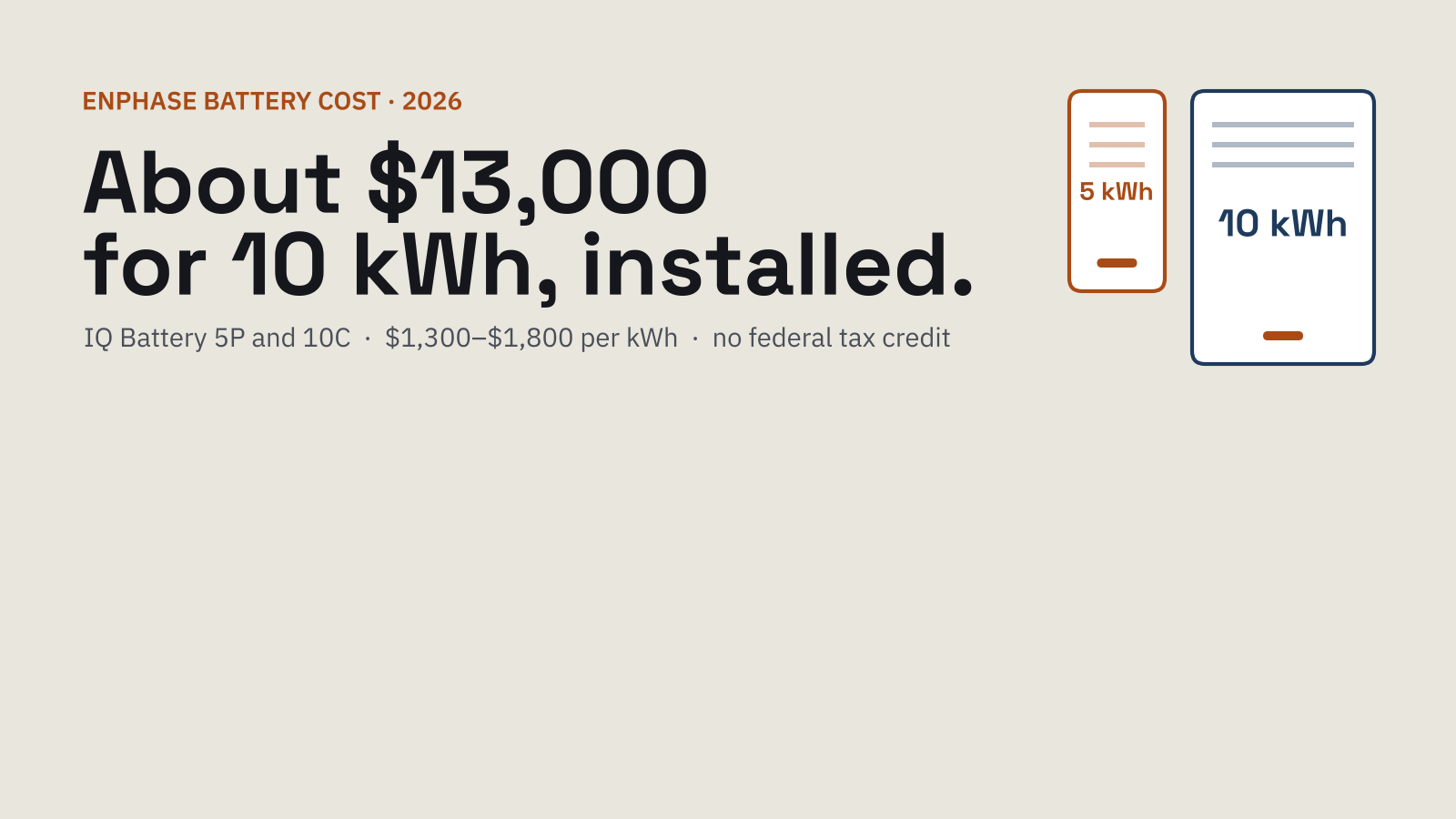
Short answer: One Enphase IQ Battery 10C (10 kWh) typically costs about $13,000 to $18,000 installed in 2026, or $1,300 to $1,800 per kWh. A single IQ Battery 5P (5 kWh) runs about $7,500 to $8,500, and a two-battery 5P system about $15,000 to $17,000. The 30% federal tax credit for homeowners ended on December 31, 2025, so for most buyers the quoted price is close to what they pay, unless a state or utility program applies.
Key takeaways
- Enphase is usually the most expensive mainstream home battery per kWh: about $1,300 to $1,800 per kWh installed, against roughly $960 to $1,220 for a Powerwall 3 and $730 to $1,000 for a FranklinWH aPower 2 in California quotes.
- The 10C is the better value of the two current models. It stores twice as much as a 5P and needs one set of mounting, wiring and commissioning instead of two.
- What you pay for: a 15-year warranty (Tesla offers 10), built-in microinverters, small modular steps and an easy fit with existing Enphase solar.
- Backup is not automatic. A 5P system needs an IQ System Controller (about $2,900 to $3,050 for the hardware alone); a 10C system uses an IQ Combiner 6C and, for whole-home backup, an IQ Meter Collar.
- On full retail net metering, a battery saves little on the bill. It pays back mainly where exports earn far less than evening electricity, as under California’s net billing.
Enphase battery prices in 2026
Installers set the final price, so the most useful figures come from quote data. The table below combines California installer quotes from NRG Clean Power (August 2026), a 2025 SolarReviews estimate for a two-battery 5P system, and our own estimate for two 10C batteries based on how much a second battery usually adds.
| System | Usable capacity | Continuous power | Typical installed cost | Cost per kWh |
|---|---|---|---|---|
| 1 × IQ Battery 5P | 5 kWh | 3.84 kW | $7,500–$8,500 | $1,500–$1,700 |
| 2 × IQ Battery 5P | 10 kWh | 7.68 kW | $15,000–$17,000 | $1,500–$1,700 |
| 1 × IQ Battery 10C | 10 kWh | 7.08 kW | $13,000–$18,000 | $1,300–$1,800 |
| 2 × IQ Battery 10C (estimate) | 20 kWh | 14.16 kW | $23,000–$30,500 | $1,150–$1,525 |
Prices outside California tend to be in the same range or slightly higher. EnergySage’s marketplace data shows an average of about $1,074 per kWh for all home batteries quoted in California (May 2026) and about $1,367 per kWh in Kentucky (July 2026), with Enphase’s 10C and 5P among the most-quoted models in both states. Enphase systems usually sit above those state averages, because the brand carries a price premium.
One detail to watch: a single 5P plus the IQ System Controller that it needs for backup already retails for about $6,700 to $7,500 before any labor. A whole-home backup quote for one 5P at the low end of the range is unlikely. Low single-battery quotes usually cover grid-tied storage only, or a home that already has the controller.
How Enphase compares on cost per kWh
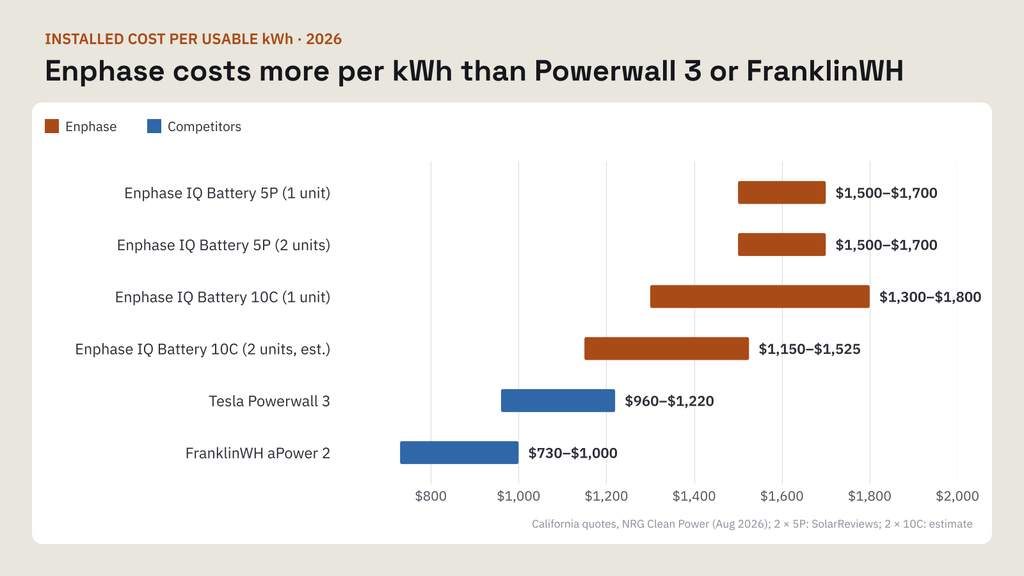
Per kWh of storage, Enphase costs about 40% more than a Tesla Powerwall 3, which stores 13.5 kWh in one box. The gap narrows as you add 10C units, because the fixed costs (design, permits, backup hardware and the crew’s visit) get spread over more kWh. EnergySage saw the same pattern in its own marketplace data: in the first half of 2024, Enphase quotes had a median of $1,344 per kWh, against $1,000 for the Powerwall 3.
| Enphase IQ Battery 5P | Enphase IQ Battery 10C | Tesla Powerwall 3 | FranklinWH aPower 2 | |
|---|---|---|---|---|
| Usable capacity | 5 kWh | 10 kWh | 13.5 kWh | 15 kWh |
| Continuous power | 3.84 kW | 7.08 kW | 11.5 kW | 10 kW |
| Typical installed cost (California) | $7,500–$8,500 | $13,000–$18,000 | $13,000–$16,500 | $11,000–$15,000 |
| Cost per kWh | $1,500–$1,700 | $1,300–$1,800 | $960–$1,220 | $730–$1,000 |
| Warranty | 15 years | 15 years | 10 years | 15 years |
Cost per kWh is not the whole story. A homeowner who needs only 10 kWh of backup would buy capacity they don’t use with a 13.5 kWh or 15 kWh battery, and Enphase’s 5 kWh steps let you match the system to the load. For sizing, see our guide to home battery backup and how many kWh a house uses.
What’s in an Enphase battery quote
An Enphase storage system is more than the battery. The parts depend on which generation your installer uses.
- Third generation (IQ Battery 5P): the batteries, an IQ Gateway for monitoring and an IQ System Controller 3 or 3G, which disconnects the home from the grid during an outage. Without the controller, the battery can still shift solar into the evening but cannot run the house in a blackout.
- Fourth generation (IQ Battery 10C): the batteries, an IQ Combiner 6C (which combines the gateway, metering and breaker spaces for solar, battery and EV charging) and, for whole-home backup, an IQ Meter Collar. The collar fits behind the utility meter, so the installer does not have to move circuits to a separate backup panel.
Installers buy this equipment at trade prices, but distributor list prices give a sense of where the money goes:
| Component | Distributor price (October 2026) |
|---|---|
| IQ Battery 5P (each) | $3,800–$4,450 |
| IQ Battery 10C (each) | $6,000–$7,600 |
| IQ System Controller 3G (for 5P backup) | $2,900–$3,050 |
| IQ Meter Collar (whole-home backup) | $580–$630 |
| Labor, permits, electrical work, design and installer margin | The rest of the quote, usually several thousand dollars |
Homeowners can’t simply buy the parts and plug them in: Enphase requires a certified installer account to commission a storage system. The hardware prices are useful for one thing, though. If a quote is far above them plus a reasonable labor charge, ask the installer to break it down.
What pushes the price up
Two homes with the same batteries can get very different quotes. NRG Clean Power lists the cost drivers it sees most often in California:
- Main panel upgrade: $2,500 to $5,000, typically for older 100 A service.
- Adding the battery later instead of with solar: $1,500 to $3,000 more, for a second permit, inspection and crew visit.
- Permits and inspection: $400 to $1,200, depending on the city.
- Long conduit runs: $500 to $1,500 when the battery sits in a detached garage or far from the panel.
- Whole-home backup instead of partial backup: more battery capacity, and sometimes more electrical work. The IQ Meter Collar was designed to cut that work, and it is now approved by 80 utilities serving more than 38 million customers in the US and Canada.
IQ Battery 5P vs 10C: which costs less?
For new systems, the 10C is usually the cheaper way to get 10 kWh or more. It packs two 5 kWh battery units into one cabinet, with 7.08 kW of continuous power and up to 14.16 kVA for a few seconds to start motors such as air conditioners and well pumps. Two 5P batteries give 7.68 kW continuous, slightly more, but need two cabinets, two mounting jobs and two circuits. The 10C also saves wall space: it measures about 24.5 × 28 × 14.4 inches and weighs 317 lb, while a single 5P is about 38.6 × 21.7 × 7.4 inches and 174 lb.
| IQ Battery 5P | IQ Battery 10C | |
|---|---|---|
| Usable capacity | 5.0 kWh | 10.0 kWh |
| Continuous power | 3.84 kVA | 7.08 kVA |
| Peak power | 7.68 kVA (3 seconds) | 14.16 kVA |
| Chemistry | LFP | LFP |
| Round-trip efficiency | 90% AC, 96% DC | 90% AC, 96% DC |
| Warranty | 15 years or 6,000 cycles, at least 60% capacity | 15 years or 6,000 cycles, 60% capacity |
| Backup hardware | IQ System Controller 3/3G | IQ Combiner 6C, plus IQ Meter Collar for whole-home backup |
| Launched in the US | 2023 | 2025 |
The 5P still makes sense in two cases: adding a small amount of storage to an existing third-generation Enphase system, or expanding a home that already has 5P batteries. Note that the 5P stacks only with other 5P units, not with Enphase’s older IQ Battery 3 or 10 models.
Both use lithium iron phosphate cells, the same chemistry as the Powerwall 3. Our guide to LiFePO4 batteries explains why that chemistry dominates home storage.
Adding an Enphase battery to existing solar
Enphase batteries are AC-coupled: each one has its own microinverters and connects to the home’s AC wiring rather than to the solar inverter. That is why they are a common retrofit choice. Since August 2026, Enphase has also supported adding the 10C, with whole-home backup, to homes whose solar panels use another brand’s inverter. The IQ Combiner 6C can take in up to 15.4 kVA of existing third-party solar, and during an outage that solar keeps charging the battery.
The trade-off is efficiency. Solar energy stored in an AC-coupled battery is converted from DC to AC, back to DC and to AC again, so Enphase quotes 90% round-trip efficiency at the AC side. In practice that is close to the Powerwall 3’s 89% AC figure, so the loss is small.
Retrofits usually cost more than installing solar and storage together, because of the extra permit and crew visit. In California, homeowners on the older NEM 1.0 or 2.0 plans should ask how a battery affects their rate; Enphase says qualifying customers can add storage configured for self-consumption while keeping their existing net metering benefits, subject to utility rules.
Tax credits and incentives in 2026
- Federal credit for homeowners: gone. The 30% Residential Clean Energy Credit (Section 25D) ended for expenditures after December 31, 2025. Be wary of any 2026 quote that still subtracts it.
- Leases and PPAs: a company that owns the battery may still claim the business credit under Section 48E and price that into a lease. The 10C is built with US domestic content, which can raise the value of that credit for the owner. Compare the total paid over the contract, not just the monthly payment.
- California SGIP: as of August 2026, the general residential step ($150 per kWh) was closed in the big investor-owned utility territories, while some equity categories worth $1,100 per kWh were open or waitlisted. Eligibility depends on income, location and the specific budget.
- Grid-services programs: some utilities and community choice programs pay battery owners to share stored power during peak demand. Enphase points to San Diego Community Power’s Solar Battery Savings program as one example. Payments vary widely, so check what your utility offers.
Does an Enphase battery pay for itself?
It depends almost entirely on how your utility values exported solar. Here is a simple example for a California home on net billing that adds one 10C to existing solar:
- Installed cost: $14,000.
- The battery delivers about 10 kWh to the house on 300 evenings a year: 3,000 kWh.
- At 90% efficiency, that takes about 3,330 kWh of midday solar that would otherwise be exported.
- Evening electricity avoided at 45¢ per kWh: $1,350 a year. Export credit given up at 7¢ per kWh: about $230.
- Net saving: about $1,120 a year, for a simple payback of roughly 12 to 13 years.
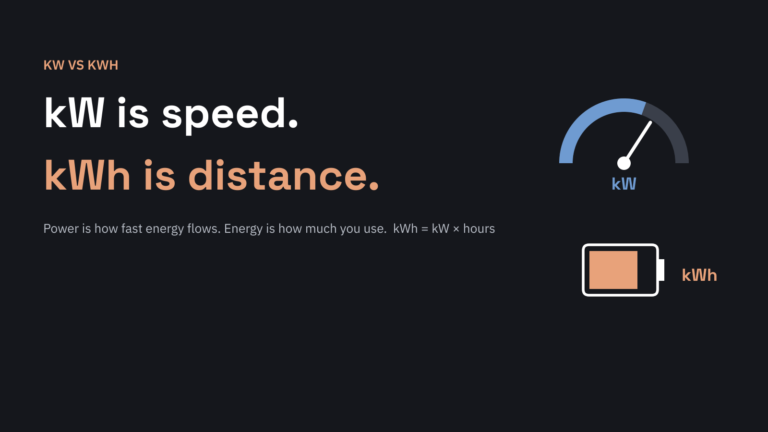
That fits inside the 15-year warranty, but not by much, and it ignores financing costs and capacity fade. On full retail net metering, where exports earn the same rate you pay, the battery saves almost nothing on the bill, and backup becomes the main reason to buy. Our solar battery guide and solar payback calculator go deeper into the numbers. If kW and kWh still blur together, our explainer on kW vs kWh shows why a battery needs both.
Should you wait for the IQ Battery G5?
Enphase announced its fifth-generation IQ Battery G5 in June 2026. It stacks 5 kWh blocks into a single tower of 5 to 30 kWh, with about 1.9 times the energy density of Enphase’s third-generation European battery and a 15-year warranty. It is scheduled for Europe in the first quarter of 2027. Enphase has not announced US pricing or a US launch date, so it is not a reason to delay a purchase you need now.
How to get a fair Enphase quote
- Get at least three itemized quotes that list the battery model (5P or 10C), the number of units, the backup hardware and the electrical work separately.
- Ask whether the quote is for partial backup, whole-home backup or no backup at all.
- Ask for a comparable Powerwall 3 or FranklinWH quote if the installer carries them, to see the real price gap.
- Check that no federal homeowner credit has been subtracted, and that any SGIP or utility rebate is confirmed rather than assumed.
- If you plan solar too, install both together to avoid paying for a second permit and visit.
FAQ
How much does an Enphase battery cost?
In 2026, one IQ Battery 10C typically costs $13,000 to $18,000 installed and one IQ Battery 5P about $7,500 to $8,500. A two-battery 5P system runs about $15,000 to $17,000. Prices are before any state or utility incentives.
Is Enphase more expensive than a Tesla Powerwall?
Usually, yes, per kWh. California quotes put Enphase at about $1,300 to $1,800 per kWh and the Powerwall 3 at about $960 to $1,220. Enphase offers a longer warranty (15 years versus 10) and smaller capacity steps.
How many Enphase batteries do I need?
Many homes choose 10 to 15 kWh: one or two 10C units, or two or three 5P units. For essentials such as the fridge, lights, internet and a few outlets, 10 kWh often covers a night. Running central air or an electric range in an outage needs more capacity and more continuous power.
Can I add an Enphase battery without Enphase solar panels?
Yes. Enphase batteries are AC-coupled, and since August 2026 the IQ Battery 10C, with the IQ Combiner 6C and IQ Meter Collar, can add whole-home backup to homes whose solar uses another brand’s inverter.
Is there a tax credit for Enphase batteries in 2026?
Not for homeowners who buy the battery. The 30% Section 25D credit ended on December 31, 2025. Leased systems may still benefit indirectly, because the owner can claim the Section 48E business credit.
How long does an Enphase battery last?
Both current models carry a 15-year or 6,000-cycle warranty, with about 60% of the original capacity guaranteed at the end. With one cycle a day, 6,000 cycles is about 16 years, so the 15-year limit usually comes first.
Sources
- NRG Clean Power: How much does a solar battery cost? (August 19, 2026)
- SolarReviews: Enphase battery review, cost, specifications and availability
- EnergySage: Enphase IQ Battery review (median price per kWh, first half of 2024)
- EnergySage: Enphase IQ Battery 10C review (June 2025)
- EnergySage storage cost data: California (May 2026) and Kentucky (July 2026)
- Enphase: IQ Battery 5P datasheet (North America)
- Enphase: IQ Battery 10C datasheet (July 2025)
- Enphase: IQ Battery 10C and whole-home backup for existing third-party solar (August 10, 2026)
- Enphase: IQ Meter Collar approved by 80 utilities in the US and Canada (September 21, 2026)
- Enphase: Product innovations at Intersolar Europe, including the IQ Battery G5 (June 17, 2026)
- ESS News: Enphase launches fourth-generation system with the IQ Battery 10C (July 30, 2025)
- Distributor prices checked October 2026: Platt (IQ Battery 5P), Solartown (IQ Battery 10C), EcoDirect (IQ Battery 10C), Northern Arizona Wind and Sun (IQ System Controller 3G), RES Supply (IQ Meter Collar)
Prices are typical ranges from public quote data and distributor listings as of October 2026. Your installed price will depend on your home, your installer and local incentives. This article is general information, not financial advice.