kW vs kWh: What’s the Difference?

kW and kWh look almost the same and appear on the same bills, battery spec sheets and solar quotes, yet they measure different things. A kilowatt (kW) is power: how fast energy is being used or produced at a given moment. A kilowatt-hour (kWh) is energy: how much has been used or produced over time. Mixing them up leads to undersized home batteries, solar systems that don’t cover the bill and confusion about EV charging. This guide explains the difference with examples from your electric bill, your roof, your garage and your car.
Short answer: kW measures power, the rate at which electricity flows. kWh measures energy, the total amount used over time. Multiply power by time to get energy: a 1.5 kW space heater running for 4 hours uses 1.5 × 4 = 6 kWh. Your utility bills you for kWh. Chargers, solar panels and inverters are rated in kW.
Key takeaways
- 1 kW is 1,000 watts of power. 1 kWh is the energy of 1 kW used for one hour.
- kWh = kW × hours. To go the other way, kW = kWh ÷ hours.
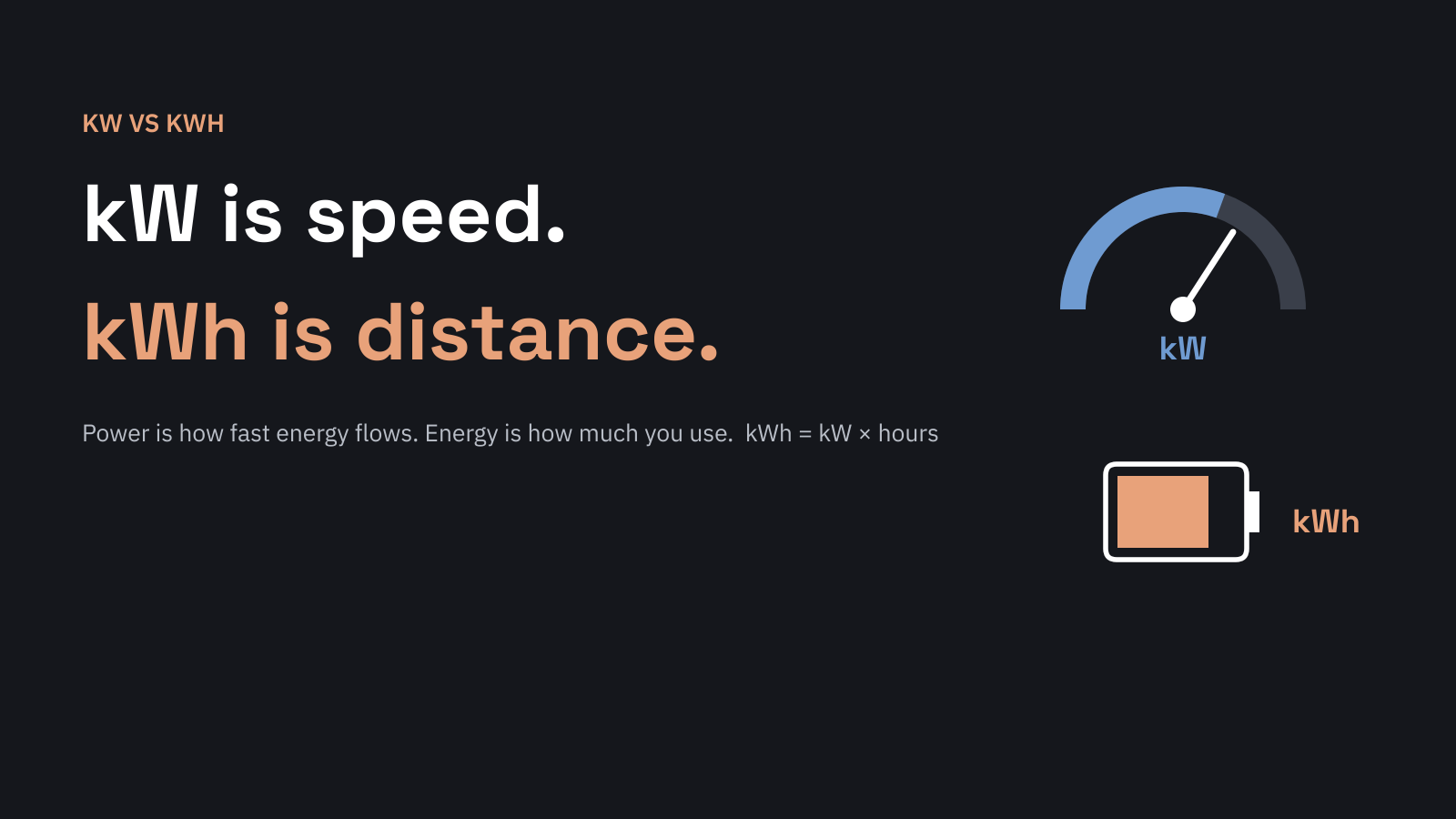
- Think of kW as speed and kWh as distance, or kW as how wide the tap is open and kWh as how much water is in the bucket.
- An average US home uses about 865 kWh a month. At about 18.3 cents per kWh, that is roughly $158 before fixed fees.
- Batteries need both numbers: kWh says how long they last, kW says how much they can run at once.
What is a kW?
A watt is a unit of power, named after the steam engine pioneer James Watt. A kilowatt is 1,000 watts. Power describes a rate: how fast electricity is being delivered or consumed right now. A 60-watt light bulb draws 0.06 kW. A microwave draws about 1 kW. A central air conditioner might draw 3 to 4 kW while the compressor is running.
The kW rating on a device tells you how much it draws while it runs, or for a generator, solar system or charger, how much it can deliver at most. It says nothing on its own about how much energy is used, because it doesn’t include time.
What is a kWh?
A kilowatt-hour is an amount of energy: one kilowatt of power flowing for one hour. The US Energy Information Administration gives the example of a 40-watt bulb left on for five hours, which uses 200 watt-hours, or 0.2 kWh. A 1 kW microwave running for 6 minutes (a tenth of an hour) uses 0.1 kWh.
Because a kWh includes time, it is what your meter counts and what your utility charges for. It is also the unit for anything that stores energy, such as a home battery, a portable power station or an EV battery.
The formula: from kW to kWh and back
Energy (kWh) = power (kW) × time (hours)
That one line answers most practical questions:
- kW to kWh: a 3.5 kW air conditioner that runs 8 hours uses 3.5 × 8 = 28 kWh.
- kWh to hours: a 13.5 kWh battery powering a 1.5 kW load lasts about 13.5 ÷ 1.5 = 9 hours, before losses.
- kWh to kW: adding 45 kWh to an EV battery in 6 hours needs about 45 ÷ 6 = 7.5 kW of charging power.
- Watts to kWh: divide watts by 1,000 first. A 1,500-watt heater is 1.5 kW.
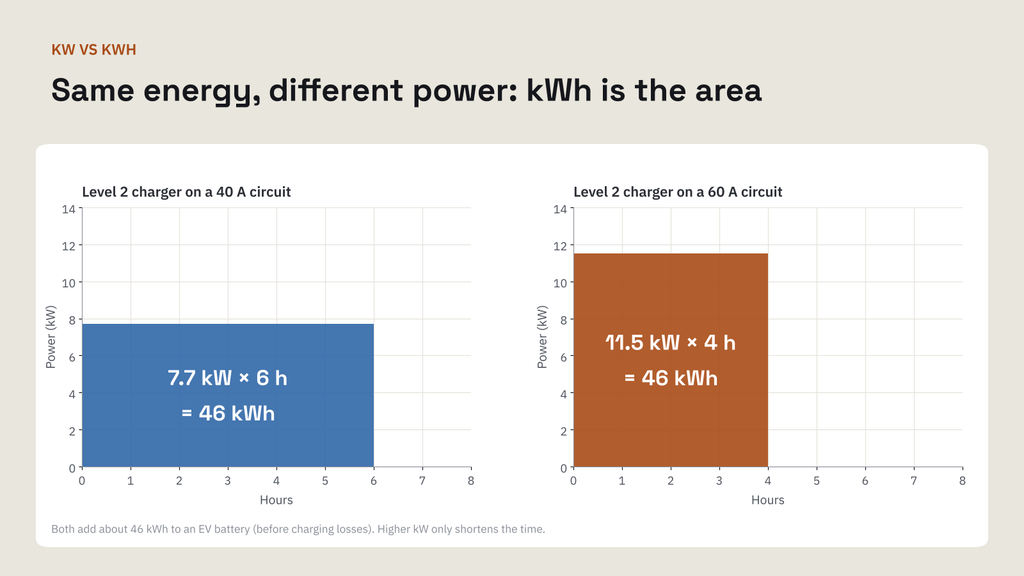
The same amount of energy can come quickly at high power or slowly at low power. Charging an EV with 46 kWh takes about 6 hours at 7.7 kW or about 4 hours at 11.5 kW. The kWh is the same; only the kW, and therefore the time, changes.
kW vs kWh at a glance
| kW (kilowatt) | kWh (kilowatt-hour) | |
|---|---|---|
| Measures | Power: the rate of energy flow | Energy: the total amount |
| Everyday analogy | Speed (miles per hour) | Distance (miles) |
| On your electric bill | Only on demand-charge plans | Always: what you pay for |
| Solar system | System size, e.g. 8 kW | Output, e.g. 10,500 kWh a year |
| Home battery | How much it can run at once | How much it stores |
| EV | Charger and motor power | Battery size and energy use |
| Appliance label | Watts drawn while running | Annual use (on EnergyGuide labels) |
kWh on your electric bill
Your meter adds up kWh, and most residential bills are simply kWh used multiplied by a price per kWh, plus fixed fees. An average US home used about 865 kWh a month in 2024, according to the EIA. The average residential price reached about 18.3 cents per kWh in mid-2026, so 865 kWh costs roughly $158 before fixed charges and taxes. Our guide to how many kWh a house uses breaks this down by state and by appliance.
A few utilities also bill some homes for kW. These demand charges are based on your highest power draw over a short window, typically one hour or 15 minutes, during the billing period. Running the dryer, oven, air conditioner and EV charger at the same time raises your peak kW even if your total kWh stays the same. Demand charges are standard for businesses and have been proposed or adopted for homes by utilities in several states, including Arizona. If your bill shows a line in kW, staggering big loads lowers it.
kW vs kWh for solar panels
A solar system’s size is quoted in kW, sometimes written kWp or kWdc: the power the panels produce in full sun under test conditions. What you care about is the kWh it produces over a year. An 8 kW system in a place with 4.5 peak sun hours a day, after about 20% in real-world losses, produces about 8 × 4.5 × 365 × 0.8 = 10,500 kWh a year. The same 8 kW system makes far fewer kWh in Seattle than in Phoenix.
To size a system, start from your annual kWh and work back to kW. Our solar panel calculator does exactly that.
kW vs kWh for home batteries
Batteries need both numbers, and confusing them is the most common sizing mistake. Take the Tesla Powerwall 3: it stores 13.5 kWh and delivers up to 11.5 kW of continuous power.
- kWh (capacity) decides how long the battery lasts. 13.5 kWh runs a 1 kW load for about 13 hours, or a 3 kW load for about 4.5 hours.
- kW (power) decides what you can run at the same time. An air conditioner, well pump and electric range together may need more than one battery can supply, even if the battery is full.
Our guides to home battery backup and Tesla Powerwall 3 cost show how to size both. The same logic applies to a portable power station: the Wh rating is the tank, the W rating is the tap.
kW vs kWh for electric cars
An EV’s battery size is in kWh: a typical 2026 crossover has 70 to 85 kWh. Charger power is in kW: a home Level 2 charger supplies 7 to 19 kW and a DC fast charger 50 to 350 kW. Divide the kWh you need by the kW of the charger to get the charging time, as explained in our guide to how long it takes to charge an electric car.
Efficiency is quoted in kWh per 100 miles, or miles per kWh. An EV that uses 30 kWh per 100 miles costs about $5.50 per 100 miles to charge at 18.3 cents per kWh. Our guide to the cost to charge an electric car has a calculator for your own numbers.
Calculator: watts to kWh and cost
Enter an appliance’s wattage, usually on a label on the back or bottom, and how many hours a day it runs.
kWh and cost calculator
1.5 kW
6.0 kWh
180 kWh
$32.94
A month is counted as 30 days. Devices that cycle on and off, such as fridges and air conditioners, draw full power only part of the time, so their real use is lower than watts × hours.
Common mistakes
- “kW per hour.” There is no such everyday unit. A kW already describes a rate. People who say “kW per hour” usually mean kWh.
- Sizing a battery by kWh alone. A big battery with low power output may not start a well pump or air conditioner.
- Comparing solar quotes by kW alone. Two 8 kW systems on different roofs can produce very different kWh. Compare the estimated annual kWh.
- Treating watts on a label as constant use. A fridge rated at 150 watts does not use 150 × 24 hours a day, because its compressor cycles on and off. See our guide to running a fridge on a power station.
Frequently asked questions
Is kWh the same as kW?
No. kW is power, a rate. kWh is energy, an amount. A 1 kW device running for one hour uses 1 kWh; running for three hours, it uses 3 kWh.
How do I convert kW to kWh?
Multiply the kW by the number of hours. A 2 kW load for 5 hours is 10 kWh. You cannot convert kW to kWh without knowing the time.
How many watts are in a kWh?
A kWh is 1,000 watt-hours: 1,000 watts for one hour, 100 watts for 10 hours or 10 watts for 100 hours. In heat terms, the EIA puts 1 kWh at 3,412 Btu.
What does 1 kWh run?
Roughly: a 10-watt LED bulb for 100 hours, a laptop for 15 to 20 hours, a 1,500-watt space heater for 40 minutes, or about 3 to 4 miles of driving in an efficient EV.
Why is my battery rated in both kW and kWh?
Because it has two limits. kWh is how much energy it holds; kW is how fast it can deliver that energy. You need enough of both for what you want to run.
Sources
- US Energy Information Administration: Measuring electricity
- US Energy Information Administration: Glossary, kilowatt and kilowatthour
- US Energy Information Administration: Average residential electricity use and bills in 2024 (May 2025)
- El Cronista: US residential electricity price reaches 18.31 cents per kWh in July 2026 (EIA data)
- EnergySage: Demand charges explained