LFP vs NMC Batteries: Which Is Better for EVs and Home Storage?

If you are shopping for an electric car, a home battery or a portable power station, you will eventually see two abbreviations on the spec sheet: LFP and NMC. Both are lithium-ion batteries, but they use different cathode materials, and that one difference changes cost, lifespan, safety, weight and how you should charge them. This guide compares LFP vs NMC in plain terms and ends with a simple rule of thumb for choosing.
Short answer: LFP (lithium iron phosphate) is cheaper, lasts more charge cycles and is more resistant to overheating, but it stores less energy per kilogram and is weaker in the cold. NMC (nickel manganese cobalt) packs more energy into less weight, which means more range in a car, at a higher price. For home batteries and power stations, LFP is now the clear default. For EVs, both make sense depending on how far you drive and where you live.
Key takeaways
- LFP packs averaged about $81/kWh in 2025, against $128/kWh for NMC, according to BloombergNEF.
- LFP typically survives several thousand full charge cycles; NMC usually fewer, though modern EV packs of both types are built to outlast most owners’ needs.
- NMC stores roughly 30–50% more energy per kilogram at cell level, which is why long-range and performance EVs still favor it.
- LFP is happy to be charged to 100% regularly; NMC lasts longer if you usually stop at 80–90%.
- LFP now makes up more than half of EV batteries worldwide, but most of that is in China. Outside China, nickel-based chemistries still dominate.
What LFP and NMC actually mean
Every lithium-ion cell has a cathode (positive electrode), an anode (usually graphite), and an electrolyte that lets lithium ions shuttle between them. The names LFP and NMC describe only the cathode, but the cathode sets most of the battery’s character.
- LFP stands for lithium iron phosphate, LiFePO4. You will often see it sold simply as “LiFePO4” on power stations, RV batteries and solar storage. It contains no nickel and no cobalt.
- NMC (also written NCM) stands for lithium nickel manganese cobalt oxide. Numbers such as NMC 532, 622 or 811 give the ratio of nickel to manganese to cobalt. Higher nickel means more energy and less cobalt, but also more demanding thermal management.
A close cousin, NCA (nickel cobalt aluminium), behaves much like high-nickel NMC and is grouped with it in this guide.
Why they behave differently: a look at the crystal structure
This is where a materials view helps. NMC is a layered oxide: sheets of metal and oxygen with lithium sitting between them. Lithium can move in and out easily in two dimensions, and the high voltage of nickel gives lots of energy. The catch is that, when the cell is highly charged and hot, those layers can become unstable and release oxygen, which feeds a fire if the cell fails.
LFP has an olivine structure in which oxygen is locked into very strong phosphorus-oxygen bonds. It releases oxygen far less readily, so it is much harder to push into thermal runaway. The trade-offs are a lower voltage (about 3.2 V per cell versus roughly 3.6–3.7 V for NMC), lithium that moves along one-dimensional channels, and poor electrical conductivity. Manufacturers fix the last two by making the particles very small and coating them with carbon, which is one reason LFP took decades to become competitive.
LFP vs NMC: side-by-side comparison
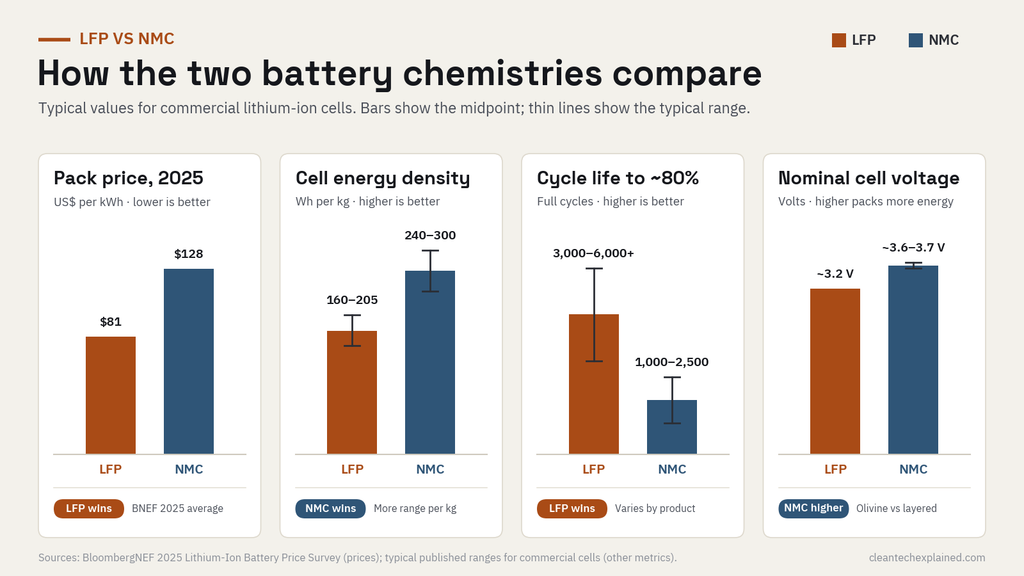
The figures below are typical ranges for current commercial cells. Individual products vary, so always check the datasheet or warranty for the specific battery you are considering.
| Property | LFP | NMC |
|---|---|---|
| Nominal cell voltage | ~3.2 V | ~3.6–3.7 V |
| Cell energy density | ~160–205 Wh/kg | ~240–300 Wh/kg |
| Typical cycle life (to ~80% capacity) | ~3,000–6,000+ | ~1,000–2,500 |
| Average pack price, 2025 (BNEF) | $81/kWh | $128/kWh |
| Thermal stability | High; hard to ignite | Lower; needs careful thermal management |
| Cold-weather performance | Weaker, especially charging below freezing | Better |
| Daily charge limit (typical advice) | 100% is fine | 80–90% for longest life |
| Nickel and cobalt | None | Yes |
Cost: LFP is cheaper, and the gap is large
Iron and phosphate are cheap and abundant; nickel and cobalt are not. In BloombergNEF’s 2025 survey, LFP packs averaged $81/kWh across all segments and NMC packs $128/kWh, while stationary storage packs, which are mostly LFP, fell to about $70/kWh. For a 60 kWh EV pack, that gap is worth well over a thousand dollars before any other differences.
Avoiding nickel and cobalt also reduces exposure to volatile metal prices and to mining regions with supply or ethical concerns. Both metals appear on the US and EU lists covered in our critical minerals guide. LFP is not free of supply-chain risk, though: its production is overwhelmingly concentrated in China.
Lifespan: LFP wins on cycles
LFP cells typically deliver several thousand full cycles before falling to about 80% of their original capacity, while NMC cells usually deliver fewer. That is why home battery makers favor LFP; a battery cycled once a day for 15 years sees more than 5,000 cycles.
For cars, the difference matters less than it sounds. A 300-mile NMC pack that lasts 1,500 full cycles covers roughly 450,000 miles, far longer than most people keep a car. Calendar ageing (time and heat) often matters more than cycle count, and here too LFP generally holds up well. For real-world numbers, see how long EV batteries last.
Energy density and range: NMC’s big advantage
NMC stores substantially more energy per kilogram and per liter. For the same weight and space, an NMC pack gives more range, or the same range with a lighter car. This is why long-range, performance and premium EVs have mostly stayed with nickel-based chemistries, while LFP is common in standard-range and more affordable models.
The gap has narrowed at pack level. Cell-to-pack designs, which skip the intermediate module layer, let LFP packs fit more cells into the same space. Newer variants such as lithium manganese iron phosphate (LMFP) raise the voltage and energy of the phosphate family further.
Safety
All lithium-ion batteries sold by reputable brands are designed and tested to be safe. Still, if something goes badly wrong, LFP is far more forgiving: its thermal runaway starts at a higher temperature and releases less heat and oxygen. That makes it the preferred choice for batteries installed inside homes and garages, and for large grid storage.
NMC is safe in well-engineered EV packs with active cooling and good battery management, but it depends more on that engineering.
Cold weather
This is LFP’s weak point. At low temperatures, LFP cells lose more usable capacity and, crucially, cannot be fast-charged safely below freezing without first being warmed. Modern EVs with LFP packs pre-heat the battery automatically, especially if you set a charging stop in the navigation, but winter range loss and slower cold charging are more noticeable than with NMC. If you live somewhere with long, hard winters and park outside, NMC is the more comfortable choice.
How to charge each one
LFP: Charging to 100% is fine and often recommended. LFP has a very flat voltage curve, so the battery management system struggles to estimate the state of charge in the middle of the range; a full charge recalibrates it. Tesla, for example, advises owners of LFP-equipped cars to charge to 100% at least once a week.
NMC: For daily use, set the limit to about 80–90% and charge to 100% only before long trips. Avoid leaving the car parked at 100% for days, especially in hot weather.
For both, avoid regularly running the battery to 0%, and don’t worry about occasional fast charging.
How quickly you can recharge at home depends on your charger. We compare the options in Level 1 vs Level 2 EV charger.
Which is better for you?
Home batteries
Choose LFP. Long cycle life, high safety margins and lower cost per kWh matter more than weight in a box on a wall. Most current home batteries, including Tesla’s Powerwall 3 and Enphase’s IQ Battery range, use LFP. Our solar battery guide covers costs and sizing for home storage.
Portable power stations
Choose LFP unless weight is critical. It lasts many more cycles, and most mainstream models have switched to it. If you are sizing one for a fridge or backup, our power station runtime guide includes a calculator.
Electric cars
- LFP suits you if you mostly drive locally, charge at home, want to charge to 100% without thinking, and live somewhere with mild winters. LFP often appears in standard-range versions, which are cheaper.
- NMC suits you if you drive long distances often, want maximum range, face harsh winters or tow regularly.
Battery chemistry often varies by trim, market and model year, even within one model. Check the spec sheet or ask the dealer rather than assuming.
Where each chemistry is used today
According to the International Energy Agency, LFP accounted for over 55% of EV batteries deployed globally in 2025, up from nearly half in 2024. That growth is concentrated in China. In the European Union, LFP held a little over 10% of EV battery demand in 2025, and in the United States its share almost halved from an already low base because of higher tariffs on Chinese imports and stricter sourcing rules linked to the EV tax credit.
That may change as local production starts. Ford’s LFP cell plant in Marshall, Michigan, built with technology licensed from CATL, began pilot production in 2026 and is expected to deliver its first regular cells later in the year, both for a midsize electric pickup and for battery storage.
What comes next
- LMFP: Adding manganese to LFP raises voltage and energy density while keeping most of the cost and safety benefits.
- High-manganese and low-cobalt NMC: Aimed at cutting cost and cobalt while keeping the energy advantage.
- Sodium-ion: No lithium, nickel or cobalt at all, with good cold-weather behavior, but lower energy density. It is starting to appear in small EVs and storage.
- Faster-charging LFP: Several manufacturers now offer LFP cells designed for much higher charging rates, narrowing one of NMC’s traditional advantages.
- Solid-state batteries
Frequently asked questions
Is LiFePO4 the same as LFP? Is it lithium-ion?
YYes on both counts. LiFePO4 is the chemical formula for lithium iron phosphate, so “LiFePO4” and “LFP” are the same thing; our LiFePO4 battery guide covers it in detail.
Can I charge an LFP battery to 100% every day?
Yes. LFP tolerates full charges well, and regular full charges help the battery management system estimate the remaining capacity accurately. Always follow your manufacturer’s guidance.
Why do LFP batteries lose more range in winter?
Lithium moves more slowly through the LFP cathode at low temperature, and charging a cold LFP cell quickly risks damaging it. The car limits power and charging speed until the pack warms up.
How do I know which battery my EV has?
Check the manufacturer’s specification sheet, the owner’s manual or the battery information screen. Some cars show the chemistry or give charging advice that reveals it; a recommendation to charge to 100% regularly usually means LFP.
Do LFP batteries contain cobalt?
No. LFP uses lithium, iron and phosphate. It contains no nickel or cobalt.
Sources
- BloombergNEF, Lithium-Ion Battery Pack Prices Fall to $108 per Kilowatt-Hour, Despite Rising Metal Prices, December 2025
- International Energy Agency, Global EV Outlook 2026: Electric vehicle batteries, May 2026
- International Energy Agency, Global EV Outlook 2025: Electric vehicle batteries, 2025
- electrive, Ford to produce first LFP cells this year, thanks to CATL, June 2026
- TechCrunch, Ford is starting a battery storage business to power data centers and the grid, December 2025
- Portlandia Electric Supply, Tesla Powerwall 3 vs Enphase IQ Battery 5P (chemistry and specifications), August 2026
Featured image and diagrams: original graphics by CleanTech Explained.