Terbium: Uses, Properties, Price and Why Magnets Need It

Terbium is one of the rarest of the rare earth elements, and one of the most valuable. For decades it was best known for the green glow in fluorescent lamps and old TV screens. Today most of it goes into the high-performance magnets inside electric motors, where a fraction of a percent of terbium keeps the magnet working when it gets hot. This guide explains what terbium is, what it is used for, why magnet makers prize it, where it comes from and why its price depends so much on where you buy it.
Short answer: Terbium (Tb, atomic number 65) is a heavy rare earth metal. Its main uses are in neodymium magnets, where small amounts at the grain boundaries greatly raise heat resistance, in green phosphors for lighting and displays, and in Terfenol-D, a material that changes shape in a magnetic field. Almost all refined terbium comes from China, much of it from clay deposits in southern China and Myanmar, and it is under Chinese export licensing. In 2026 terbium metal cost about $1,000 per kilogram inside China, while terbium oxide bought outside China cost $5,000–7,000 per kilogram.
Key takeaways
- Terbium makes up only about 1.2 parts per million of Earth’s crust, making it one of the scarcer rare earths.
- A terbium-iron-boron crystal resists demagnetization about three times better than the neodymium version, which is why tiny amounts of terbium make magnets far more heat-tolerant.
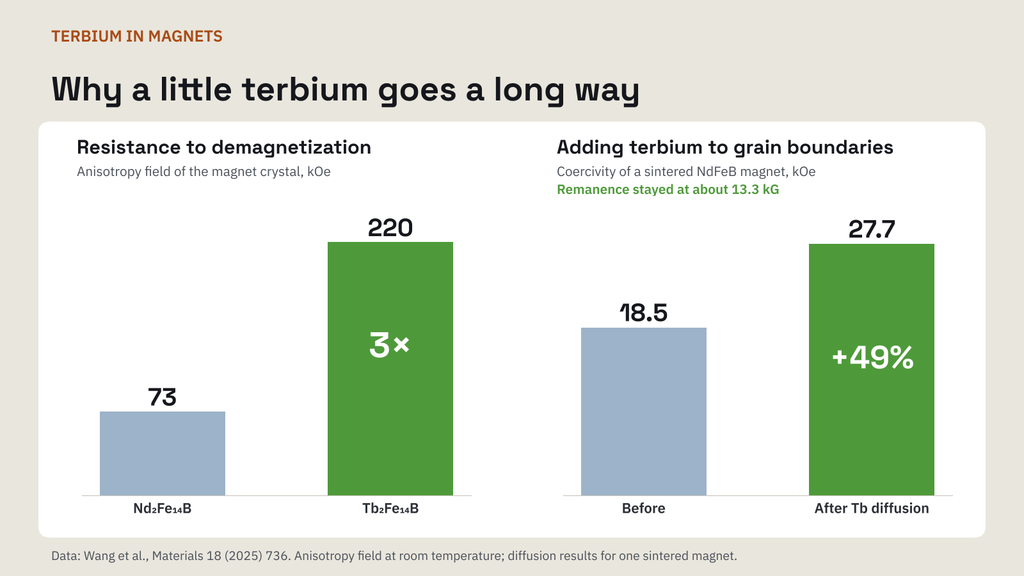
- Grain boundary diffusion places terbium only where it is needed; in one 2025 study it raised a magnet’s coercivity by 49% with no loss of strength.
- China refines nearly all the world’s terbium, and terbium has been on China’s export licensing list since April 2025.
- Outside China, terbium oxide traded at several times the Chinese domestic price in 2026.
What is terbium?
Terbium is a soft, silvery metal in the lanthanide series. It is classed as a heavy rare earth, alongside dysprosium, holmium and the elements after it. Like most lanthanides, it usually forms compounds in the +3 state, though it can also reach +4, which gives its common oxide the formula Tb4O7.
| Property | Value |
|---|---|
| Symbol and atomic number | Tb, 65 |
| Atomic weight | 158.93 |
| Density | 8.23 g/cm³ |
| Melting point | 1,356 °C |
| Boiling point | 3,123 °C |
| Abundance in Earth’s crust | About 1.2 ppm |
| Stable isotopes | One (terbium-159) |
| Magnetic behavior | Ferromagnetic below −54 °C (219 K) |
| Common oxide | Tb4O7 |
A short history
Swedish chemist Carl Gustaf Mosander found terbium in 1843 as an impurity in yttrium oxide. Like yttrium, ytterbium and erbium, it is named after Ytterby, the village near Stockholm whose quarry supplied the mineral. Separating terbium from its near-identical neighbors was so difficult that pure terbium only became available after ion-exchange separation was developed in the twentieth century. Our rare earth elements guide explains why these elements are so hard to tell apart.
What is terbium used for?
Terbium has a handful of uses, but magnets now dominate. One industry estimate for 2024 put demand at about 60% for magnets, 30% for phosphors and 10% for everything else.
Magnets for motors
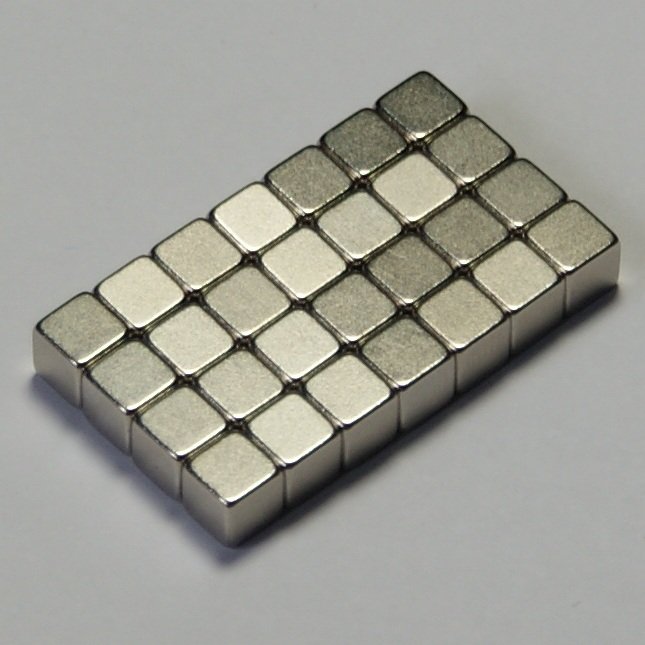
Neodymium-iron-boron magnets lose their resistance to demagnetization as they heat up. Adding a heavy rare earth, dysprosium or terbium, fixes that. EV traction motors, wind turbine generators, industrial servo motors and other high-temperature applications rely on these grades. This is now the single largest use of terbium. The next section explains how it works.
Green phosphors
Terbium ions give off a bright, pure green light when excited by ultraviolet light or electrons. That made terbium the green in “tri-color” fluorescent lamps, compact fluorescent bulbs and cathode-ray-tube screens, alongside europium for red and blue. Phosphor demand is shrinking as LEDs replace fluorescent lighting, but terbium-based green phosphors and security inks are still in use.
Terfenol-D
Terfenol-D is an alloy of terbium, dysprosium and iron, roughly Tb0.3Dy0.7Fe2. It changes length more than any other alloy when placed in a magnetic field, about 0.2%. The name combines terbium, iron (Fe), the US Naval Ordnance Laboratory where it was developed in the 1970s, and D for dysprosium. It is used in naval sonar, precision actuators, vibration sources and some fuel injectors.
Other uses
- Optics: terbium-doped glasses and garnets rotate polarized light in a magnetic field, which is used in optical isolators that protect lasers.
- Fuel cells: terbium stabilizes zirconia in some high-temperature solid oxide fuel cells.
- Medicine: the radioactive isotope terbium-161 is being studied for targeted cancer therapy.
Why magnets need terbium
A neodymium magnet gets its strength from tiny crystals of Nd2Fe14B. How well each crystal resists being flipped by an opposing field depends on its magnetocrystalline anisotropy. When terbium takes neodymium’s place in the crystal, that anisotropy field roughly triples, from about 73 kOe to about 220 kOe at room temperature.
There is a catch. Terbium’s magnetic moment points against the iron’s, so Tb2Fe14B has less than half the magnetization of the neodymium compound (about 7.0 kG against 16.0 kG). Mixing terbium evenly through the magnet raises heat resistance but weakens it. Older high-temperature magnets did exactly that, with several percent of dysprosium or terbium spread through every grain.
Grain boundary diffusion: terbium only where it counts
Demagnetization usually starts at the surface of each grain, where the crystal is least perfect. Grain boundary diffusion takes advantage of that. A finished magnet is coated with terbium metal, terbium hydride, terbium fluoride or a terbium alloy and heated, so the terbium travels along the grain boundaries and forms a thin terbium-rich shell around each grain. The core of the grain stays pure Nd2Fe14B and keeps its strength.
The results can be striking. In a 2025 study published in Materials, diffusing terbium into a sintered magnet raised its coercivity from 18.5 to 27.7 kOe, an increase of 49%, while its remanence stayed at about 13.3 kG. Because only a thin layer near the surface can be treated this way, the method works best for magnets a few millimeters thick, which suits motor magnets.
Terbium or dysprosium?
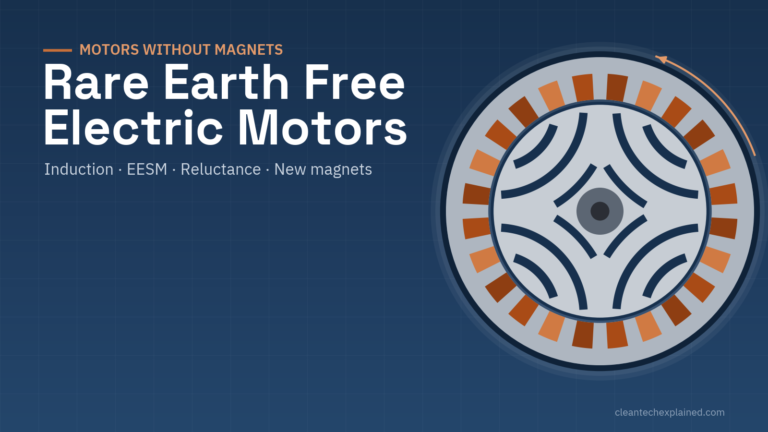
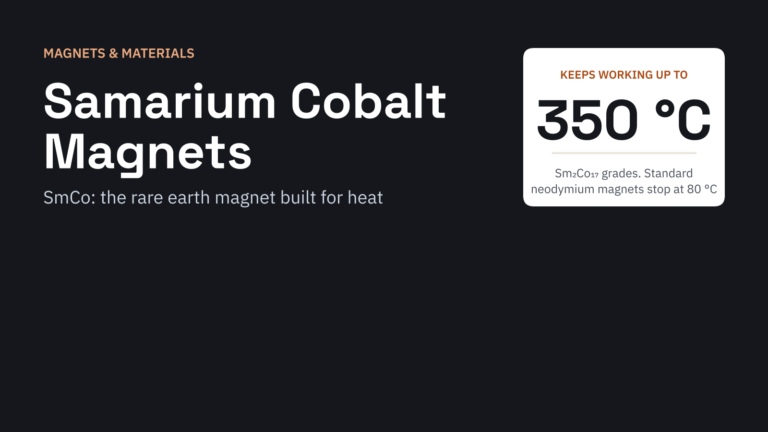
Both do the same job. Terbium is more effective per gram, so less is needed for the same heat rating, but it is scarcer and more expensive. In practice, magnet makers choose based on price and availability, and many have switched from dysprosium to terbium for grain boundary diffusion or the reverse as prices moved. Both appear on the same supply-risk lists, and both are targets of research into heavy-rare-earth-free magnets, cheaper rare earth substitutes and rare earth magnet alternatives. For very hot applications, samarium cobalt magnets avoid heavy rare earths altogether.
Where terbium comes from
Terbium is a minor part of every rare earth ore, but some ores contain far more than others:
- Ion-adsorption clays in southern China and northern Myanmar are the richest commercial source. The rare earths sit loosely on clay particles and can be leached out without crushing hard rock, and concentrates contain around 1% terbium oxide.
- Xenotime and some other heavy-rare-earth minerals also carry useful amounts.
- Bastnäsite and monazite, the main light rare earth ores, contain very little terbium, but they are mined in such large volumes that they still supply a meaningful share.
Element-by-element production figures are not published, so estimates of world terbium supply vary, from a few hundred tonnes to about 500 tonnes of oxide a year. For scale, the US Geological Survey puts world mine production of all rare earths at about 390,000 tonnes in 2025, with China at 270,000 tonnes.
China and Myanmar
Industry analysts estimate that China separates and refines more than 98% of the world’s heavy rare earths, including terbium. Much of its feedstock comes from across the border: Myanmar has supplied more than half of the dysprosium and terbium concentrate China imports in recent years, much of it from mines in conflict areas with serious environmental damage. That makes terbium supply vulnerable to both Chinese policy and instability in Myanmar.
Export controls
In April 2025, China introduced export licensing for seven medium and heavy rare earths, including terbium and dysprosium. Those controls remain in force. A broader set of restrictions announced in October 2025 is suspended until November 10, 2026. Our critical minerals guide covers how these rules affect other materials.
New supply outside China
- Lynas Rare Earths produced the first commercial heavy rare earth oxides outside China at its plant in Kuantan, Malaysia: dysprosium oxide in May 2025 and terbium oxide in June 2025.
- Serra Verde in Brazil has produced a rare earth concentrate rich in dysprosium and terbium from ionic clays since 2024.
- Energy Fuels in Utah and Iluka Resources in Western Australia are building heavy rare earth separation, with first commercial output targeted for 2026–2027.
- Recycling returns terbium from old magnets; see our rare earth magnet recycling guide.
These volumes are still small next to Chinese output, and no producer reports terbium tonnage separately.
Terbium price in 2026
Terbium now trades in two very different markets.
| Product and market | Price | Date and source |
|---|---|---|
| Terbium metal, inside China | About $1,070/kg | September 30, 2026 (SMM) |
| Terbium metal, FOB China | About $1,530/kg | September 30, 2026 (SMM) |
| Terbium oxide, CIF North America | About $4,900/kg | March 31, 2026 (S&P Global Platts) |
| Terbium oxide, CIF Europe | About $6,750/kg | September 2026 (Benchmark Mineral Intelligence) |
Inside China, terbium metal fell to roughly $600–700/kg in 2024, when Chinese production quotas created a surplus, and climbed back to about $1,000–1,200/kg in mid-2026. Outside China, buyers pay a large premium for material that is not subject to Chinese export licensing, or simply for material they can obtain at all. Benchmark reported that ex-China terbium oxide rose 23% in September 2026 alone. These prices move quickly, so treat any figure as a snapshot.
For comparison, NdPr oxide, the main ingredient of magnets, cost around $100/kg in 2026 (see our praseodymium guide), so a gram of terbium can cost as much as tens of grams of the neodymium it protects.
Is terbium toxic?
Terbium and its compounds are considered of low to moderate toxicity and are not classified as hazardous under the global chemical labeling system. Its biological effects are not well studied, and fine metal powder, like many metal powders, can be a fire hazard. The bigger concerns are environmental: leaching ion-adsorption clays with chemicals has damaged soil and water in parts of southern China and Myanmar.
Frequently asked questions
Is terbium a rare earth element?
Yes. Terbium is one of the 17 rare earth elements and belongs to the heavy rare earth group. It is a lanthanide, element 65, between gadolinium and dysprosium.
Why is terbium so expensive?
It is scarce in the crust, concentrated in a few clay deposits, hard to separate from its neighbors, and almost entirely refined in one country that controls exports. Magnet demand from EVs and wind power keeps rising while new supply outside China is still small.
Does terbium glow?
Terbium compounds give off a strong green glow under ultraviolet light. That is why terbium was used for the green in fluorescent lamps and old color TV screens.
How much terbium is in an EV?
Typically only a few grams, in the traction motor magnets of cars that use them. The amount depends on the motor design and on whether the magnet uses dysprosium or terbium. Some EVs use motors with no rare earth magnets at all; see which EVs don’t use rare earth magnets.
Can magnets be made without terbium?
Yes. Many magnets for lower-temperature uses contain no heavy rare earths, and fine-grained processing and better motor cooling let more applications go without them. For the hottest motors, though, terbium or dysprosium is still the standard way to keep a neodymium magnet stable.
Which countries produce terbium?
China produces and refines nearly all of it, with much of the raw material coming from Myanmar. Small amounts are now refined in Malaysia by Lynas, and projects in the United States, Australia and Brazil aim to add more.
Sources
- Wikipedia, Terbium (properties, history, uses, toxicity)
- Wikipedia, Terfenol-D
- F. Wang et al., Effect on Microstructure and Magnetic Properties of Nd-Fe-B Magnets Through Grain Boundary Diffusion of Tb and Multi-Component Alloys, Materials 18 (2025) 736
- US Geological Survey, Mineral Commodity Summaries 2026: Rare Earths
- True Source Metals, Terbium: prices, production, reserves, producers (demand split and producers outside China)
- Mining Weekly, Lynas adds terbium oxide to heavy rare earths portfolio, June 2025
- Rare Earth Mining, Terbium price today (SMM data, September 2026)
- S&P Global, New Platts rare earth assessments reveal security-of-supply premiums in North America, March 2026
- Benchmark Mineral Intelligence, Ex-China heavy rare earths continue to surge: Q3 2026 Rare Earths Price Review, September 2026
Featured image and diagram: original graphics by CleanTech Explained.