Cerium Magnets: How Cerium and Lanthanum Replace Neodymium in NdFeB

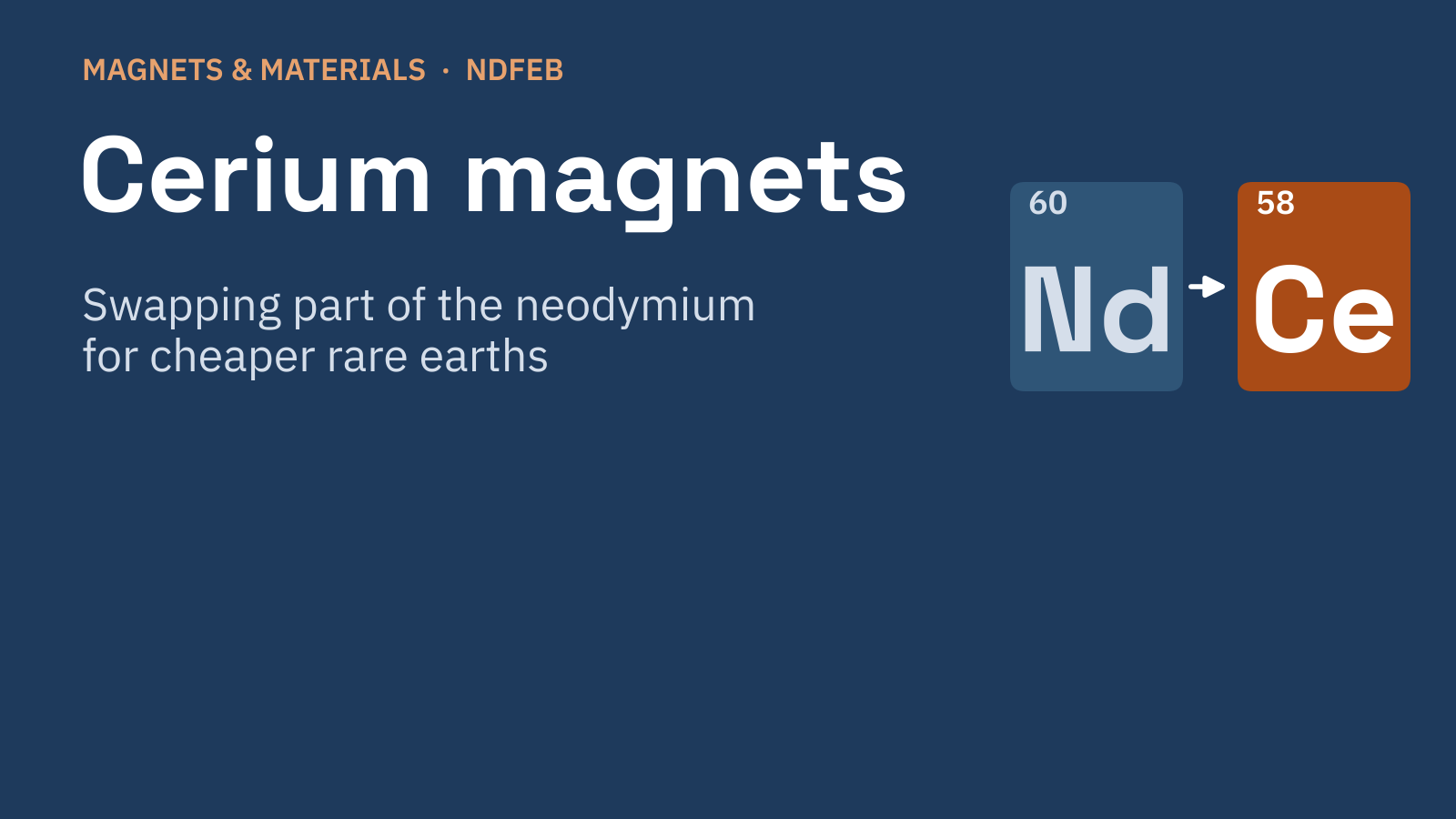
A cerium magnet is a neodymium magnet in which part of the neodymium has been replaced with cerium, the cheapest and most plentiful rare earth. It is not a new magnet family so much as a cost-cutting recipe for the existing one, and it has quietly become one of the biggest product lines in China’s magnet industry. This guide explains why magnet makers substitute neodymium, what cerium, lanthanum and other rare earths do to the magnet, the tricks used to limit the damage, and where cerium magnets are and are not good enough.
Short answer: Cerium magnets are NdFeB magnets with some of the neodymium replaced by cerium, sometimes together with lanthanum. Cerium costs about $2 per kilogram as oxide against about $100 for neodymium-praseodymium, so substitution cuts raw material costs sharply. The price is performance: Ce2Fe14B has lower magnetization, much lower anisotropy and a lower Curie temperature than Nd2Fe14B, so strength and heat resistance fall as more cerium goes in. Most cerium magnets replace a minority of the neodymium and are used in speakers, appliances, e-bikes and industrial motors rather than EV traction motors.
Key takeaways
- Same structure, cheaper ingredient. Cerium forms the same tetragonal 2:14:1 crystal as neodymium, so it can sit on the neodymium sites.
- Every intrinsic property gets worse. Lower magnetization means a weaker magnet, lower anisotropy means it demagnetizes more easily, and a lower Curie temperature means it handles heat badly.
- Small amounts are almost free. At around 10 to 20% of the rare earth content, careful processing keeps most of the performance.
- It is already a mass product. China Northern Rare Earth estimates that China made more than 100,000 tonnes of cerium-containing NdFeB in 2025.
- It also fixes a supply problem. Magnets now absorb a large share of the surplus cerium that every rare earth mine produces.
Why replace neodymium at all?
Two reasons, and they point in the same direction.
Cost. The rare earth content of an NdFeB magnet is mostly neodymium and praseodymium, traded together as NdPr. NdPr oxide roughly doubled in price between mid-2025 and mid-2026, to about $100 per kilogram inside China. Cerium oxide cost about $2 per kilogram in September 2026. Since rare earths make up roughly 30% of a magnet by weight, replacing even a fifth of the NdPr with cerium makes a noticeable difference to the bill of materials.
Balance. Rare earth ores contain far more cerium and lanthanum than neodymium. In bastnäsite, cerium is about half of the rare earth content and neodymium about an eighth. Mines built to supply magnet metals therefore produce a surplus of cerium that is hard to sell. Putting some of it back into magnets uses both ends of the ore.
Which rare earths can replace neodymium?
Every rare earth forms an R2Fe14B compound with the same crystal structure. What differs is their intrinsic magnetic properties, which set the ceiling for any magnet made from them. The table gives room-temperature values from a classic set of measurements by Hilscher and colleagues; other studies differ slightly.
| Compound | Saturation polarization (Js) | Anisotropy field compared with Nd2Fe14B | Curie temperature | Role in magnets |
|---|---|---|---|---|
| Nd2Fe14B | 1.57 T | Reference | 585 K (312 °C) | The reference |
| Pr2Fe14B | 1.43 T | Similar | 564 K (291 °C) | Standard partner of Nd, as NdPr |
| Y2Fe14B | 1.28 T | About a quarter | 565 K (292 °C) | Additive, studied for temperature stability |
| Ce2Fe14B | 1.16 T | About a third | 424 K (151 °C) | Main low-cost substitute |
Lanthanum is not in that data set. La2Fe14B also has low anisotropy, and lanthanum is used mainly as a helper alongside cerium rather than as a substitute on its own.
Three things stand out.
- Praseodymium is barely a substitution. It performs about as well as neodymium, which is why NdPr has been the normal feedstock for years.
- Cerium’s weakest point is anisotropy. The anisotropy field is the theoretical limit for coercivity, the resistance to demagnetization. At roughly a third of neodymium’s value, it is the main reason cerium magnets lose coercivity.
- Cerium’s Curie temperature is very low. At about 150 °C, pure Ce2Fe14B would lose its magnetism at a temperature that ordinary motors reach. Mixed with neodymium, the Curie temperature falls in between.
Mischmetal, the natural mixture of light rare earths, has also been used directly to make low-cost “MM-Fe-B” magnets. It is cheaper still because it skips most of the separation steps, but its high lanthanum and cerium content limits performance further.
What cerium does to a magnet
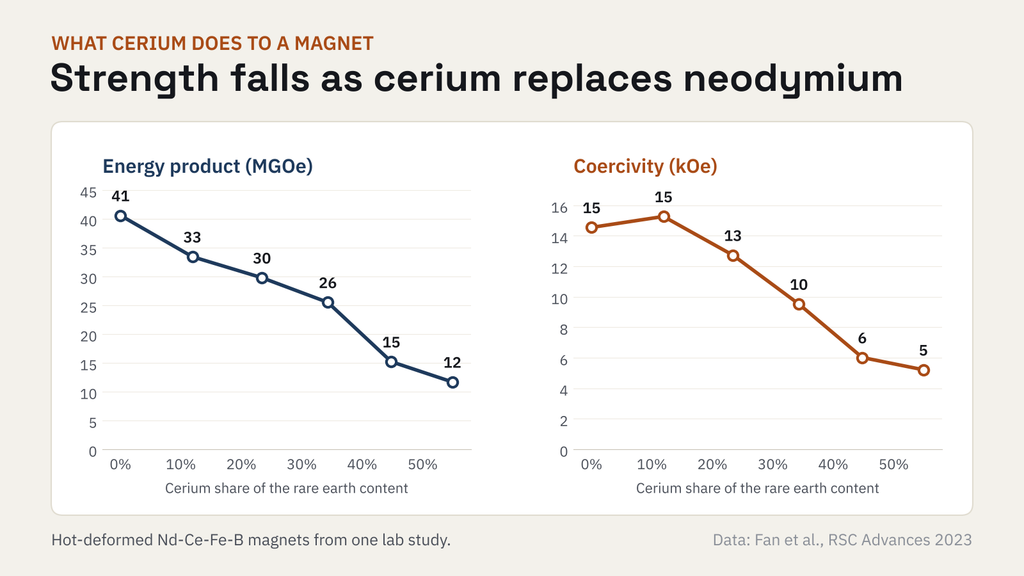
As cerium replaces neodymium, remanence and energy product fall steadily, and coercivity eventually falls faster. A 2023 study of hot-deformed Nd-Ce-Fe-B magnets in RSC Advances gives a clean example, measured on one batch of magnets made the same way.
| Cerium share of the rare earths (wt%) | Remanence (T) | Coercivity (kOe) | Energy product (MGOe) |
|---|---|---|---|
| 0 | 1.34 | 14.6 | 40.6 |
| 12 | 1.21 | 15.3 | 33.4 |
| 23 | 1.16 | 12.7 | 29.8 |
| 34 | 1.14 | 9.5 | 25.5 |
| 45 | 1.03 | 6.0 | 15.2 |
| 55 | 0.94 | 5.2 | 11.7 |
At low cerium levels the coercivity can even rise slightly, which the authors link to cerium’s chemistry at grain boundaries. Above about a third cerium, both coercivity and energy product drop sharply. For comparison, a 55% cerium magnet with about 12 MGOe is roughly as strong as the best alnico and more than twice as strong as ferrite, but far below a standard N35 neodymium grade.
Why cerium is harder to use than its numbers suggest
- Mixed valence. Most rare earths are trivalent in the magnet phase. Cerium sits between Ce3+ and Ce4+, with an average valence of about +3.4 in Ce2Fe14B. The tetravalent part contributes almost no magnetic moment or anisotropy.
- An unwanted CeFe2 phase. At high cerium levels, a cubic CeFe2 phase forms. It is not a useful magnet and it ties up the rare-earth-rich liquid that normally wets and isolates the grains during processing, which hurts coercivity.
- Weak grain boundaries. Coercivity in NdFeB depends on thin non-magnetic layers that separate the grains magnetically. Cerium-rich grain boundaries do this job less well.
How manufacturers keep cerium magnets strong
Dual main phase
The most important technique is the dual main phase (DMP) method. Instead of melting neodymium and cerium into one alloy, manufacturers make two separate powders, one Nd-Fe-B and one Ce-Fe-B, and press them together. The finished magnet contains neodymium-rich and cerium-rich grains side by side. Because cerium is not spread evenly through every grain, the neodymium-rich grains keep their high anisotropy and the magnet as a whole loses less coercivity than a uniform alloy with the same total cerium. One study of a DMP sintered magnet containing about 18 wt% lanthanum-cerium reported an energy product of about 41 MGOe and a coercivity of about 13 kOe, close to a standard N40 grade.
A lab example: hybrid magnets
The author of this guide studied a version of the same idea for his master’s thesis at Pukyong National University in South Korea. Instead of one alloy, the magnet was made from two materials: commercial melt-spun Nd-Fe-B flakes with no cerium, and a cerium-rich powder made by the HDDR process, in which 45% of the rare earth was cerium. The two were mixed, hot pressed and then die-upset, a hot deformation step that aligns the grains.
A 50:50 mix, with cerium making up about a quarter of the total rare earth content, reached an energy product of 19.8 MGOe, a remanence of 10.6 kG and a coercivity of 6.8 kOe. A magnet made from a single alloy with exactly the same overall composition, by the same route, managed only 11.6 MGOe and 3.9 kOe. Keeping cerium concentrated in separate regions, rather than spreading it evenly, was worth about 70% more energy product.
A follow-up techno-economic study by the same author put the trade-off in cost terms. Across a series of these magnets, replacing 12 to 45% of the neodymium with cerium cut the raw material cost by 7 to 27%, while the energy product fell from 43.9 to as low as 8.2 MGOe. The study identified 12 to 35% substitution as the most useful range: strong enough to replace standard NdFeB in steady, low-temperature uses such as washing machine motors and water pumps, and cheaper than the full neodymium grade. Below about 8 MGOe, ferrite magnets do the same job for far less money.
Adding lanthanum
Lanthanum is even cheaper than cerium and is also in surplus. Small additions of lanthanum alongside cerium suppress the formation of CeFe2 and push cerium toward its trivalent state, which improves the magnetic phase. La-Ce co-substituted magnets are a common commercial recipe.
Grain boundary engineering
The grain boundary diffusion process used to add dysprosium or terbium to high-end magnets also works on cerium magnets. Diffusing neodymium, praseodymium or a heavy rare earth into the surface of the grains rebuilds a high-anisotropy shell around a cheap cerium-containing core. It adds cost back, so it is used selectively.
Where cerium magnets are used
China has produced cerium-containing NdFeB commercially since the early 2010s, mainly around Baotou in Inner Mongolia, where the Bayan Obo mine is rich in cerium. The market has grown quickly:
- Adamas Intelligence estimated that magnets accounted for 18% of global cerium oxide consumption in 2023, up from 5% in 2017.
- China Northern Rare Earth estimates that China’s output of cerium-containing NdFeB magnets exceeded 100,000 tonnes in 2025.
- In 2026 Northern Rare Earth and its partner Ningbo Shuoteng announced a joint venture in Baotou to build 10,000 tonnes a year of cerium magnet capacity, in two phases, for about 595 million yuan.
Typical applications are those that need more than a ferrite magnet can give but less than a premium NdFeB grade:
- Speakers, headphones and small consumer electronics
- Motors in appliances such as air conditioners and washing machines
- E-bikes, scooters and other two-wheelers
- Industrial motors, magnetic separators and holding magnets
- Some motors in low-priced electric cars
High-performance EV traction motors, wind turbine generators and aerospace systems still use full NdPr magnets, usually with dysprosium or terbium, because they run hot and cannot afford the loss of coercivity.
What cerium magnets mean for supply outside China
New rare earth mines in Australia, the United States and elsewhere are being built to supply NdPr. Each of them will also produce cerium, and today almost all the demand for cerium in magnets is inside China. A magnet industry outside China that could use cerium-containing grades for its lower-end products would give those mines a buyer for their surplus and improve their economics. It would not reduce the need for NdPr in demanding applications, but it would stretch each tonne further.
Cerium substitution is one of several ways to make magnets with less critical material. Others include cutting dysprosium with grain boundary diffusion, recycling, rare-earth-free materials such as iron nitride, and motors without magnets. Our rare earth magnet alternatives guide compares them.
Frequently asked questions
What is a cerium magnet?
A neodymium-iron-boron magnet in which part of the neodymium is replaced by cerium, often together with lanthanum. Pure cerium-iron-boron magnets are possible but too weak for most uses.
Are cerium magnets weaker than neodymium magnets?
Yes. The more cerium they contain, the lower their strength and coercivity. With a modest share of cerium and good processing, the loss can be small.
How much neodymium can cerium replace?
There is no fixed limit, but commercial magnets typically replace a minority of the rare earth content. Above roughly a third, coercivity and energy product drop sharply in most studies.
Are cerium magnets cheaper?
Yes. Cerium oxide costs about one fiftieth as much as NdPr oxide, so the raw material saving grows with every percent of substitution.
Can cerium magnets be used at high temperatures?
Not as well as standard grades. Cerium lowers both the Curie temperature and the coercivity, so cerium magnets are best kept to applications that stay cool.
Do cerium magnets need dysprosium?
Not usually, because they are aimed at low-temperature, low-cost uses. Heavy rare earths can be diffused in to improve coercivity, but that removes much of the cost advantage.
Are cerium magnets the same as samarium cobalt or ferrite magnets?
No. They are a variant of NdFeB. Samarium cobalt and ferrite are separate magnet families with different chemistry.
Sources
- Fan, Zhou, He, Liao, Wu, Yu, Wei and Liu, Magnetic properties and rare earth element diffusion behavior of hot-deformed nanocrystalline dual-main-phase Nd–Ce–Fe–B magnets, RSC Advances, 2023
- Djuanda, Kang, Kwon, Kim, Lee and Kim, Magnetic performance of (Nd,Ce)-Fe-B-type die-upset hybrid magnet composed of melt-spun and HDDR-treated materials, Journal of Magnetics, 2019
- Djuanda, Irianto and Hasby, Fabrication of Ce-substituted Nd in Nd-Fe-B-type rare earth permanent magnet toward techno-economic assessment
- Hilscher, Grössinger, Heisz, Sassik and Wiesinger, Magnetic and anisotropy studies on Nd-Fe-B based permanent magnets, Journal of Magnetism and Magnetic Materials 54–57, 577–578, 1986
- Orimoloye, Ryan, Pinkerton and Medraj, Intrinsic magnetic properties of Ce2Fe14B modified by Al, Ni, or Si, Applied Sciences, 2018
- Matsumoto et al., Optimal uni-axial ferromagnetism in (La,Ce)2Fe14B for permanent magnets, 2019
- Adamas Intelligence, Cerium NdFeB magnets: gift or a curse?, October 2024
- The Metalnomist, Cerium NdFeB magnet project strengthens Northern Rare Earth’s downstream strategy, May 2026
- Idaho National Laboratory, Impacts of aluminum-cerium alloy deployment on different cerium commodities (cerium surplus and ore composition), 2024
- Rare Earth Mining, Cerium price (Shanghai Metals Market data, September 2026)
- Lynas Rare Earths, Results for the year ending 30 June 2026 (NdPr price), August 2026
Featured image and diagram: original graphics by CleanTech Explained. This article reflects the author’s personal views and publicly available information as of October 2026. It is general information, not engineering or purchasing advice.