Solar Panel Payback Period: Calculator and 2026 Numbers

The solar panel payback period is the number of years it takes for the money you save on electricity to add up to what you paid for the system. It is the single most useful number for deciding whether solar makes financial sense, and in 2026 it changed: the 30% federal tax credit for home solar ended, so the same system now takes longer to pay off. This guide shows how payback is calculated, what drives it, typical numbers for 2026 and a calculator to work out your own.
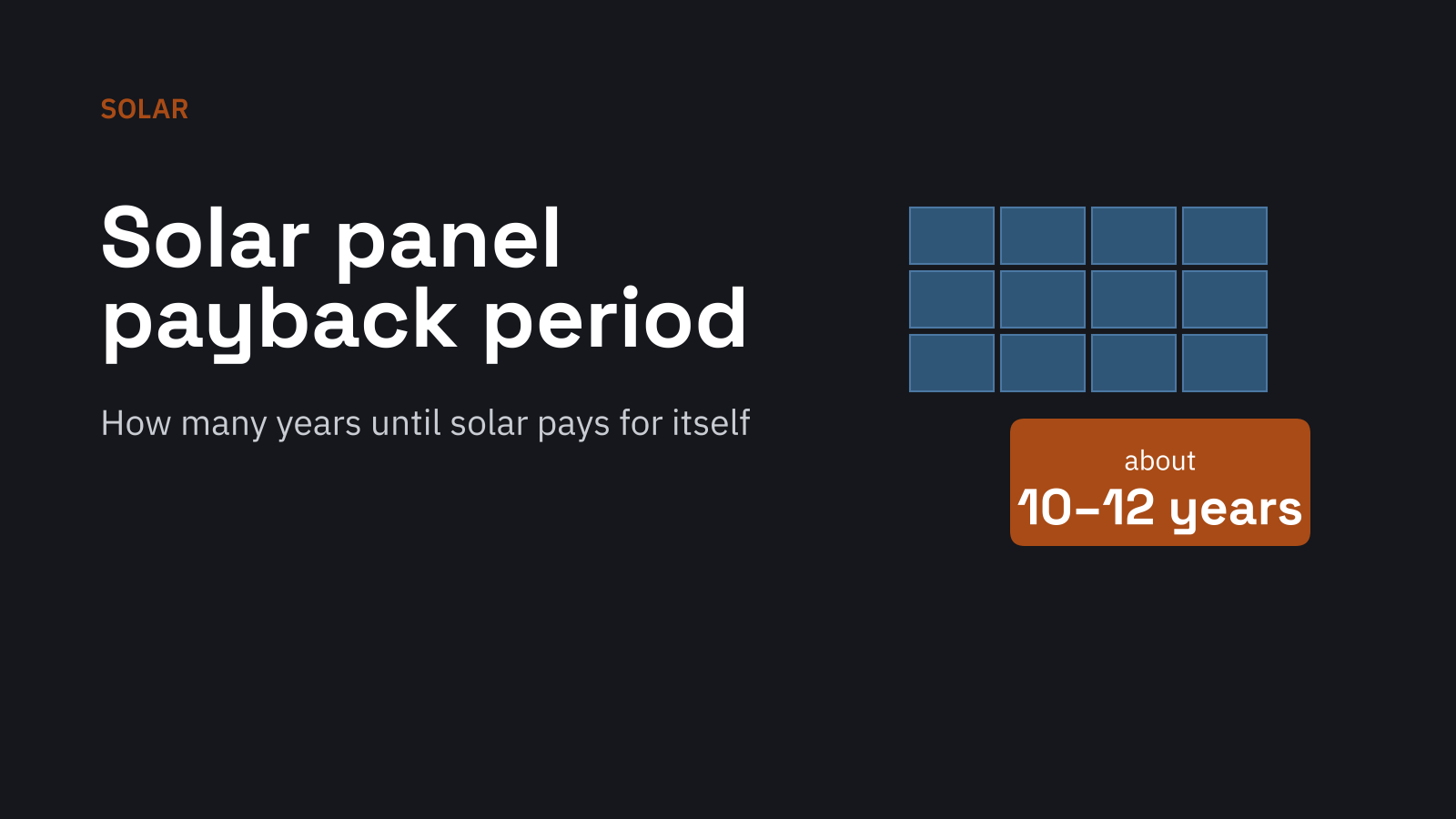
Short answer: For a typical US home paying cash for solar in 2026, the payback period is about 10 to 12 years. It can be as short as 6 to 8 years in states with high electricity prices and full net metering, and longer than 15 years where electricity is cheap or exported solar earns little. Since panels usually last 25 to 30 years or more, a 10-year payback still leaves well over a decade of nearly free electricity.
Key takeaways
- Payback = system cost after incentives ÷ yearly savings, adjusted for rising electricity prices and slowly falling panel output.
- EnergySage puts the national average quote at about $2.60 per watt and the average payback at about 10 years in 2026.
- The 30% federal Residential Clean Energy Credit ended for systems installed after December 31, 2025, which adds several years to payback compared with 2025.
- Your electricity rate and how your utility credits exported solar matter as much as the price of the panels.
- Loans, batteries and roof work raise the cost and lengthen payback; state rebates shorten it.
Solar payback calculator
Enter your own numbers below. The defaults describe an 8 kW system at $3.00 per watt in a location with 4.5 peak sun hours, paying the US average electricity rate.
Solar payback calculator
Change any number to see how many years your system needs to pay for itself.
Assumes 20% system losses and panels losing 0.5% of output a year. Excludes financing costs, maintenance and inverter replacement. An estimate, not a quote.
How the payback period is calculated
The simplest version is one division:
Payback period (years) = net system cost ÷ first-year savings
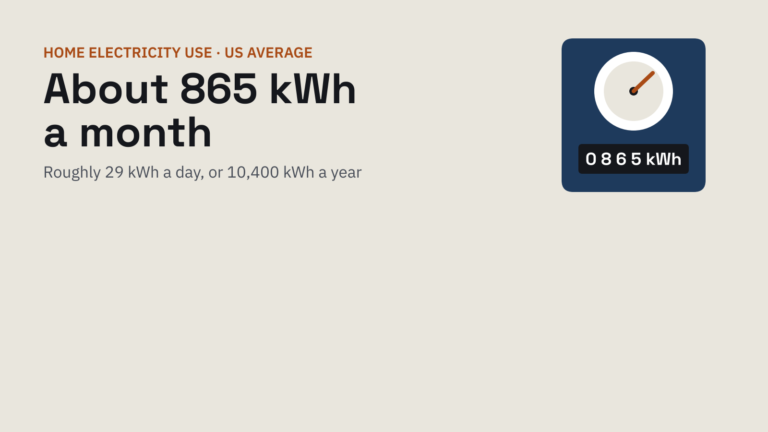
For example, an 8 kW system at $3.00 per watt costs $24,000. In a place with 4.5 peak sun hours it produces about 10,500 kWh in its first year (8 kW × 4.5 hours × 365 days × 0.8 for real-world losses, the same method as our solar panel calculator). At 18.3¢ per kWh that is worth about $1,920, so the simple payback is 24,000 ÷ 1,920 ≈ 12.5 years.
The simple formula ignores two things that pull in opposite directions:
- Electricity prices tend to rise. If rates go up 3% a year, each year’s savings are worth a little more than the last, which shortens payback. With that assumption, the example above pays back in about 11 years.
- Panels lose output slowly, typically about 0.5% a year, which lengthens payback slightly. See how long solar panels last for the details.
The calculator above includes both. For a cautious estimate, set the yearly price rise to 0%: the example then pays back in about 13 years.
What solar costs in 2026
Two widely used sources give different pictures, and both are useful:
- EnergySage, which collects competing installer quotes, put the average at about $2.60 per watt before incentives in 2026, or about $31,000 for a 12 kW system.
- Lawrence Berkeley National Laboratory, which tracks installed systems, found a median of $3.60 per watt for homeowner-owned residential systems in 2025: about $3.00 per watt for cash purchases and $4.50 for loan-financed ones. The median system was 7.7 kW.
The gap shows how much shopping around matters. Quotes from a marketplace with several bids tend to be lower than what the average buyer ends up paying, especially when a loan’s fees are built into the price. For a full breakdown by system size and state, see our guide to solar panel cost.
The federal tax credit has ended
Until the end of 2025, homeowners could claim 30% of the cost of a solar system as a federal tax credit (the Residential Clean Energy Credit, Section 25D). That credit ended for systems installed after December 31, 2025. On a $24,000 system it was worth $7,200, which cut payback by roughly three years. Some states and utilities still offer rebates, tax credits or performance payments; enter any you qualify for in the calculator. Leased and third-party-owned systems are treated differently, and installers may pass on business tax credits through lower lease prices.
What determines your savings
1. How much electricity the system produces
Production depends mainly on sunshine and roof conditions. Peak sun hours range from about 3.5 a day in cloudy northern regions to about 6.5 in the desert Southwest, so the same system can produce nearly twice as much in Arizona as in Washington State. Shade, roof direction and tilt also matter.
2. What your electricity costs
Every kilowatt-hour your panels supply is one you do not buy. The higher your rate, the faster solar pays back. The US average residential price was about 18.3¢ per kWh in July 2026, up nearly 5% from a year earlier, according to the US Energy Information Administration. But rates vary widely, from around 13¢ in the cheapest states to above 30¢ in California and parts of New England.
3. How your utility credits exported solar
Solar panels produce the most at midday, when many homes use little power, so a large share of output is exported to the grid. What you get for those exports can change payback by years:
- Full net metering: each exported kWh earns a credit equal to the retail rate. Several states, including New Jersey, Massachusetts, New York and Maryland, still offer this or something close to it.
- Net billing: exports earn a lower rate, often based on the utility’s avoided cost. California moved to this system (often called NEM 3.0) in April 2023, and Arizona, Nevada, Arkansas, Indiana and others have also cut export credits.
Under net billing, using more of your own solar, for example by running appliances during the day or adding a solar battery, becomes more valuable.
Typical payback periods in 2026
The table shows payback for an 8 kW system with 4.5 peak sun hours, full net metering and electricity prices rising 3% a year. Find your installed cost and your electricity rate:
| Installed cost | 12¢/kWh | 16¢/kWh | 20¢/kWh | 25¢/kWh | 30¢/kWh |
|---|---|---|---|---|---|
| $2.50/W | 13.5 yrs | 10.5 yrs | 8.6 yrs | 7.1 yrs | 6.0 yrs |
| $3.00/W | 15.8 yrs | 12.4 yrs | 10.2 yrs | 8.3 yrs | 7.1 yrs |
| $3.50/W | 17.9 yrs | 14.1 yrs | 11.6 yrs | 9.6 yrs | 8.1 yrs |
| $4.00/W | 19.9 yrs | 15.8 yrs | 13.1 yrs | 10.8 yrs | 9.2 yrs |
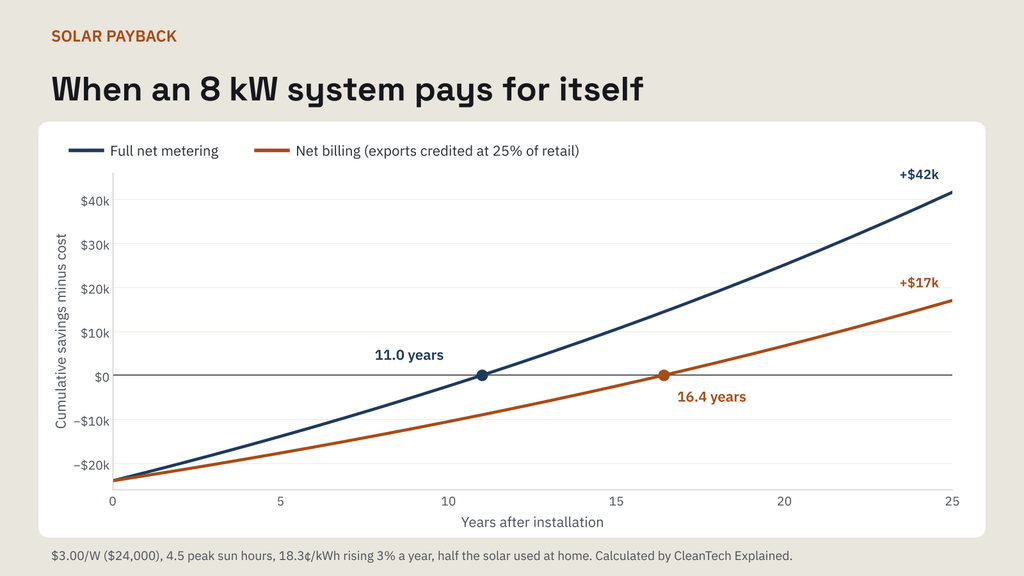
More sunshine shortens these numbers, and lower export credits lengthen them. With the same $3.00/W system and 18.3¢ electricity, cutting the export credit to 25% of the retail rate stretches payback from about 11 to about 16 years if half the solar is exported.
What makes payback longer
- Financing. Loans add interest and often dealer fees. Berkeley Lab’s data show loan-financed systems costing about 50% more per watt than cash purchases.
- Batteries. A battery adds backup power and can raise savings under net billing, but it adds roughly $10,000–$16,000. Solar-plus-storage systems had a median price of $4.90 per watt in 2025, against $3.60 for solar alone.
- Inverter replacement. String inverters typically last 10–15 years, so most systems need one replacement during their life. Microinverters usually last longer.
- Roof work. If your roof needs replacing within a few years, do it before installing solar; removing and reinstalling panels later costs extra.
- Moving. If you sell the house before payback, you recover the investment only if buyers pay more for a home with owned solar.
What makes payback shorter
- High or fast-rising electricity prices.
- Full net metering, or using most of your solar at home.
- State or utility rebates, solar renewable energy certificates (SRECs) and property tax exemptions.
- Getting several quotes; prices for the same system often differ by thousands of dollars.
- An electric car or heat pump that uses daytime solar instead of exporting it. Our EV charging cost calculator shows what that electricity is worth.
Leases and power purchase agreements
With a solar lease or power purchase agreement (PPA), a company owns the panels on your roof and you pay a monthly fee or a price per kWh. There is no upfront cost, so there is no payback period in the usual sense. Instead, compare the lease or PPA price with your current electricity rate, and check how fast the payments rise each year. Ownership usually saves more over 25 years; leasing suits people who cannot use the upfront cost or want maintenance handled by someone else.
Is solar still worth it without the tax credit?
Often, yes. A payback of 10 to 12 years on panels that last 25 to 30 years still leaves 13 to 20 years of nearly free electricity, worth tens of thousands of dollars in many states. In the calculator’s default example, net savings over 25 years come to about $42,000 on a $24,000 system. The case is weakest where electricity is cheap, exports earn little and you may move within a decade. Run your own numbers with real quotes rather than relying on averages.
Frequently asked questions
What is a good payback period for solar panels?
Anything under about 10 years is very good, and 10–15 years is reasonable given that panels last 25 years or more. A payback longer than about 15 years leaves little margin for repairs or a move.
What is the average solar payback period in the US?
About 10 years, according to EnergySage’s 2026 marketplace data, based on competitive quotes. Buyers who pay more per watt or finance their system often see 12 years or longer.
How do I calculate my solar payback period?
Divide the net cost of the system by your expected yearly savings. Yearly savings equal the system’s annual production in kWh multiplied by your electricity rate, adjusted for how your utility credits exports. The calculator above does this for you and accounts for rising prices and panel degradation.
Do solar panels increase home value?
Owned systems generally add to a home’s value, though how much depends on the local market, the system’s age and whether buyers understand the savings. Leased systems can complicate a sale because the buyer must take over the contract.
Does adding a battery shorten the payback period?
Usually not. A battery raises the upfront cost by more than it raises savings in most places. It can make sense under net billing, with time-of-use rates, or if backup power during outages is worth money to you.
Is there still a federal solar tax credit in 2026?
Not for homeowners who buy their own system. The 30% Residential Clean Energy Credit ended for systems installed after December 31, 2025. State and utility incentives may still be available.
Sources
- EnergySage, Solar panel cost by state (average cost per watt, system cost and payback, 2026)
- Mercom, US residential solar-storage adoption jumps to 37% in 2025 (Lawrence Berkeley National Laboratory data, October 2026)
- IRS, Residential Clean Energy Credit
- US Energy Information Administration, Average price of electricity to ultimate customers by state
- SolarReviews, Net metering in 2026 (state policies)
- NREL, PVWatts Calculator (production estimates for your address)
Featured image, diagram and calculator: original work by CleanTech Explained. Payback figures are estimates, not financial advice; get several installer quotes and check local incentives.