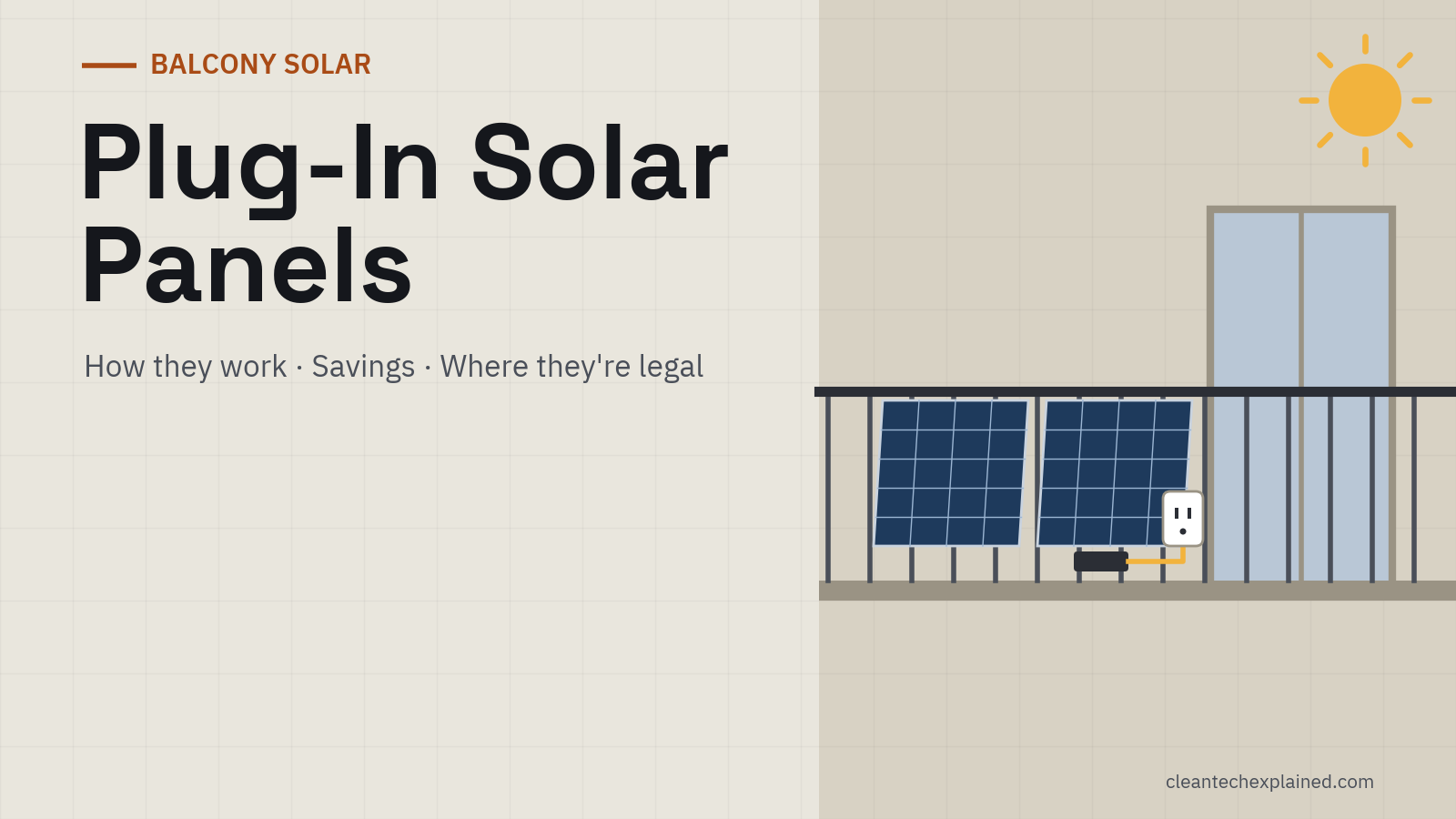
Plug-In Solar Panels: How They Work and Where They’re Legal

Plug-in solar panels, often called balcony solar, are small solar kits you can plug into a standard wall outlet. There is no roof work, no installer and often no utility paperwork. The panels feed power into your home’s wiring, and whatever your appliances use at that moment comes from the sun instead of the grid. Popular in Germany for years, plug-in solar is now being legalized across the United States at remarkable speed. This guide explains how it works, how much it can save, the safety questions, and where it is allowed.
Short answer: A plug-in solar kit is typically one to four panels plus a microinverter, limited to around 1,200 watts in most US states that allow it. It can cover a modest share of a household’s electricity, works for renters and apartments, and pays back fastest where electricity is expensive. As of October 2, 2026, ten states have signed plug-in solar laws, and effective dates vary.
Key takeaways
- Plug-in solar feeds power into your home through an ordinary outlet; it offsets what your home is using at that moment.
- Most US state laws cap systems at 1,200 W per household or meter. Colorado allows up to 1,920 W.
- Ten states have signed plug-in solar laws: Utah, Maine, Colorado, Maryland, New Hampshire, Vermont, Connecticut, Virginia, New Jersey and California.
- A certified microinverter must shut off instantly when unplugged or when the grid goes down.
- Savings depend on sun, panel placement and local electricity prices. Expensive power, like California’s, means faster payback.
How plug-in solar works
A typical kit has three parts:
- Solar panels: usually 1–4 panels, mounted on a balcony railing, a wall, a patio or in a yard.
- A microinverter: converts the panels’ DC power into AC power that matches your home’s electricity.
- A cable and plug: connects the inverter to a standard 120 V outlet. Some kits add a small battery.
When the panels produce power, it flows into the circuit and is used first by whatever is running in your home: the fridge, Wi-Fi, a TV or a computer. Your meter simply draws less from the grid. If the panels produce more than your home uses at that moment, the surplus may flow back to the grid. Whether you are paid for that surplus depends on your state and utility, and many plug-in rules do not require any credit.
This is why self-consumption matters: plug-in solar saves the most when your home has a steady daytime load. A small battery can store midday surplus for the evening.
How much can plug-in solar save?
A rough estimate:
Yearly kWh ≈ System watts × Peak sun hours per day × 365 × 0.75 ÷ 1,000
The 0.75 factor allows for inverter losses, heat, shading and panels that are not perfectly angled, which is common on balconies. For example, an 800 W kit in a location with 4.5 peak sun hours produces about 800 × 4.5 × 365 × 0.75 ÷ 1,000 ≈ 985 kWh a year.
| Electricity price | Value of ~1,000 kWh a year |
|---|---|
| $0.12/kWh (e.g. Utah) | ~$120 |
| $0.18/kWh (US average range) | ~$180 |
| $0.30/kWh (e.g. California, Connecticut) | ~$300 |
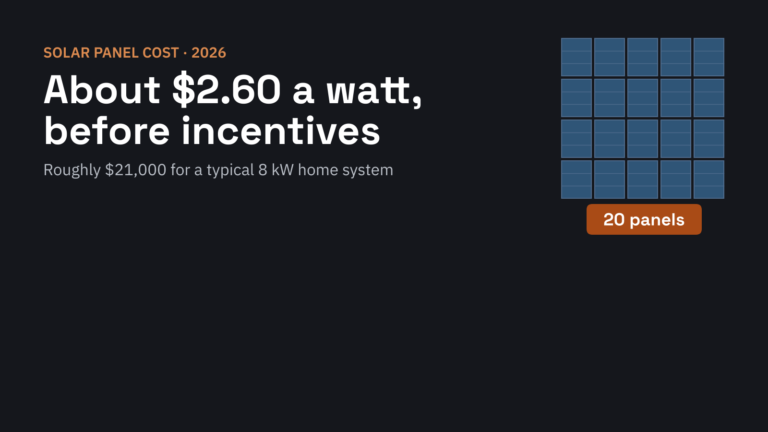
These values assume you use all the power yourself. If much of the midday output flows back to the grid without credit, real savings are lower. Supporters of California’s new law say a kit can cover up to around a fifth of a small apartment’s electricity. Basic kits start around $500, and prices are expected to fall as more states open their markets. A kit that costs $600–$1,000 can pay back in roughly 3–6 years where electricity is expensive, and much longer where it is cheap.
For a full rooftop system, use our solar panel calculator instead.
Is plug-in solar legal in the US?
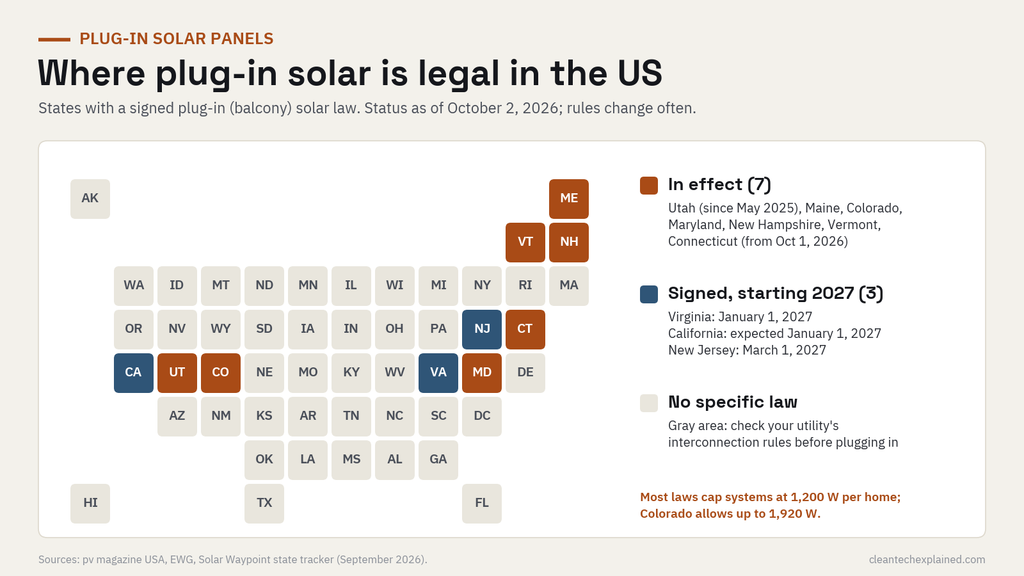
There is no federal law on plug-in solar; it is decided state by state, and often utility by utility. Utah was the first state to create a clear legal pathway in 2025. Since then, the list has grown quickly.
| State | Status (as of October 2, 2026) |
|---|---|
| Utah | In effect since May 2025 |
| Maine, Colorado, Maryland, New Hampshire, Vermont | In effect (Maine requires an electrician above 420 W) |
| Connecticut | In effect from October 1, 2026 |
| Virginia | Takes effect January 1, 2027 |
| California | Signed September 30, 2026; expected to take effect January 1, 2027 |
| New Jersey | Takes effect March 1, 2027 |
| Other states | No specific law; check with your utility before connecting |
Details differ between states. Most cap systems at 1,200 W, require certified equipment, and replace a full utility interconnection agreement with simple notification or nothing at all. Some go further: Virginia stops larger landlords from banning plug-in solar, and Colorado limits HOA restrictions. California’s law includes a 2030 sunset that would need to be extended. Laws are changing every few months, so check your state’s current rules before buying.
In states without a specific law, plug-in solar is a gray area. Connecting a generating device without permission may break your utility’s interconnection rules, even if no law bans the equipment itself.
Is plug-in solar safe?
Engineers have raised two main concerns, and good equipment and sensible limits address both.
- Live plug pins: A plug that feeds power out could in theory be live when pulled from the wall. Certified microinverters detect the loss of grid voltage and shut off within a fraction of a second, so the pins are not energized. This anti-islanding protection also protects utility workers during outages.
- Circuit overload: A circuit breaker measures only the current coming from the panel. Solar feeding in from an outlet can let appliances on the same circuit draw more total current than the breaker sees. Wattage caps around 1,200 W on a 120 V circuit keep this within safe margins, and some states require a dedicated circuit for larger systems.
To stay safe:
- Buy kits certified by a recognized testing laboratory. UL 3700 is the emerging US standard for plug-in solar, though few products had full certification by mid-2026; check what your state’s law requires.
- Plug directly into a wall outlet, never into an extension cord or power strip.
- Use one kit per circuit unless the manufacturer and your state’s rules allow more.
- Mount panels securely, especially on balconies, and follow building or HOA rules.
Lessons from Germany
Germany, where balcony solar is called “Balkonkraftwerk”, has made plug-in systems mainstream. Rules there allow up to 800 W of inverter output and only require online registration. Their popularity with renters, who cannot install rooftop solar, is a big reason US lawmakers have moved so quickly.
Plug-in solar vs other options
- Rooftop solar: Far more output and savings, but requires a suitable roof, ownership and a much larger investment. Solar panels last much longer; see how long solar panels last.
- Portable power station plus panels: Stores energy for outages and camping, but does not reduce your bill unless you manually run devices from it. See our portable power station guide.
- Home battery: Best for backup and time-of-use savings with existing solar. See our solar battery guide.
Frequently asked questions
Can I plug a solar panel into my wall outlet?
Only with a kit designed for it, using a certified microinverter, and where your state and utility allow it. Never connect a standard panel or inverter to an outlet without proper safety protection.
Do plug-in solar panels work during a power outage?
No. Certified systems shut off automatically when the grid goes down, for safety. Kits with a built-in battery may offer a separate backup outlet.
Can renters use plug-in solar?
Yes, which is one of its biggest advantages. You still need your landlord’s or building’s permission in most cases, although Virginia’s law stops larger landlords from banning it.
How many watts can I plug in?
Most US state laws allow up to 1,200 W per household or meter, and Colorado allows 1,920 W. Germany’s limit is 800 W.
Do I need to tell my utility?
It depends on the state. Utah requires no routine approval, while Maryland requires notice before installation and Maine requires notification for systems above 420 W. Outside states with plug-in laws, contact your utility first.
Sources
- pv magazine USA, Newsom signs California plug-in solar bill, establishing the nation’s largest balcony solar market, October 1, 2026
- Environmental Working Group, Newsom signs landmark bill easing Californians’ access to clean, affordable balcony solar, September 2026
- Solar Waypoint, Where Is Plug-In Solar Legal? State-by-State Guide (2026), September 2026
- Solar.com, 2026 Guide to Balcony and Plug-In Solar, August 2026
- Exact Solar, Your New State-By-State Balcony Solar Update, July 2026
- PromptQuorum, Balcony Solar Legalization Race: Five States Compared (UL 3700 certification status), 2026
Featured image and diagrams: original graphics by CleanTech Explained.