Level 1 vs Level 2 EV Charger: Which Do You Need at Home?

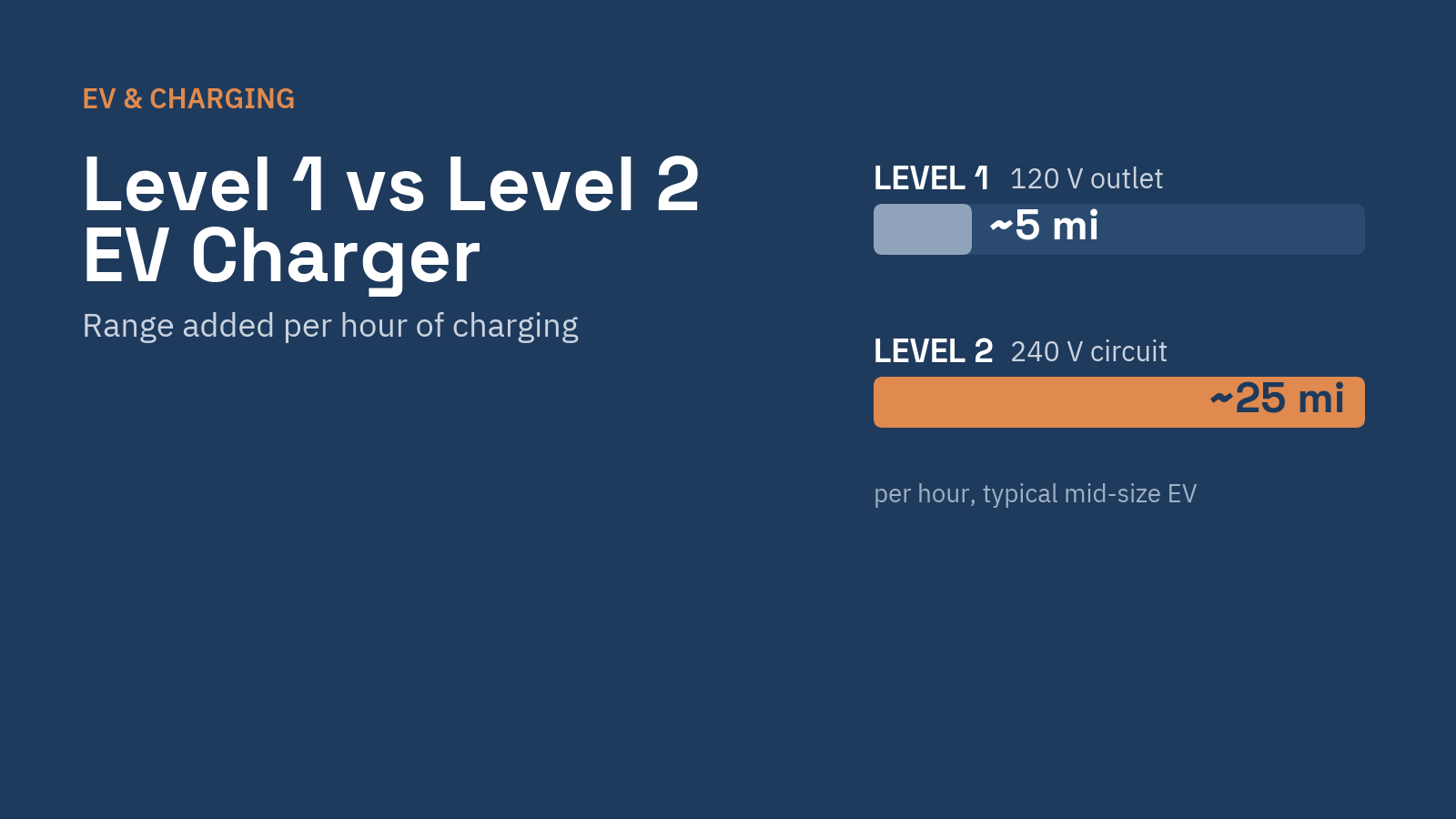
A Level 1 vs Level 2 EV charger comparison comes down to one number: how many miles you need to put back into the battery each night. Level 1 uses a standard 120-volt outlet and adds roughly 5 miles of range per hour. Level 2 uses a 240-volt circuit and adds roughly 25 miles per hour. If you drive less than about 40 miles a day, the cord that came with your car may be all you need. If you drive more, or own a large-battery EV, Level 2 is worth the installation cost.
This guide explains the difference in plain terms, shows the math behind charging times, and covers what a Level 2 installation involves in 2026.
Level 1 vs Level 2 at a glance
| Level 1 | Level 2 | |
|---|---|---|
| Voltage (North America) | 120 V | 240 V (208 V at many public sites) |
| Typical power at home | 1.4 kW | 7.7 to 11.5 kW |
| Range added per hour | About 5 miles | About 25 miles, more on high-power units |
| Range added in 10 hours overnight | About 40 to 50 miles | A full battery for most EVs |
| Equipment | Portable cord, often included with the car | Wall unit or 240 V portable cord |
| Installation | None if you have a suitable outlet | Dedicated 240 V circuit, usually by an electrician |
| Best for | Short commutes, plug-in hybrids | Longer commutes, large batteries, two-EV homes |
The range figures follow the US Department of Energy’s Alternative Fuels Data Center, which puts Level 1 at approximately 5 miles of range per hour and Level 2 at approximately 25. Real results depend on how efficient your car is. A compact sedan gains more miles per hour than a heavy pickup on the same charger.
What Level 1 charging is
Level 1 means plugging the car into an ordinary household outlet. In North America that is a 120-volt, 15-amp circuit. Because EV charging is a continuous load, the car draws no more than 80% of the circuit rating, which is 12 amps. Multiply 120 volts by 12 amps and you get 1.44 kW.
That is about the power of a hair dryer, running for many hours. It is slow, but it is not useless. Ten hours on Level 1 puts around 12 kWh into the battery after losses, enough for 40 to 50 miles in a typical EV.
Level 1 suits you if:
- You drive less than about 40 miles on a normal day.
- You own a plug-in hybrid, whose small battery refills overnight on 120 V.
- You rent, or cannot easily add a 240 V circuit where you park.
- You can top up at work or at public chargers when you need extra.
Two cautions. Use a dedicated outlet in good condition, not an old receptacle shared with a freezer or power tools, and never use a household extension cord. Hours of continuous current will expose a weak connection that a vacuum cleaner never would.
What Level 2 charging is
Level 2 uses 240 volts, the same supply that runs an electric dryer or oven. Doubling the voltage and raising the current makes a large difference. Common home setups are:
| Circuit breaker | Charging current | Power | Typical connection |
|---|---|---|---|
| 40 A | 32 A | 7.7 kW | Plug-in or hardwired |
| 50 A | 40 A | 9.6 kW | Plug-in (NEMA 14-50) or hardwired |
| 60 A | 48 A | 11.5 kW | Hardwired only |
The standard allows Level 2 up to 80 amps (19.2 kW), but few cars can accept that much AC power, and few homes have the spare capacity.
One point is often missed: the charger on your wall is not really the charger. It is a smart switch that supplies AC power safely. The device that converts AC to DC for the battery is the onboard charger inside the car, and it sets the ceiling. If your car’s onboard charger is rated at 7.2 kW, a 48-amp wall unit will not make it charge any faster than a 32-amp one.
How long does each one take?
The math is simple:
Hours = energy needed (kWh) ÷ (charger power in kW × efficiency)
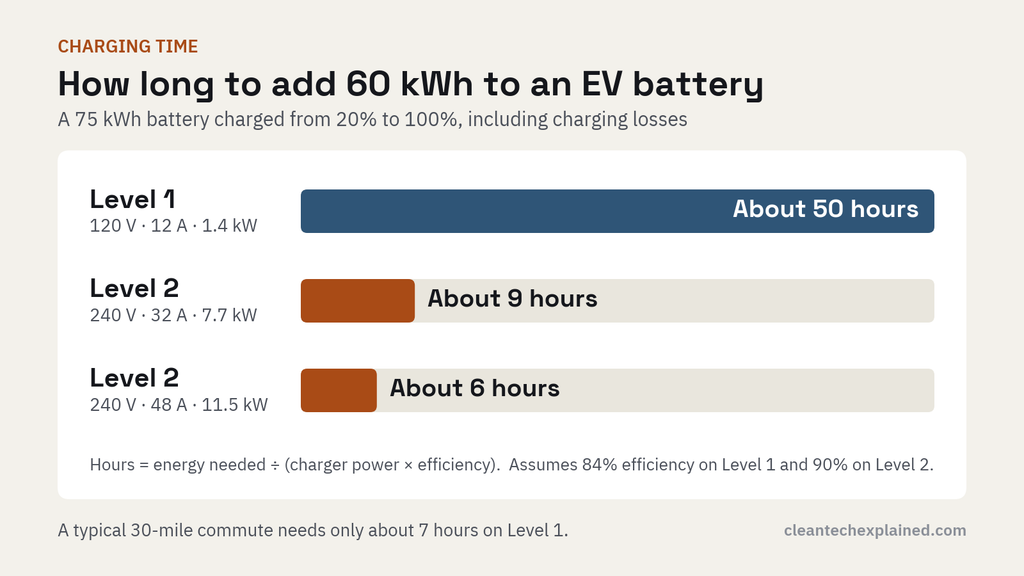
Take an EV with a 75 kWh battery going from 20% to 100%. That is 60 kWh into the battery.
| Charger | Power from the wall | Assumed efficiency | Time for 60 kWh |
|---|---|---|---|
| Level 1, 12 A | 1.44 kW | 84% | About 50 hours |
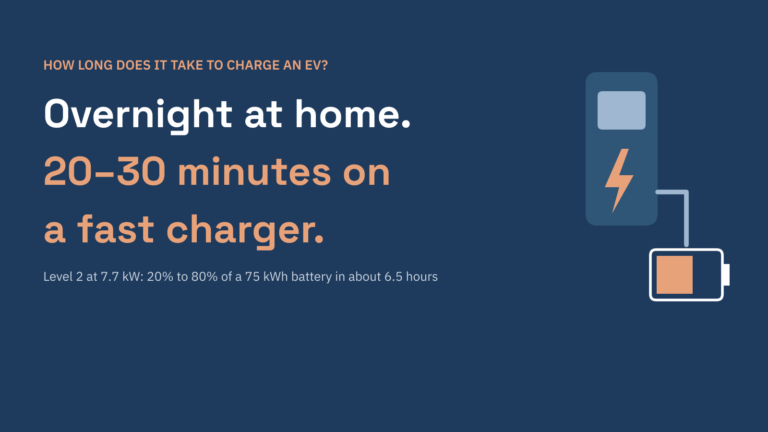
| Level 2, 32 A | 7.7 kW | 90% | About 9 hours |
| Level 2, 48 A | 11.5 kW | 90% | About 6 hours |
Fifty hours looks alarming, but it describes a situation most owners rarely face. Daily charging replaces what you drove that day, not the whole battery. A 30-mile commute uses roughly 9 kWh, which Level 1 restores in about seven hours.
The problem appears when you fall behind. After a 200-mile weekend trip, Level 1 needs two full days to catch up, while Level 2 does it in one night.
Level 2 wastes less electricity
Charging is never 100% efficient. Some energy is lost as heat in the onboard charger, and some runs the car’s electronics and cooling pumps while it charges. Because those background loads run for far longer on Level 1, a larger share of the energy is lost.
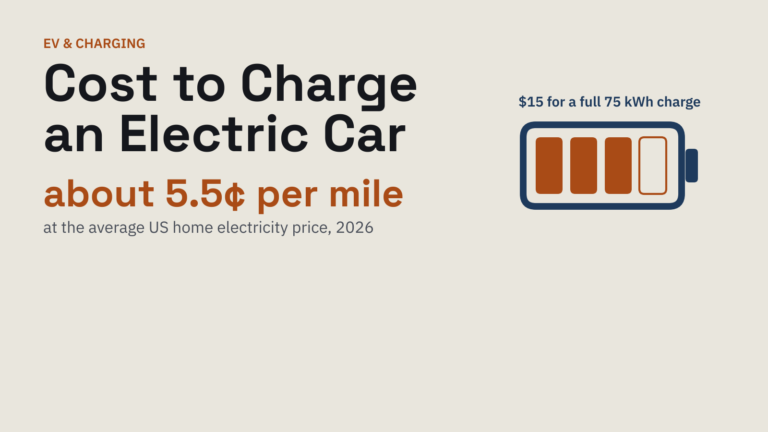
A frequently cited field study found average efficiency of 83.8% on Level 1 and 89.4% on Level 2. For a driver covering 12,000 miles a year at 3.5 miles per kWh, that gap is about 250 kWh a year. At 17 cents per kWh it comes to a little over $40. That is real, but it will not pay for an installation by itself. Speed and convenience are the reasons to upgrade. Our guide to the cost to charge an electric car has a calculator for your own numbers.
Cold weather widens the gap. In freezing temperatures the car may use part of the incoming power to warm the battery, and on Level 1 there is not much power to spare.
What a Level 2 installation costs
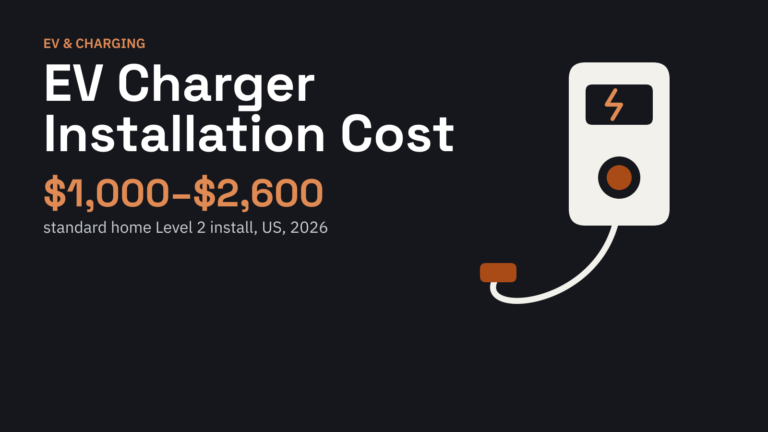
The hardware is the small part. A good Level 2 unit typically costs a few hundred dollars. For a full breakdown, see our guide to EV charger installation cost. To see how long your own car takes to charge, use our EV charging time calculator. The electrical work is what varies:
- Simple installation. Panel in or near the garage, spare capacity, short wire run. Installer estimates commonly land between about $1,000 and $2,500 including the unit, labor and permit.
- Long wire run. If the panel is on the far side of the house, copper wire and conduit add several hundred dollars or more.
- Panel or service upgrade. An older home with 100-amp service may need an upgrade, which can add a few thousand dollars.
Before accepting a panel upgrade, ask the electrician for a load calculation and about two cheaper routes. One is a lower-power setting: a 24-amp or 32-amp charger still refills most daily driving overnight. The other is a load management device, which pauses or slows charging when the house is drawing heavily.
Get two or three quotes. Prices for the same job vary widely between installers.
The federal tax credit has ended
Until mid-2026, US homeowners in eligible areas could claim a federal credit of 30% of the cost, up to $1,000, for a home charger. Under legislation passed in 2025, the credit cannot be claimed for equipment placed in service after June 30, 2026. Many utilities and some states still offer their own rebates or discounted overnight rates, so check with your electricity provider before you buy.
Plugs and connectors
North America is in the middle of a connector change. Older and many current non-Tesla EVs use the J1772 plug for Level 1 and Level 2. Tesla’s design, now standardized as SAE J3400 and also called NACS, is being adopted by most other carmakers.
For home charging this matters less than it sounds. Both plugs carry the same AC power, home units are sold with either connector, and simple adapters work in both directions. Buy the one that matches your car.
A note for readers in Europe
“Level 1” and “Level 2” are North American terms. Europe’s household supply is already 230 volts, so the picture is different:
- A portable cable on a domestic socket usually delivers about 2.3 kW, a little better than Level 1.
- A single-phase wallbox delivers up to 7.4 kW, similar to a common US Level 2 unit.
- A three-phase wallbox delivers 11 kW, or 22 kW where the supply and the car allow it.
The decision logic is the same. A domestic socket covers short daily distances, and a wallbox is the comfortable choice for regular use.
Which one do you need?
Work through these questions in order:
- How far do you drive on a typical day? Under 40 miles, Level 1 can keep up. Over 50 miles, plan for Level 2.
- How many hours is the car parked at home? Level 1 needs 10 to 12 hours a night to do its job.
- Is it a plug-in hybrid? Level 1 is almost always enough.
- Do you have cold winters, a large truck or SUV, or two EVs? Each of these pushes toward Level 2.
- Do you have off-peak electricity rates? Level 2 lets you fit all your charging into the cheap window. Level 1 often cannot.
A sensible approach for a new owner is to start on Level 1 for a few weeks. If the battery keeps up with your routine, you have saved the cost of an installation. If you find yourself watching the percentage, you will know exactly what you are paying for.
Does Level 2 wear the battery faster?
No. Both levels are slow, gentle AC charging by battery standards. Even an 11.5 kW unit charges a 75 kWh pack at a small fraction of what a DC fast charger delivers. What matters more for battery life is how full you keep the pack day to day, and that depends on its chemistry. Our guide to LFP vs NMC batteries explains why some EVs are happy at 100% and others prefer 80%.
Frequently asked questions
Can I install a Level 2 charger myself?
A plug-in unit can be plugged into an existing 240 V outlet of the correct type. Adding a new 240 V circuit is electrical work that usually requires a permit and should be done by a licensed electrician.
Is a 48-amp charger better than a 32-amp one?
Only if your car can accept the extra power and you need it. For most drivers, 32 amps refills a day’s driving in two to three hours.
Can solar panels charge my EV?
Yes. A typical EV adds roughly 250 to 350 kWh a month to a household’s use. Our solar panel calculator shows how many extra panels that takes.
Is Level 3 an option at home?
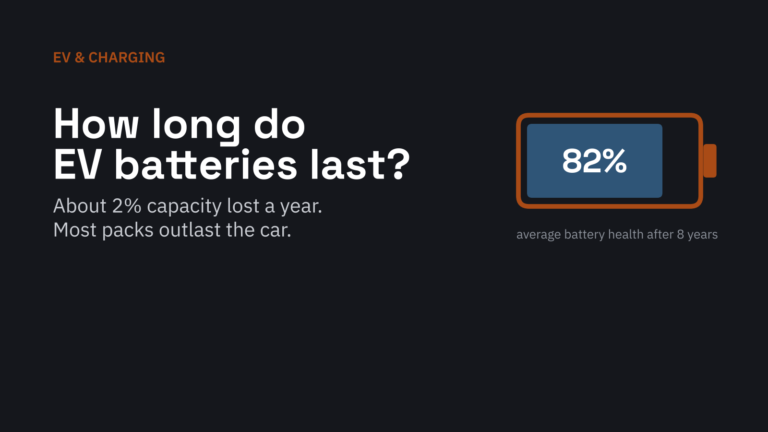
No. “Level 3” is an informal name for DC fast charging, which needs commercial three-phase power and equipment costing tens of thousands of dollars. Frequent high-power fast charging also wears the battery a little faster; see how long EV batteries last.
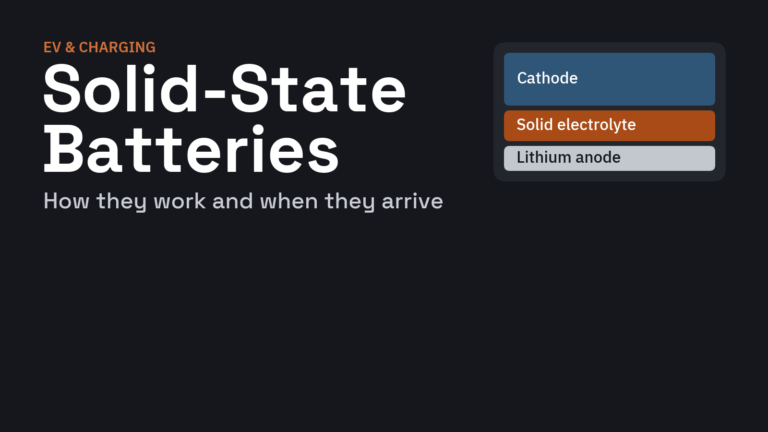
Wondering what comes after LiFePO4? See our guide to solid-state batteries.
Sources
- US Department of Energy, Alternative Fuels Data Center: Electric Vehicle Charging Stations
- Internal Revenue Service: Alternative Fuel Vehicle Refueling Property Credit
- US Department of Transportation: EV Charging Speeds
- Recurrent: Why Doesn’t Your Battery Get All the Energy You Pay For?