Rare Earth Elements: The Complete List and What They Do

Rare earth elements are a group of 17 metals that sit quietly inside almost every piece of modern technology: smartphones, electric car motors, wind turbines, MRI scanners, fiber-optic networks and fighter jets. Despite the name, most of them are not especially rare. What makes them strategic is how hard they are to separate from each other, and how much of that work happens in a single country. This guide lists all 17 rare earth elements, explains what each one does, and why they have become a flashpoint in trade and clean energy.
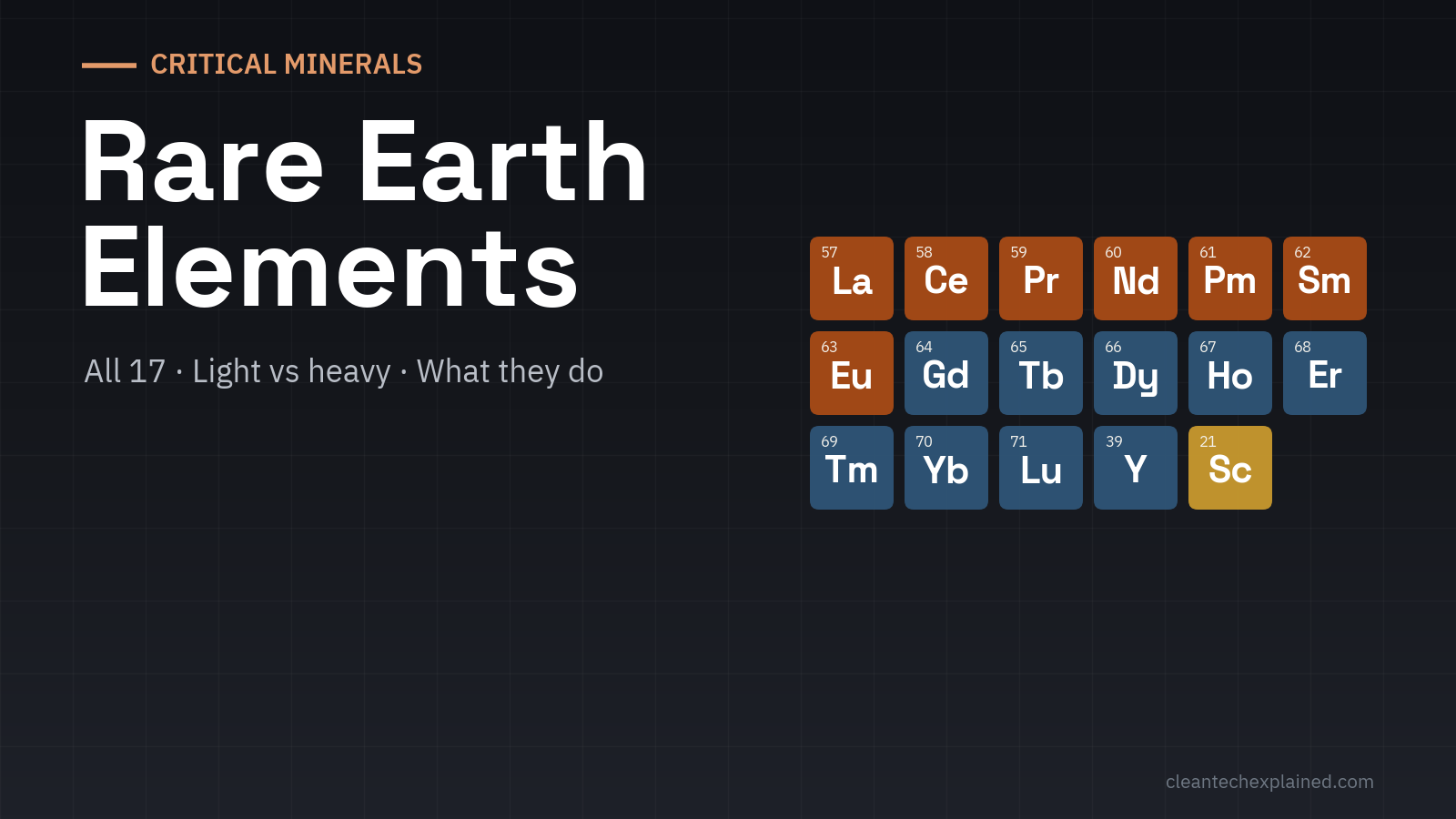
Short answer: The 17 rare earth elements are the 15 lanthanides (lanthanum through lutetium, atomic numbers 57–71) plus scandium and yttrium. The most economically important are neodymium and praseodymium, used in powerful permanent magnets, along with dysprosium and terbium, which keep those magnets working at high temperatures.
Key takeaways
- There are 17 rare earth elements: 15 lanthanides plus scandium and yttrium.
- They are often split into light and heavy rare earths. Heavy rare earths are scarcer and usually more valuable.
- Most rare earths are about as abundant in the Earth’s crust as common metals such as copper, but rarely occur in concentrated, mineable deposits.
- Their near-identical chemistry makes separating them slow, costly and chemically intensive.
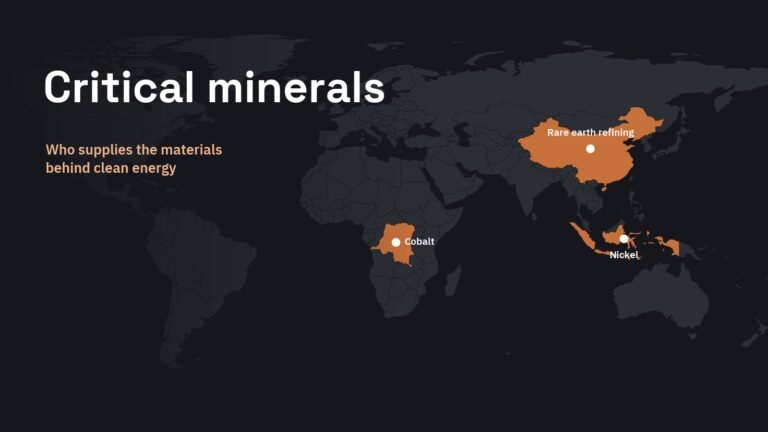
- China produced about 70% of the world’s mined rare earths in 2025 and dominates refining and magnet production even more.
The complete list of rare earth elements
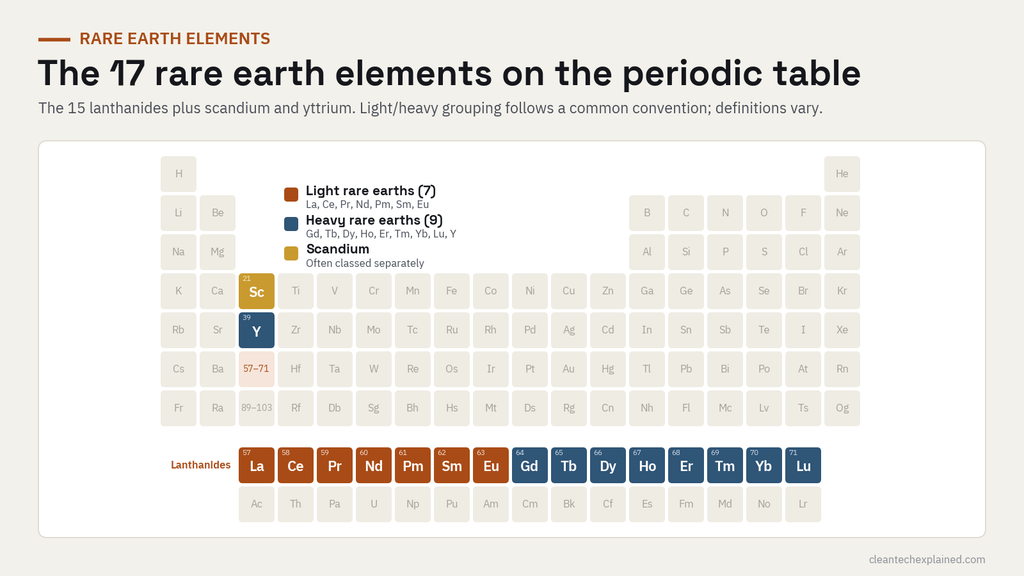
Classifications into “light” and “heavy” vary between organizations. This table follows a widely used convention; scandium is often treated separately because it behaves differently in nature.
| Element | Symbol | Atomic no. | Group | Main uses |
|---|---|---|---|---|
| Lanthanum | La | 57 | Light | Oil refining catalysts, nickel-metal hydride batteries, high-quality camera and optical glass |
| Cerium | Ce | 58 | Light | Glass polishing, catalytic converters, glass decolorizing |
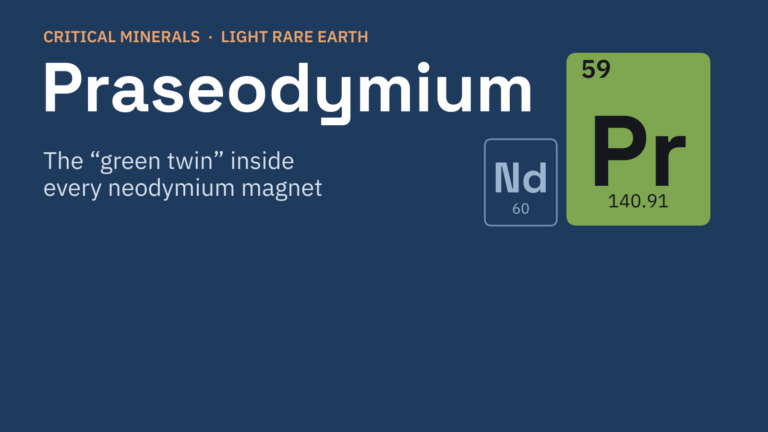
| Praseodymium | Pr | 59 | Light | Permanent magnets (with neodymium), aircraft engine alloys, yellow glass and ceramics |
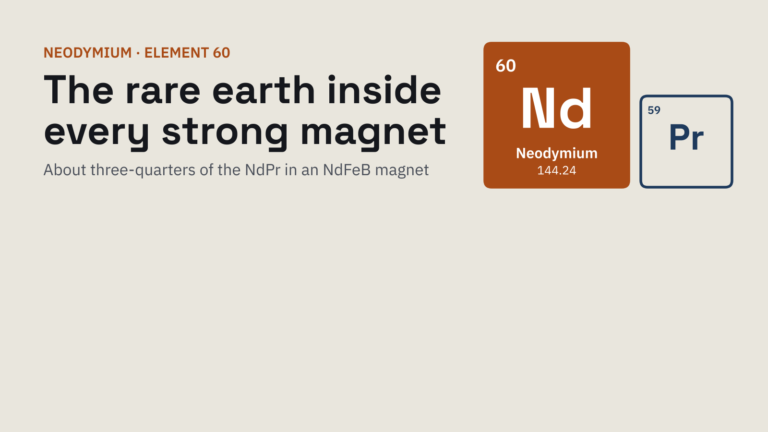
| Neodymium | Nd | 60 | Light | NdFeB permanent magnets for EV motors, wind turbines and electronics; lasers |
| Promethium | Pm | 61 | Light | Radioactive with no stable isotopes; tiny amounts for research and specialized batteries |
| Samarium | Sm | 62 | Light | Samarium-cobalt magnets for high temperatures and defense; cancer treatment |
| Europium | Eu | 63 | Light | Red and blue phosphors in displays and lighting; anti-counterfeiting marks on banknotes |
| Gadolinium | Gd | 64 | Heavy | MRI contrast agents, neutron absorbers in nuclear reactors |
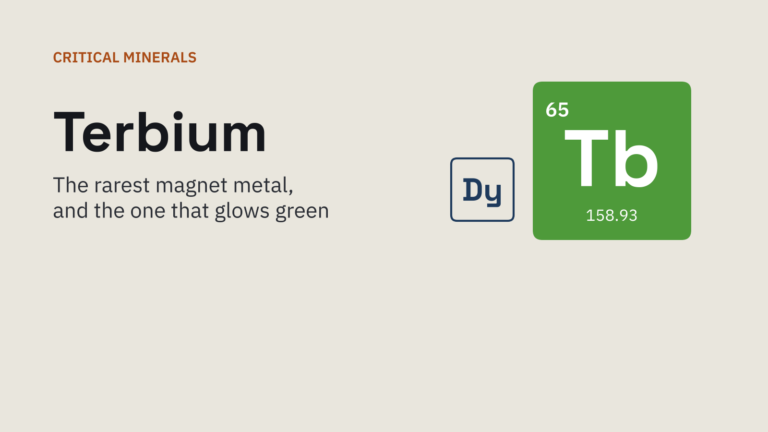
| Terbium | Tb | 65 | Heavy | Heat-resistant NdFeB magnets, green phosphors, magnetostrictive alloys |
| Dysprosium | Dy | 66 | Heavy | Heat-resistant NdFeB magnets for EV motors and wind turbines |
| Holmium | Ho | 67 | Heavy | Medical and industrial lasers, magnet pole pieces |
| Erbium | Er | 68 | Heavy | Fiber-optic signal amplifiers, lasers, pink glass |
| Thulium | Tm | 69 | Heavy | Portable X-ray sources, surgical lasers |
| Ytterbium | Yb | 70 | Heavy | Fiber lasers, atomic clocks, stainless steel additive |
| Lutetium | Lu | 71 | Heavy | PET scanner detector crystals, catalysts, cancer therapy |
| Yttrium | Y | 39 | Heavy | LED and display phosphors, laser crystals, thermal barrier coatings, superconductors |
| Scandium | Sc | 21 | Often separate | Lightweight aluminium-scandium alloys, solid oxide fuel cells |
Why are they called “rare”?
The name dates from the late 18th and 19th centuries, when these elements were first isolated from unusual minerals and their oxides were called “earths”. In terms of abundance, cerium is roughly as common in the Earth’s crust as copper, and neodymium is more common than lead. Even the scarcest stable rare earths are far more abundant than gold.
What is rare is a deposit where they are concentrated enough to mine profitably. The USGS notes that rare earths are relatively abundant in the crust but that mineable concentrations are less common than for most other ores.
Why rare earths are so hard to separate
From a materials perspective, this is the heart of the story. Rare earth atoms differ mainly in how many electrons fill an inner shell, called the 4f shell. Those inner electrons give rare earths their unique magnetic and optical properties, which is why they make such strong magnets and bright phosphors. But because the outer electrons that control chemical behavior are nearly identical, the elements react almost the same way.
Separating them usually involves solvent extraction: dissolving the ore and passing it through hundreds of mixing and settling stages, each nudging the elements slightly apart. It is slow, capital-intensive and generates acidic and sometimes radioactive waste, because rare earth ores often contain thorium or uranium. That separation and refining step, more than mining, is where China’s dominance is most pronounced.
Light vs heavy rare earths
Light rare earths such as lanthanum, cerium, neodymium and praseodymium make up most of the tonnage in typical ore deposits. Heavy rare earths such as dysprosium, terbium and yttrium are much scarcer and found in fewer deposits, including the ionic clay deposits of southern China and neighboring Myanmar.
Heavy rare earths matter far more than their small volumes suggest. A few percent of dysprosium or terbium added to a neodymium magnet keeps it from demagnetizing at the temperatures found inside an electric motor. That makes them a key bottleneck for EVs and wind turbines.
Rare earths and clean energy
The fastest-growing use of rare earths is in permanent magnets. Neodymium-iron-boron (NdFeB) magnets power most electric car motors, many offshore wind turbines, e-bikes, drones, industrial robots and countless smaller motors. Each EV motor typically contains on the order of one to two kilograms of magnet material.
Because of supply concerns, engineers are pursuing two strategies:
- New magnet materials that use little or no rare earth content, such as iron nitride and tetrataenite. Our guide to rare earth magnet alternatives compares them.
- Motor designs that need no permanent magnets at all, already used by Renault, Nissan and BMW. See our guide to rare earth free electric motors and our list of EVs that don’t use rare earth magnets.
Who produces rare earth elements?
According to the US Geological Survey, world mine production reached about 390,000 tonnes of rare earth oxide equivalent in 2025, with China accounting for roughly 70%. Other producers include the United States, from the Mountain Pass mine in California, as well as Australia, Myanmar, Thailand and Nigeria. Global reserves are estimated at more than 85 million tonnes, with China holding the largest share and Brazil, India, Australia and Vietnam among the others.
Mining is only the first step. The International Energy Agency estimates that China accounted for about 91% of global rare earth refining and 94% of sintered permanent magnet production in 2024. Even rare earths mined elsewhere are often shipped to China for processing.
China’s export controls
In April 2025, China began requiring export licences for seven medium and heavy rare earths: samarium, gadolinium, terbium, dysprosium, lutetium, scandium and yttrium. Those controls remain in force.
In October 2025, China announced a much broader package, covering additional elements, rare earth processing technology and some foreign-made products containing Chinese rare earths. After a meeting between the US and Chinese presidents, that package was suspended until November 10, 2026. Whether it is extended, partly reinstated or fully reimposed is one of the key supply-chain questions for the coming months. We will update this guide when the outcome is known.
All rare earth elements appear on the US critical minerals list, and several appear on the EU’s strategic raw materials list. Our critical minerals guide explains how these lists work.
Can rare earths be recycled?
Technically yes, but very little is today. The USGS reports only limited recovery from batteries, permanent magnets and fluorescent lamps. Magnets are spread across millions of small devices and are hard to collect and disassemble. New recycling plants focused on magnets from hard drives, motors and wind turbines are being built in Europe, North America and Japan, but they will supply only a small share of demand for years.
Frequently asked questions
How many rare earth elements are there?
Seventeen: the 15 lanthanides from lanthanum (57) to lutetium (71), plus scandium (21) and yttrium (39).
Are rare earth elements actually rare?
Not in abundance. Most are as common in the Earth’s crust as familiar metals like copper, nickel or lead. They are “rare” in the sense that concentrated, economic deposits are uncommon, and they are hard to separate.
Which rare earth element is the most important?
By value and strategic importance, neodymium, followed by praseodymium, dysprosium and terbium, because together they make the high-performance magnets used in EVs, wind turbines and defense systems.
Is lithium a rare earth element?
No. Lithium is an alkali metal, not a rare earth. Lithium, cobalt, nickel and graphite are often discussed alongside rare earths because they are all critical minerals for batteries and clean energy.
Where are rare earths mined in the United States?
The main US source is the Mountain Pass mine in California. The United States is also building separation and magnet-making capacity, including facilities for heavy rare earths.
Why does China dominate rare earths?
China combined large deposits with decades of investment in separation, refining and magnet manufacturing, often at lower cost and with looser environmental rules than elsewhere. Rebuilding that integrated chain outside China takes many years and billions of dollars.
Sources
- US Geological Survey, Mineral Commodity Summaries 2026: Rare Earths, February 2026
- US Geological Survey, Mineral Commodity Summaries 2026: Rare Earths (Heavy), February 2026
- Gulf News, World’s rare earth giants: Top 10 countries with the biggest reserves (USGS 2025 production share), 2026
- Electrek, A $5M startup claims rare earth-free electric motor breakthrough (IEA refining and magnet figures), July 2026
- Global Times, China suspends export controls on rare earths, other key resources, November 2025
- Asia Times, How US blindly ceded its rare earth dominance to China, September 2026
Featured image and diagrams: original graphics by CleanTech Explained.