Solar Panel Cost in 2026: Price per Watt, by Size and State

Solar panel cost quotes can look wildly different, from under $15,000 to well over $40,000 for what seems like the same house. Most of that gap comes down to system size, location, equipment and how you pay. This guide sets out what solar panels cost in 2026, how to compare quotes fairly, where the money actually goes, and what incentives are left now that the federal tax credit for homeowners has ended.
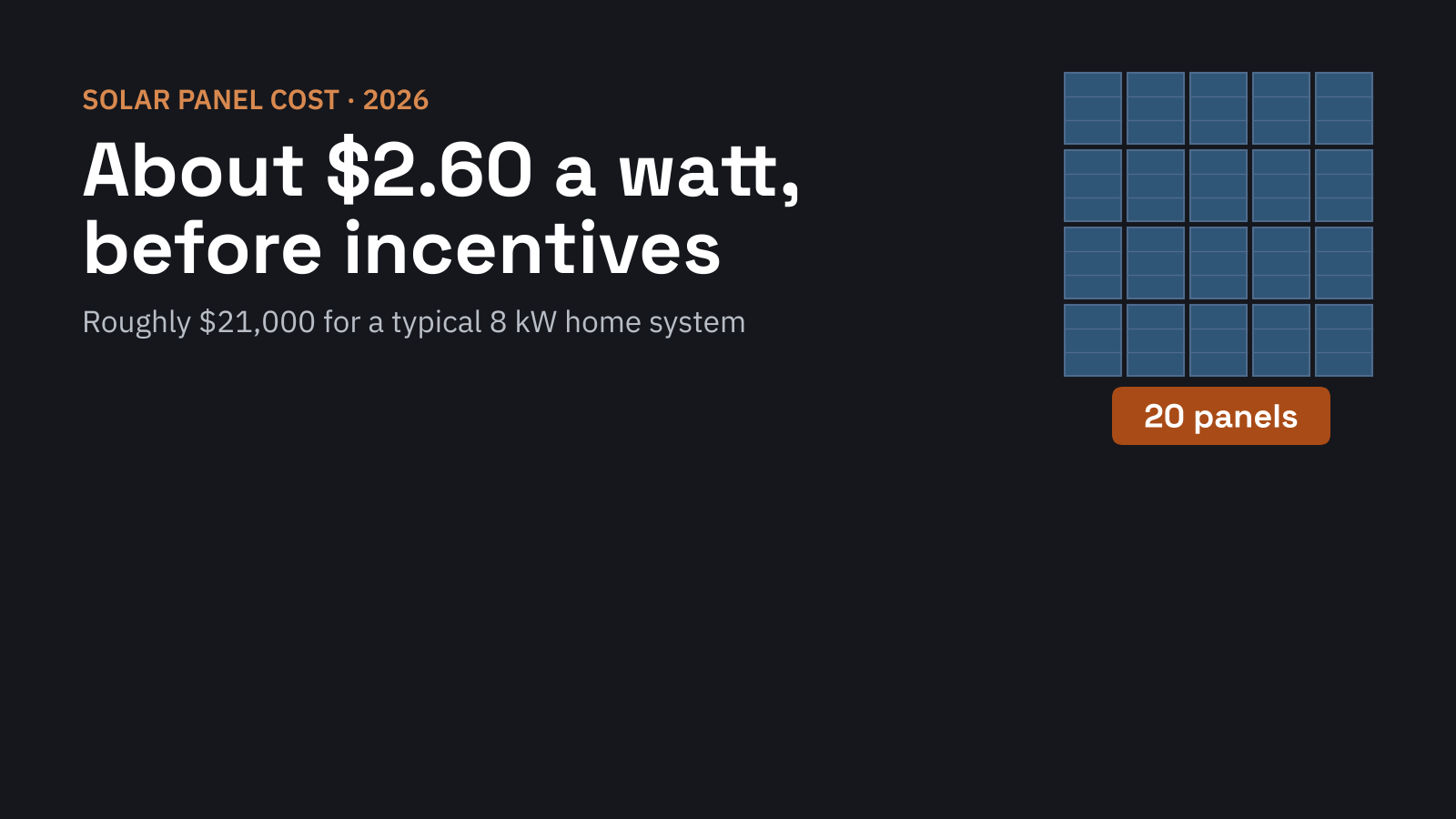
Short answer: Residential solar in the US costs about $2.60 to $3.60 per watt before incentives in 2026. For a typical 8 kW system of about 20 panels, that works out to roughly $21,000 to $29,000. Larger homes with 12 kW systems usually pay $30,000 or more. Since 1 January 2026, homeowners who buy a system can no longer claim the 30% federal tax credit, but many states still offer credits, rebates and tax exemptions.
Key takeaways
- EnergySage puts the average 2026 quote at about $2.60 per watt. Berkeley Lab’s data on installed systems shows a 2025 median of $3.60 per watt, or $3.00 for cash purchases.
- A typical 8 kW system costs around $21,000 at $2.60 per watt and $24,000 at $3.00.
- The panels themselves are only about 12% of the price. Most of the cost is labor, permits, sales, overhead and other “soft costs”.
- Prices range from about $2.10 per watt in Florida to over $3.80 in Alabama, according to EnergySage quote data.
- Loan-financed systems cost about 50% more per watt than cash purchases. Adding a battery raises the price substantially.
- The federal 25D credit ended for systems installed after 31 December 2025. State incentives and leases are now the main ways to reduce the cost.
Average solar panel cost in 2026
Solar is priced per watt of capacity, which makes quotes for different system sizes easy to compare. Two widely used benchmarks give slightly different answers, because they measure different things.
- Quotes: EnergySage, which runs a solar quote marketplace, puts the national average at about $2.60 per watt before incentives in 2026. Its average system is 12 kW, costing about $31,000.
- Installed systems: Lawrence Berkeley National Laboratory tracks prices of systems actually installed. For homeowner-owned systems installed in 2025, the median was $3.60 per watt, down from $4.10 in 2024. Cash purchases had a median of $3.00 and loan-financed systems $4.50.
The gap is mostly about financing and sales channels. Marketplace quotes tend to come from competing installers and are often for cash or low-cost loans, while Berkeley Lab’s data includes every financing route, including expensive dealer loans. If you pay cash and collect several quotes, something close to $2.60 to $3.00 per watt is a realistic target.
Solar panel cost by system size
Bigger systems cost more in total but less per watt, because fixed costs such as permits, design and sales are spread over more panels. The table uses EnergySage’s 2026 averages before incentives. Panel counts assume 400 W panels.
| System size | Panels (400 W) | Average price per watt | Average cost before incentives |
|---|---|---|---|
| 4 kW | 10 | $2.89 | $11,560 |
| 5 kW | 13 | $2.78 | $13,900 |
| 6 kW | 15 | $2.68 | $16,080 |
| 8 kW | 20 | $2.62 | $20,960 |
| 10 kW | 25 | $2.58 | $25,800 |
| 12 kW | 30 | $2.56 | $30,720 |
| 15 kW | 38 | $2.47 | $37,050 |
Not sure what size you need? Our guide to how many solar panels you need has a calculator that works it out from your electricity bill and your location’s sun hours. Berkeley Lab’s median residential system in 2025 was 7.7 kW, and most fall between about 5 and 12 kW.
How much does one solar panel cost?
It depends on whether you mean the panel or the installed system. A 400 W panel on its own is cheap: wholesale module prices in the US were about $0.28 per watt in early 2026, according to Anza, so the panel is worth roughly $110 to the installer. Installed as part of a full system, the cost works out to around $1,000 to $1,200 per panel ($2.60 to $3.00 per watt × 400 W), because each panel carries its share of the inverter, wiring, racking, labor, permits and overhead.
That is why buying panels yourself saves less than you might expect. The hardware is the cheap part.
Where the money goes
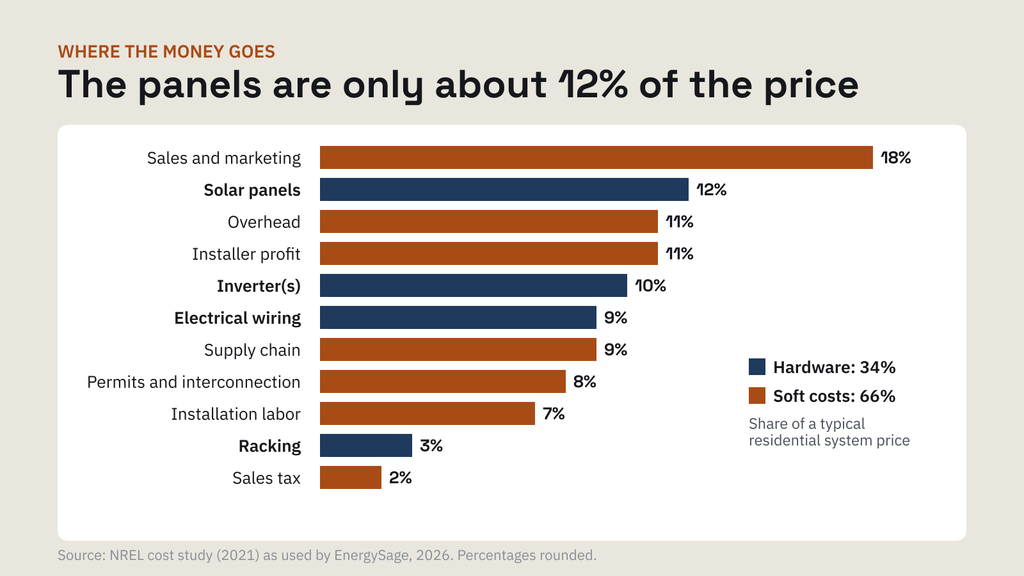
Based on a National Renewable Energy Laboratory cost study used by EnergySage, hardware (panels, inverters, racking and electrical equipment) makes up only about a third of the price of a home solar system. The other two-thirds are soft costs: sales and marketing (the single biggest item at about 18%), overhead, installer profit, supply chain, permits and interconnection, and installation labor.
Berkeley Lab reaches a similar conclusion from a different angle. It found that installed prices have fallen by only about $0.10 to $0.20 per watt a year since 2014, mostly through lower soft costs, and that soft costs and other balance-of-system costs made up roughly 80% of the 2025 median price. Module prices barely move the total any more.
Solar panel cost by state
Prices vary a lot between states, driven by labor costs, permitting rules, installer competition and typical system sizes. The figures below are EnergySage’s average quotes before incentives. The average system cost depends on system size as well as price per watt, which is why California, where systems are smaller, shows a low total.
| State | Average price per watt | Average system cost |
|---|---|---|
| Florida | $2.12 | $33,803 |
| Texas | $2.25 | $29,513 |
| Arizona | $2.26 | $30,377 |
| California | $2.52 | $21,198 |
| New Jersey | $2.59 | $31,993 |
| New York | $2.76 | $33,349 |
| Massachusetts | $2.90 | $32,104 |
| Illinois | $2.94 | $34,153 |
| Hawaii | $3.43 | $30,727 |
| Alabama | $3.82 | $54,749 |
A cheap price per watt does not automatically mean solar pays off well in that state. Electricity prices and how your utility credits exported power matter just as much. Our guide to the solar panel payback period explains how to put the two together.
What changes the price of a solar system
Equipment
Premium high-efficiency panels cost more per watt but can make sense on a small or awkward roof. Microinverters or optimizers, which let each panel work independently, usually cost more than a single string inverter but help on shaded roofs. Most panels last 25 to 30 years or more; see how long solar panels last.
Your roof and electrical system
Steep, tiled or multi-plane roofs take longer to install. A roof near the end of its life should be replaced first, which can add thousands of dollars. Older homes may need a main panel upgrade, which installers often quote at $1,500 to $4,500.
How you pay
Financing has a bigger effect than most buyers expect. In Berkeley Lab’s 2025 data, the median loan-financed system cost $4.50 per watt against $3.00 for cash, about 50% more. Part of that is interest built into “zero-down” dealer loans as fees. Always compare the cash price, even if you plan to borrow.
Adding a battery
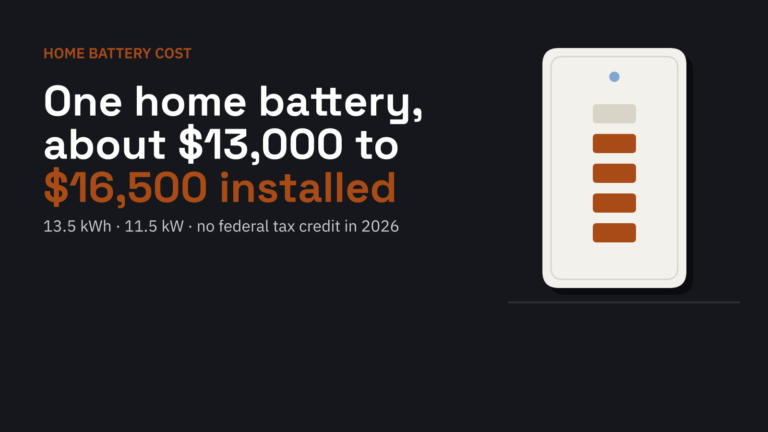
Batteries are now common: 37% of new US home solar systems in 2025 included one, according to Berkeley Lab. The median price of solar-plus-storage was $4.90 per watt against $3.60 for solar alone. A single 13.5 kWh battery typically adds $10,000 to $16,000. Our solar battery guide covers when one is worth it.
Tariffs and trade rules
US module prices have been creeping up. Anza’s Q1 2026 report showed a median of about $0.28 per watt, up from $0.25 a year earlier, under pressure from trade duties and rules on Chinese-linked supply chains. Because panels are only a small slice of the total, this adds a few hundred dollars to a typical home system, not thousands.
The installer
Even among the 100 largest US residential installers, median prices in 2025 ranged from about $2.40 to $6.30 per watt, according to Berkeley Lab. The same system can cost twice as much from one company as from another.
Solar incentives in 2026
The federal tax credit has ended for buyers
The Residential Clean Energy Credit (Section 25D) let homeowners deduct 30% of the cost of a solar system from their federal taxes. It applies only to systems installed by 31 December 2025. If you buy a system in 2026, there is no federal credit.
Leases and power purchase agreements
Systems owned by a third party, such as a lease or a power purchase agreement, can still qualify for a federal business credit (Section 48E), generally if they are placed in service by the end of 2027. The installer claims it and may pass some of the saving on as a lower monthly payment. You do not own the system, so compare the total payments over the contract carefully.
State credits, rebates and exemptions
- State tax credits: examples include New York (25%, up to $5,000), South Carolina (25%, up to $3,500 a year), Hawaii (35%, up to $5,000), New Mexico (30%, up to $15,000), Massachusetts (15%, up to $1,000) and Arizona (25%, up to $1,000).
- Rebates: programs such as NY-Sun, Delaware, Rhode Island, Wisconsin and some utilities pay upfront per watt or a fixed amount.
- Performance payments: solar renewable energy credits (SRECs) and similar programs in states such as New Jersey, Massachusetts, Illinois, Maryland and Washington, D.C. pay for the power your system produces.
- Tax exemptions: many states exempt solar from sales tax, property tax or both.
Programs change often, so check your state’s energy office or the DSIRE database before you sign.
How to estimate your own solar cost
You can get a reasonable estimate in three steps.
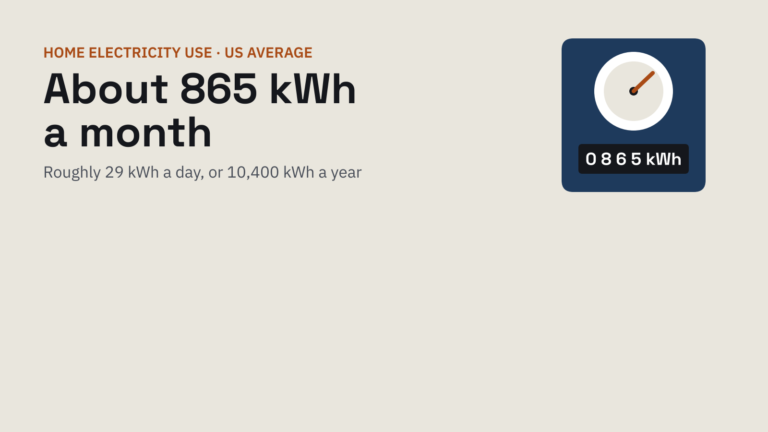
- Find your system size. Take your monthly electricity use from your bill and use our solar panel calculator. For example, a home using the US average of 865 kWh a month, in a place with 4.5 peak sun hours, needs about 8 kW, or 21 panels of 400 W (8.4 kW).
- Multiply by a price per watt. At $2.60 to $3.00 per watt, 8.4 kW costs about $21,800 to $25,200 before incentives. Use your state’s average from the table above if it is listed.
- Subtract incentives. Take off any state credit, rebate or exemption you qualify for.
Then plug the result into our solar payback calculator to see how many years the system takes to pay for itself.
How to get a fair price
- Get at least three quotes and compare them on price per watt, not monthly payment.
- Ask for the cash price even if you plan to finance, so you can see what the loan really costs.
- Check the equipment list: panel and inverter brands, warranties and expected annual production in kWh.
- Look at the production estimate, not just the system size. A cheaper system that produces less is not a bargain.
- Be wary of pressure sales and of quotes built around incentives that no longer exist, such as the federal credit for purchased systems.
Frequently asked questions
How much does a 10 kW solar system cost?
About $25,800 before incentives at EnergySage’s 2026 average of $2.58 per watt for that size, and around $30,000 at $3.00 per watt. A 10 kW system uses about 25 panels of 400 W.
How much do solar panels cost for a 2,000 square foot house?
Floor area is only a rough guide; your electricity use matters more. A typical 2,000 square foot home might need 7 to 10 kW, which costs about $18,000 to $30,000 before incentives.
Are solar panels still worth it without the tax credit?
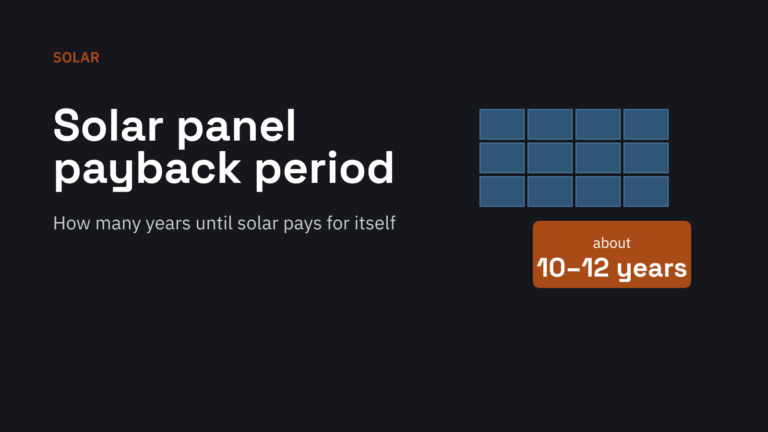
Often yes, but payback is longer. In states with high electricity prices and good export credits, systems can still pay for themselves in around 10 years or less. In states with cheap power or low export rates, it can take much longer. Our payback guide runs the numbers.
Is it cheaper to install solar panels yourself?
You can save the installer’s labor, overhead and profit, but you still need permits, inspections and utility approval, and grid-connected work usually requires a licensed electrician. Many panel warranties also require professional installation. For a small, simple setup, see our guide to plug-in solar panels.
Will solar panel prices go down?
Slowly, if at all. Installed prices have fallen by only $0.10 to $0.20 per watt a year since 2014, and module prices have been rising in 2026 because of trade rules. Waiting a year is unlikely to save much.
Does solar add to my property taxes?
In many states, no. A large number exempt the added value of a solar system from property tax, sometimes for a fixed number of years.
Sources
- EnergySage, Solar panel cost in 2026 (cost per watt, system size and state data; cost breakdown from NREL)
- Mercom, US residential solar-storage adoption jumps to 37% in 2025 (Lawrence Berkeley National Laboratory data), October 2026
- pv magazine USA, US solar module prices face upward pressure as trade risks and FEOC rules dominate Q1 2026 (Anza data), April 2026
- SolarReviews, Solar incentives by state, 2026
- IRS, Residential Clean Energy Credit
- DSIRE, Database of State Incentives for Renewables and Efficiency
Featured image and diagram: original graphics by CleanTech Explained. This article reflects the author’s personal views and publicly available information as of October 2026. Prices and incentives change often. It is general information, not financial or purchasing advice.