Tesla Powerwall 3 Cost in 2026: What You’ll Pay Installed

The Tesla Powerwall 3 is the most popular home battery in the US, and the first question almost everyone asks is what it really costs. Tesla’s website shows a price for your address, installers quote their own numbers, and many guides online still subtract a 30% federal tax credit that no longer exists for homeowners. This guide puts the 2026 numbers side by side: what one Powerwall 3 costs installed, what is inside that price, what extra capacity costs, which incentives are left, and when the battery pays for itself.
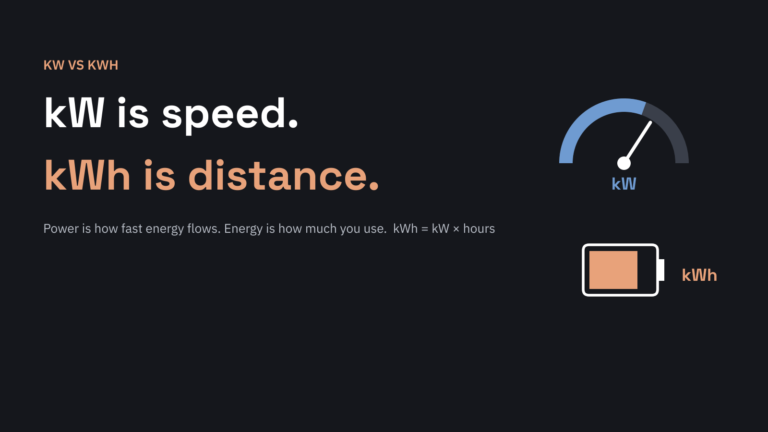
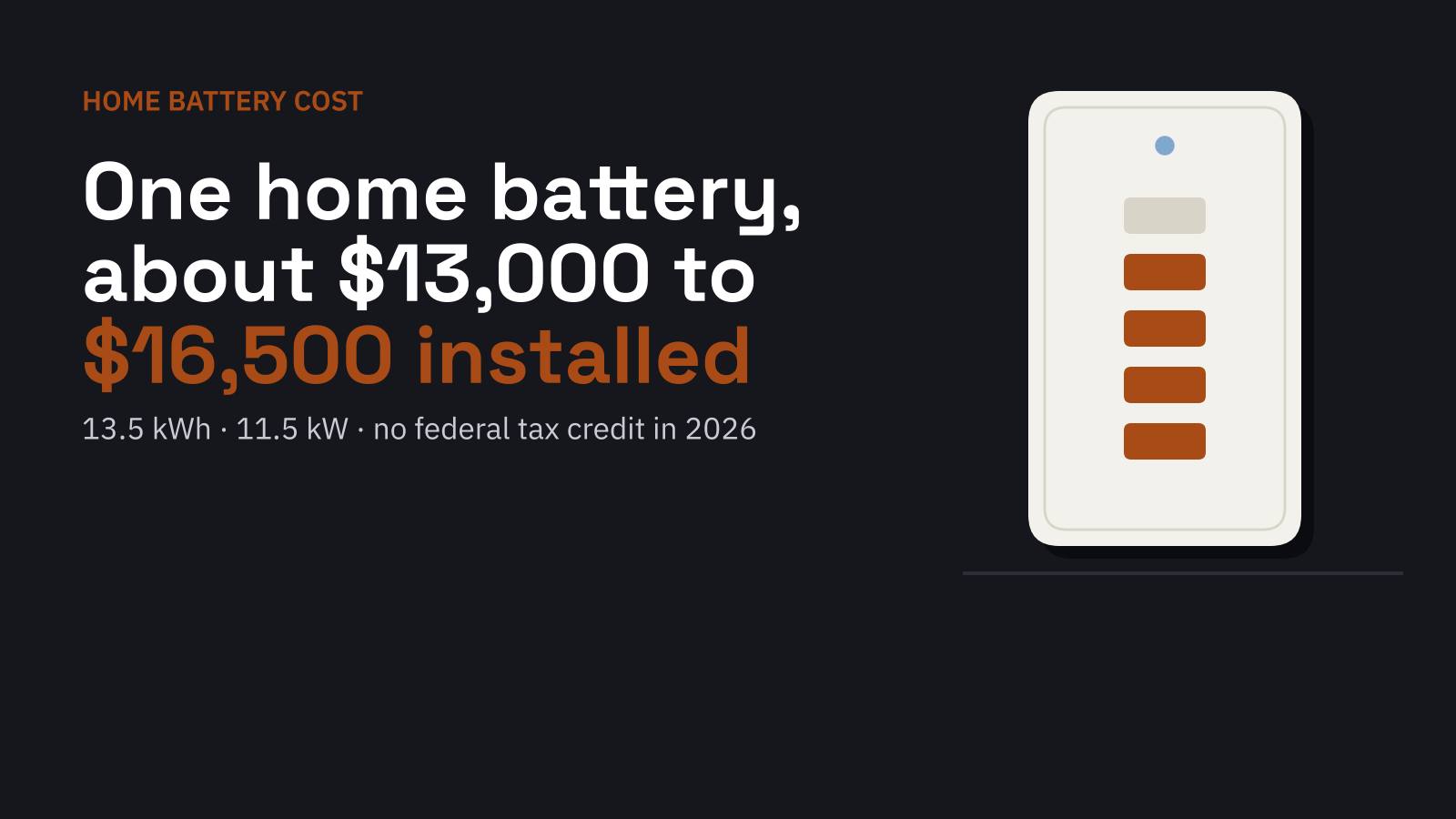
Short answer: A single Tesla Powerwall 3 (13.5 kWh) costs about $13,000 to $16,500 installed in 2026, before incentives. EnergySage puts the typical all-in price at about $13,500, roughly $1,000 per kWh of storage. Each Powerwall 3 Expansion adds another 13.5 kWh for $5,900 in hardware plus installation. Homeowners who buy the battery no longer get a federal tax credit, so the price you pay depends heavily on your state, your utility and your electrical panel.
Key takeaways
- One Powerwall 3 usually costs $13,000 to $16,500 installed. The battery hardware is roughly $9,000 of that; the rest is installation, switching equipment and permits.
- The Powerwall 3 is cheaper per kWh than the average home battery, and its 11.5 kW of continuous power is about twice what most competitors deliver.
- Expansion units are the cheapest way to add storage, but they add hours of backup, not more power.
- The 30% federal tax credit for homeowner-owned batteries ended on December 31, 2025, and Tesla’s own $500 rebate required installation by September 30, 2026.
- Utility rebates can still cut the price by $5,000 to $7,500 in some places, and grid programs in states like California pay owners to share stored energy.
- Your main electrical panel often decides whether a quote lands at the low or high end.
How much does a Tesla Powerwall 3 cost?
Tesla does not publish one national installed price, because labor, permits and electrical work vary by address. The best guide is the range that shows up across large samples of real quotes:
| Source | What it measures | Price for one Powerwall 3 |
|---|---|---|
| EnergySage (May 2026) | Quotes on its installer marketplace | About $13,473 typical, $998 per kWh |
| SolarReviews (2026) | Tesla website quotes in eight US markets | $15,300 to $16,200 before tax, about $16,600 with tax |
| NRG Clean Power (Oct 2026) | Installed price in California | $13,000 to $16,500 |
The spread is not a contradiction. Marketplace quotes from independent installers tend to come in lower than Tesla’s own website price, and California’s labor and permitting costs push its range up. For planning, $13,000 to $16,500 covers most single-battery installations, with about $15,000 a reasonable midpoint.
For context, EnergySage’s marketplace average for all home batteries is about $1,159 per kWh, or roughly $15,650 for 13.5 kWh, so the Powerwall 3 runs about 13% below the average battery. Our solar battery guide covers costs across brands.
What is inside the price
The battery is the predictable part of a quote. The site work is what moves it. One compilation of 2026 installer quotes broke a single-unit installation down like this:
| Item | Typical cost | Needed? |
|---|---|---|
| Powerwall 3 unit | $8,700 to $10,000 | Always |
| Backup Switch or Gateway 3 | $0 to $300 (Backup Switch) / $900 to $1,165 (Gateway 3) | For backup during outages |
| Installation labor | $1,500 to $3,500 | Always |
| Permits and inspection | $100 to $800 | Always |
| Critical loads panel | $1,100 to $3,000 | Only for partial backup with Gateway 3 |
| Main panel upgrade | $1,300 to $4,000 | Only for some older 100 to 150 A panels |
| Wiring, conduit, mounting | $200 to $500 | Always |
Two items explain most of the gap between quotes:
- The switching device. To keep your home running in an outage, the battery needs equipment that disconnects the house from the grid. Tesla’s Backup Switch mounts at the electric meter and is the simplest option for whole-home backup where your utility allows it. Gateway 3 is used elsewhere and for partial backup, and it often comes with a separate panel for the circuits you want to keep powered.
- Your main panel. At its default 11.5 kW output, a Powerwall 3 needs a 60 A breaker. Many standard 200 A panels cannot take that under the usual backfeed rule, but installers can often avoid a costly upgrade by setting a lower output (10, 7.6 or 5.8 kW) or by using Tesla’s software power limits. Ask about this before you accept a quote that includes a new panel.
Powerwall 3 Expansion vs a second Powerwall 3
If 13.5 kWh is not enough, there are two ways to add storage, and they solve different problems.
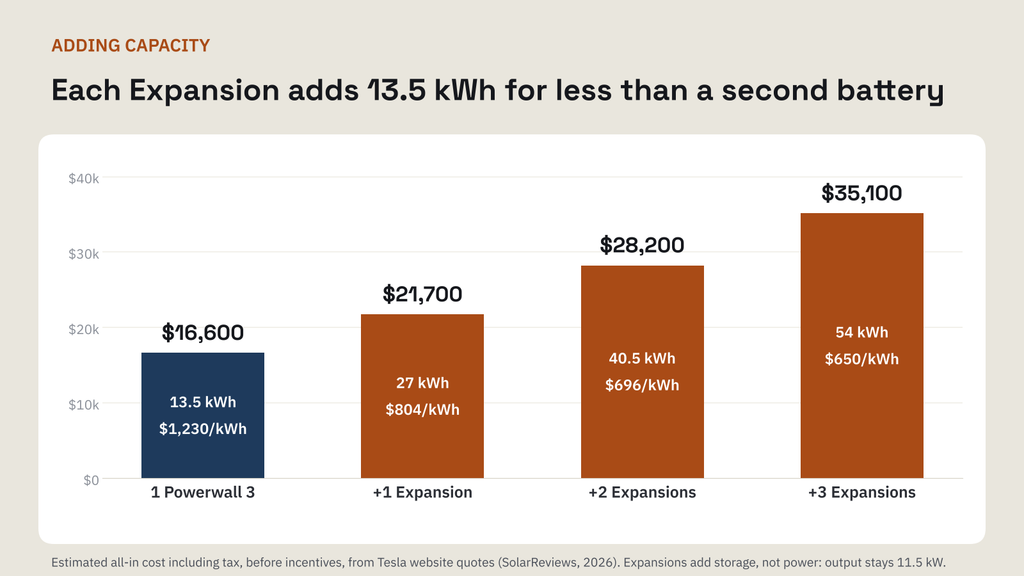
A Powerwall 3 Expansion is a battery without an inverter. Tesla lists it at $5,900 in hardware, and installing it alongside a Powerwall 3 adds roughly $700 to $1,000 in labor. Because it shares the main unit’s inverter, it adds hours of backup but no extra power: the system still delivers 11.5 kW.
A second Powerwall 3 adds both storage and another 11.5 kW of output. California installers quote about $9,500 to $11,500 for the second unit, since the switching equipment is shared. It is the better choice if you want central air, a well pump and an EV charger to run at the same time during an outage. Tesla’s design guide allows up to four Powerwall 3 units and up to three Expansion units in one system.
The chart shows why expansions are popular. In SolarReviews’ Tesla website estimates, the cost per kWh drops from about $1,230 for a single Powerwall 3 to about $650 with three expansions. Before adding capacity, though, check how much you actually need: our guide to home battery backup shows how to size a battery from the loads you want to keep running, and our breakdown of how many kWh a house uses gives typical daily figures.
Powerwall 3 specs that affect what you get for the money
| Spec | Powerwall 3 |
|---|---|
| Usable energy | 13.5 kWh |
| Continuous power | 11.5 kW (can be set to 10, 7.6 or 5.8 kW) |
| Off-grid power with sun | Up to 15.4 kW, with an 80 A breaker and enough solar |
| Motor starting | 185 A locked rotor amps for about one second |
| Solar input | Up to 20 kW DC through 6 inputs (MPPTs) |
| Solar to battery to home efficiency | 89% |
| Maximum charge rate | 5 kW (8 kW with Expansion units) |
| Chemistry | Lithium iron phosphate (LFP) |
| Warranty | 10 years, at least 70% capacity retained |
Three of these matter most for value. The 11.5 kW output and 185 A starting surge let one unit start heavy motors such as air conditioners and well pumps, a job that often needed two older batteries. The built-in solar inverter means that if you are buying new panels at the same time, you do not pay for a separate solar inverter. And the LFP chemistry is the same long-lived, heat-tolerant type used in most home batteries now; our LiFePO4 guide explains why.
There are limits too. A Powerwall 3 system must stay connected to the grid, so it is not an off-grid product. Its inverter groups panels into strings rather than optimizing each panel, which can cost some output on shaded or complicated roofs. If you already have solar, the Powerwall 3 connects on the AC side and does not replace your existing inverter.
Tax credits and rebates for the Powerwall 3 in 2026
Federal tax credit: none for homeowners who buy. The 30% Residential Clean Energy Credit (Section 25D), which used to cover home batteries, ended for systems installed after December 31, 2025. Leased systems and power purchase agreements are the exception: the company that owns the battery can still claim the business-side Section 48E credit and may pass some of it on through lower payments.
Tesla’s own rebate: the “Next Million Powerwall” offer took $500 off one unit and $1,000 off larger systems, but it required installation by September 30, 2026, so it is gone.
Utility rebates: these now make the biggest difference, and they vary street by street. In California in October 2026, for example:
| Utility | Rebate for one Powerwall 3 | Net cost at $15,000 installed |
|---|---|---|
| PG&E, SCE, SDG&E | $0 for most households (SGIP general budget closed) | $15,000 |
| SMUD (Sacramento) | About $5,400, plus up to about $440 a year for grid events | About $9,600 |
| Riverside Public Utilities | $6,750 ($500 per kWh) | About $8,250 |
| Pasadena Water and Power | Up to $7,425 (up to $550 per kWh) | About $7,575 |
Income-qualified California households can apply for SGIP’s equity budget, which pays $1.10 per watt-hour, enough to cover nearly the whole battery, though most of that budget is waitlisted. Outside California, some of the strongest battery programs are in North Carolina, New York and Colorado. Tesla keeps a list of incentives by state, and your utility’s website will show what is open at your address.
Getting paid by the grid: virtual power plant programs pay battery owners to send stored energy to the grid during peak demand. They are growing fast. On October 6, 2026, more than 85,000 Powerwall owners in California sent over 600 MW to the grid during a heat wave, the largest such event yet, through state programs that compensate participants.
One more cost factor: new Section 232 tariffs on imported solar and storage equipment took effect in August 2026. If you get a quote now, ask whether the equipment price is locked until installation.
Is a Powerwall 3 worth the cost?
A home battery earns money in three ways: by storing solar power instead of exporting it cheaply, by covering expensive peak hours on time-of-use rates, and through grid programs. How much it earns depends almost entirely on your utility’s rules.
A worked example from California shows the math under net billing, where exported solar is credited at a low rate:
- Exported solar earns about 4.6 cents per kWh for new SCE customers, while SCE’s average residential rate was 35.3 cents in January 2026.
- If the battery shifts 10 kWh a day from export to evening use, each kWh is worth about 30.7 cents more: 3,650 kWh × $0.307 ≈ $1,120 a year.
- At $15,000 installed with no rebate, that is a simple payback of about 13 years, before rate increases and before any value you place on backup power.
With a $5,400 to $7,425 utility rebate, the same battery pays back in roughly half the time. Where your utility offers full retail net metering, the picture is weaker: the grid already acts like a free battery, so the Powerwall’s value comes mostly from backup. SolarReviews estimates that adding a Powerwall stretches a typical solar payback from about 10 years to about 14 in the best case, and longer in most others. Try your own numbers in our solar payback calculator.
A Powerwall 3 is most likely to be worth it if you have frequent or long outages, a utility that pays little for exported solar, a big gap between peak and off-peak rates, or a rebate or grid program available. If you only want to keep a fridge and a few lights running, a portable power station costs a fraction as much. If you own a compatible EV, bidirectional charging can also power a home in an outage.
How the Powerwall 3 compares on price
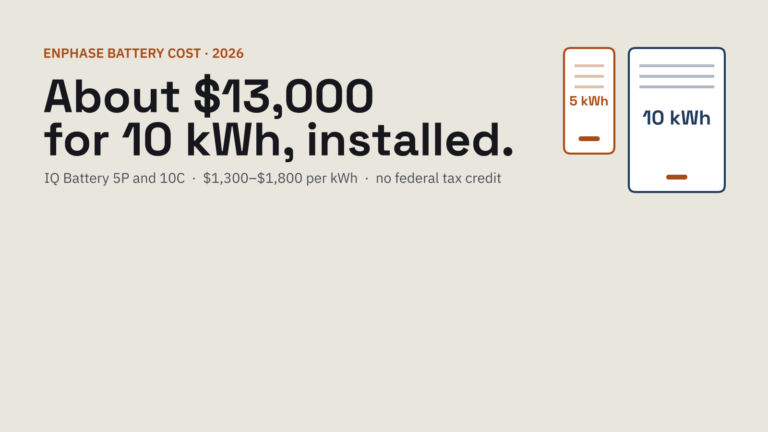
On EnergySage’s marketplace the Powerwall 3 is the most popular battery by a wide margin, with 61% of battery quotes in the second half of 2025. Its price per kWh is below average, and most competitors offer 5 to 7 kW of continuous power against its 11.5 kW. The trade-offs are less flexible sizing, an inverter that suits simple roofs better than shaded ones, and waits of three to six months for installation in some markets. Competing batteries from brands such as Enphase and Franklin WH can make sense for shaded roofs, existing microinverter systems, or homes that want to grow storage in smaller steps. For the modular alternative, see our guide to Enphase battery cost.
How to get an accurate Powerwall 3 quote
- Ask whether the quote uses the Backup Switch or Gateway 3, and which circuits will be backed up.
- Ask whether a panel upgrade is truly required, or whether a lower output setting or software limit would avoid it.
- Confirm the quote does not subtract the expired 30% federal credit or Tesla’s ended $500 rebate.
- Check which utility rebates and grid programs are open at your address, and whether they require you to join before installation.
- Ask whether the equipment price is locked if tariffs change before installation.
- Use a Tesla Certified Installer, and get at least three quotes; prices for the same battery can differ by thousands of dollars.
Frequently asked questions
How much does a Tesla Powerwall 3 cost installed?
About $13,000 to $16,500 for one unit in 2026, before incentives. EnergySage’s typical marketplace price is about $13,500, while Tesla’s own website quotes have run about $15,300 to $16,200 before tax.
How much does a Powerwall 3 Expansion cost?
Tesla lists the Expansion at $5,900 for the hardware. Installation adds roughly $700 to $1,000. Each Expansion adds 13.5 kWh but no extra power output.
Is there a tax credit for the Tesla Powerwall in 2026?
Not for homeowners who buy it. The 30% Section 25D credit ended for systems installed after December 31, 2025. Leased and PPA systems can still benefit indirectly through the Section 48E business credit, and some states and utilities offer rebates.
Can I buy a Powerwall 3 without solar panels?
Yes. A Powerwall 3 can charge from the grid and provide backup power, but without solar it cannot recharge during a long outage, and it saves less money day to day.
How many Powerwall 3 units do I need?
One is enough to back up essentials for about two days and to start most large appliances. Homes that want whole-home backup with central air, or multi-day backup, often add Expansion units or a second Powerwall 3.
How long does a Powerwall 3 last?
The warranty covers 10 years and guarantees at least 70% of capacity at the end. Its LFP cells usually keep working beyond that with gradually reduced capacity.
Does Tesla install the Powerwall 3 itself?
Tesla sells installed Powerwalls in many areas, and a network of Tesla Certified Installers also sells and installs them. To keep the warranty, the installer must be certified by Tesla. If you are weighing a battery against a standby generator, see generator vs battery backup.
Sources
- EnergySage, Tesla Powerwall 3 review in 2026 (price per kWh, typical installed cost, market share)
- SolarReviews, The Actual Cost of a Tesla Powerwall 3 (Tesla website quotes, Expansion pricing)
- NRG Clean Power, How Much Does a Tesla Powerwall 3 Cost in California? (October 2026) (California prices, utility rebates, payback example)
- Exspenditure, How Much Does the Powerwall 3 Cost in 2026? (cost breakdown)
- Tesla, Powerwall 3 Datasheet (North America)
- Tesla, Powerwall 3 System Design Guide: Design Considerations
- Electrek, Tesla Powerwalls supply most of record 745 MW California grid dispatch (October 14, 2026)
- EnergySage, Solar battery cost in 2026 (average for all home batteries)
Featured image and chart: original graphics by CleanTech Explained. Tesla and Powerwall are trademarks of Tesla, Inc.; this site is not affiliated with Tesla.