LiFePO4 Battery Explained: What It Is and When to Choose It

A LiFePO4 battery is a type of lithium-ion battery that uses lithium iron phosphate as its cathode. You will find it in home batteries, portable power stations, RV and boat house batteries, solar storage and a growing share of electric cars. It is often sold under two names that mean exactly the same thing: LiFePO4 (the chemical formula) and LFP (the industry abbreviation). This guide explains what makes it different, how long it lasts, how to charge it and what to check before you buy one.
Short answer: A LiFePO4 battery trades some energy density for a very long life, strong safety margins and a lower cost per kWh over its lifetime. It is the best choice for most batteries that stay in one place or get cycled every day. Its main weaknesses are extra weight compared with other lithium-ion types and the need for protection when charging below freezing.
Key takeaways
- LiFePO4 and LFP are the same chemistry: lithium iron phosphate. It is a lithium-ion battery.
- Typical LiFePO4 cells deliver several thousand full cycles, often 10 years or more of daily use.
- It is much harder to push into thermal runaway than nickel-based lithium-ion batteries.
- A 12 V LiFePO4 battery is a popular drop-in replacement for lead-acid, with more usable capacity at roughly half the weight or less.
- Never fast-charge a LiFePO4 battery below 0 °C (32 °F) unless it has built-in heating or low-temperature protection.
What is a LiFePO4 battery?
Every lithium-ion battery moves lithium ions between two electrodes. The name of the battery usually describes the positive electrode, the cathode. In a LiFePO4 battery, the cathode is lithium iron phosphate, a compound made from lithium, iron, phosphorus and oxygen. The negative electrode is usually graphite, just as in other lithium-ion batteries.
The material was first reported by John Goodenough’s research group at the University of Texas in 1996–97. For years it was held back by poor electrical conductivity. Two engineering fixes changed that: shrinking the particles to the nanoscale, so lithium has a shorter path to travel, and coating them with a thin layer of carbon to carry electrons. Today LiFePO4 is the most widely used lithium-ion chemistry in the world for electric vehicles and stationary storage.
Why it is so stable
In LiFePO4, oxygen atoms are locked into phosphate groups by very strong phosphorus-oxygen bonds. Even when the battery is fully charged and hot, the cathode releases oxygen far less readily than the layered oxide cathodes used in nickel-based batteries. Less oxygen means less fuel for a fire if a cell fails. That single structural feature explains most of LiFePO4’s safety and longevity.
LiFePO4 at a glance
| Property | Typical value |
|---|---|
| Nominal cell voltage | 3.2 V |
| Full-charge cell voltage | 3.60–3.65 V |
| Nominal voltage of a 12 V pack (4 cells in series) | 12.8 V |
| Cell energy density | ~160–205 Wh/kg |
| Cycle life to ~80% capacity | ~3,000–6,000+ cycles |
| Usable depth of discharge | 80–100% |
| Self-discharge | Low, a few percent per month |
| Charging temperature | 0 °C to about 45 °C (32–113 °F), per manufacturer |
Values vary between products. Always follow the datasheet for the battery you own.
Advantages of LiFePO4 batteries
- Long life. Thousands of cycles means a battery cycled once a day can last well over a decade. Many home battery warranties now run 10 to 15 years.
- Safety. High resistance to thermal runaway makes LiFePO4 the preferred chemistry for batteries installed in homes, garages, vans and boats.
- Low cost per kWh. Iron and phosphate are cheap and abundant. BloombergNEF put the average LFP pack price at $81/kWh in 2025, against $128/kWh for nickel-based NMC packs.
- No nickel or cobalt. That avoids two metals with volatile prices and supply-chain concerns.
- Deep usable capacity. You can routinely use most of the rated capacity without shortening life dramatically.
- Stable voltage. Output voltage stays almost flat until the battery is nearly empty, so devices run at full performance for longer.
Disadvantages of LiFePO4 batteries
- Heavier than other lithium-ion types. Lower energy density means a bigger, heavier battery for the same capacity. It is still far lighter than lead-acid.
- Cold charging limits. Charging below freezing can plate metallic lithium on the anode and permanently damage the cell. Quality batteries include low-temperature charge cut-off or built-in heaters. Sodium-ion batteries handle cold far better, which is their main selling point.
- Harder to read state of charge. The flat voltage curve makes voltage a poor fuel gauge. A battery monitor that counts current (a shunt) or the battery’s own app is more reliable.
- Higher upfront price than lead-acid. The lifetime cost is usually lower, but the purchase price is higher.
How long does a LiFePO4 battery last?
Most quality LiFePO4 batteries are rated for somewhere between 3,000 and 6,000 cycles or more before capacity falls to about 80%. In practice:
- A home battery cycled once a day reaches 3,650 cycles in 10 years.
- An RV or camping battery used on weekends may see only 50–100 cycles a year, so calendar ageing, not cycling, will set its life. Expect 10 years or more if it is stored properly.
- Heat is the biggest enemy. Keeping the battery below about 30 °C (86 °F) most of the time matters more than almost anything else you can do.
A battery at 80% of its original capacity still works; it simply holds less energy. Many users keep going well beyond that point.
How to charge a LiFePO4 battery
- Use a LiFePO4-compatible charger or charge profile. For a 12 V battery, the charge voltage is typically 14.2–14.6 V. Lead-acid chargers with an automatic desulfation or equalization mode can over-voltage a LiFePO4 battery and should not be used.
- Float charging is optional. LiFePO4 does not need to be held at full charge. If your charger floats, a setting around 13.4–13.6 V is common.
- Charging to 100% is fine. Unlike nickel-based lithium-ion, LiFePO4 is not significantly harmed by regular full charges, and a periodic full charge helps the battery management system recalibrate its state-of-charge estimate.
- Respect the temperature limit. Do not charge below 0 °C (32 °F) unless the battery has heating or low-temperature protection. Discharging in the cold is generally allowed, at reduced capacity.
- For long storage, leave the battery at about 50–60% charge, disconnect loads and store it somewhere cool and dry. Top it up every few months.
LiFePO4 vs lead-acid
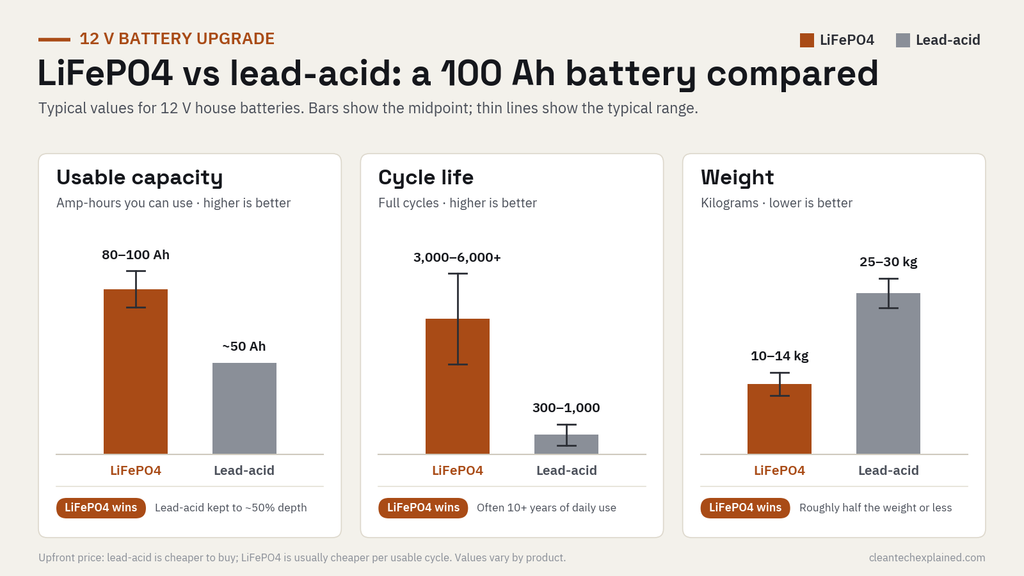
For RVs, boats, off-grid cabins and older solar systems, the most common upgrade is replacing a lead-acid battery with a 12 V LiFePO4 battery.
| 12 V LiFePO4 | 12 V lead-acid (AGM or flooded) | |
|---|---|---|
| Usable capacity of a 100 Ah battery | ~80–100 Ah | ~50 Ah (to protect lifespan) |
| Typical cycle life | 3,000–6,000+ | 300–1,000 |
| Weight of a 100 Ah battery | Roughly 10–14 kg (22–31 lb) | Roughly 25–30 kg (55–66 lb) |
| Maintenance | None | Flooded types need watering |
| Upfront price | Higher | Lower |
| Cost per usable cycle | Usually much lower | Higher |
Before switching, check that your charger, solar charge controller and alternator can handle a lithium profile. Alternators in particular may need a DC-DC charger to avoid overheating when charging a large LiFePO4 bank.
LiFePO4 vs lithium-ion: what is the difference?
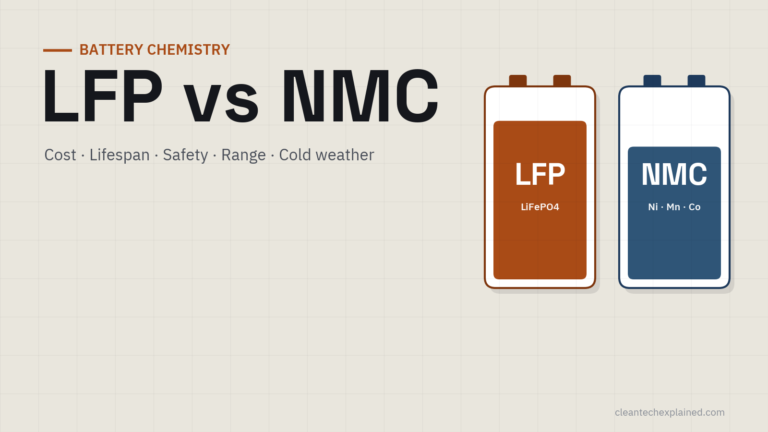
Product listings often compare “LiFePO4 vs lithium-ion”, which is slightly misleading: LiFePO4 is a lithium-ion battery. What those comparisons really mean is LiFePO4 versus the nickel-based lithium-ion chemistries used in phones, laptops, many power tools and long-range EVs, mainly NMC and NCA.
In short, LiFePO4 lasts longer, costs less per kWh and is safer, while nickel-based lithium-ion is lighter and more compact for the same energy. We cover the trade-offs in detail, including range and cold-weather performance, in our LFP vs NMC comparison.
Where LiFePO4 batteries are used
- Home batteries: Most current home storage systems, including Tesla’s Powerwall 3 and Enphase’s IQ Battery range, use LiFePO4. Thinking of adding one to your panels? See our solar battery guide.
- Portable power stations: Most mainstream models have switched to LiFePO4. See how long one can run a fridge in our power station runtime guide.
- Solar storage: From small off-grid kits to grid-scale projects. If you are sizing a solar system, start with our solar panel calculator.
- RVs, vans and boats: As house batteries replacing lead-acid.
- Electric vehicles: According to the International Energy Agency, LFP made up more than 55% of EV batteries deployed worldwide in 2025, mostly in China.
- Golf carts, e-bikes, forklifts and backup power for telecom and data centers.
What to check before buying a LiFePO4 battery
- Battery management system (BMS): It should protect against over-charge, over-discharge, over-current, short circuit and high temperature. Check its continuous current rating against your loads.
- Low-temperature charge protection: Essential if the battery will ever sit below freezing. Self-heating models cost more but charge safely in winter.
- Certifications: Look for UN 38.3 (transport testing) as a minimum. For home energy storage, UL 1973 for the battery and UL 9540 for the complete system are the key North American standards; installers and local codes may require them.
- Real capacity and warranty: Prefer brands that publish cycle-life ratings with test conditions and offer long warranties. Be wary of vague “Grade A cells” claims without documentation.
- Monitoring: Bluetooth or app-based monitoring makes the flat voltage curve much less of a problem.
- Compatibility: Confirm your charger, inverter and charge controller support LiFePO4 charge settings.
Frequently asked questions
Is LiFePO4 the same as LFP?
Yes. LiFePO4 is the chemical formula for lithium iron phosphate, and LFP is its abbreviation. Both terms describe the same battery chemistry.
Is a LiFePO4 battery lithium-ion?
Yes. It is one of several lithium-ion chemistries. It differs from other lithium-ion batteries in its cathode material, which gives it longer life and better thermal stability.
Can a LiFePO4 battery catch fire?
Any battery can fail if it is damaged, badly made or abused. LiFePO4 is far more resistant to thermal runaway than nickel-based lithium-ion, which is why it is favored for home and vehicle installations. Buying certified products with a proper BMS reduces the risk further.
Can I use a lead-acid charger on a LiFePO4 battery?
Only if it has a lithium or LiFePO4 mode, or if its voltages match the battery maker’s specifications and it has no equalization or desulfation mode. When in doubt, use a charger designed for LiFePO4.
Should I charge a LiFePO4 battery to 100%?
Yes, that is generally fine. Regular full charges do little harm and help the BMS keep an accurate state-of-charge reading. For long-term storage, around 50–60% is better.
How long does a LiFePO4 battery last?
Typically 3,000 to 6,000 or more full cycles, which often means 10 years or longer. Heat, very high charge or discharge currents and poor-quality cells shorten life.
Wondering what comes after LiFePO4? See our guide to solid-state batteries.
Sources
- BloombergNEF, Lithium-Ion Battery Pack Prices Fall to $108 per Kilowatt-Hour, Despite Rising Metal Prices, December 2025
- International Energy Agency, Global EV Outlook 2026: Electric vehicle batteries, May 2026
- Padhi, Nanjundaswamy and Goodenough, Phospho-olivines as Positive-Electrode Materials for Rechargeable Lithium Batteries, Journal of the Electrochemical Society, 1997
- Portlandia Electric Supply, Tesla Powerwall 3 vs Enphase IQ Battery 5P (chemistry and specifications), August 2026
Featured image and diagrams: original graphics by CleanTech Explained.