How Many Solar Panels Do I Need?

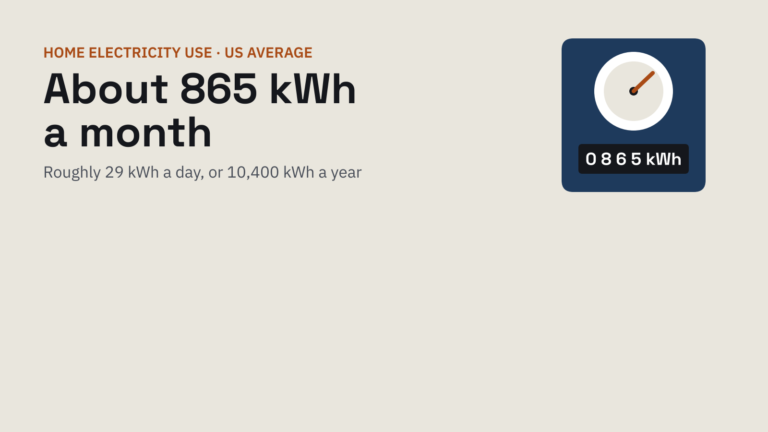
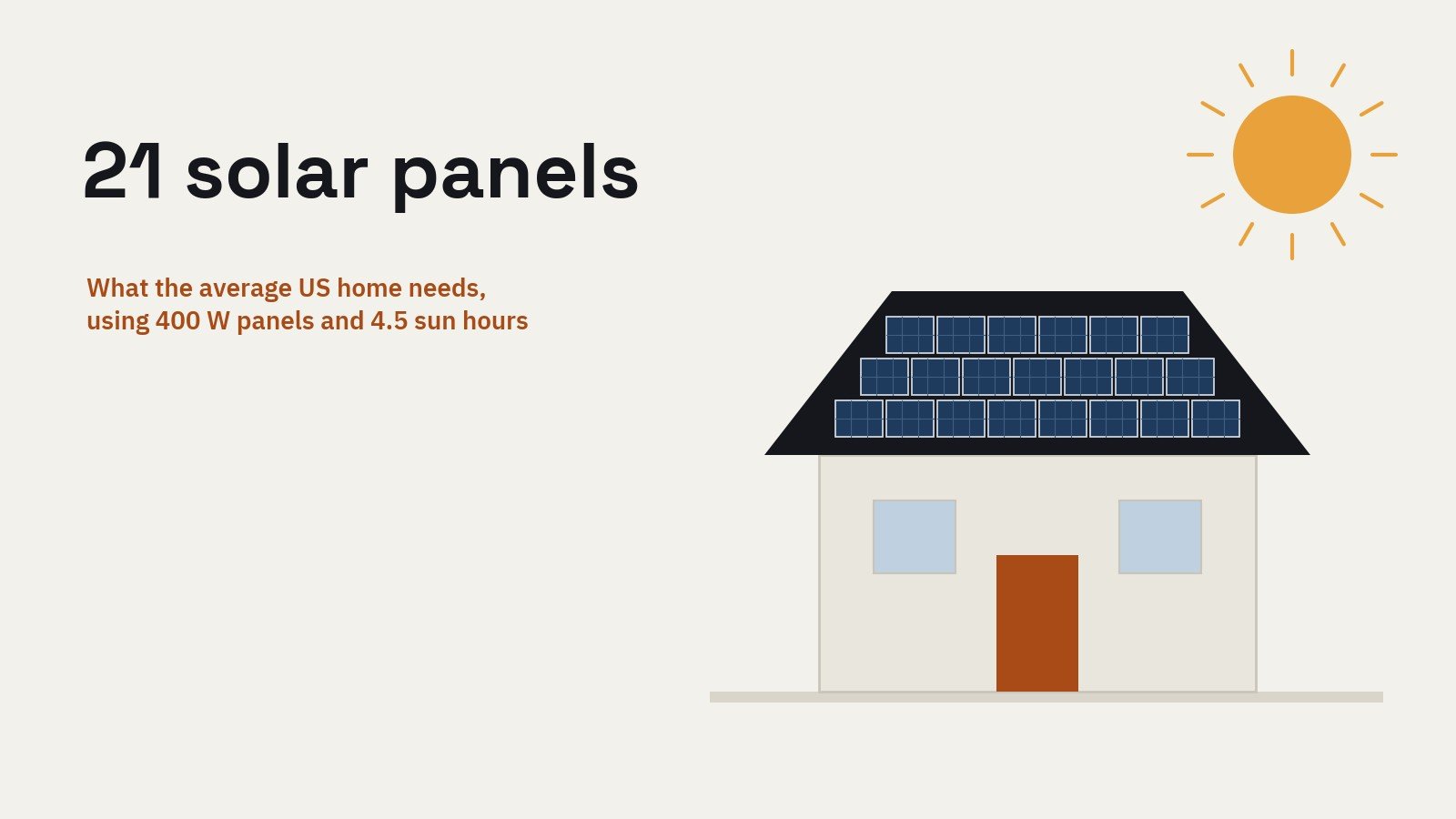
How many solar panels do I need? For the average US home, which uses about 865 kWh of electricity a month, the answer is roughly 17 to 26 panels of 400 watts each, depending on how much sun your location gets. Your own number depends on three things: how much electricity you use, how many hours of strong sunlight you receive, and the wattage of the panels you choose.
This guide walks you through a simple three-step formula, a quick-reference table and the real-world factors that installers check before quoting a system.
Last reviewed: September 2026.
Quick answer
- Average US home (865 kWh a month): about 17 panels in a very sunny region, 21 in an average one and 26 in a cloudier one, using 400 W panels.
- Smaller home (500 kWh a month): about 10 to 15 panels.
- Larger home (1,200 kWh a month): about 23 to 36 panels.
- These figures aim to cover 100% of your yearly electricity use. Many homeowners install less, depending on roof space, budget and local rules.
Solar panel calculator
Estimate how many panels you need to cover your home’s electricity use.
21 panels
of 400 W, an 8.4 kW system
- System size
- 8.4 kW
- Estimated output
- 907 kWh/month
- Yearly output
- 11,038 kWh
- Roof area (approx.)
- 420 sq ft (39 m²)
Estimate for planning only. Real output depends on your roof angle, direction, shading and local weather. Roof area assumes about 20 sq ft per panel and excludes walkways and setbacks.
Step 1: Find how much electricity you use
Look at your electricity bills for the past 12 months and add up the kWh. Divide by 12 to get your average monthly use. Using a full year matters because consumption changes with the seasons, especially if you use air conditioning or electric heating.
If you do not have your bills, use the national average as a starting point: US residential customers used an average of 865 kWh per month in 2024, according to the US Energy Information Administration. Averages vary widely by state, from around 500 kWh a month in mild-climate states to well over 1,000 kWh in hot southern states.
Plan ahead. If you expect to buy an electric car or switch to a heat pump in the next few years, add that future demand now. A typical EV can add a few hundred kWh a month, depending on how far you drive.
Step 2: Find your peak sun hours
Peak sun hours measure how much solar energy your location receives. One peak sun hour equals one hour of sunlight at an intensity of 1,000 watts per square meter, the standard used to rate solar panels. A location with 5 peak sun hours per day receives the same energy as 5 hours of full, direct midday sun, spread across the whole day.
Typical US values range from about 3.5 peak sun hours per day in cloudier northern regions to about 6.5 in the desert Southwest.
To find your exact number, use NREL’s free PVWatts calculator at pvwatts.nrel.gov and enter your address. Outside the US, the Global Solar Atlas at globalsolaratlas.info provides similar data.
Step 3: Calculate the number of panels
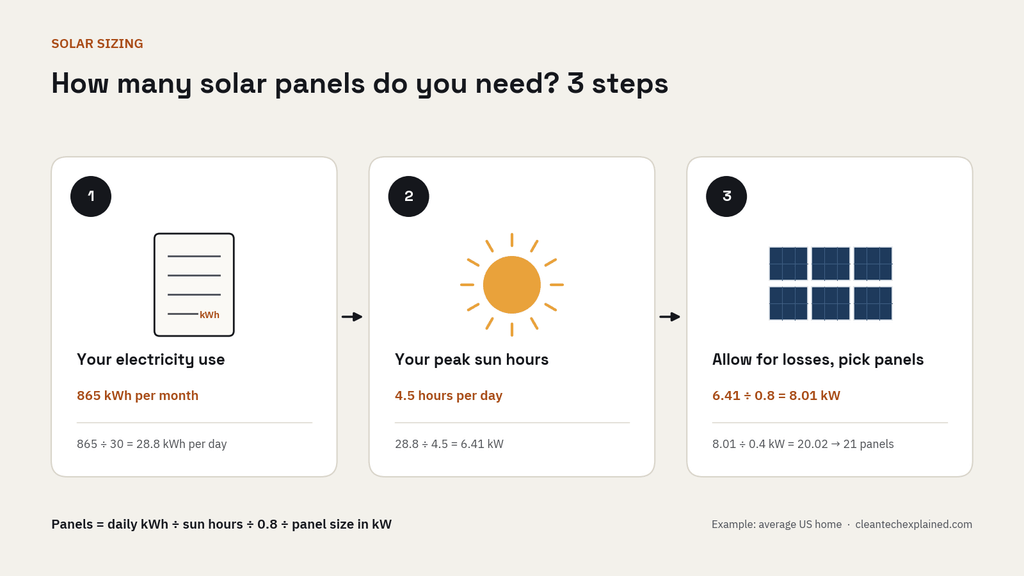
Use this formula:
Number of panels = Daily electricity use (kWh) ÷ Peak sun hours ÷ 0.8 ÷ Panel wattage (kW)
Then round up to the next whole panel.
The 0.8 accounts for real-world losses. NREL’s PVWatts model uses a default of 14% for system losses such as dirt on the panels, shading, wiring, mismatch between panels and downtime, and the inverter loses a few percent more when it converts DC power to AC. Using 0.8, or about 20% total losses, gives a realistic, slightly conservative estimate.
Prefer not to do the math? Use the calculator at the top of this page.
Worked example
A home uses 865 kWh a month in a location with 4.5 peak sun hours, and plans to install 400 W panels.
- Daily use: 865 ÷ 30 = 28.8 kWh per day
- Divide by peak sun hours: 28.8 ÷ 4.5 = 6.41 kW
- Allow for losses: 6.41 ÷ 0.8 = 8.01 kW
- Divide by panel size: 8.01 ÷ 0.4 = 20.02, rounded up to 21 panels
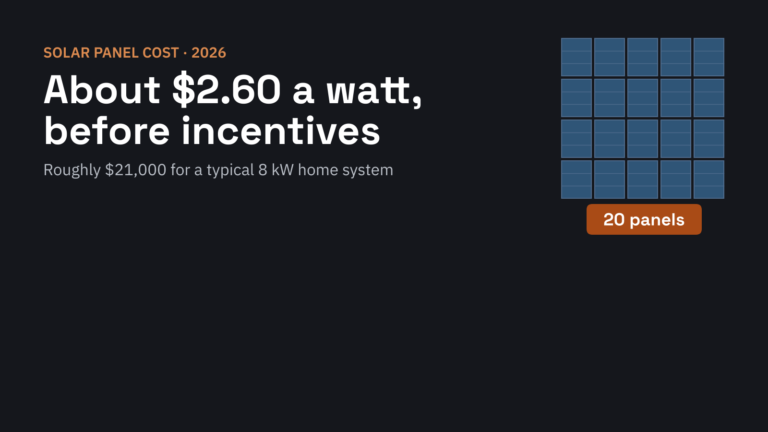
This home needs a system of about 8 to 8.4 kW, or 21 panels of 400 W, to cover its yearly use. To turn that into a price, see what solar panels cost.
Quick-reference table
Estimated number of 400 W panels needed to cover 100% of yearly electricity use, with the resulting system size:
| Monthly use | Cloudy region (3.5 sun hours) | Average region (4.5 sun hours) | Sunny region (5.5 sun hours) |
|---|---|---|---|
| 500 kWh | 15 panels (6.0 kW) | 12 panels (4.8 kW) | 10 panels (4.0 kW) |
| 865 kWh (US average) | 26 panels (10.4 kW) | 21 panels (8.4 kW) | 17 panels (6.8 kW) |
| 1,200 kWh | 36 panels (14.4 kW) | 28 panels (11.2 kW) | 23 panels (9.2 kW) |
These are estimates for well-oriented, largely unshaded roofs. Your installer’s design software will account for your exact roof angle, direction and shading.
How much roof space do you need?
A typical 400 W residential panel measures roughly 1.7 by 1.1 meters, or about 20 square feet. A 21-panel system therefore needs around 420 square feet of usable roof, plus space for walkways and setbacks required by fire codes in many areas.
If roof space is tight, higher-wattage panels let you produce more electricity from the same area. Swapping 400 W panels for 450 W panels would cut the example system from 21 panels to 18.
Factors that change the answer
Roof direction and angle
In the Northern Hemisphere, south-facing roofs produce the most energy. East- and west-facing roofs typically produce somewhat less, and north-facing roofs are usually a poor choice. Panels tilted at an angle close to your latitude generally perform best over a full year.
Shading
Trees, chimneys and neighboring buildings can significantly reduce output, especially if they shade panels during the middle of the day. If part of your roof is shaded, microinverters or power optimizers can reduce the impact on the rest of the system.
Climate and season
Solar output is much higher in summer than in winter. A system sized for your yearly use will usually produce a surplus in summer and a shortfall in winter. How that balances out financially depends on your utility’s rules.
Net metering and export rates
Many utilities credit you for extra electricity you send to the grid, but the rules vary widely. Where export credits are low, it can make more sense to size the system closer to your daytime use, or to add a home battery to store surplus energy for the evening.
Panel degradation
Solar panels slowly lose output over time. Most manufacturers warranty their panels to keep a large share of their original output after 25 years. Some homeowners add a small margin to their system size to allow for this. Our guide to how long solar panels last has the numbers.
Do you need to cover 100% of your electricity use?
No. Covering 100% is a useful reference point, but many homeowners choose a smaller system to fit their budget, roof space or local rules. Even a system that covers half of your use can meaningfully reduce your electricity bills. The right size depends on your electricity prices, available incentives and how your utility credits exported power. To see how many years your system needs to pay for itself, use our solar panel payback period calculator.
Frequently asked questions
Want to use your solar power in the evening or keep the lights on during an outage? Our solar battery guide explains costs, sizing and whether a battery is worth it.
Renting, or no suitable roof? Small plug-in solar panels connect to a standard outlet and are now legal in a growing number of US states.
How many solar panels do I need for a 2,000 square foot house?
It depends on how much electricity the house uses, not its floor area. A 2,000 square foot home that uses 1,000 kWh a month in a location with 4.5 peak sun hours would need about 24 panels of 400 W.
How many kWh does one solar panel produce?
A 400 W panel in a location with 4.5 peak sun hours produces about 1.4 kWh per day after typical losses, or roughly 44 kWh per month. In sunnier locations it produces more, and in cloudier locations less.
How many solar panels do I need to power an electric car?
An EV that uses 300 kWh a month would need about 7 additional 400 W panels in a location with 4.5 peak sun hours, using the same formula as above.
Can I install solar panels myself?
Small off-grid systems can be DIY projects, but grid-connected home systems usually require permits, inspections and utility approval, and electrical work may legally require a licensed electrician. Always follow local codes.
Should I add a battery?
A battery lets you use solar energy at night and provides backup power during outages. It is most valuable where export credits are low or power outages are common.
Sources
- US Energy Information Administration, residential electricity bills and consumption (2024): https://www.eia.gov/todayinenergy/detail.php?id=65244
- NREL, PVWatts Version 5 Manual: https://pvwatts.nrel.gov/downloads/pvwattsv5.pdf
- NREL, PVWatts Calculator: https://pvwatts.nrel.gov/
- Global Solar Atlas: https://globalsolaratlas.info/