Solid-State Batteries Explained: How They Work and When They Arrive

A solid-state battery replaces the flammable liquid inside today’s lithium-ion cells with a solid material. That one change could give electric cars more range, faster charging and a lower fire risk. It is also why the technology has been “a few years away” for more than a decade: solid materials are far harder to manufacture at scale than liquids. This guide explains how solid-state batteries work, what is actually on sale in 2026, where each major company stands, and when you can realistically expect to buy one.
Short answer: No car with a true all-solid-state battery is on sale yet. Toyota, Samsung SDI, CATL and BYD are all targeting first, limited production in 2027 or 2028, with mainstream volumes closer to 2030. What you can buy today, mainly in China, are hybrid solid-liquid batteries, often sold as “semi-solid-state”, which still contain some liquid.
Key takeaways
- A solid-state battery uses a solid electrolyte instead of a liquid one. Everything else about how lithium ions move stays the same.
- The main promises are higher energy density, faster charging and better safety. The main obstacles are manufacturing and cost.
- Many batteries marketed as “solid-state” are really semi-solid. China’s standard GB/T 43568-2026, in effect since July 1, 2026, classifies them as hybrid solid-liquid and reserves “all-solid-state” for cells with less than 5% liquid.
- Samsung SDI is targeting mass production in the second half of 2027, Toyota its first all-solid-state EV in 2027 or 2028, and CATL and BYD small batches in 2027. All of them point to around 2030 for large volumes.
- There is no reason to delay buying an EV. Current batteries are good, and solid-state will arrive slowly and expensively.
How a solid-state battery works
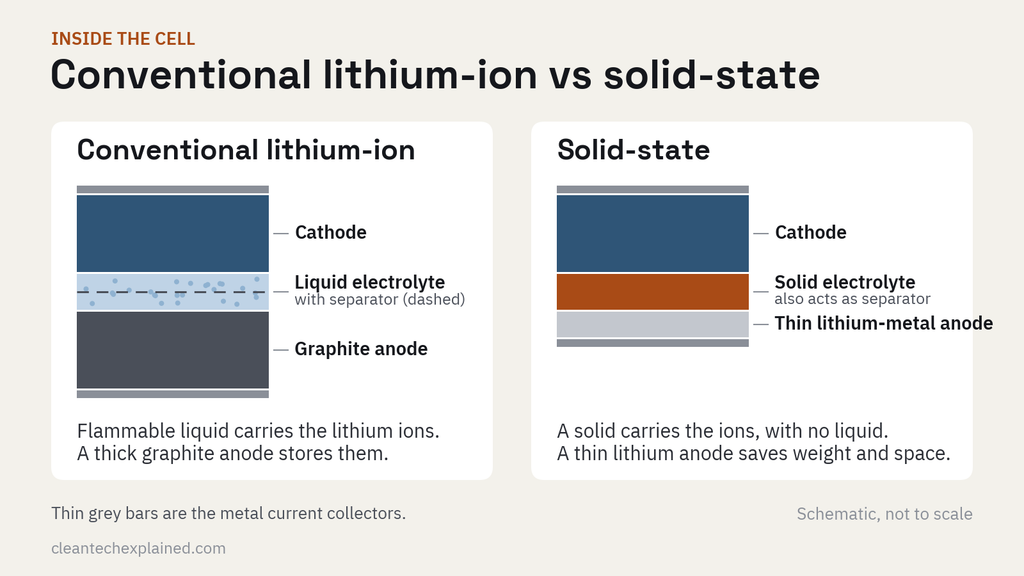
Every lithium-ion cell has three main parts: a cathode, an anode, and an electrolyte between them. When you charge the battery, lithium ions travel through the electrolyte from cathode to anode. When you drive, they travel back.
In a conventional cell, the electrolyte is a liquid: a lithium salt dissolved in organic solvents. It conducts ions well, but it is flammable, and it limits which materials can be used for the anode.
A solid-state battery swaps that liquid for a solid that still lets lithium ions pass. The solid also does the job of the separator, the thin sheet that stops the two electrodes from touching.
Why it matters
- More energy in the same space. A solid electrolyte can make it practical to use a lithium-metal anode, or no anode material at all at the time of manufacture, in place of graphite. That is where most of the energy gain comes from. Today’s best nickel-based cells store roughly 250 to 300 Wh/kg. Solid-state developers are aiming for 400 to 500 Wh/kg. Samsung SDI quotes its target by volume instead: 900 Wh/L, about 40% more than the roughly 650 Wh/L of current liquid cells.
- Faster charging. Several developers are targeting a 10 to 80% charge in around 10 minutes, against roughly 20 to 30 minutes for today’s best fast-charging EVs. Our guide to how long it takes to charge an electric car has current numbers.
- Better safety. Removing the flammable liquid reduces fire risk. It does not make a battery impossible to damage.
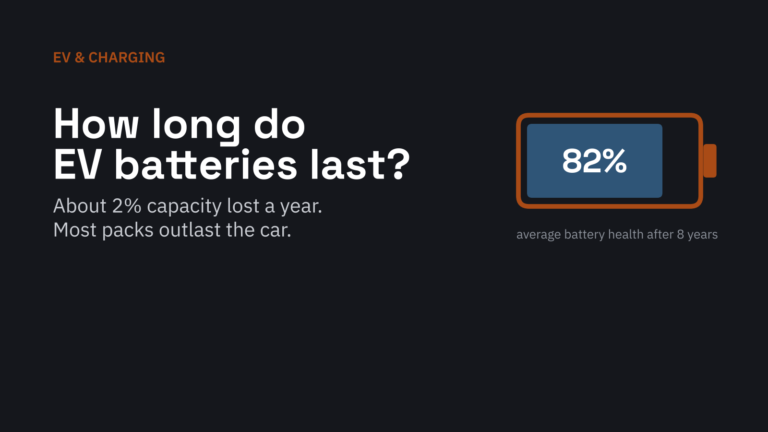
- Longer life, at least in principle, because some of the reactions that slowly degrade liquid cells are reduced. Today’s packs already age slowly; see how long EV batteries last.
These are targets, not guarantees. Laboratory cells have hit many of them one at a time. Hitting all of them at once, in millions of cells, at a competitive price, is the unsolved part.
The three types of solid electrolyte
| Type | Strength | Weakness | Who is working on it |
|---|---|---|---|
| Sulfide | Conducts ions almost as well as liquid; soft enough to press into good contact | Reacts with moisture, so it needs very dry factories | Toyota, Samsung SDI, CATL, BYD, Solid Power |
| Oxide (ceramic) | Chemically stable and non-flammable | Brittle and difficult to make in large, thin sheets | QuantumScape |
| Polymer | Easiest to manufacture with existing equipment | Lower conductivity, often needs warmth or some liquid to work well | Factorial and others |
Most of the large carmakers and cell makers have settled on sulfides for cars. That is why Toyota’s partners include Idemitsu, an oil refiner that in early 2026 began building a pilot plant for solid electrolyte. Idemitsu expects to finish it by the end of 2027, with eventual output of several hundred tonnes a year.
Why solid-state batteries are so hard to build
Solids do not flow. A liquid seeps into every pore of an electrode. A solid has to be pressed into contact, and that contact must survive thousands of cycles in which the electrodes swell and shrink. Many designs need the cells to be held under pressure.
Dendrites still form. Lithium metal can grow needle-like filaments that push through the electrolyte and short the cell. Solid electrolytes were expected to stop this. In practice, dendrites can travel through cracks and grain boundaries in the solid.
New factories. Sulfide materials need extremely dry rooms. Ceramic separators need defect-free sheets only tens of microns thick. Neither fits neatly into today’s battery plants.
Cost. Conventional cells keep getting cheaper. Solid-state has to chase a moving target, starting from a much higher cost. Samsung SDI is aiming its first cells at luxury cars and robots, a market that can absorb cell prices above $150 per kWh.
Semi-solid vs all-solid-state: read the label
This is the most confusing part of the topic. Cars marketed with “solid-state” batteries are already on the road in China, but they use semi-solid-state cells, which keep some liquid electrolyte.
- NIO has offered a 150 kWh semi-solid pack since 2024.
- SAIC began delivering the MG4 with a semi-solid battery in December 2025, priced at around $14,500 in China. The company says the cell contains about 5% liquid electrolyte, and plans to bring the technology to Europe by the end of 2026.
- Dongfeng plans to start fitting a 350 Wh/kg hybrid solid-liquid battery to cars in the fourth quarter of 2026, with a goal of 50,000 vehicles in 2027. Chery has set the same quarter for its first semi-solid vehicles.
- Cell maker SVOLT began volume production of a hybrid solid-liquid battery in the third quarter of 2026.
Semi-solid cells are a real improvement, mainly in safety and cold-weather behavior. They are not the large jump in energy density that all-solid-state promises.
China’s solid-state battery standard
China has now drawn a line. GB/T 43568-2026, “Electric vehicle solid-state battery, Part 1: Terminology and classification”, took effect on July 1, 2026. It sorts batteries by the share of liquid electrolyte they contain:
| Class | Liquid electrolyte by mass | Extra test |
|---|---|---|
| Liquid battery | More than 20% | None |
| Hybrid solid-liquid battery | 5% to 20% | None |
| All-solid-state battery | Less than 5% | No more than 0.5% weight loss after 6 hours of vacuum drying at 120 °C |
The standard replaces loose marketing terms such as “semi-solid” and “quasi-solid” with these classes. It is a recommended national standard (the “T” in GB/T), not a safety rule, and solid-state packs must still pass the same mandatory battery safety tests as any other EV battery in China. If you see “solid-state” in an advertisement, check which class it is.
| Conventional lithium-ion | Semi-solid (hybrid solid-liquid) | All-solid-state | |
|---|---|---|---|
| Electrolyte | Liquid | Mostly solid or gel, 5 to 20% liquid | Solid, under 5% liquid |
| On sale in cars? | Yes, worldwide | Yes, mainly China | No |
| Main benefit | Cheap and proven | Improved safety | Energy density, charging speed, safety |
| Main drawback | Flammable electrolyte | Modest gains | Cost and manufacturing |
Who is closest?
Here is where the main players stood at the end of October 2026, based on their own announcements:
| Company | Electrolyte | Stated target | Status in 2026 |
|---|---|---|---|
| Toyota | Sulfide | First EV in 2027 or 2028 | Cathode deal with Sumitomo Metal Mining; Idemitsu building a solid electrolyte pilot plant |
| Samsung SDI | Sulfide | Mass production in the second half of 2027 | Pilot line in Suwon, Korea; 900 Wh/L target |
| CATL | Sulfide | Small-scale production in 2027, mass production around 2030 | 20 Ah trial cells; 500 Wh/kg target |
| BYD | Sulfide | Limited batches and first vehicle in 2027, mass production around 2030 | Development through its FinDreams battery unit |
| QuantumScape | Oxide (ceramic) | No car launch date; 100 MWh production line from 2028 | Eagle pilot line running since February 2026; partners include PowerCo and Honda |
| Dongfeng, Chery | Hybrid now, all-solid-state later | Semi-solid cars from late 2026; all-solid-state vehicle validation in 2027 | 350 to 400 Wh/kg cells announced |
| LG Energy Solution | Sulfide | Commercial launch moved to 2029 | Development |
Toyota solid-state battery
Toyota has worked on solid-state cells for well over a decade and holds more patents in the field than any other company. It is targeting its first EV with an all-solid-state battery in 2027 or 2028, aiming for about 1,000 km (620 miles) of range and a 10 to 80% charge in around 10 minutes. In October 2025, Toyota and Sumitomo Metal Mining announced a durable cathode material and agreed to mass produce it, with Sumitomo aiming to start as early as the fiscal year beginning April 2028. Idemitsu is supplying the sulfide electrolyte materials and started building its pilot electrolyte plant in early 2026.
Toyota has missed earlier dates, and the first cars are expected to be low-volume, high-priced models. Treat 2027 to 2028 as the start of a slow rollout.
Samsung SDI
The Korean cell maker runs a pilot line for sulfide-based cells in Suwon. In October 2026 it repeated its plan to start mass production of 900 Wh/L all-solid-state cells in the second half of 2027, aimed first at luxury cars and robots.
QuantumScape
The Volkswagen-backed US company makes a ceramic separator for lithium-metal cells. In 2025 it brought a faster separator process into its baseline production, expanded its licensing deal with Volkswagen’s battery unit PowerCo, and showed its cells running in a Ducati electric motorcycle. Its Eagle pilot line opened in February 2026, and Honda signed on as a partner in June. In October 2026 the company announced a 100 MWh production line, targeted to start in 2028, and began pitching its cells for data center energy storage, aerospace and defense as well as cars. It has not given a date for its first car.
CATL and BYD
The two largest battery makers are both planning small-scale all-solid-state production in 2027. CATL’s chairman said in June 2026 that the technology was at about level 4 on a 9-point readiness scale, with true mass production around 2030. By October, CATL had moved to 20 Ah sulfide-based trial cells, aiming for 500 Wh/kg. BYD has given a similar outline: first vehicles in 2027, large volumes around 2030.
Dongfeng and Chery
Both Chinese carmakers are developing their own cells. Dongfeng says its 400 Wh/kg all-solid-state battery is in prototype testing in vehicles, while its 350 Wh/kg hybrid cell goes into cars first. Chery says its Rhinoceros S cell reaches 400 Wh/kg and plans to start its solid-state pilot line in 2027.
Mercedes-Benz and Factorial
Mercedes put a test car with a Factorial lithium-metal solid-state battery on the road in 2025. It remains a development program.
A realistic timeline
- Now: semi-solid (hybrid solid-liquid) batteries in production cars in China, reaching Europe soon.
- 2027 to 2028: the first all-solid-state cars, in small numbers, in expensive models.
- Around 2030: larger volumes, if the first generation goes well.
- After 2030: mainstream prices, if costs fall as hoped.
Every date in this field has slipped before; LG Energy Solution has already pushed its launch to 2029. The pattern to expect is the one LFP and NMC followed: a slow start in niche models, then years of cost reduction.
Should you wait for a solid-state battery?
For almost everyone, no. Today’s batteries already last longer than most people keep a car, and prices are still falling. A first-generation solid-state car will cost more and will come with first-generation risks. If you need a car now, compare the chemistries you can actually buy in our guide to LFP vs NMC batteries, and plan your home charging with Level 1 vs Level 2 EV chargers.
For home storage, solid-state matters even less. Weight and size are not the constraint for a battery on a wall, and LFP is already safe, durable and cheap. See our solar battery guide and LiFePO4 battery explainer. The newer chemistry more likely to reach stationary storage first is the sodium-ion battery.
FAQ
What is a solid-state battery?
A lithium battery that uses a solid electrolyte instead of a liquid one. The solid carries lithium ions between the electrodes and also keeps them apart.
Are solid-state batteries available now?
Not all-solid-state ones for cars. Semi-solid-state batteries, which contain some liquid, are on sale in several Chinese EVs. Small solid-state cells are also used in some electronics and medical devices.
When will the Toyota solid-state battery arrive?
Toyota is targeting 2027 or 2028 for its first EV with an all-solid-state battery. Early production is expected to be limited.
What counts as a solid-state battery in China?
Under GB/T 43568-2026, an all-solid-state battery must contain less than 5% liquid electrolyte by mass and lose no more than 0.5% of its weight in a vacuum drying test. Cells with 5% to 20% liquid are hybrid solid-liquid batteries, the class often marketed as semi-solid.
Are solid-state batteries safer?
They remove the flammable liquid electrolyte, which lowers fire risk. They still store a lot of energy and can still fail if damaged or badly made.
How is a solid-state battery different from lithium-ion?
It is still a lithium battery. The difference is the electrolyte: solid in one, liquid in the other. A solid electrolyte makes it possible to use a lithium-metal anode, which stores more energy than graphite.
Will solid-state batteries be more expensive?
At first, yes. New materials and new factories mean high early costs, which is why the first cells are aimed at luxury cars. Prices should fall as production grows, but conventional batteries are getting cheaper at the same time.
Sources
- Reuters: Toyota, Sumitomo Metal make advances in cathode materials for solid-state batteries
- Electrek: Toyota aims to launch all-solid-state EV batteries
- Carscoops: Idemitsu starts building a solid electrolyte plant for Toyota (February 2026)
- Electrek: CATL chief says solid-state batteries are at level 4 of 9
- Electrek: CATL pushes ahead with 20 Ah solid-state EV batteries (October 28, 2026)
- SMM: Samsung SDI reiterates 900 Wh/L all-solid-state mass production in H2 2027 (October 2026)
- Battery Design: GB/T 43568-2026, electric vehicle solid-state battery terminology and classification
- All About Industries: China defines what may be called a solid-state battery
- Electrek: MG begins deliveries of EV with semi-solid-state battery
- EnergyTrend: Dongfeng and Chery release latest progress on solid-state batteries (October 26, 2026)
- SMM: Solid-state battery industry in July 2026 (standard, production lines, semi-solid batteries)
- QuantumScape: Q4 fiscal 2025 letter to shareholders
- QuantumScape: third quarter 2026 business and financial results (October 21, 2026)
This article reflects the author’s personal views and publicly available information as of October 30, 2026. Timelines in this field change often. It is not investment or purchasing advice.