EESM Motor Explained: How Magnet-Free EV Motors Work

Most electric cars are driven by permanent magnet motors that rely on neodymium and other rare earths. A growing number are not. Renault, BMW and Nissan use a different design called an EESM, short for electrically excited synchronous motor, in which a copper coil on the rotor takes the place of the magnets. This guide explains how an EESM motor works, how it gets current into a spinning rotor, where it beats a magnet motor and where it falls short, and which cars use one today.
Short answer: An EESM motor is a synchronous electric motor whose rotor field comes from a direct current flowing through copper windings instead of from permanent magnets. It needs no rare earths, and because the rotor field can be turned up, down or off, it is very efficient at motorway speeds and creates no drag when coasting. The trade-offs are some extra losses at low load, a rotor that has to be powered and cooled, and, in most current designs, brushes and slip rings that wear slowly over time.
Key takeaways
- EESM stands for electrically excited synchronous motor. It is also called a wound rotor synchronous motor (WRSM), an externally excited or separately excited synchronous motor, or, at BMW, a current-excited synchronous motor.
- The stator is the same as in a permanent magnet motor. Only the rotor is different: copper windings fed with DC instead of magnets.
- Renault has built EESMs since 2011. BMW uses them in its fifth-generation drives and on the rear axle of every Neue Klasse model, and the Nissan Ariya has one.
- BMW says its sixth-generation drive cuts energy losses by 40%, weight by 10% and cost by 20% compared with the previous generation.
- Most production EESMs still feed the rotor through brushes and slip rings. Contactless designs from ZF, Mahle and Valeo remove that wear part and are moving toward production.
What is an EESM motor?
Every synchronous motor has two parts that each make a magnetic field. The stationary part, the stator, carries three-phase windings that create a rotating field. The rotor carries a second field that locks onto the stator’s field and turns in step with it, which is what “synchronous” means.
In a permanent magnet synchronous motor (PMSM), the rotor field comes from neodymium magnets buried in the rotor steel. In an EESM, it comes from copper coils wound around the rotor’s poles. When a direct current flows through those coils, the rotor becomes an electromagnet. Switch the current off and the rotor is just a lump of steel and copper.
That makes an EESM one of the four main families of rare earth free electric motors, alongside induction motors and the two kinds of reluctance motor. It is the one that comes closest to the behavior of a permanent magnet motor.
How an EESM works
An EESM gives the motor controller two separate handles instead of one.
- Stator current, supplied by the main inverter, sets the rotating field and the torque, exactly as in a PMSM.
- Rotor (field) current, supplied by a small extra converter, sets the strength of the rotor’s magnetic field.
In a magnet motor the rotor field is fixed. That is fine at low speed, but as the motor spins faster the magnets induce a rising voltage in the stator windings, called back-EMF. Above a certain speed that voltage approaches the battery voltage, and the controller has to push extra current into the stator just to cancel part of the magnets’ field. This “field weakening” current produces heat without producing torque.
An EESM avoids the problem by simply turning down its rotor current. At low speed the controller uses a strong field for maximum torque; on the motorway it uses a weaker one. The controller can also choose the combination of stator and rotor current that wastes the least energy at each operating point, which is why EESMs tend to be at their best in steady high-speed driving.
Getting current into a spinning rotor
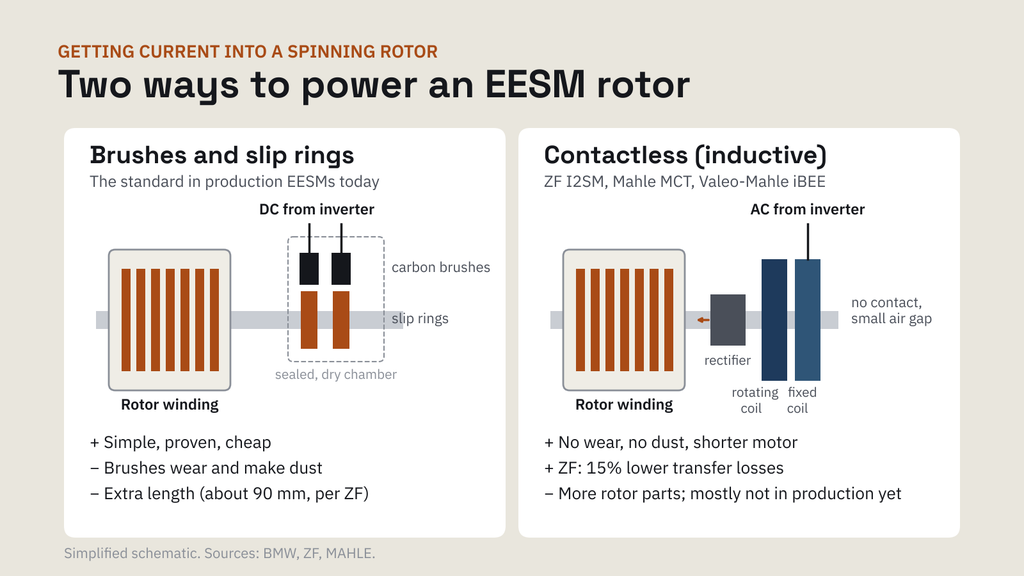
The obvious engineering problem is that the rotor turns at up to tens of thousands of revolutions per minute, and it still needs a supply of current. There are two ways to deliver it.
Brushes and slip rings
The traditional solution, used in most EESMs on the road today, is a pair of smooth copper rings on the rotor shaft with carbon brushes pressing against them. Current flows from the brushes into the rings and on to the rotor windings. Unlike the commutator in an old-style DC motor, slip rings do not switch the current, so they run with little sparking and the brushes last a long time.
They do still wear, and they shed fine carbon dust. BMW places them in a completely sealed compartment so that no particles escape into the motor. The brush assembly also adds length: ZF estimates that conventional EESMs need around 90 mm more axial space than an equivalent permanent magnet motor, which matters when the motor has to fit between the wheels.
Contactless (inductive) excitation
The newer approach works like a wireless phone charger built into the shaft. A fixed coil and a rotating coil sit face to face across a small air gap, forming a rotary transformer. The inverter feeds the fixed coil with alternating current, the rotating coil picks it up, and a small rectifier on the rotor turns it into the DC the windings need.
Nothing touches, so nothing wears. ZF’s I2SM puts the inductive exciter inside the rotor shaft, which ZF says removes the extra 90 mm of length and cuts energy transfer losses into the rotor by 15% compared with conventional designs. Mahle’s contactless transmitter works on the same principle, and Mahle says its motor reaches more than 95% efficiency at almost all operating points. The cost is extra electronics spinning on the rotor, which must survive heat, vibration and centrifugal force.
Advantages of EESM motors
- No rare earths. The rotor uses copper and electrical steel instead of neodymium, praseodymium and, in hot-running motors, dysprosium or terbium. That removes exposure to a supply chain in which China refines about 84% of the key magnet metals. Our guide to neodymium explains that concentration.
- Efficiency at high speed. With no fixed magnets to fight, the motor wastes less energy on the motorway, where long-distance range is decided.
- No drag when coasting. An unpowered magnet motor still drags slightly, because its spinning magnets induce losses in the stator steel. An EESM with its rotor current switched off spins almost freely. BMW notes that this lets it avoid the clutch some carmakers fit to disconnect a magnet motor on the secondary axle.
- No magnets to demagnetize. A permanent magnet loses strength if it gets too hot. A wound rotor has no such limit, only the temperature limit of its insulation.
- Lower production emissions. ZF says avoiding rare earth magnets can cut the production carbon footprint by up to 50%, and Valeo and Mahle quote more than 40% for their design. These are manufacturer figures.
Disadvantages of EESM motors
- Losses at low load. Keeping the rotor energized costs power all the time the motor is working. In slow city driving, where the motor delivers little torque, that fixed loss is a bigger share of the total, so a good PMSM usually has the edge there.
- A hot rotor. The rotor current heats the rotor windings, and heat is harder to remove from a spinning part than from the stator. Production EESMs use oil cooling through the shaft or spray cooling.
- Size and weight. For the same power, an EESM is usually somewhat larger than a top-end magnet motor, especially with brushes and slip rings.
- Brush wear. Slip-ring designs have a part that wears, even if it is designed to last the life of the car.
- More copper and an extra converter. Copper has its own price and supply concerns, and the rotor needs its own small power supply and control.
EESM vs PMSM vs induction motor
| EESM | Permanent magnet (PMSM) | Induction | |
|---|---|---|---|
| Rotor field from | DC in copper windings | Rare earth magnets | Currents induced in a copper or aluminum cage |
| Rare earths | None | Yes (Nd, Pr, often Dy or Tb) | None |
| Efficiency in the city | Good | Best | Lowest |
| Efficiency on the motorway | Best or equal | Good | Good |
| Drag when unpowered | Almost none | Some | Almost none |
| Power density | High | Highest | Medium |
| Rotor heating | Yes, from field current | Low | Yes, from induced current |
| Wear parts | Brushes (unless contactless) | None | None |
| Typical role | Main drive motor | Main drive motor | Secondary axle or performance motor |
In practice the choice is close. Battery size, aerodynamics, tires and software matter far more to a car’s range than the motor type, and the best EESM cars post range figures on par with magnet-motor rivals.
Which cars use an EESM?
Renault
Renault has sold EESM-powered cars longer than anyone. Its first-generation motor powered the Kangoo Z.E. from 2011 and the Zoe from 2012, at 57 to 100 kW, and a 60 kW version went into the Twingo Electric. The smaller, lighter second generation, built at Cléon in France, arrived in the Megane E-Tech Electric in 2022 with up to 160 kW. It is also used in the Scenic E-Tech and Alpine A290, and a 110 kW version drives the Renault 5 and Renault 4 E-Tech.
The third generation, known as E7A, is rated at 200 kW and 400 Nm, runs on 800 volts, and is about 30% smaller than the current motor. Renault says Cléon will build it from 2027.
BMW
BMW switched to what it calls a current-excited synchronous motor with its fifth-generation eDrive, first in the 2020 iX3 and then in the i4, iX, i5 and i7. The sixth-generation drive for the Neue Klasse uses an upgraded EESM on the rear axle, with an induction motor on the front axle in all-wheel-drive versions. BMW plans rear motors from about 200 to 300 kW.
Compared with a fifth-generation all-wheel-drive car, BMW says the new system cuts energy losses by 40%, weight by 10% and manufacturing cost by 20%. The motors are built in Steyr, Austria, which produced 8,500 of them in 2025, opened a second line in April 2026 and aims for more than 100,000 this year. The iX3 M60 xDrive, announced in October 2026, uses a Gen6 EESM with a stronger 420 A inverter at the rear, part of a 450 kW system.
Nissan
The Nissan Ariya, launched in 2022, uses an EESM with a copper-wound rotor, making it one of the few Japanese-brand EVs with no rare earth magnets in its drive motor.
For a full list of models, see our guide to which EVs don’t use rare earth magnets.
What comes next for EESMs
The next step is the brushless EESM. Several large suppliers are working on it:
- ZF has developed the I2SM with an inductive exciter in the rotor shaft, offered for 400 and 800 volt systems, and says it matches permanent magnet motors on power and torque density.
- Mahle has developed a contactless magnet-free motor with efficiency above 95% at most operating points, aimed at everything from small cars to commercial vehicles.
- Valeo and Mahle are jointly developing the iBEE (inner Brushless Electrical Excitation) system for upper-segment cars, with peak power of 220 to 350 kW. Commercialization has been reported for around 2028.
If brushless designs reach mass production at a competitive cost, they remove the EESM’s main practical drawback. Permanent magnet motors are still expected to remain the most common EV motor, but the share of magnet-free designs is rising. Other routes to the same goal, such as ferrite magnets and new rare-earth-free magnet materials, are covered in our guide to rare earth magnet alternatives.
Frequently asked questions
What does EESM stand for?
Electrically excited synchronous motor (or machine). The same design is also called a wound rotor synchronous motor, externally excited synchronous motor or separately excited synchronous motor. BMW calls it a current-excited synchronous motor.
Is an EESM better than a permanent magnet motor?
Neither is better everywhere. A permanent magnet motor is usually a little more efficient in city driving and more compact. An EESM matches or beats it at motorway speeds, creates no drag when idle and needs no rare earths.
Do EESM motors have brushes?
Most production EESMs do, using carbon brushes on slip rings in a sealed chamber. Contactless versions that transfer power inductively are being developed by ZF, Mahle and Valeo.
Do EESM brushes need replacing?
They are designed to last the life of the vehicle under normal use, and carmakers do not list them as a routine service item. They are still a wear part, which is one reason suppliers are developing brushless designs.
Does Tesla use EESM motors?
No. Tesla uses permanent magnet motors and induction motors. In September 2026 it showed a rare-earth-free drive unit for the Cybercab, but it has not said what kind of motor it is.
Which BMW models use an EESM?
The i4, iX, i5, i7 and the 2020-generation iX3 use BMW’s fifth-generation EESM. The Neue Klasse iX3 and i3 use the sixth-generation version on the rear axle.
Is an EESM motor more expensive?
Not necessarily. It saves the cost of rare earth magnets but adds copper, a rotor power supply and, in brushed designs, slip rings. BMW says its latest EESM-based drive costs 20% less to make than the previous generation.
Sources
- Renault Group, All about electric motors with no rare earths
- electrive, BMW introduces sixth drive generation, February 2025
- electrive, BMW starts series production on second e-drive motor line at Steyr plant, April 2026
- BMW Group, The new BMW iX3 M60 xDrive, October 2026
- BMWBLOG, BMW Gen6 electric motors, February 2025
- BMWBLOG, BMW’s externally excited electric motor explained, November 2023
- Magnetics Magazine, ZF makes magnet-free electric motor uniquely compact and competitive, September 2023
- MAHLE, MAHLE develops highly efficient magnet-free electric motor, May 2021
- EV Design & Manufacturing, Magnet-free electric motor technology expands (Valeo and MAHLE iBEE)
Featured image and diagram: original graphics by CleanTech Explained. This article reflects the author’s personal views and publicly available information as of October 2026. It is general information, not engineering or purchasing advice.