Ferrite Magnets (Ceramic Magnets) Explained: Grades, Strength and Uses

Ferrite magnets are the dark grey magnets found in loudspeakers, small electric motors and on refrigerator doors. They are also called ceramic magnets, because they are made by pressing and firing a powder, much like pottery. They are weak compared with neodymium magnets, but they are cheap, they do not rust and they contain no rare earth elements, which is why they still make up most of the world’s magnets by weight.
This guide explains what ferrite magnets are made of, how strong they are, what the grades mean, and where they fit as manufacturers look for ways to use fewer rare earths.
Short answer
A ferrite magnet is a permanent magnet made from iron oxide combined with strontium or barium. It has roughly one-tenth the energy of a neodymium magnet of the same size, but it costs far less, resists corrosion without any coating and works at temperatures up to about 250 °C. Ferrite magnets and ceramic magnets are the same thing.
Key takeaways
- Ferrite magnets are made mostly of iron oxide, with strontium or barium. They contain no rare earths, nickel or cobalt.
- They are the least expensive permanent magnets and account for about 85% of permanent magnets by weight.
- Common grades have a maximum energy product of about 3.3 to 4.8 MGOe, against 30 to 55 MGOe for neodymium magnets.
- They do not rust, they are electrical insulators, and they tolerate heat well, with a Curie temperature of about 450 °C.
- Unlike most magnets, ferrite is more easily demagnetized in the cold than in the heat.
- Several companies are developing EV motors that use ferrite instead of rare earth magnets, but they are larger for the same power.
What is a ferrite magnet?
A ferrite magnet is a hard ceramic made from iron oxide and either strontium carbonate or barium carbonate. The finished material is strontium ferrite (SrFe12O19) or barium ferrite (BaFe12O19). About 90% of its weight is iron oxide, the same compound as rust, which is one reason it is so cheap.
Engineers call these materials hard ferrites or hexaferrites, after their hexagonal crystal structure. “Hard” here means magnetically hard: difficult to demagnetize. Soft ferrites are a different family, used in transformers and inductors, and they do not stay magnetized.
Ferrite magnets were developed at the Philips Research Laboratories in the Netherlands. Philips announced the first barium ferrite magnet in 1952 under the name Ferroxdure, and by 1954 its researchers had worked out how to align the crystals during pressing. That method is still the basis of ferrite production today.
How strong are ferrite magnets?
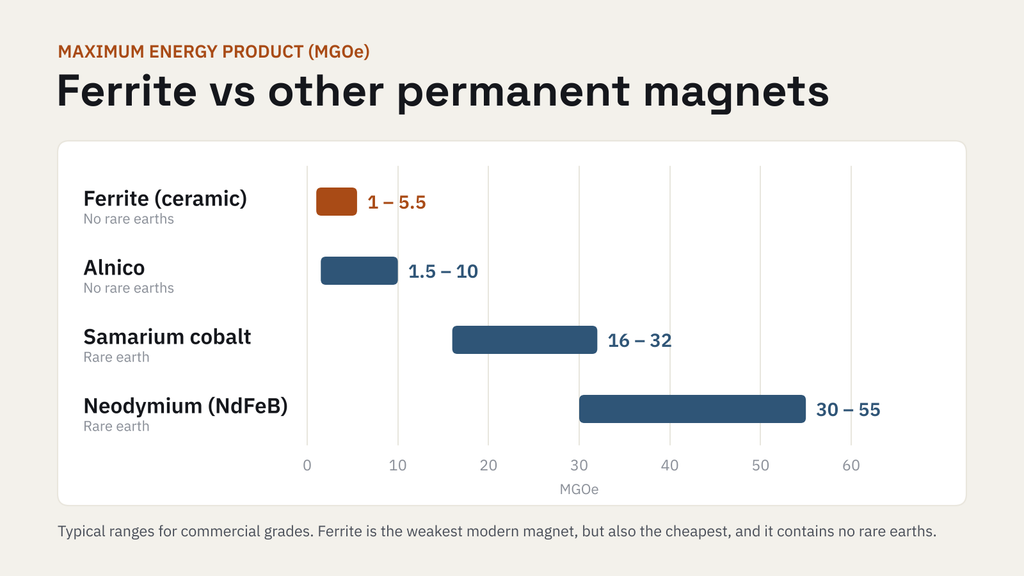
The usual measure of magnet strength is the maximum energy product, written BHmax and given in megagauss-oersteds (MGOe) or kilojoules per cubic metre. Ferrite sits at the bottom of the range for modern magnets:
- Isotropic ferrite, with randomly oriented crystals: about 1 MGOe
- Standard anisotropic grades: about 3.3 to 4.8 MGOe
- The best commercial grades, which add small amounts of lanthanum and cobalt: up to about 5.5 MGOe
The theoretical ceiling for this material is only a little higher, at about 45 kJ/m³, so ferrite cannot be improved much further. A neodymium magnet reaches 30 to 55 MGOe, around ten times as much. Samarium cobalt magnets, the other rare earth family, fall in between at 16 to 32 MGOe. Alnico magnets, the other rare-earth-free family, sit in a similar energy range but trade ferrite’s low cost for a much higher operating temperature.
Ferrite magnet grades
Two naming systems are common. The American system uses C for ceramic (C1, C5, C8). The Chinese system uses Y (Y10T, Y30, Y35). In both, a higher number generally means a stronger magnet.
| Grade | Remanence Br (mT) | Intrinsic coercivity Hcj (kA/m) | BHmax (MGOe) | Notes |
|---|---|---|---|---|
| C1 | 230 | 258 | 1.05 | Isotropic, can be magnetized in any direction |
| Y10T | 200–235 | 210–280 | 0.8–1.2 | Isotropic |
| C5 | 380 | 199 | 3.4 | General purpose, loudspeakers |
| Y30 | 370–400 | 180–220 | 3.3–3.8 | General purpose |
| C8 | 385 | 242 | 3.5 | Higher coercivity, motors |
| Y30BH | 380–390 | 231–245 | 3.4–3.8 | Higher coercivity, motors |
| Y35 | 430–450 | 217–241 | 4.2–4.8 | High strength |
Values are typical figures from supplier data and vary slightly between manufacturers.
How ferrite magnets behave with temperature
Ferrite handles heat well. Its Curie temperature, where all magnetism is lost, is about 450 °C, and suppliers quote maximum working temperatures of about 250 to 300 °C. Its strength does fall as it warms, by about 0.2% per degree, but that loss returns when the magnet cools.
The unusual part is the cold. In most magnets, resistance to demagnetization falls as temperature rises. In ferrite it does the opposite: coercivity rises by roughly 0.3% per degree of warming and falls by the same amount as the magnet cools. A ferrite magnet is therefore most at risk of being permanently weakened in freezing conditions, not hot ones.
A materials engineer’s note: This is the detail that most often catches designers who are used to neodymium. With NdFeB you check the demagnetization margin at the hottest operating point. With ferrite you check it at the coldest, for example a motor drawing peak current on a winter start. A thin ferrite magnet in a poorly designed magnetic circuit can lose strength at temperatures that would not trouble any other magnet type.
How ferrite magnets are made
- Mixing and calcining. Iron oxide and strontium carbonate are blended and heated to above 1,000 °C, where they react to form ferrite.
- Milling. The material is ground to a powder of about one micrometre, small enough for each particle to be a single magnetic domain.
- Pressing. The powder is pressed into shape. For anisotropic grades this is done in a magnetic field, usually as a wet slurry, so that the particles line up in one direction.
- Sintering. The pressed part is fired at about 1,200 °C until it fuses into a dense ceramic.
- Grinding and magnetizing. The part is ground to size with diamond tools and then magnetized.
Because the result is a ceramic, ferrite is hard and brittle. It cannot be drilled or machined with ordinary tools, and it chips if dropped.
Advantages and limits
The main advantages:
- Low cost. The raw materials are abundant and inexpensive.
- No corrosion. Ferrite is already an oxide, so it does not rust and needs no plating or coating.
- Electrical insulation. It does not conduct electricity, so it suffers almost no eddy current losses at high speed.
- Heat tolerance. It works at higher temperatures than standard neodymium grades.
- Secure supply. It needs no rare earths and no heavy rare earths such as dysprosium.
The main limits:
- Low strength. A ferrite magnet must be much larger and heavier to do the same job.
- Brittleness. It cracks and chips easily.
- Cold sensitivity. It can be demagnetized at low temperatures.
Ferrite vs neodymium magnets
| Ferrite | Neodymium (NdFeB) | |
|---|---|---|
| Main ingredients | Iron oxide, strontium or barium | Neodymium, iron, boron |
| Rare earths | None | Yes |
| Maximum energy product | About 1 to 5.5 MGOe | About 30 to 55 MGOe |
| Curie temperature | About 450 °C | About 315 °C |
| Corrosion | Does not rust | Rusts unless coated |
| Weak point | Cold temperatures | High temperatures |
| Density | About 5 g/cm³ | About 7.5 g/cm³ |
| Cost | Lowest of any permanent magnet | Much higher, and volatile |
Choose ferrite when space and weight are not tight and cost matters. Choose neodymium when the magnet has to be small, light and powerful. For other options between the two, see our guide to rare earth magnet alternatives.
What ferrite magnets are used for
- Loudspeakers and headphones
- Small DC motors in cars, such as those for wipers, windows, seats and fans
- Motors in household appliances and power tools
- Refrigerator magnets and door seals, where ferrite powder is mixed into flexible rubber or plastic
- Magnetic separators and holding magnets
- Sensors, toys and craft magnets
One 2013 estimate put ferrite at 85% of all permanent magnets by weight but only about half of the market by value. That gap shows how cheap each kilogram is.
Can ferrite magnets replace rare earths in EV motors?
Partly. Ferrite cannot simply be swapped into a motor designed for neodymium magnets, because the motor would lose most of its torque. The motor has to be redesigned to get more of its torque from the shape of the rotor and less from the magnets. This design is called a ferrite-assisted synchronous reluctance motor.
Real examples exist:
- Chevrolet Volt. The second-generation Volt, launched for the 2016 model year, used ferrite magnets in one of its two motors to cut rare earth use.
- Proterial. In 2023 the Japanese magnet maker, formerly Hitachi Metals, reported a prototype EV motor using its NMF-15 ferrite. It reached 102 kW at up to 15,000 rpm, against 110 kW for a comparable neodymium motor.
- Astemo. In October 2025 the Japanese supplier announced a rare-earth-free motor whose 180 kW main drive uses ferrite magnets as an assist. Astemo says the main drive is up to 30% larger than a rare earth motor and is targeted for practical use around 2030.
The pattern is consistent: ferrite motors can reach useful power, but they are bigger and heavier, and they must be protected against cold demagnetization. For how they compare with other magnet-free designs, see rare earth free electric motors. Newer materials such as iron nitride aim to fill the wide gap between ferrite and neodymium.
FAQ
Are ferrite magnets and ceramic magnets the same?
Yes. Ceramic magnet is the common name, mainly in North America. Ferrite magnet and hard ferrite are the technical names.
What are ferrite magnets made of?
Iron oxide combined with strontium or barium, forming strontium ferrite (SrFe12O19) or barium ferrite (BaFe12O19). About 90% of the weight is iron oxide.
Do ferrite magnets rust?
No. Ferrite is an oxide already, so it does not corrode in water or humid air and needs no coating.
How strong is a ferrite magnet compared with neodymium?
Roughly one-tenth as strong for the same volume. Common ferrite grades reach about 3.3 to 4.8 MGOe, while neodymium magnets reach 30 to 55 MGOe.
What is the maximum temperature for ferrite magnets?
Suppliers quote maximum working temperatures of about 250 to 300 °C. The Curie temperature, where magnetism is lost completely, is about 450 °C.
Do ferrite magnets lose strength over time?
Very little. Kept away from strong opposing fields and extreme cold, a ferrite magnet keeps its strength for decades.
Can ferrite magnets be used outdoors?
Yes. They do not corrode, which makes them a common choice for outdoor and wet uses. In very cold climates, the magnet and its circuit should be designed for low temperatures.
Sources
- de Julián Fernández et al., “Permanent Magnets Based on Hard Ferrite Ceramics” (review, 2023)
- e-Magnets UK: Grades of ferrite
- Eclipse Magnetics: Ferrite and ceramic magnets datasheet
- Alliance LLC: Ceramic magnets technical data
- SAE International: Next Generation Voltec Electric Machines, Design and Optimization for Performance and Rare-Earth Mitigation (2015)
- Charged EVs: Proterial prototypes 100 kW motor using ferrite magnets (2023)
- Astemo: New rare-earth-free motor for battery electric vehicles (2025)
This article reflects the author’s personal views and publicly available information as of October 2026. It is general information, not engineering or purchasing advice.