Samarium Cobalt Magnets (SmCo) Explained: Grades, Heat Limits and Uses

Samarium cobalt magnets were the first rare earth magnets, and for about fifteen years they were the strongest magnets you could buy. Neodymium took that title in the 1980s, but samarium cobalt never went away. It does one thing better than any other permanent magnet: it keeps working when it gets hot.
Short answer
Samarium cobalt (SmCo) magnets are rare earth magnets made mostly of samarium and cobalt. They are somewhat weaker than neodymium magnets at room temperature, but they work at up to 250–350 °C, resist corrosion without a coating, and lose very little strength as temperature changes. They cost several times more than neodymium, so they are used where heat or reliability matters more than price: aerospace, defense, satellites, motorsport and downhole tools.
Key takeaways
- There are two families: SmCo5 (1:5), the original, and Sm2Co17 (2:17), which is stronger and handles more heat.
- Typical strength is 16–32 MGOe, against up to about 55 MGOe for neodymium.
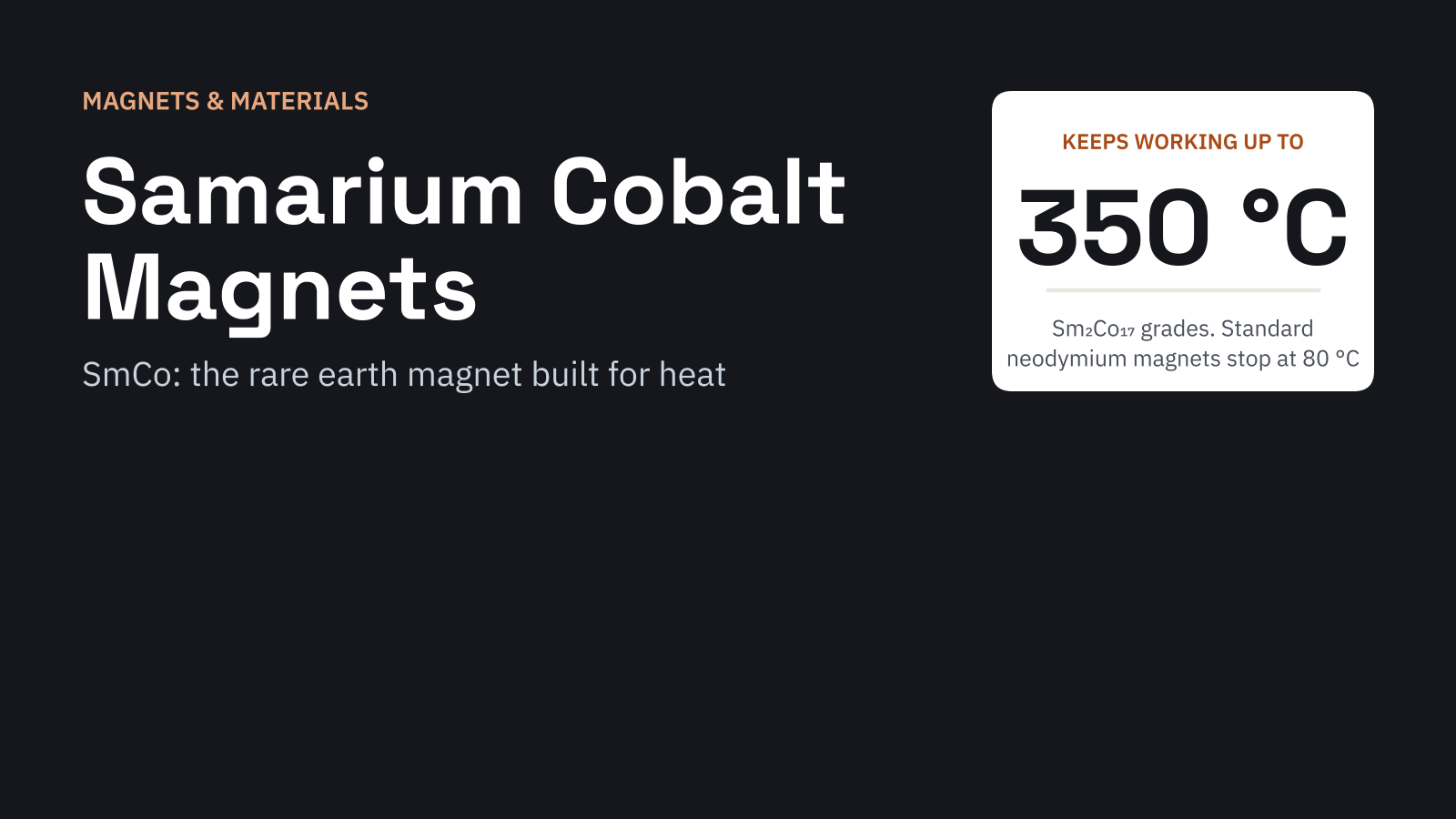
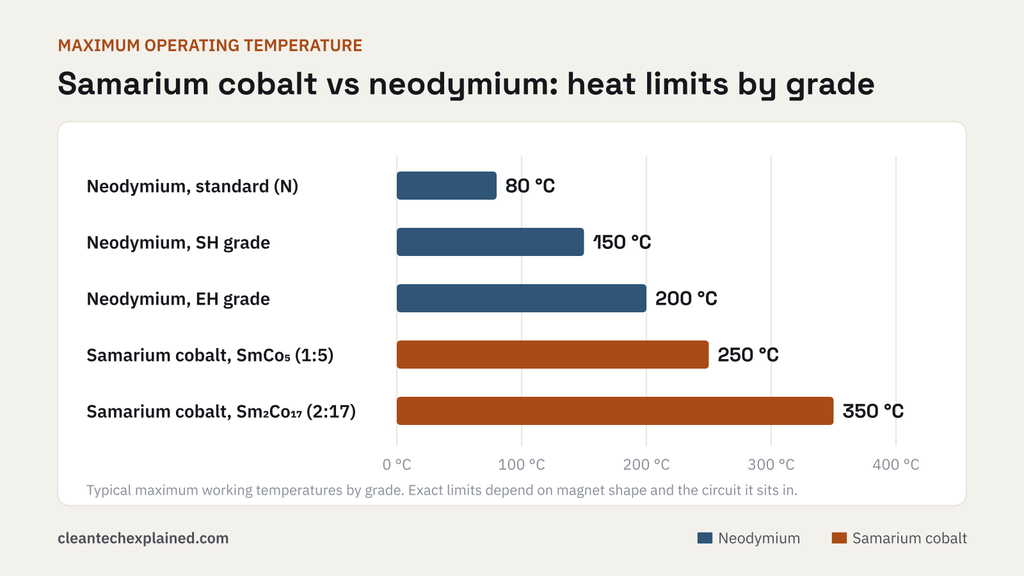
- Maximum operating temperature is about 250 °C for SmCo5 and 300–350 °C for Sm2Co17. Standard neodymium stops at 80 °C.
- Above roughly 150–180 °C, samarium cobalt is the stronger magnet of the two.
- Samarium has been under Chinese export controls since April 2025, and non-Chinese supply is only now starting.
What is a samarium cobalt magnet?
A samarium cobalt magnet is an alloy of samarium, one of the rare earth elements, and cobalt. The cobalt supplies most of the magnetism. The samarium locks that magnetism along one direction of the crystal, which makes the magnet very hard to demagnetize.
The same division of labour appears in neodymium magnets, where iron supplies the magnetism and neodymium holds it in place. The difference is that cobalt keeps its magnetic order to a much higher temperature than iron does in the neodymium compound. That is the root of samarium cobalt’s heat resistance.
Alnico magnets, the other rare-earth-free family, sit in a similar energy range but trade ferrite’s low cost for a much higher operating temperature.
A short history
In the 1960s Karl Strnat, a researcher at the Wright-Patterson Air Force Base Materials Laboratory in Ohio, noticed that compounds of cobalt with rare earths had an unusually strong preference for one magnetic direction. In 1966 he and Gary Hoffer reported promising results for yttrium cobalt. Within a year the group had tried other rare earths and found that SmCo5 was the best choice for a practical magnet.
Strnat later moved to the University of Dayton, where he and Alden Ray developed the second generation, Sm2Co17, in the 1970s. Samarium cobalt held the record for magnetic strength until neodymium iron boron was announced in 1983.
SmCo5 vs Sm2Co17: the two families
The numbers describe the ratio of atoms. SmCo5 has one samarium atom for every five cobalt atoms. Sm2Co17 has two samarium atoms for roughly seventeen atoms of cobalt and other metals.
| Property | SmCo5 (1:5) | Sm2Co17 (2:17) |
|---|---|---|
| Samarium content by weight | About 36% | About 25% |
| Other elements | Cobalt | Cobalt (about half), iron, copper, zirconium |
| Maximum energy product | 16–25 MGOe | 20–32 MGOe, up to 35 in the best grades |
| Maximum operating temperature | About 250 °C | 300–350 °C |
| Curie temperature | About 720–750 °C | About 800–850 °C |
| Corrosion resistance | Excellent (no iron) | Good to very good |
Sm2Co17 has largely replaced SmCo5 in new designs. It is stronger, tolerates more heat and uses less samarium. A typical 30 MGOe grade contains about 25% samarium, 48% cobalt, 19% iron, 5% copper and 3% zirconium by weight. The copper and zirconium are what give it its resistance to demagnetization, through a long heat treatment that builds a fine cell structure inside each grain.
SmCo5 is still made because it is simpler to produce, easier to magnetize and contains no iron at all, which makes it the most corrosion-resistant option.
How grades are named
Most suppliers name grades by energy product, so “SmCo 26” or “S2869” style codes refer to a magnet of about 26 or 28 MGOe. The name alone does not always tell you which family it is, so check the datasheet for “1:5” or “2:17”. The record holder is Arnold Magnetic Technologies’ Recoma 35E, a Sm2Co17 grade at 35 MGOe made in Lupfig, Switzerland.
Samarium cobalt vs neodymium
| Property | Samarium cobalt | Neodymium (NdFeB) |
|---|---|---|
| Strength at room temperature | 16–32 MGOe | Up to about 55 MGOe |
| Maximum operating temperature | 250–350 °C | 80 °C standard, about 200–230 °C for the best grades |
| Curie temperature | About 720–850 °C | About 310–370 °C |
| Strength lost per °C of heating | About 0.03–0.05% | About 0.12% |
| Corrosion | Usually needs no coating | Must be coated |
| Mechanical behaviour | Very brittle, chips easily | Brittle |
| Cost | Several times higher | Lower |
At room temperature, neodymium wins clearly. But a neodymium magnet loses strength two to four times faster as it warms up, and it needs dysprosium or terbium to survive above about 150 °C, which lowers its strength and raises its cost. Somewhere between 150 and 180 °C the two lines cross, and above that point samarium cobalt delivers more magnetic energy.
Samarium cobalt also holds up better in salt water, vacuum, cryogenic cold and radiation. For a broader comparison that includes cheaper options, see our guides to ferrite magnets and rare earth magnet alternatives.
What samarium cobalt magnets are used for
- Aerospace and defense. Missiles, guidance systems, radar and aircraft actuators. An F-35 fighter contains up to 50 pounds of samarium cobalt magnets, according to the head of the only US producer.
- Satellites. Traveling-wave tubes, the amplifiers in communications satellites, rely on samarium cobalt because the magnets must stay stable for years across wide temperature swings.
- High-speed motors and generators. Motorsport energy-recovery systems and aircraft generators, where rotors run hot and fast.
- Oil and gas. Downhole tools and sensors that operate at high temperature and pressure.
- Medical and instruments. Surgical tools, sensors and precision instruments that need a field that barely drifts.
Are samarium cobalt magnets used in electric cars?
Rarely. EV traction motors run at temperatures that dysprosium-containing neodymium magnets can handle, and neodymium gives more torque for less money. Samarium cobalt shows up in racing and in some specialist machines, not in mass-market cars. Automakers trying to cut rare earth use are moving to ferrite, to wound rotors or to magnet-free designs instead.
Drawbacks
- Cost. Cobalt is expensive and volatile in price, samarium supply is tight, and production volumes are small.
- Brittleness. The magnets chip and crack easily. They are usually ground to shape with diamond tools and need careful handling during assembly.
- Lower strength at room temperature. If the application never gets hot, neodymium does the same job with a smaller magnet.
- Two critical materials. Both samarium and cobalt appear on critical minerals lists.
Supply: why samarium became a headline in 2025–2026
Samarium is not geologically scarce. It comes out of the same ores as neodymium. The problem is that almost all of the separation, metal making and magnet production takes place in China.
In April 2025 China placed export controls on seven rare earths, including samarium, and on samarium cobalt magnet materials. Exports now need a licence. Further controls announced in October 2025 were suspended for one year, until November 10, 2026.
The effect has been sharpest in defense. In July 2026 the chief executive of Permag, the only US maker of samarium cobalt magnets, said the US defense industry was down to a two-to-three-year supply of samarium. From January 1, 2027, US rule DFARS 252.225-7052 bars defense contractors from using samarium cobalt magnets if any production step took place in China, Russia, Iran or North Korea.
New supply is starting, slowly:
- Lynas Rare Earths produced its first samarium oxide in Malaysia in March 2026, ahead of schedule, becoming the first commercial producer outside China.
- Energy Fuels began expanding its White Mesa Mill in Utah in July 2026 to add about 140 tonnes a year of samarium capacity, with those circuits due by the end of 2028.
- MP Materials is stockpiling samarium-bearing concentrate at Mountain Pass, California, and plans first samarium production in 2028.
- Permag is more than doubling magnet capacity at its Electron Energy plant in Pennsylvania.
Recycling may help at the margin. Most rare earth magnet recycling today targets neodymium magnets, but samarium cobalt scrap is valuable for both of its main metals.
FAQ
Are samarium cobalt magnets stronger than neodymium?
Not at room temperature. Neodymium magnets reach about 55 MGOe and samarium cobalt about 32–35 MGOe. Above roughly 150–180 °C the order reverses, because neodymium loses strength much faster as it heats up.
What is the difference between SmCo5 and Sm2Co17?
SmCo5 is the original 1960s alloy of samarium and cobalt only. Sm2Co17 adds iron, copper and zirconium, is stronger, and works at up to 300–350 °C instead of 250 °C. Most new designs use Sm2Co17.
Do samarium cobalt magnets rust?
Very little. SmCo5 contains no iron and is highly corrosion resistant. Sm2Co17 contains some iron and can show light surface corrosion in water, but most applications use it uncoated. Coatings are sometimes added to reduce chipping.
Why are samarium cobalt magnets so expensive?
About half the magnet is cobalt, a costly metal with a volatile price. Samarium supply is concentrated in China and under export control, and the magnets are made in small volumes with a long heat treatment.
Is samarium a rare earth element?
Yes. Samarium is element 62, one of the lanthanides. It is usually grouped with the medium or heavy rare earths, and it is one of the seven that China placed under export control in April 2025.
Sources
- University of Dayton Research Institute: Dayton Contributes to the History of Magnetic Materials
- Wikipedia: Samarium–cobalt magnet
- Sigma-Aldrich: Samarium-cobalt alloy 30, composition and properties
- Alliance LLC: Samarium cobalt magnet grades
- TY Magnets: Samarium Cobalt, High Temperature Rare Earth Magnet
- Magnetics Magazine: Arnold Magnetic Technologies Launches RECOMA 35E
- National Defense Magazine: Stockpiles of Critical Mineral Needed for High-End Magnets Begin to Dwindle (July 2026)
- Rare Earth Exchanges: Samarium Is Not China’s Geological Monopoly
- Mining Technology: Lynas announces first samarium oxide output in Malaysia (March 2026)
- Mining Weekly: Energy Fuels kicks off Utah rare-earth expansion (July 2026)
- MarketBeat: MP Materials Q2 2026 earnings call highlights
- Magnetics Magazine: Permag Doubles Capacity for Samarium Cobalt Magnet Manufacturing