Neodymium Magnets (NdFeB) Explained: Grades, Strength and Limits

Neodymium magnets are the strongest permanent magnets available. A piece the size of a coin can lift several kilograms, and larger ones drive the motors of electric cars and the generators of wind turbines. Their full name is neodymium iron boron, usually shortened to NdFeB. This guide explains what they are made of, how they are manufactured, how to read a grade such as N42SH, and where their limits are. It also includes photos and measurements from samples the author made in a magnet lab.
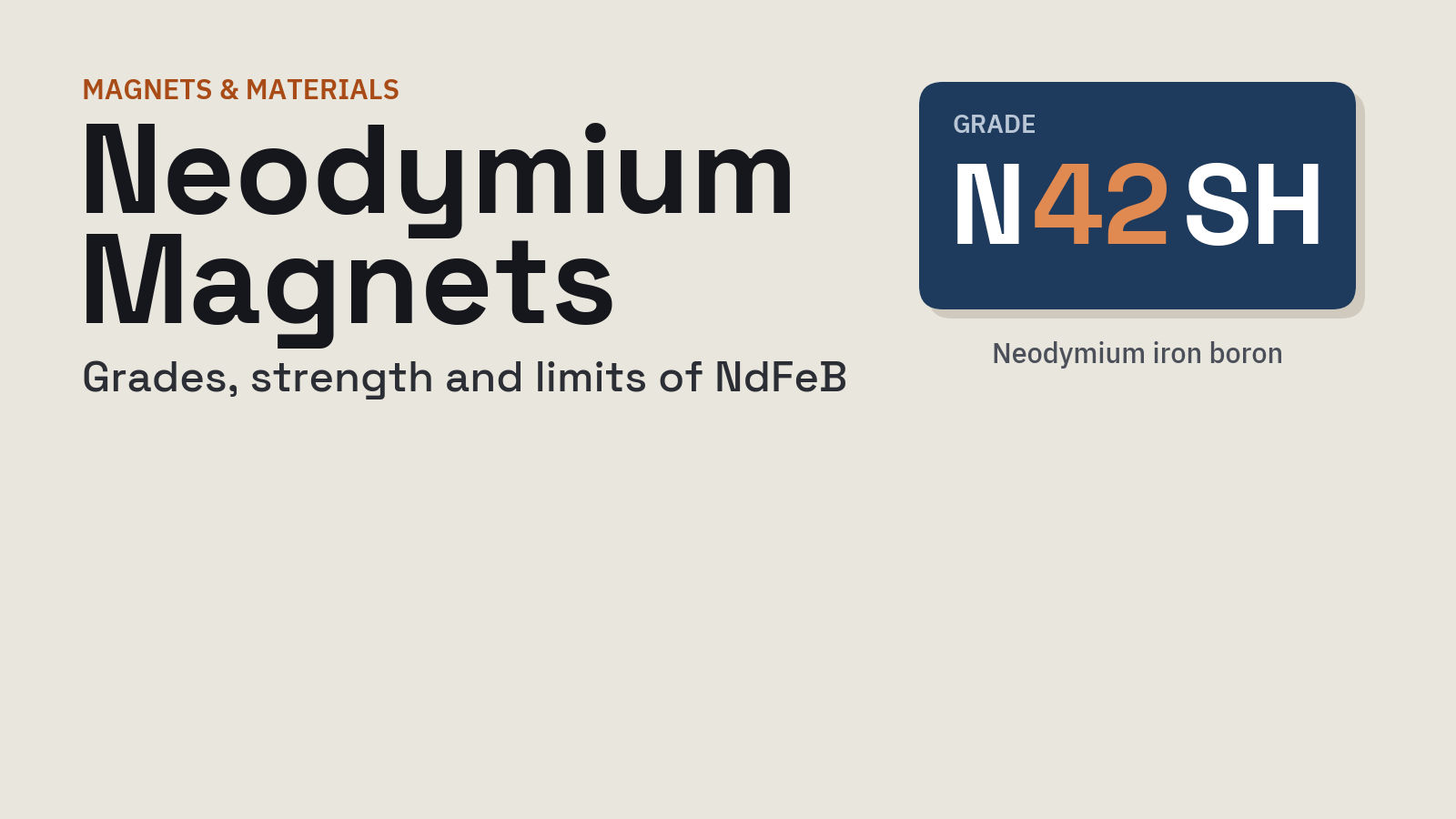
Short answer: A neodymium magnet is an alloy of neodymium, iron and boron with the crystal structure Nd2Fe14B. It stores more magnetic energy per unit volume than any other commercial magnet. Its weaknesses are heat, corrosion and brittleness, plus a supply chain concentrated in China. The grade tells you two things: the number is the strength, and the letters are the temperature class.
Key takeaways
- Neodymium magnets and NdFeB magnets are the same thing. By weight they are mostly iron, with about 30% rare earths and 1% boron.
- They were invented in 1984, independently by General Motors and Sumitomo Special Metals.
- In a grade like N42SH, 42 is the maximum energy product in MGOe and SH is the temperature class (about 150 °C).
- N52 is the strongest common grade, but only at room temperature. Hot applications use lower numbers with higher temperature letters.
- Sintered magnets are the strongest type. Bonded magnets are weaker but can be molded into complex shapes.
- Alignment matters as much as chemistry. In the author’s lab, hot-deforming one batch of powder raised its remanence from 6.7 to 12.3 kG without changing its composition.
- Standard grades start to lose strength permanently above about 80 °C. High-temperature grades need dysprosium or terbium.
What is a neodymium magnet?
A neodymium magnet is a permanent magnet built around one compound: Nd2Fe14B, two atoms of neodymium and one of boron for every fourteen of iron. Neodymium is one of the 17 rare earth elements, which is why these are also called rare earth magnets.
By weight, a typical magnet is roughly:
- 64 to 68% iron, which provides most of the magnetization
- 29 to 32% rare earths, mainly neodymium and praseodymium, sometimes with dysprosium or terbium
- About 1% boron, which holds the crystal structure together
- Small additions of cobalt, copper, aluminum or gallium to fine-tune the properties
So a “neodymium” magnet is mostly iron. The neodymium does a specific job. It locks the magnetization of the iron atoms along one direction of the crystal, which is what makes the magnet hard to demagnetize.
A short history
Before 1984, the strongest magnets were samarium cobalt, which were expensive because both samarium and cobalt were costly. Two teams went looking for an iron-based replacement and found the same compound almost at the same time.
At General Motors, John Croat produced Nd2Fe14B by cooling the molten alloy extremely fast, a process called melt spinning. That route led to bonded magnets. At Sumitomo Special Metals in Japan, Masato Sagawa developed the sintered magnet, which is denser and stronger and now dominates the market.
How neodymium magnets are made
Sintered magnets
Most high-performance magnets are sintered. The steps, simplified:
- The alloy is melted and cast into thin flakes.
- The flakes are broken down with hydrogen and milled into a powder with particles a few microns across.
- The powder is pressed in a strong magnetic field, so every particle points the same way.
- The pressed block is sintered at around 1,050 °C until it becomes a dense solid, then heat treated.
- It is cut and ground to shape, coated against corrosion, and finally magnetized.
Types of neodymium magnets
| Type | How it is made | Strength | Typical uses |
|---|---|---|---|
| Sintered | Aligned powder pressed and sintered | Highest | EV motors, wind turbines, hard drives |
| Bonded | Magnet powder mixed with a polymer and molded | Roughly a quarter to half of sintered | Small motors, sensors, complex shapes |
| Hot-deformed | Fine-grained powder pressed and deformed while hot | Close to sintered | Ring magnets, some vehicle motors |
Hot-deformed magnets get their alignment without a magnetic field. Squeezing the hot material makes its tiny grains turn and grow so that their preferred magnetic direction lines up with the pressing direction. Honda and Daido Steel used this route to make traction motor magnets for hybrid cars without heavy rare earths, with properties comparable to sintered magnets containing 4 to 5% dysprosium.
Making a neodymium magnet in the lab
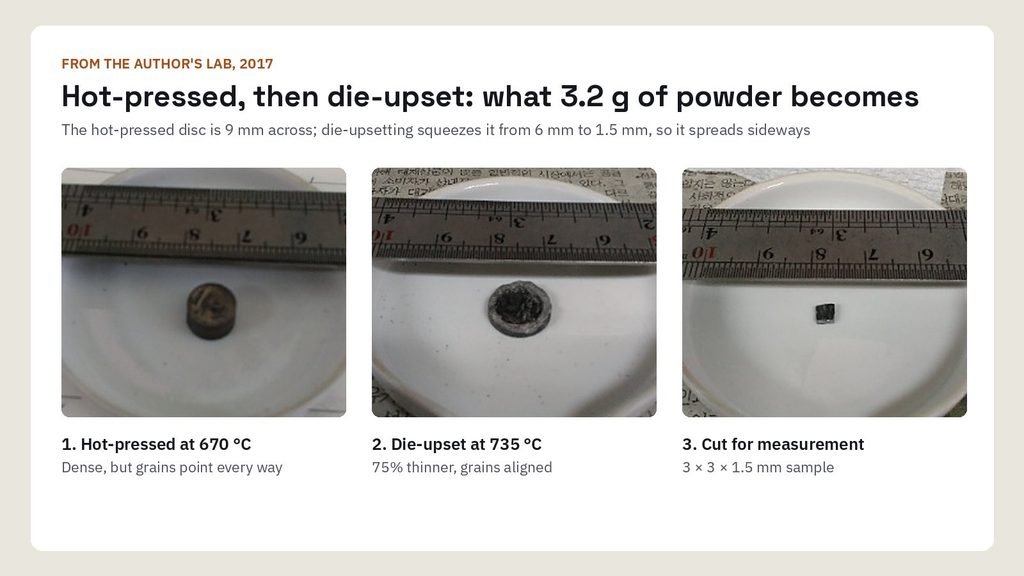
The author of this guide made and measured NdFeB samples in 2017, during his master’s research in magnetic materials at Pukyong National University in Busan, South Korea. The photos and numbers in this section come from that work. They show, at small scale, the step that turns a weak magnet into a strong one.
The starting powder
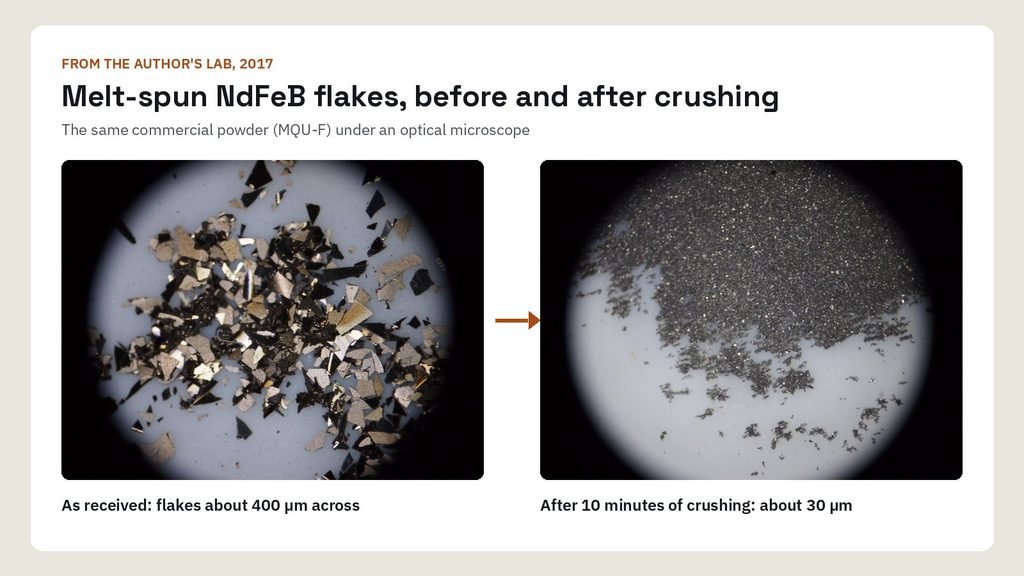
The starting material was MQU-F, a commercial melt-spun powder from Magnequench, the company that grew out of the General Motors magnet business. Its composition is Nd13.6Fe73.6Co6.6Ga0.6B5.6 in atomic percent. It arrives as shiny flakes about 400 µm across. Each flake is made of grains far smaller than a micron, and their magnetic directions point every which way. That makes the powder isotropic: it is magnetic, but its remanence is only about half of what the same grains give once they are aligned.
Hot pressing and die-upsetting
The process took two presses and a few minutes of heat from an induction coil:
- About 3.2 grams of powder went into a 9 mm die and was hot pressed at 670 °C under about one tonne of force, giving a dense disc about 6 mm tall.
- The disc was then die-upset at 735 °C: pressed again, this time without side walls, until it was 75% thinner (1.5 mm). The whole squeeze took about a minute.
- A 3 × 3 × 1.5 mm piece was cut from the center and measured in a vibrating sample magnetometer (VSM).
What the measurements showed
| Property | Isotropic powder | After die-upsetting |
|---|---|---|
| Remanence, Mr | 6.7 kG | 12.3 kG |
| Coercivity, iHc | 20 kOe | 13.1 kOe |
| Maximum energy product | Not measured | 35.6 MGOe |
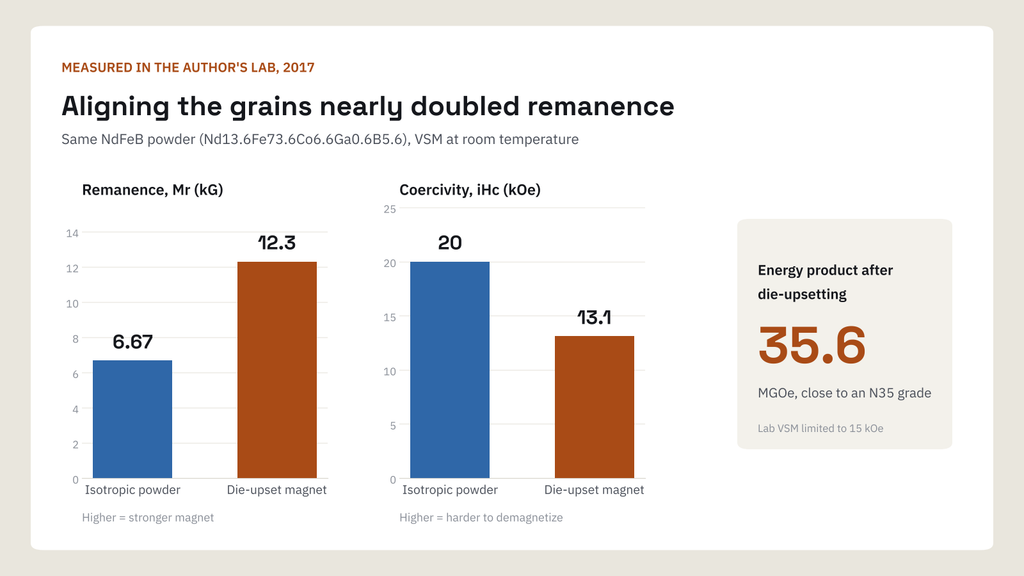
Remanence, the magnetization left after the field is removed, rose by about 85%. Nothing was added to the alloy. The only change was that the grains now pointed the same way. An energy product of 35.6 MGOe sits in the range of an N35 sintered grade, from a disc smaller than a coin made in about a minute of pressing.
Coercivity went the other way, falling from 20 to 13.1 kOe, partly because the grains grow while the material is hot and deforming. This is the same trade-off that shows up in the grade letters below: processing that raises strength tends to lower resistance to demagnetization, and getting both takes extra steps or extra heavy rare earths.
Two caveats. The lab VSM could apply only 15 kOe, less than needed to saturate this alloy fully, and the die-upset values include the usual correction for the sample’s shape. A small, hand-run press also cannot match industrial hot-deformation lines, so these numbers show the size of the effect rather than the best this alloy can do.
What went wrong, and what it teaches
Not every experiment worked, and the failures explain a lot about how magnets are made in factories.
- Too much milling destroyed the magnet. After 48 hours in a high-energy ball mill, the same powder’s coercivity fell from 20 kOe to under 0.5 kOe, and X-ray diffraction showed growing iron peaks from wear of the steel balls and jar. Coercivity depends on the grain structure, not just the chemistry, and it is easy to ruin.
- Fine powder oxidizes. One batch of alloy powder oxidized during hydrogen processing and lost its properties. Neodymium reacts readily with oxygen, which is why factories mill and press under nitrogen or argon, and why finished magnets need a coating.
- Replacing neodymium has limits. The same lab tested alloys where cerium replaced part of the neodymium. Magnetic properties fell steadily as cerium rose, a story told in our guide to cerium magnets.
How to read neodymium magnet grades
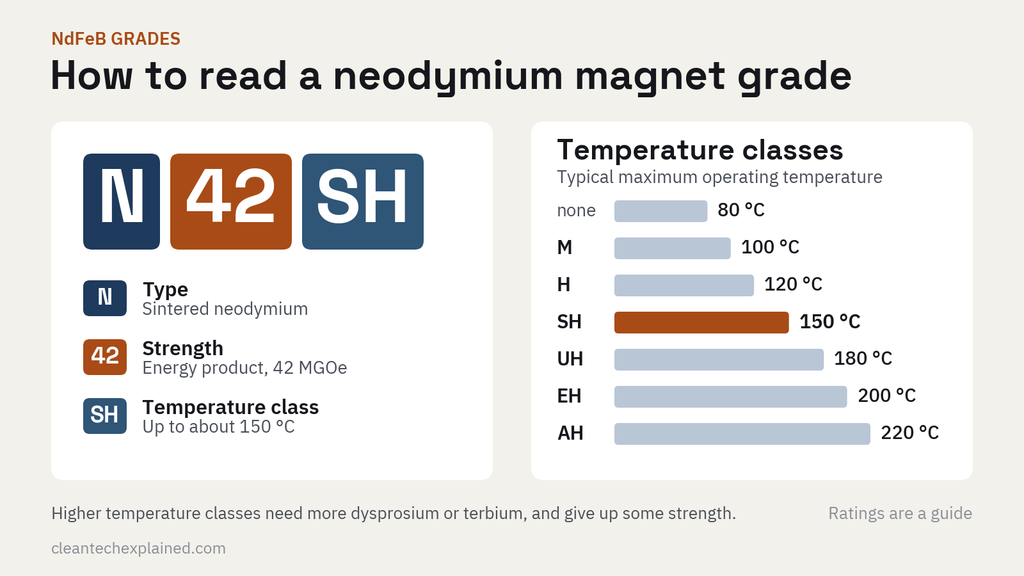
A grade such as N42SH has three parts.
- N means sintered neodymium.
- 42 is the maximum energy product in megagauss-oersteds (MGOe). This is the headline strength figure. Common grades run from N35 to N52.
- SH is the coercivity class, which sets how much heat the magnet can take before it starts to lose strength permanently.
| Suffix | Meaning | Typical maximum operating temperature |
|---|---|---|
| (none) | Normal coercivity | 80 °C |
| M | Medium | 100 °C |
| H | High | 120 °C |
| SH | Super high | 150 °C |
| UH | Ultra high | 180 °C |
| EH | Extremely high | 200 °C |
| AH | Highest standard class | 220 °C |
Two points are easy to miss.
You cannot have the highest number and the highest letter together. The additions that raise heat resistance also lower the energy product. N52 exists mainly as a room-temperature grade. For a motor running at 150 °C or more, designers choose grades such as N45SH, N42UH or N38EH.
The temperature rating is a guide. The real limit depends on the magnet’s shape and on the magnetic circuit around it. A thin magnet in open air demagnetizes at a lower temperature than a thick one mounted on steel.
How strong are neodymium magnets?
Engineers compare magnets by maximum energy product, the amount of magnetic energy stored per unit volume. On that measure NdFeB is far ahead of everything else.
| Magnet type | Energy product (MGOe) | Typical maximum temperature | Relative cost |
|---|---|---|---|
| Neodymium (NdFeB) | 33 to 55 | 80 to 220 °C | High |
| Samarium cobalt (SmCo) | 16 to 32 | 250 to 350 °C | Highest |
| Alnico | 5 to 10 | About 500 °C | Medium |
| Ferrite (ceramic) | 1 to 5 | About 250 °C | Lowest |
In practice, a neodymium magnet can do the same job as a ferrite magnet roughly ten times its volume. That is why it made small, powerful motors possible.
Alnico magnets, the other rare-earth-free family, sit in a similar energy range but trade ferrite’s low cost for a much higher operating temperature.
A caution on the numbers: going from N35 to N52 raises the energy product by about 50%, but the magnetic field at the surface, which determines pull force, rises by only about 20%. An N52 magnet is stronger than an N35 of the same size, though not by as much as the grade suggests.
The weaknesses of NdFeB
Heat
NdFeB loses its magnetism entirely at its Curie temperature, about 312 °C for the pure Nd2Fe14B compound. Long before that, a magnet pushed past its rated temperature loses part of its strength permanently. Raising the limit means adding heavy rare earths. Our guide to dysprosium explains how that works and why the industry wants to use less of it.
Cobalt raises the Curie temperature. In the author’s thermomagnetic measurements, the MQU-F alloy described above, with 6.6 atomic percent cobalt, lost its magnetism at about 410 °C. That helps the magnet hold its strength as it warms, but it does not replace dysprosium: the point where a magnet starts losing strength permanently is set by coercivity, not by the Curie temperature.
Corrosion
The alloy rusts easily, especially along its grain boundaries. Nearly every magnet is coated, most often with nickel-copper-nickel plating, or with zinc or epoxy. If the coating is chipped, the magnet can slowly crumble.
Brittleness
Sintered magnets behave more like ceramic than metal. They chip and crack if they snap together, and they cannot be drilled or machined with ordinary tools.
Supply
China produces around 90% of the world’s neodymium magnets and has required export licenses for several rare earths since April 2025. That concentration is the reason for the search for rare earth magnet alternatives such as iron nitride and tetrataenite. Some lower-cost grades replace part of the neodymium with cerium; see our guide to cerium magnets.
What neodymium magnets are used for
- Electric vehicle motors. Most EVs use permanent magnet motors with one to two kilograms of NdFeB. Some carmakers avoid them. See rare earth free electric motors and which EVs don’t use rare earth magnets.
- Wind turbines. Direct-drive generators can contain hundreds of kilograms of magnets per megawatt.
- Hard disk drives. Two curved neodymium magnets move the read arm. They are the strong magnets people salvage from old drives.
- Speakers and headphones, where a small magnet saves weight.
- Power tools, robots, drones and appliances, in their compact motors.
Safety
Large neodymium magnets deserve respect. They can snap together hard enough to pinch skin or shatter into sharp fragments. Small magnets are dangerous if swallowed, particularly more than one, so keep them away from children. People with pacemakers or other implanted devices should keep strong magnets at a distance.
FAQ
What are neodymium magnets made of?
An alloy of neodymium, iron and boron (Nd2Fe14B). By weight they are about two-thirds iron, around 30% rare earths and about 1% boron.
Is NdFeB the same as a neodymium magnet?
Yes. NdFeB is the chemical shorthand for neodymium iron boron. “Neo magnet” and “NIB magnet” mean the same thing.
What does N52 mean?
N stands for sintered neodymium, and 52 is the maximum energy product in MGOe. N52 is the strongest grade in common use, with a standard temperature limit of about 80 °C or lower.
What is a hot-deformed neodymium magnet?
A magnet made by pressing fine-grained NdFeB powder into a dense block and then squeezing it while hot, so its grains line up without a magnetic field. In the author’s lab, this step raised remanence from 6.7 to 12.3 kG and gave an energy product of 35.6 MGOe. Hot-deformed magnets have very fine grains, which helps them resist heat with little or no dysprosium.
At what temperature do neodymium magnets lose their magnetism?
Standard grades begin to lose strength permanently above about 80 °C. High-temperature grades tolerate up to about 220 °C. All magnetism is lost at the Curie temperature, about 312 °C for the pure compound and higher, around 400 °C, in alloys that contain cobalt.
Do neodymium magnets lose strength over time?
Very slowly. Kept within its temperature rating and protected from corrosion and strong opposing fields, a magnet holds nearly all of its strength for decades.
What is stronger than a neodymium magnet?
No permanent magnet in commercial production is stronger. Electromagnets and superconducting magnets can produce stronger fields, but they need a power supply.
Sources
- Goudsmit Magnetics: NdFeB grade system and technical data
- e-Magnets UK: NdFeB magnet grades
- Radial Magnets: Neodymium magnet grades chart
- Honda Prize background: John Croat and the invention of the neodymium magnet
- Wikipedia: Neodymium magnet (history and property tables)
- MEXT Elements Strategy Initiative: Heavy-rare-earth-free hot-deformed Nd-Fe-B magnets for traction motors (Daido Steel and Honda)
- Lab measurements: the author’s own samples, Pukyong National University, 2017 (hot pressing, die-upsetting, VSM, thermomagnetic analysis and X-ray diffraction).
This article reflects the author’s personal views and publicly available information as of October 2026. It is general information, not engineering or purchasing advice.