Solar Panel Maintenance: What It Takes and What It Costs

Solar panel maintenance is mostly a matter of paying attention. Panels have no moving parts, and in most of the US, rain keeps them reasonably clean. But dirt, pollen, bird droppings, snow and a failing inverter can all quietly cut your output, and a few simple habits catch those problems early. This guide explains what maintenance a home solar system really needs, how to clean panels safely, what professional service costs, and when cleaning is worth paying for.
Short answer: Most home solar systems need very little maintenance. Check your monitoring app once a month, look at the panels from the ground once or twice a year, and book a professional inspection every few years. Cleaning is only worth paying for where dust, pollen or bird droppings build up, and it typically costs $150 to $350 a visit. The biggest single maintenance cost over a system’s life is usually replacing a string inverter after 10 to 15 years.
Key takeaways
- In typical US climates, dirt reduces output by about 1% to 5%. In dry, dusty or pollen-heavy areas, losses can reach 10% to 15% without cleaning.
- Rain helps but is not a full cleaner. An NREL study found rain did not wash away heavy pollen, and cleaning raised output by 5% to 11% at sites left uncleaned for years.
- Professional cleaning costs about $150 to $350 per visit. Inspections cost about $100 to $300.
- Never use a pressure washer, harsh brushes or soap on panels, and do not climb on the roof to clean them.
- A monitoring app is the best maintenance tool you have. A sudden drop in output, or one panel lagging behind the rest, is the earliest sign of a problem.
- String inverters usually need replacing once in a system’s life, at about $1,500 to $2,500. Microinverters often last as long as the panels.
Do solar panels need maintenance?
Not much. Modern panels are sealed glass-and-aluminum units designed to sit outside for 25 to 30 years or more. They do not need oiling, adjusting or regular servicing like a furnace or a car. Our guide to how long solar panels last explains why most of them outlive their warranties.
What they do need is someone to notice when something goes wrong. The common problems are:
- Soiling: dust, pollen, leaves, bird droppings and, near farms or roads, grime that builds up on the glass.
- Shade: trees that have grown since the system was installed.
- Snow: output drops to near zero while panels are covered.
- Animals: squirrels and birds that nest under panels or chew wiring.
- Electrical faults: loose connectors, damaged cables or, most often, a failing inverter.
A simple maintenance schedule
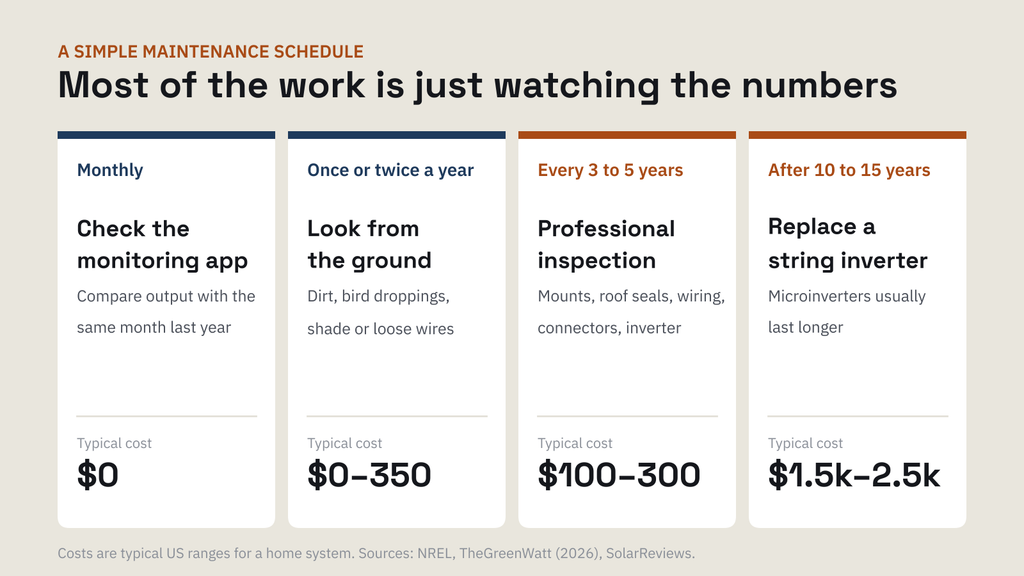
Monthly: check your monitoring
Almost every modern system comes with an app that shows daily and monthly production. Compare each month with the same month last year, not with the month before, because output naturally swings with the seasons. If production falls by more than about 10% with no obvious weather explanation, or one panel or string shows much less than its neighbors, something needs attention.
Once or twice a year: look from the ground
Walk around the house and look at the panels, ideally with binoculars. Check for heavy dirt, bird droppings, leaves stuck along the lower edge, new shade from trees, loose or hanging wires, and signs of animals nesting underneath. Also look at the inverter, usually mounted on a wall near your electrical panel, for warning lights or error messages.
Every three to five years: a professional inspection
A solar technician checks the mounting hardware and roof seals, tightens connectors, inspects wiring for damage, and tests system output. This typically costs $100 to $300. Many installers include periodic checks in a service plan, so check what your contract already covers before paying for one.
After 10 to 15 years: plan for an inverter
The inverter, which converts the panels’ direct current into household alternating current, is the part most likely to fail. A central string inverter typically lasts 10 to 15 years, and replacing one costs about $1,500 to $2,500 installed. Microinverters, mounted under each panel, usually carry 20- to 25-year warranties. Budgeting for one inverter replacement is sensible; it affects the long-run numbers in our solar payback guide.
Should you clean your solar panels?
It depends on where you live. In most of the US, rain and wind keep panels clean enough that soiling costs only 1% to 5% of output, and professional cleaning would cost more than it saves. Three situations change that:
- Dry, dusty climates such as Arizona, Nevada, New Mexico, inland Southern California and California’s Central Valley, where long periods without rain let dust build up. NREL has found that cleaning more than once a year can make economic sense in the Central Valley.
- Heavy pollen. In a 2023 study of five solar plants in North Carolina, NREL found pollen cut output by up to 15% at peak season, rain did not fully wash it off, and annual losses could reach about 10% without cleaning.
- Bird droppings and leaves. These block light on part of a panel, which can drag down the whole panel’s output. They do not wash off easily once baked on.
Is cleaning worth the money?
A quick calculation tells you. Take an 8 kW system producing about 10,500 kWh a year, with electricity at 18.3 cents per kWh. That electricity is worth about $1,920 a year.
- If dirt costs you 3%, you lose about $58 a year. A $200 cleaning does not pay for itself.
- If dirt costs you 10%, you lose about $190 a year. One cleaning a year roughly breaks even.
- If dirt costs you 15%, you lose about $290 a year, and cleaning is clearly worth it.
Your monitoring app shows how much you would gain: compare output on a sunny day just before and just after a cleaning or a heavy rain.
How to clean solar panels safely
If you decide to clean them yourself, keep it gentle and stay off the roof.
- Check your warranty and manual first. Some manufacturers specify how panels may be cleaned, and the wrong method can void the warranty.
- Clean early in the morning or in the evening. Cold water on hot glass can stress it, and water evaporates fast in the sun, leaving spots.
- Rinse with a garden hose from the ground. Plain water at normal pressure removes most dust and pollen.
- Use a soft brush or squeegee on an extension pole for stubborn dirt. Deionized or softened water avoids mineral spots in hard-water areas.
- Do not use a pressure washer, abrasive pads, scrapers or detergents. They can damage the glass coating, push water past the frame seals, and void the warranty.
If the panels can only be reached from the roof, hire a professional. Falls from roofs are a far greater risk than a few percent of lost output.
Snow, animals and storms
Snow
Panels are dark, smooth and tilted, so snow usually slides off within a day or two of sunshine. If it does not, a soft foam roof rake used from the ground can help. Never chip at ice or use metal tools, and do not climb onto a snowy roof. A few snow days barely affect annual output.
Squirrels and birds
The gap under rooftop panels is a sheltered spot for nests, and squirrels can chew through wiring. A mesh “critter guard” around the edge of the array, installed by a professional, typically costs $200 to $400 and is usually a one-time expense.
Hail and storms
Panels are tested to withstand hail, but very large hailstones can crack the glass. After a severe storm, look for cracked panels from the ground and check your monitoring for a drop in output. Damage is often covered by homeowner’s insurance, so check your policy.
What does solar panel maintenance cost?
| Task | How often | Typical cost |
|---|---|---|
| Checking the monitoring app | Monthly | $0 |
| DIY rinse from the ground | As needed | $0 to $50 a year |
| Professional cleaning | 0 to 2 times a year | $150 to $350 per visit |
| Professional inspection | Every 3 to 5 years | $100 to $300 |
| Critter guard | Once | $200 to $400 |
| String inverter replacement | Once, after 10 to 15 years | $1,500 to $2,500 |
For a typical home in a rainy climate, routine maintenance costs close to nothing in most years. In a dusty area with yearly professional cleaning, budget around $150 to $350 a year. Either way, the inverter is the one larger expense to plan for. If you are still pricing a system, our guide to solar panel cost covers the upfront side.
When to call a professional
- Output drops sharply and does not recover after a sunny, clear day.
- The inverter shows a fault light or error code.
- You see cracked glass, scorch marks, loose panels or hanging wires.
- You notice water leaks or stains on the ceiling under the array.
- Animals are nesting under the panels.
Never open the inverter or touch damaged wiring yourself. Solar panels produce voltage whenever light hits them, even when the system is switched off.
Frequently asked questions
How often should solar panels be cleaned?
In most rainy climates, rarely or never. In dry, dusty or pollen-heavy areas, once or twice a year is common. Let your monitoring app tell you: clean when output drops noticeably compared with the same period last year.
Can I clean my solar panels with a hose?
Yes, from the ground, with plain water at normal pressure, early or late in the day. Avoid pressure washers and soap.
Does rain clean solar panels?
Partly. Rain removes loose dust well, but NREL found it did not fully wash off heavy pollen, and it does little against baked-on bird droppings.
How much does solar panel cleaning cost?
About $150 to $350 per visit for a typical home system, or roughly $10 to $20 per panel. Annual contracts with two visits a year are often cheaper per visit.
Do solar panels need to be serviced every year?
No. A visual check from the ground and a look at the monitoring app are enough most years. A professional inspection every three to five years is a sensible extra.
Does maintenance affect my warranty?
It can. Pressure washing, abrasive cleaning or unapproved repairs can void panel and installation warranties. Check the terms before cleaning or hiring anyone other than your installer.
Sources
- NREL, NREL research finds rain not enough to wash pollen from solar panels, December 2023
- Aurora Solar, Do you actually need to clean your solar panels?
- TheGreenWatt, Solar panel maintenance: costs, schedule and what you actually need to do, April 2026
- NREL, Best Practices for Operation and Maintenance of Photovoltaic and Energy Storage Systems, 3rd edition
Featured image and diagram: original graphics by CleanTech Explained. This article reflects publicly available information as of October 2026. It is general information, not professional or safety advice; follow your manufacturer’s instructions.