Tetrataenite: The Meteorite Magnet Explained

The tetrataenite magnet is one of the most intriguing candidates for a rare-earth-free permanent magnet. Tetrataenite is an iron-nickel mineral found in meteorites, and on paper its magnetic performance approaches that of the neodymium magnets inside electric vehicle motors and wind turbines, yet it contains nothing but iron and nickel, two abundant and inexpensive metals.
There is one catch. In nature, tetrataenite takes millions of years to form, and scientists have spent six decades trying to make it faster. This guide explains what tetrataenite is, why it matters, where the research really stands, and why a widely shared 2022 “breakthrough” turned out to be wrong.
Key takeaways
- Tetrataenite (L1₀ FeNi) is an ordered iron-nickel alloy that occurs naturally only in meteorites.
- Its theoretical maximum energy product is about 42 MGOe, within the range of commercial neodymium magnets, without any rare earth elements.
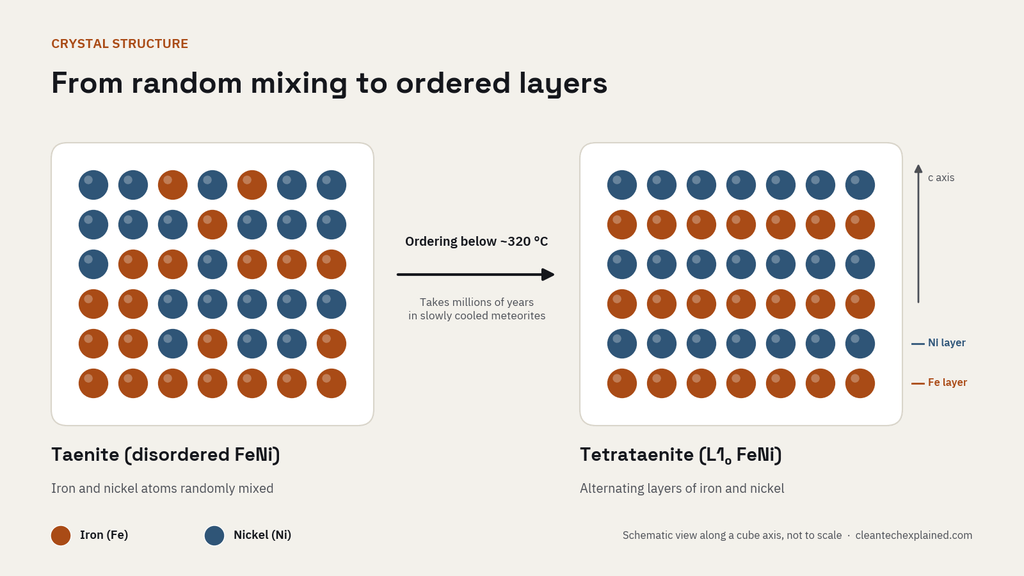
- It is extremely hard to make because iron and nickel atoms barely move below about 320 °C, the temperature under which the ordered structure is stable.
- The best lab-made tetrataenite so far reaches about 6 MGOe, similar to good ferrite or alnico magnets, far below its theoretical potential.
- A 2022 study claiming tetrataenite could be cast in seconds was retracted in December 2024 after the authors found they had misinterpreted their data.
What is tetrataenite?
Tetrataenite is an alloy of roughly equal parts iron and nickel with a special atomic arrangement. In ordinary iron-nickel alloys, the two kinds of atoms are scattered randomly across a cubic crystal lattice. In tetrataenite, they sit in neat alternating layers: a layer of iron, a layer of nickel, a layer of iron, and so on. Materials scientists call this the L1₀ structure.
This layering slightly distorts the crystal in one direction, turning the cubic lattice into a tetragonal one, which is where the name comes from. It also gives the material a strong preferred direction of magnetization, known as magnetocrystalline anisotropy. That property is what separates a permanent magnet, which holds on to its magnetism, from a soft magnetic material that loses it easily.
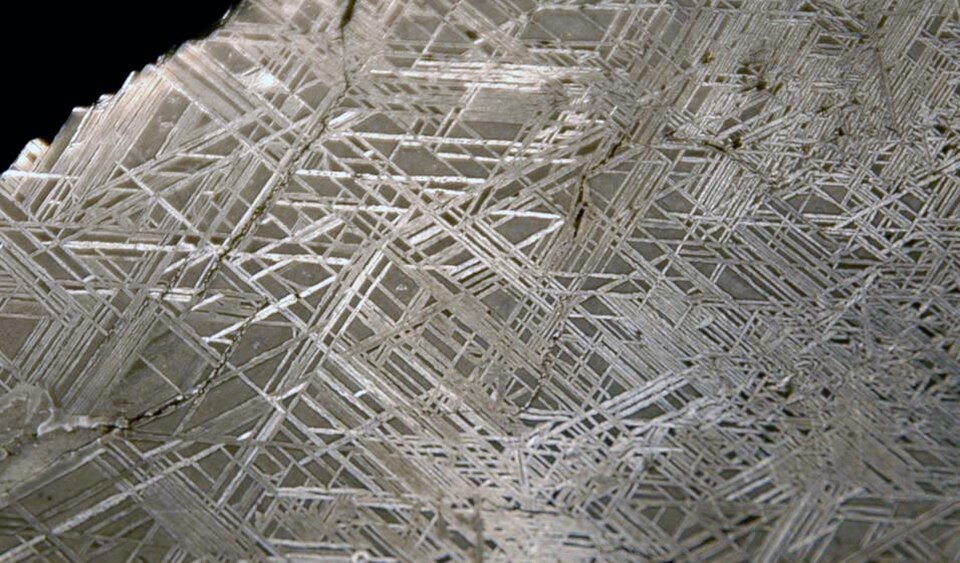
On Earth, tetrataenite is found only in iron-rich meteorites. These meteorites cooled extraordinarily slowly inside ancient asteroids, giving the iron and nickel atoms enough time to sort themselves into layers.
Why a tetrataenite magnet could replace rare earth magnets
Today’s strongest permanent magnets are neodymium-iron-boron (NdFeB) magnets. They power EV traction motors, wind turbine generators, hard drives and countless small motors. Many grades also contain dysprosium or terbium so they can keep working at high temperatures. Mining, refining and magnet production for these elements is heavily concentrated in China, which leaves manufacturers exposed to export controls and price swings.
Tetrataenite would avoid that problem entirely. Here is how it compares on paper:
| Tetrataenite (L1₀ FeNi) | Neodymium magnets (NdFeB) | |
|---|---|---|
| Main ingredients | Iron and nickel | Neodymium, iron, boron, often dysprosium or terbium |
| Maximum energy product | About 42 MGOe (theoretical) | About 30–52 MGOe (commercial grades) |
| Curie temperature | About 550 °C | About 310 °C |
| Key limitation | Ordered structure is lost above about 320 °C | Rare earth supply risk; loses strength when hot |
| Status | Research only | Mass-produced |
Researchers see tetrataenite as a possible replacement for lower-energy ferrite and alnico magnets, and as an alternative to dysprosium-containing neodymium magnets in some higher-temperature applications. Its magnetization approaches that of NdFeB, and its ingredients are cheap, abundant and non-toxic.
Why tetrataenite is so hard to make
The ordered layers are only stable below roughly 320 °C. Above that temperature, heat scrambles the atoms back into a random arrangement. Below it, the atoms must move to reach their ordered positions, but at such low temperatures iron and nickel atoms diffuse extremely slowly.
That creates a frustrating trap. Heat the alloy and the order disappears. Cool it and the atoms are almost frozen in place. Meteorites solve the problem with time, cooling over millions of years. Factories cannot wait that long.
The low ordering temperature causes a second problem further down the production line. Conventional magnet manufacturing, such as sintering powder into dense blocks, relies on high temperatures. Any practical way of making tetrataenite magnets will have to keep the material below the point where its order breaks down.
How scientists have tried to make tetrataenite
Neutron irradiation. In the 1960s, French researchers including Nobel laureate Louis Néel first produced ordered iron-nickel by bombarding alloy crystals with neutrons. The radiation creates vacancies in the crystal that help atoms move. It proved the structure could be made in a laboratory, but it is not a practical manufacturing method.
Thin films. Researchers have built tetrataenite films one atomic layer at a time. These films are valuable for studying the physics of the material, but they are a long way from bulk magnets.
Nitrogen insertion and topotactic extraction (NITE). In 2017, a team from DENSO and Japanese universities reacted iron-nickel powder with ammonia to form FeNiN, a compound whose atoms already sit in the same ordered layout. Removing the nitrogen left behind single-phase tetrataenite with an order parameter of 0.71, and the powder’s coercivity rose about tenfold, from 14.5 to 142 kA/m. Later optimization of this route reached a record energy product of about 6 MGOe, reported in 2024.
Mechanical alloying and heat treatment. A 2023 study ball-milled iron and nickel powders and then heat-treated them just above the ordering temperature. Without a magnetic field this took 1,000 hours. With a 1.5-tesla magnetic field applied, ordering was achieved in 4 hours.
The “cosmic magnet in seconds” claim, and why it was retracted
In October 2022, researchers at the University of Cambridge reported in the journal Advanced Science that adding phosphorus to iron-nickel alloys allowed tetrataenite to form in seconds during ordinary casting, 11 to 15 orders of magnitude faster than in meteorites. The story spread widely, and it is still repeated today in articles about rare earth alternatives.
It did not hold up. After publication, the authors themselves reported a possible misinterpretation of their data. Follow-up experiments at Cambridge found that the extra X-ray diffraction peaks came from an iron-nickel phosphide, (Fe,Ni)₃P, not tetrataenite, and that the electron diffraction signals came from oxidation of the sample surface during preparation. Magnetic measurements showed none of the high coercivity expected if tetrataenite were present. The team concluded that the cast alloys contained no tetrataenite at any length scale, and the paper was retracted in December 2024. An independent research group that tried to reproduce other alloys from the original report also found no ordering boost from phosphorus.
There are two lessons here. First, this is science correcting itself: the original authors raised the problem and published the reinterpretation. Second, be careful with headlines. If you read an article presenting phosphorus-cast tetrataenite as a solved problem, it is out of date.
What would it take to make tetrataenite magnets real?
Several hurdles stand between tetrataenite and a commercial magnet:
- Bulk production at industrial speed. Researchers still need a fast, scalable way to make large quantities of ordered material.
- A higher degree of order. Partially ordered tetrataenite has weaker anisotropy, so it performs far below its theoretical potential.
- Magnet processing below 320 °C. Powder must be turned into dense, shaped magnets without heating it enough to destroy the ordered structure.
- Coercivity. Good raw material is not enough; the microstructure must be engineered so the magnet resists demagnetization.
For now, tetrataenite remains a research material. Nearer-term routes to cutting rare earth use include improved ferrite magnet designs, heavy-rare-earth-free neodymium magnets, iron nitride magnets and electric motors that use no permanent magnets at all.
How tetrataenite compares with other rare earth alternatives
Ferrite magnets are cheap and commercially mature but much weaker, so designs must use more material. Iron nitride magnets, also made from abundant elements, are moving from the laboratory toward early production. Manganese-based magnets such as MnBi and MnAl are still mostly in research. Tetrataenite has one of the highest theoretical potentials of any rare-earth-free magnet, but it is also one of the furthest from the factory. For a full overview of every option, see our guide to rare earth magnet alternatives.
Frequently asked questions
Is tetrataenite stronger than a neodymium magnet?
In theory, fully ordered tetrataenite could rival mid-range neodymium magnets, with a maximum energy product of about 42 MGOe. In practice, the best synthetic samples reach about 6 MGOe, so today’s lab-made tetrataenite is much weaker than commercial neodymium magnets.
Where is tetrataenite found?
Naturally, only in meteorites, especially iron-rich meteorites that cooled extremely slowly inside ancient asteroids.
Can tetrataenite be made in a laboratory?
Yes, but only in small amounts or with partial ordering, using methods such as neutron irradiation, atomic-layer thin films and nitrogen-based powder processing. No method yet produces bulk, highly ordered tetrataenite at industrial scale.
Did scientists really make tetrataenite in seconds using phosphorus?
No. The 2022 study behind that claim was retracted in December 2024. Follow-up work showed the signals had been misinterpreted and that the cast alloys contained no tetrataenite.
Sources
- Retraction notice, Advanced Science (2024): https://advanced.onlinelibrary.wiley.com/doi/10.1002/advs.202416229
- Houghton et al., “Reinterpretation of Report of Tetrataenite in Bulk Alloy Castings,” Advanced Science: https://advanced.onlinelibrary.wiley.com/doi/10.1002/advs.202408796
- University of Cambridge news release, with retraction note: https://www.cam.ac.uk/research/news/new-approach-to-cosmic-magnet-manufacturing-could-reduce-reliance-on-rare-earths-in-low-carbon
- Goto et al., “Synthesis of single-phase L1₀-FeNi magnet powder by nitrogen insertion and topotactic extraction,” Scientific Reports (2017): https://www.nature.com/articles/s41598-017-13562-2
- “Enhancement of hard magnetism and chemical order of synthetic L1₀-FeNi,” Journal of Alloys and Compounds (2024): https://www.sciencedirect.com/science/article/abs/pii/S0925838824002056
- Montes-Arango et al., “Thermodynamic and kinetic parameters of the chemical order–disorder transformation in L1₀ FeNi (tetrataenite),” Acta Materialia (2016): https://www.sciencedirect.com/science/article/abs/pii/S1359645415300422
- Woodgate et al., “Revisiting Néel 60 years on: The magnetic anisotropy of L1₀ FeNi (tetrataenite),” Journal of Applied Physics (2023): https://pubs.aip.org/aip/jap/article/134/16/163905/2919110/Revisiting-Neel-60-years-on-The-magnetic
- “Formation of L1₀ Ordering in FeNi by Mechanical Alloying and Field-Assisted Heat Treatment,” ACS Omega (2023): https://pubs.acs.org/doi/10.1021/acsomega.2c07869
- Maness, Pennell and Dunand, “Absence of L1₀ Ordering Enhancement from P Addition in Equiatomic Fe-Ni Arc-Melted Alloys,” SSRN preprint (2025): https://papers.ssrn.com/sol3/papers.cfm?abstract_id=5234835
Featured image: Carlton meteorite, pattern, by James St. John, CC BY 2.0, via Wikimedia Commons.