Iron Nitride Magnets (Fe16N2): The Complete Guide

The iron nitride magnet is the most advanced rare-earth-free magnet heading toward mass production. Made from iron and nitrogen, two of the most abundant materials on Earth, it promises useful magnetic performance without neodymium, dysprosium or any other rare earth element. A US company is building a factory to produce it at commercial scale, and several major manufacturers have signed up to test it.
The science behind it is also unusually tricky. This guide explains what iron nitride magnets are, what makes the Fe16N2 phase special, how strong the magnets are in practice, the challenges that remain and where production stands today.
Short answer: Iron nitride magnets are rare-earth-free permanent magnets based on the compound Fe16N2. The material has a very high theoretical ceiling, but today’s commercial magnets are estimated at around 10 MGOe, between ferrite and alnico at the low end and well below neodymium magnets. Their best near-term uses are speakers, small motors and actuators that run cool. Niron Magnetics expects its first full-scale plant, in Minnesota, to start operating in 2027.
Key takeaways
- Iron nitride magnets are based on a phase called α″-Fe16N2, a compound of iron and nitrogen that contains no rare earth elements.
- Thin films of Fe16N2 have been reported to show exceptionally high magnetization, higher than pure iron, although the exact values have been debated for decades.
- In practice, bulk magnets so far are far weaker than that ceiling: an estimated 10 MGOe and about 1 tesla of remanence for Niron’s product, with coercivity of no more than about 3 kOe reported in research.
- The phase is metastable. It decomposes into other iron nitrides at around 200–250 °C, depending on the form, which limits processing and operating temperatures.
- Niron Magnetics, a University of Minnesota spin-off, is building a commercial plant in Sartell, Minnesota, expected to begin operations in 2027. In 2026 it secured a 150 million dollar loan, a conditional federal commitment for another, an investment from Honda and motor partnerships with ASPINA and Moog.
What is an iron nitride magnet?
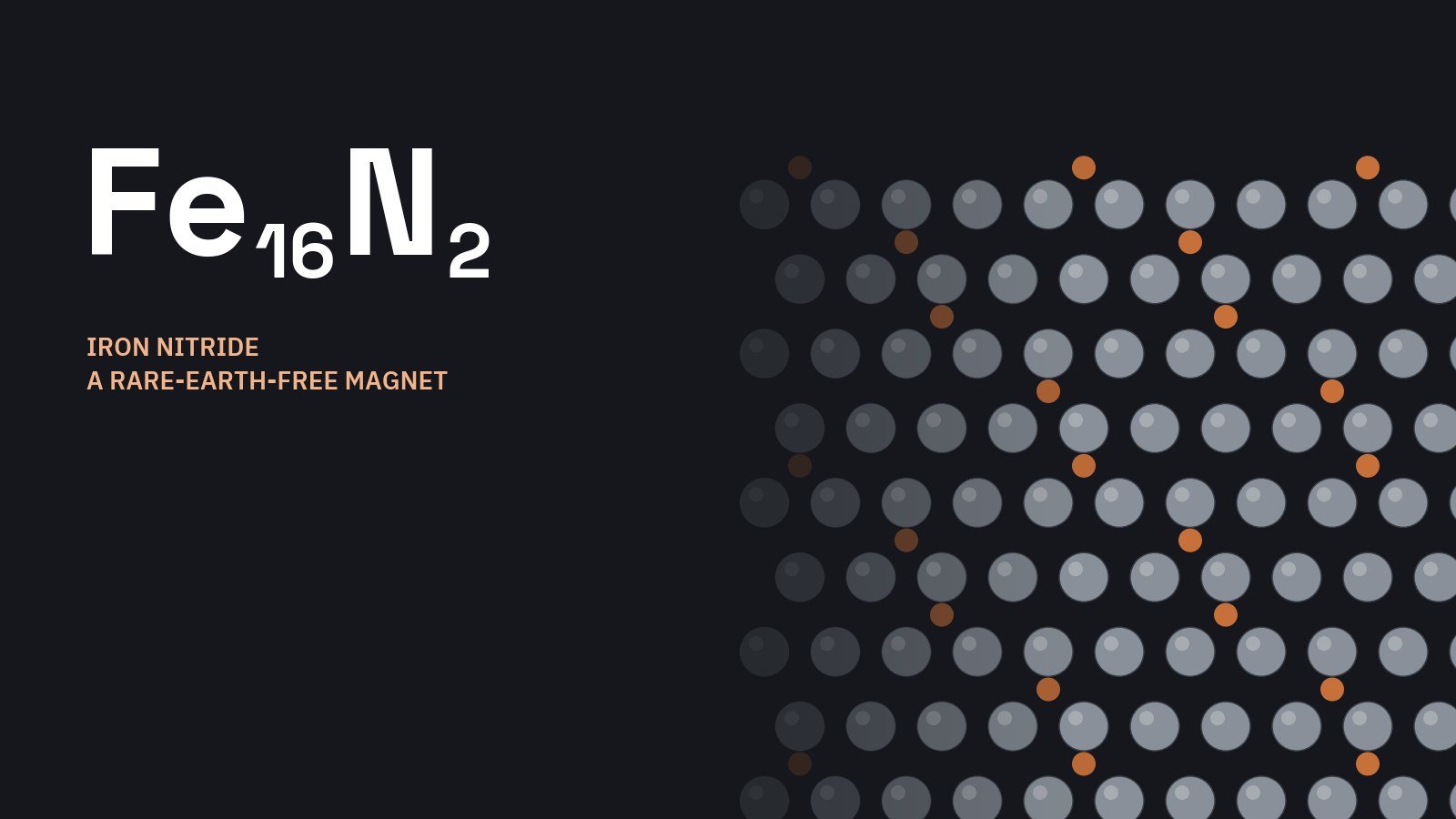
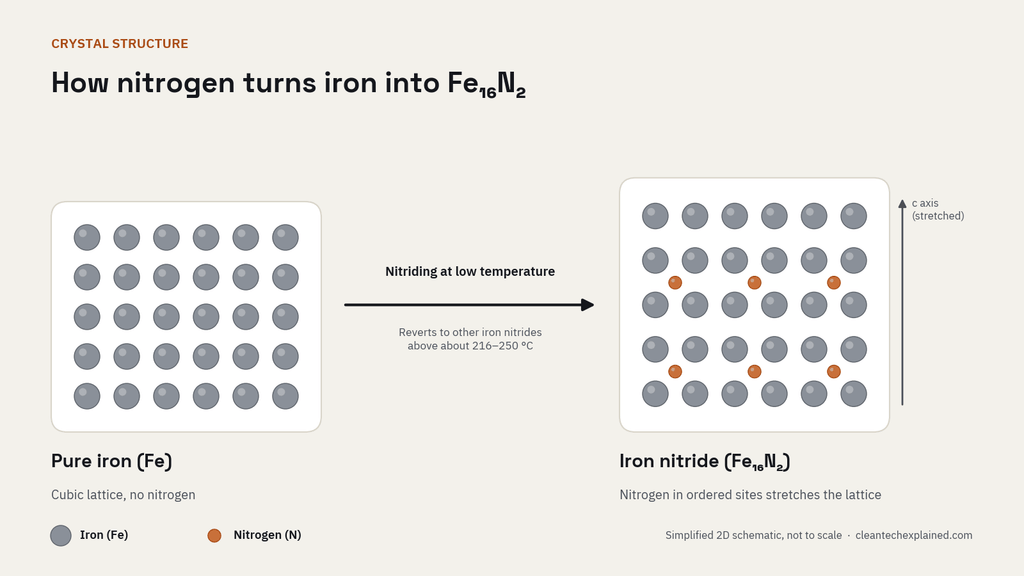
An iron nitride magnet is a permanent magnet made mainly from a specific iron-nitrogen compound, α″-Fe16N2. The formula means 16 iron atoms for every 2 nitrogen atoms. The nitrogen atoms sit in an ordered pattern inside the iron crystal lattice, stretching it slightly in one direction. That distortion turns the cubic structure of ordinary iron into a tetragonal one and changes its magnetic behavior.
Other iron nitrides exist, such as Fe4N and Fe3N, but they do not have the same magnetic properties. The challenge is to create Fe16N2 specifically, keep its nitrogen atoms ordered, and stop it from turning into those other phases.
Why Fe16N2 attracts so much attention
Very high magnetization
Magnetization measures how much magnetic moment a material packs into its volume. Pure iron already has one of the highest magnetizations of any element. Thin films of Fe16N2 have been reported to go further: an average moment of about 3 Bohr magnetons per iron atom, compared with about 2.2 for bulk iron. A higher magnetization raises the theoretical ceiling for a magnet’s strength.
These “giant magnetization” results have been debated since they were first reported, because different groups measured very different values. More recent studies using polarized neutron techniques and new theoretical models have added support for high magnetization in carefully prepared films, but the question is not fully settled.
Abundant, cheap ingredients
Iron and nitrogen are abundant, inexpensive and available almost everywhere. An iron nitride magnet supply chain would not depend on rare earth mining or processing, which is heavily concentrated in China.
How it compares
| Iron nitride (Fe16N2) | Neodymium (NdFeB) | Ferrite | |
|---|---|---|---|
| Main ingredients | Iron, nitrogen | Neodymium, iron, boron, often dysprosium | Iron oxide, strontium or barium |
| Rare earths | None | Yes | None |
| Magnetization | Very high (reported values debated) | High | Low |
| Magnetic anisotropy | Moderate (reported 0.44–2.0 MJ/m³) | Very high | Moderate |
| Phase stability limit | Decomposes around 216–250 °C | Curie temperature about 310 °C | Stable at high temperatures |
| Maturity | Pilot and early commercial production | Mass-produced | Mass-produced |
Values for iron nitride vary widely between studies and processing methods.
How strong are iron nitride magnets in practice?
The headline numbers for iron nitride come from theory and thin films. A 2025 critical review in MagNews, by Imants Dirba of TU Darmstadt and magnet consultant John Ormerod, put the theoretical maximum energy product of Fe16N2 at about 143 MGOe, more than twice the theoretical limit of neodymium iron boron. Real bulk magnets are nowhere near that.
The reason is that commercial routes start from nanoparticles that cannot easily be aligned, so the magnets are isotropic. The same review estimated Niron’s magnet at about 1 tesla of remanence and about 10 MGOe, based on figures the company shared at a 2025 conference, and described it as closer to “a super-AlNiCo” than to a neodymium magnet. The highest coercivity reported for Fe16N2 in research is about 3.35 kOe, in fine particles.
| Magnet | Typical energy product (BHmax) | Coercivity | Heat limit |
|---|---|---|---|
| Ferrite | 3.3–4.8 MGOe | About 2–4 kOe | About 250 °C |
| Alnico 5 | About 5.5 MGOe | About 0.6 kOe | About 525 °C |
| Iron nitride (Niron, estimated) | About 10 MGOe | Up to about 3 kOe reported in research | Phase breaks down from about 200 °C |
| Neodymium (NdFeB), N grades | About 35–52 MGOe | 12 kOe or more | 80 °C for standard grades, up to about 230 °C for heavy rare earth grades |
For scale, a hot-deformed neodymium magnet the author made in a university lab in 2017, without any dysprosium, reached 35.6 MGOe and 13.1 kOe, more than three times the estimated energy product of Niron’s magnet and about four times the highest coercivity reported for Fe16N2. That gap is why iron nitride is better seen as a stronger replacement for ferrite and alnico in some products than as a drop-in substitute for neodymium in EV motors. Our guide to neodymium magnets describes that lab work.
The challenges holding iron nitride back
1. Metastability
Fe16N2 is metastable, meaning it is not the most stable arrangement of iron and nitrogen atoms. Given enough heat, it decomposes into α-iron and γ′-Fe4N, usually at around 216–250 °C in published studies. Some nanopowders have remained stable to about 266 °C (539 K), while others start to break down below 200 °C in an inert atmosphere and to oxidize in air from about 160 °C, which is why particles are often coated with silica or alumina.
This has two consequences. Manufacturing steps must stay below the decomposition temperature, which rules out conventional high-temperature sintering. And finished magnets must operate below that limit, which matters for hot applications such as EV traction motors.
2. Coercivity
A strong permanent magnet needs both high magnetization and high coercivity, its resistance to being demagnetized. Coercivity depends heavily on magnetocrystalline anisotropy, and Fe16N2’s anisotropy is moderate compared with rare earth compounds. Measured values have ranged from 0.44 to 2.0 MJ/m³. The 2025 MagNews review placed Fe16N2 among “semi-hard” materials, with a hardness parameter of about 0.5, where strong permanent magnets usually need more than 1. Engineering a microstructure that delivers high coercivity from a moderately anisotropic material is one of the central problems for iron nitride magnets.
3. Making bulk magnets
Much of the early research used thin films grown atom by atom on crystal substrates, which are ideal for studying physics but not for making motor magnets. Producing bulk Fe16N2, with high phase purity and well-ordered nitrogen, at industrial scale has been the key breakthrough needed for commercialization.
4. Limited public data
Independent experts have noted that full magnetic data for commercial iron nitride magnets, including complete demagnetization curves and high-temperature performance, have not been published in detail. Until such data are available and independently verified, direct comparisons with specific neodymium magnet grades are difficult.
How iron nitride magnets are made
Researchers have used several routes to create Fe16N2:
- Thin film deposition. Techniques such as sputtering and molecular beam epitaxy grow Fe16N2 layer by layer on crystal substrates. This produced most of the early high-magnetization results.
- Nitriding iron powders. Fine iron or iron oxide particles are reduced and then exposed to nitrogen-containing gases such as ammonia at low temperatures, allowing nitrogen to enter the iron lattice.
- Strain and processing routes for bulk material. Research groups, particularly at the University of Minnesota, have developed methods that combine controlled nitrogen incorporation with strain and processing steps to stabilize the Fe16N2 phase in larger volumes.
Commercial processes are proprietary, so their exact details are not public.
Niron Magnetics: from lab to factory
Niron Magnetics is the leading company commercializing iron nitride magnets. It was founded in 2014 by Professor Jian-Ping Wang, whose University of Minnesota research group developed what it describes as the world’s first iron nitride magnet. The company sells its magnets under the name Clean Earth Magnet.
Key milestones:
- 2022: Niron received a 17.5 million dollar grant from the US Department of Energy to scale up production, with partners including Volvo Cars, audio company Peerless and Western Digital.
- 2023: Clean Earth Magnet was included in TIME’s list of the best inventions of the year.
- 2024: Niron opened a commercial pilot facility in Minneapolis.
- 2025: Groundbreaking on a full-scale plant in Sartell, Minnesota, designed to produce up to 1,500 tons of magnets a year. The 190,000-square-foot site represents a 169.7 million dollar investment and about 175 jobs. Niron and Stellantis also began a joint project, part-funded by the US Department of Energy, to design variable-flux EV motors around iron nitride permanent magnets.
- January–June 2026: Loudspeaker makers FaitalPRO, YG Acoustics and Scan-Speak showed speakers using Niron magnets at trade shows in the US and Europe.
- March 2026: The company began site selection for a second US plant of up to 10,000 tons a year, a 1.6-million-square-foot project it values at about 1.8 billion dollars, with more than 700 jobs and construction expected to start in 2028.
- July 2026: Japanese motor maker ASPINA agreed to develop brushless DC motors, hybrid stepper motors and fan blowers using Niron magnets for automotive, industrial and consumer markets.
- August 2026: Niron received a conditional commitment from the US Office of Strategic Capital for a 20-year direct loan of up to 150 million dollars for the Sartell plant. Later the same month, the Shakopee Mdewakanton Sioux Community announced a separate 150 million dollar loan to the company.
- September 2026: Honda invested in Niron through its Honda Xcelerator Ventures program. The amount was not disclosed, and Honda has not announced plans to use the magnets in a specific vehicle. The same month, steel went up on the Sartell plant.
- October 2026: Niron and Moog, a maker of aircraft and defense actuators, showed iron nitride motor technology for land and missile actuators at the AUSA defense exhibition.
Niron says the iron nitride compound itself has higher magnetization than rare earth magnets. As with any company claim, the performance of finished magnets in real products is what matters, and broader independent data will help confirm where iron nitride fits.
Niron Magnetics competitors: who else is making rare-earth-free magnets?
Niron is the only company that has publicly announced a commercial-scale plant for iron nitride permanent magnets. Other groups study Fe16N2 in university and national laboratories, but none has announced a factory. Niron’s real competition comes from other ways of solving the same supply problem.
- Neodymium magnets made outside China. MP Materials, USA Rare Earth and Noveon Magnetics are building or running NdFeB magnet plants in the United States. Their magnets still need rare earths, but they are a proven technology that motor designers already know.
- Recycled rare earth magnets. Recovering neodymium and dysprosium from scrap and old products reduces the need for new mining. See our guide to rare earth magnet recycling.
- Other rare-earth-free materials. Ferrite is cheap and mass-produced but much weaker. Tetrataenite and manganese-based magnets are still in research.
- Motors with no permanent magnets. Some carmakers avoid the question by using wound-rotor or induction motors. See rare earth free electric motors.
For most buyers, the choice is not iron nitride against one rival. It is whether an iron nitride permanent magnet can match the cost and temperature performance of these established options once the Sartell plant is running.
Where iron nitride magnets could be used
Early applications are likely to be those that do not run extremely hot and where supply security and cost matter:
- Loudspeakers and audio equipment, where Niron magnets are already in products shown by FaitalPRO, YG Acoustics and Scan-Speak
- Consumer electronics and data storage
- Appliances and small motors, such as the fan and stepper motors ASPINA is developing
- Industrial motors and power tools
- Defense actuators, the focus of Niron’s work with Moog
EV traction motors and wind turbines are larger long-term targets, but they demand proven performance at high temperatures and very large volumes. Even a 10,000-ton plant would supply only about 1–2% of the global permanent magnet market, according to Niron.
Iron nitride vs other rare earth magnet alternatives
Among rare-earth-free magnet materials, iron nitride is the furthest along the path to commercial production. Ferrite and alnico are already mass-produced; today’s iron nitride magnets beat both on energy product but sit far below neodymium. Tetrataenite, another iron-based material, has excellent theoretical properties but cannot yet be made in bulk. Manganese-based magnets such as MnBi and MnAl remain mostly in research. For a full comparison, see our complete guide to rare earth magnet alternatives.
What to watch next
- Start-up of the Sartell plant and its production ramp in 2027
- Whether the conditional federal loan reaches final agreement
- The site chosen for the second, 10,000-ton plant
- Publication of independent, complete magnetic property data and demagnetization curves for commercial magnets
- Progress on coercivity and temperature stability through alloying and microstructure engineering
- Adoption in named products beyond loudspeakers, such as ASPINA motors or Moog actuators
Frequently asked questions
Is an iron nitride magnet stronger than a neodymium magnet?
Not in practice. Fe16N2 has been reported to have higher magnetization than neodymium magnets, which gives it a high theoretical ceiling. But today’s commercial iron nitride magnets are estimated at around 10 MGOe, against roughly 35 to 52 MGOe for common neodymium grades, and neodymium is also far ahead on coercivity and temperature stability.
Do iron nitride magnets contain rare earths?
No. They are made from iron and nitrogen, with no rare earth elements.
Can you buy iron nitride magnets today?
Iron nitride magnets are produced at pilot and early commercial scale, mainly for industrial customers and partners, and already appear in some loudspeakers. Large-scale production is expected after Niron’s Sartell plant begins operations in 2027.
What is the maximum temperature for iron nitride magnets?
The Fe16N2 phase decomposes at around 200–250 °C in published studies, depending on its form, so both manufacturing and operating temperatures must stay below that range. Practical operating limits for commercial magnets depend on their specific formulation and have not been published in full.
Are iron nitride magnets better than ferrite magnets?
On strength, yes. The estimated 10 MGOe of current iron nitride magnets is roughly two to three times the energy product of ferrite, so a smaller magnet can do the same job. Ferrite is still much cheaper, made at enormous scale and stable at higher temperatures.
Who invented the iron nitride magnet?
Iron nitride’s magnetic properties have been studied for decades. Professor Jian-Ping Wang and his research group at the University of Minnesota developed methods to make bulk iron nitride magnets and founded Niron Magnetics in 2014 to commercialize them.
Who has invested in Niron Magnetics?
Niron’s backers include several carmakers and suppliers. GM Ventures and Stellantis Ventures took part in a 33 million dollar round in 2023, Samsung Ventures, Allison Transmission and Magna in a 25 million dollar round in 2024, and Honda invested in 2026. The company has also received US Department of Energy grants and, in 2026, a 150 million dollar loan from the Shakopee Mdewakanton Sioux Community and a conditional federal loan commitment of up to 150 million dollars.
Sources
- “Theoretical study of thermal stability of α″–Fe16N2 against other iron nitrides,” AIP Advances (2024)
- “Hard magnetic properties of Fe16N2 magnets,” AIP Advances (2024)
- “Large magnetic anisotropy predicted for rare-earth free Fe16-xCoxN2 alloys,” arXiv
- Oak Ridge National Laboratory, “Thermal stability of Fe16N2 thin film on GaAs (001) substrate”
- University of Minnesota, Niron Magnetics receives 17.5M DOE grant (2022)
- University of Minnesota, IEEE Magnetics Society award for Jian-Ping Wang
- University of Minnesota, Sartell groundbreaking
- MinnPost, Niron Magnetics and Minnesota manufacturing (2026)
- Niron Magnetics, second plant site selection (2026)
- Niron Magnetics, conditional 150 million dollar Office of Strategic Capital commitment (2026)
- MPR News, 150 million dollar tribal loan for Niron Magnetics (2026)
- Niron Magnetics, investment from Honda Motor Co. (2026)
- Niron Magnetics and Stellantis motor project (2025)
- Niron Magnetics, 33 million dollar round from automotive manufacturers (2023)
- CBS Minnesota, Niron Magnetics interview
- SDM Magnetics, “Iron Nitride Magnets: A Realistic Perspective”
- Dirba and Ormerod, “Fe16N2: Hype, hope, or heavy hitter? A critical review,” MagNews (2025)
- Manufacturing Dive, Niron plans 1.8 billion dollar second plant (March 2026)
- Niron Magnetics and ASPINA to develop rare-earth-free motor solutions (July 2026)
- Niron Magnetics and FaitalPRO loudspeaker designs at NAMM and ISE (January 2026)
- Niron Magnetics news: Sartell steel raising, High End Vienna loudspeakers and Moog at AUSA (2026)