Do Solar Panels Work in Winter and on Cloudy Days?

Do solar panels work in winter? Yes. They also work on cloudy and rainy days, just at lower output. Solar panels run on light, not heat, so cold weather does not stop them; it actually makes them slightly more efficient. What cuts winter production is shorter days, a lower sun, clouds and snow cover. This guide puts numbers on each of those, and shows what they mean for your bill, your battery and the size of your system.
Short answer: Panels keep producing all year. On a fully overcast day they typically make about 10% to 25% of their rated output, and 50% to 80% when it is partly cloudy. In winter, a typical US home system makes roughly a third to a half of its summer output per day, mainly because the days are short. Snow usually slides off tilted panels within a few days, and studies put the annual loss from snow at under 10% in most places.
Key takeaways
- Clouds reduce output but do not stop it. Diffuse light that passes through clouds still reaches the cells.
- Cold is good for panels: silicon cells lose about 0.24% to 0.5% of their power for every degree Celsius above 25 °C, and gain a little below it.
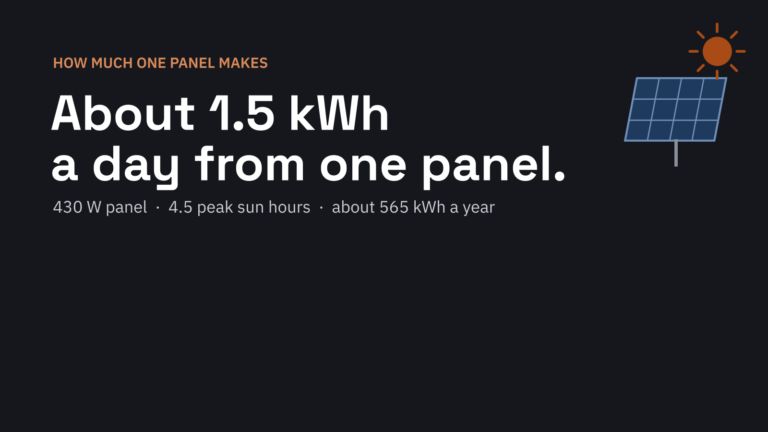
- Short days and a low sun angle are the real winter penalty. In Boston, a 430 W panel makes about 2.1 kWh a day in July but only about 0.8 kWh in December.
- Snow is usually a small annual loss: under 10% in most studies, and less on steeper roofs. Do not climb onto a roof to clear it.
- With annual net metering, summer surplus covers winter shortfall. Off-grid systems and battery backup need to be sized for the worst month, not the average.
Do solar panels work on cloudy days?
Sunlight reaches a panel in two ways: direct light from the sun’s disk, and diffuse light scattered by the sky and clouds. On a clear day most of it is direct. Under thick cloud the direct part drops to almost nothing, but diffuse light remains, and solar cells convert it just as they convert direct light. That is why output falls on gray days but never goes to zero in daylight.
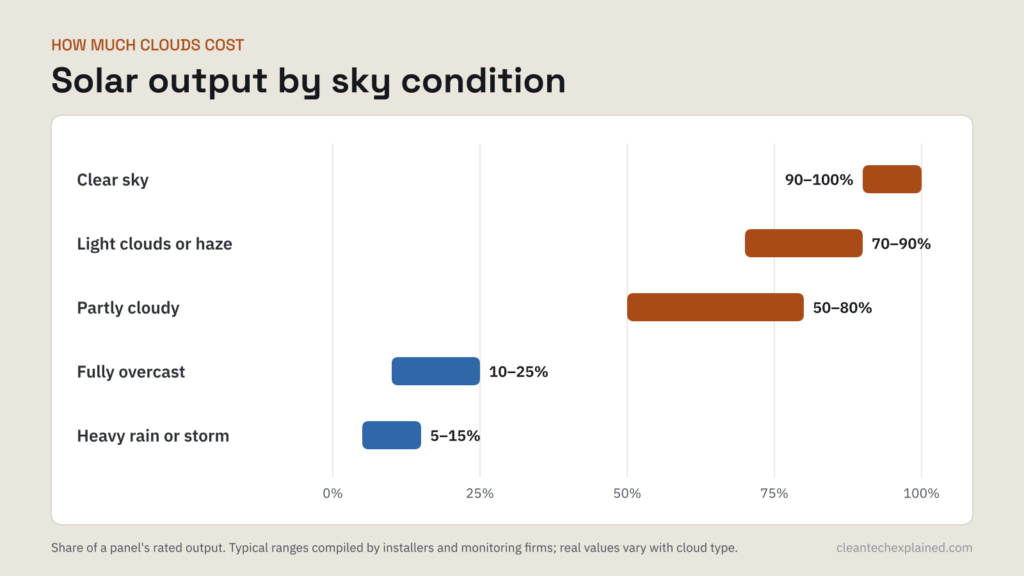
| Sky condition | Share of rated output | 8 kW system, rough daily output |
|---|---|---|
| Clear sky | 90–100% | Full clear-day production |
| Light clouds or haze | 70–90% | Most of a clear day |
| Partly cloudy | 50–80% | About half to most of a clear day |
| Fully overcast | 10–25% | About 3 to 8 kWh |
| Heavy rain or storm | 5–15% | About 2 to 5 kWh |
Cloud type matters more than how gray the sky looks. A monitoring study of home systems in four Australian cities found high, thin cloud left output largely unaffected, while a full overcast sky roughly halved it and low, dark cloud cut it much further. A bright, hazy day can beat a dark, rainy one by several times.
Two things often surprise owners. First, on broken-cloud days the monitoring app can briefly show output above normal, when sunlight reflects off cloud edges onto the panels. Second, rain helps a little afterwards by washing off dust and pollen. Neither changes the big picture, but both are normal, not a fault.
Annual production estimates already include a typical number of cloudy days for your location. That is what the “peak sun hours” figure in a solar quote means: the average amount of full-strength sunlight per day after clouds, so a cloudy climate is priced in from the start. Our guide to how many kWh a solar panel produces lists peak sun hours by state.
Do solar panels work in winter?
They do, and cold air is not the problem. A solar cell produces slightly more power when it is cold. Manufacturers list this as the temperature coefficient: typically −0.24% to −0.5% per °C above 25 °C. On a hot summer roof, cells can reach 65 °C and lose 10% to 15% of their power to heat. On a bright, cold winter day they may run near or below 25 °C and deliver close to their full rating whenever the sun is strong enough.
The cost of winter comes from geometry, not temperature:
- Shorter days. Fewer daylight hours means fewer hours of production.
- Lower sun. Light hits the panels at a steeper angle and travels through more atmosphere, so each hour carries less energy.
- Longer shadows. A tree or chimney that never touches the array in June can shade it for hours in December.
- More cloud and snow in many northern climates.
Put together, the seasonal swing is large, and it grows the farther north you are. Using PVWatts data, a 430 W panel makes about 2.8 kWh a day in a Phoenix June and 1.6 kWh in December; in Boston, about 2.1 kWh in July and 0.8 kWh in December; in Seattle, about 2.0 kWh in June and 0.5 kWh in December. The full table is in our solar panel output guide.
Because winter shadows are longer, shade hurts more in winter than in summer. This is one case where panel-level electronics earn their keep: with microinverters or optimizers, a panel shaded by a low winter sun only loses its own output. Our microinverter vs string inverter guide explains when that matters.
What snow does to solar panels
A thick layer of snow blocks light and stops production, but on most roofs the effect is short-lived. Panels have smooth glass fronts, they sit at an angle, and even a little light through the snow warms the dark cells underneath, so snow tends to slide off in a day or a few days after a storm.
Over a full year, the loss is usually modest. A 2023 review led by researchers at Michigan Tech and Western University notes that snow losses generally stay below 10% of annual energy, although one poorly designed array in an exceptionally snowy spot in Michigan’s Upper Peninsula lost up to 34%. Steeper tilts shed snow faster: one study found annual losses fell from 4.4% at a 10° tilt to 2.9% at 60°.
Snow has an upside too. Fresh snow on the ground reflects a lot of light, which can lift output on clear winter days once the panels themselves are clear, especially for bifacial panels on ground mounts.
Should you clear snow off your panels?
- Usually not. The energy you would gain in a day or two is worth a few dollars at most.
- Never climb onto a snowy roof. Falls are the real risk, far more than lost production.
- Do not use metal tools, hot water or salt. Scratched glass or a cracked panel from thermal shock can cost far more than the snow did, and may void the warranty.
- From the ground only: a soft foam roof rake made for solar panels is fine on a low roof if your panel maker allows it. Ground mounts can be brushed off gently.
Routine care through the year is covered in our solar panel maintenance guide. Panels are tested for snow loads and hail, and cold winters do not shorten their life in any meaningful way; see how long solar panels last.
Is solar worth it in a cloudy or cold climate?
Often, yes. Germany is the usual example: its solar resource is roughly comparable to Alaska’s, according to NREL resource maps, yet it is one of the world’s largest solar markets, and balcony solar kits are now common there. Almost every part of the lower 48 states gets more sun than Germany. Whether solar pays off depends far more on your electricity price, upfront cost and net metering rules than on how many sunny days you get.
Cloudy places do need more panels for the same annual output. Seattle averages about 4 peak sun hours a day against roughly 6 in Phoenix, so a Seattle home needs about half again as many panels to make the same energy. Our solar panel calculator does that math for your bill, and the payback calculator shows how the lower output affects the years to break even.
What winter means for your bill, battery and backup
- On net metering with annual true-up: summer surplus credits offset winter shortfall, so the annual total is what matters. Expect bigger grid bills in December and January, and credits building up in late spring and summer.
- On monthly netting or low export rates: the winter gap shows up on each bill, and summer surplus is worth less. Shifting more use into the sunny middle of the day helps.
- With a battery: on short gray days, panels may not fully recharge it. If backup during winter storms matters, size the battery for a day or two without much solar. Our solar battery and home battery backup guides show how.
- Off-grid or portable setups: size the panels for December, not for the annual average. That can mean two to three times the panel capacity needed in summer.
How to get more out of winter sun
- Tilt. A steeper angle catches the low winter sun better and sheds snow faster. On a ground mount, a tilt near your latitude plus 10° to 15° favors winter.
- Trim winter shade. Check the array at midday in December. Branches that only matter when the sun is low are easy to miss in a summer site survey.
- Watch the app, not the sky. Compare this December with last December. A sudden drop on clear days points to a fault, not the weather.
- Do not oversize for winter on a grid-tied system unless your utility pays well for exports. The extra panels will mostly push surplus to the grid in summer.
FAQ
Do solar panels work when it rains?
Yes, at reduced output, usually about 5% to 15% of rated power under heavy rain. Panels are sealed and built to sit in the weather for decades, and rain also rinses off dust.
Do solar panels work at night or under moonlight?
No useful amount. Moonlight is hundreds of thousands of times dimmer than sunlight. At night, a grid-tied home draws from the grid or a battery.
Can extreme cold damage solar panels?
Not normally. Panels are rated for operation down to about −40 °C. Cold raises panel voltage, which installers account for when they size strings, so a properly designed system handles it. Heavy snow and ice loads are covered by the panel’s load rating.
How much does snow reduce solar output over a year?
In most snowy regions, a few percent; studies generally find less than 10% of annual energy. Flat or low-tilt arrays in very snowy places can lose much more.
Sources
- NuWatt Energy: Do solar panels work on cloudy days? Output by sky condition
- SolarCalculator: Solar panels still work on cloudy days (Solar Analytics monitoring study)
- Williams, Lizzadro-McPherson and Pearce (2023): Snow loss estimations of PV systems, Energy Advances
- Review of snow accumulation on PV modules (tilt and annual yield loss data)
- NREL: Integration, Validation, and Application of a PV Snow Coverage Model in SAM
- Nanowerk: Germany’s solar resources compared with the US (NREL map)
- PVWatts Calculator (National Laboratory of the Rockies, formerly NREL)
- EnergySage: How hot do solar panels get? Temperature coefficients explained