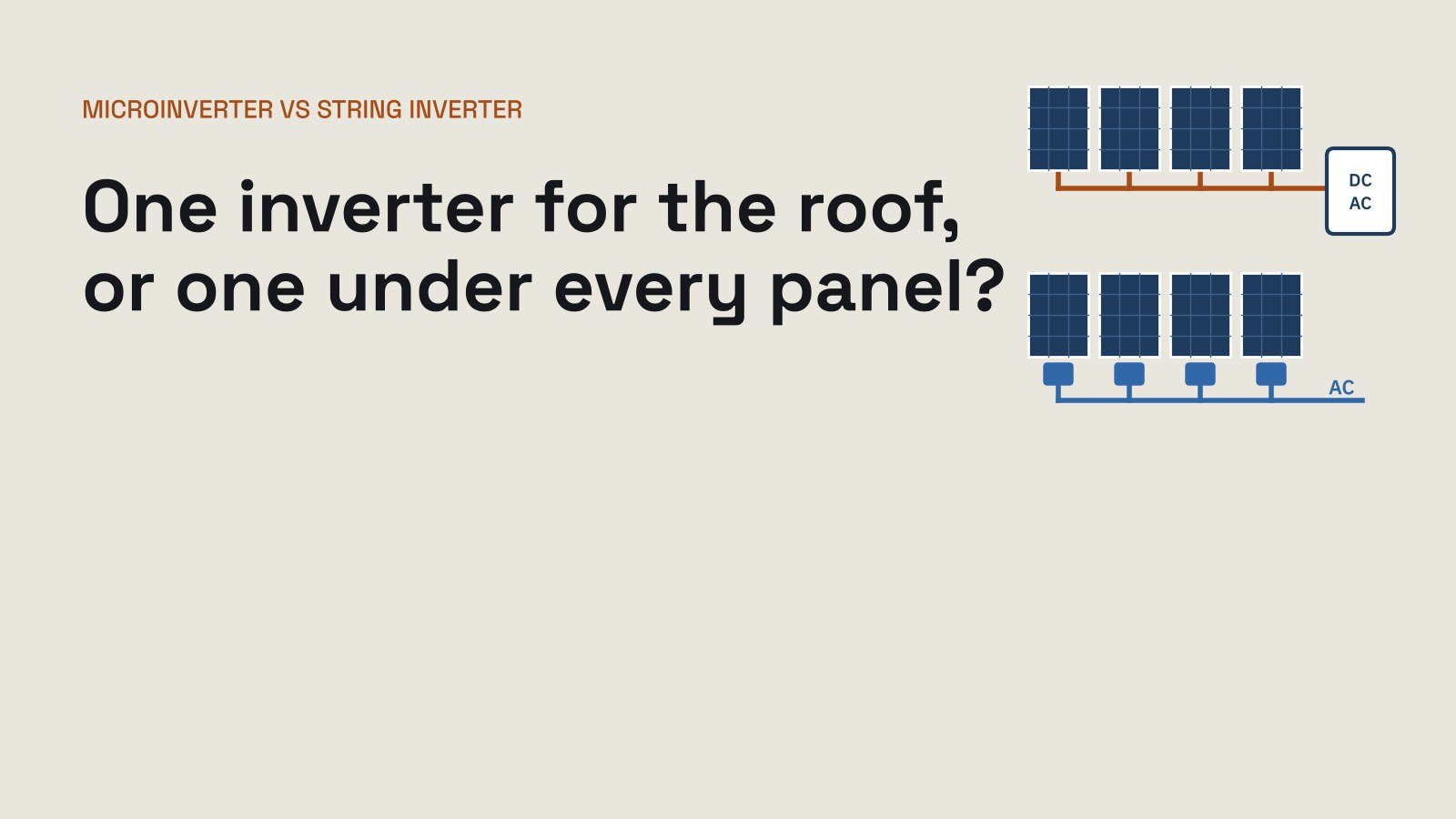
Microinverter vs String Inverter: Which Fits Your Roof?

Microinverter vs string inverter is the one equipment choice that shapes how a solar system behaves for the next 25 years: how it copes with shade, what happens when something fails, how you add a battery, and what you can see in the app. A string inverter is one box on the wall that converts power for the whole roof. Microinverters put a small inverter under every panel. This guide explains how each works, where each one wins, and how to pick the right one for your roof.
Short answer: On a simple, unshaded roof that faces one direction, a string inverter usually costs about $0.15 to $0.25 per watt less installed and produces about the same energy. On a roof with shade, several angles, or a plan to add panels later, microinverters (or a string inverter with power optimizers) recover more energy and keep one failure from shutting down the whole system. If you plan to add a large battery now, a hybrid string inverter is often the simpler, more efficient path.
Key takeaways
- Most new US home systems already use panel-level electronics: microinverters or optimizers were in 87% of residential systems installed in 2024, according to Lawrence Berkeley National Laboratory.
- Peak efficiency is close: about 97% to 98% for good string inverters and about 97% for microinverters. The real difference comes from shade, panel mismatch and roof layout, not the label.
- US fire code (NEC 690.12) requires panel-level rapid shutdown on rooftop systems, so a “plain” string inverter on a roof still needs a shutdown device under each panel. That narrows the price gap.
- Microinverters usually carry a 25-year warranty; string inverters 10 to 12 years. Over the life of the system, one string inverter replacement roughly cancels the upfront saving. See our solar inverter replacement cost guide for the numbers.
- For batteries, a hybrid string inverter charges the battery straight from DC. Microinverter systems use AC-coupled batteries, which add conversion steps but are easy to retrofit.
How a string inverter and microinverters work
Solar panels make direct current (DC). Your home and the grid use alternating current (AC). Every grid-tied system needs an inverter to convert one to the other; the question is where the conversion happens.
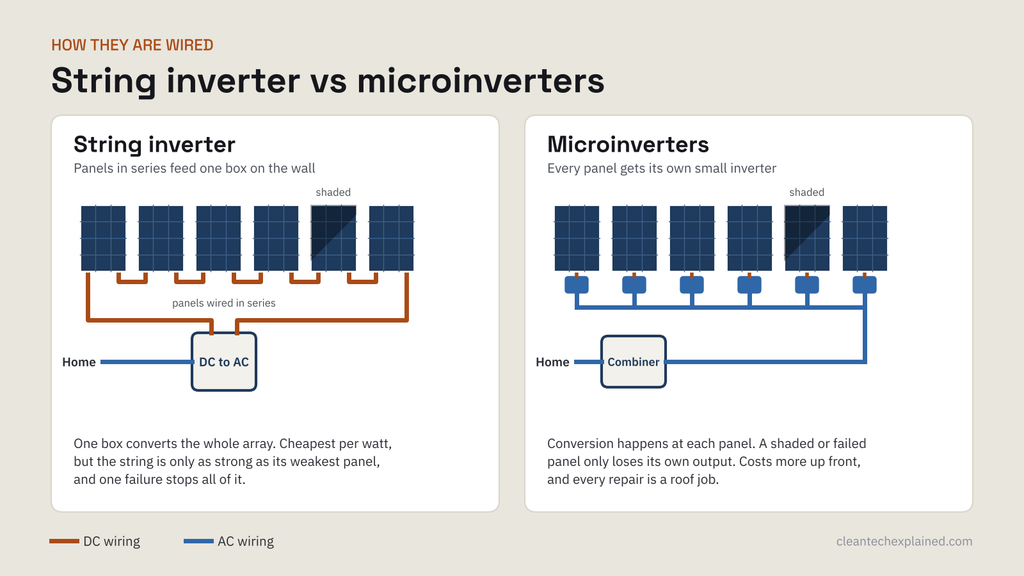
- String inverter. Panels are wired in series into one or more “strings,” usually 8 to 14 panels each. High-voltage DC runs down to a single inverter, typically mounted on a garage or exterior wall. Each input tracks the best operating point (MPPT) for the whole string at once.
- Microinverters. Each panel has its own small inverter clipped to the racking underneath it. Each one tracks and converts its own panel, and AC runs along the roof to a combiner box.
- String inverter with power optimizers. The middle path, best known from SolarEdge. A DC optimizer under each panel does the per-panel tracking, but conversion to AC still happens in one central inverter.
Side-by-side comparison
| String inverter | String + optimizers | Microinverters | |
|---|---|---|---|
| Upfront cost | Lowest | Middle | Highest (about $0.15–$0.25/W more than string) |
| Peak efficiency | About 97–98% | About 97–98% (plus a small optimizer loss) | About 97% |
| Shade and mixed roof angles | Weakest; helped by multiple MPPT inputs | Strong | Strong |
| Effect of one failure | Whole system stops | Whole system stops if the inverter fails | Only that panel stops |
| Monitoring | Whole system | Per panel | Per panel |
| Rooftop rapid shutdown | Needs extra device per panel | Built in | Built in |
| Typical warranty | 10–12 years | Inverter 12 years; optimizers 25 | Up to 25 years |
| Adding a battery | Easy with a hybrid model (DC-coupled) | Easy with a hybrid model | AC-coupled battery |
| Adding panels later | Limited by inverter size and string design | Limited by inverter size | Easy, panel by panel |
| Where repairs happen | On the wall | Wall or roof | On the roof |
Cost: what the price gap really is
Installers quoting both options typically put string-inverter systems about $0.15 to $0.25 per watt cheaper. On an 8 kW system that is roughly $1,200 to $2,000.
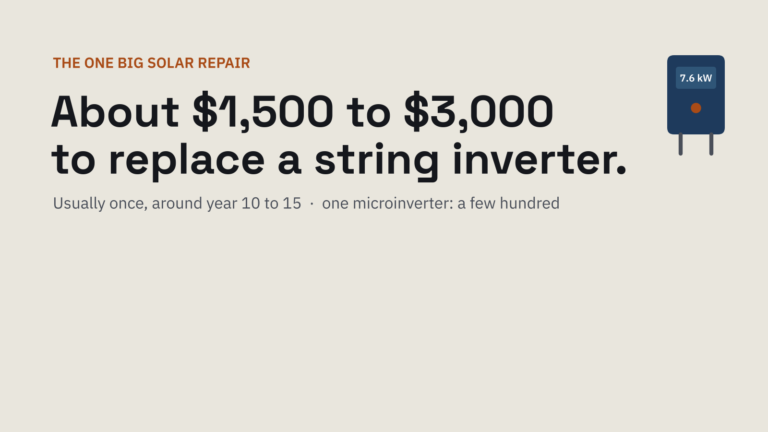
Two things shrink that gap in practice. First, a string inverter on a roof needs a rapid shutdown device under every panel (more on that below), which a microinverter system does not. Second, a string inverter is likely to be replaced once in 25 years, usually for $1,500 to $3,000. Microinverters carry warranties that cover most of the system’s life. Over the full lifespan, the two often end up within a few hundred dollars of each other. If you want the full long-term math, our solar inverter replacement cost guide breaks it down by type, and our solar panel cost guide shows where the inverter sits in a typical quote.
Shade and roof layout: where microinverters earn their money
In a series string, the same current flows through every panel. When one panel is shaded by a chimney or a tree branch, its bypass diodes switch on and the inverter has to find a compromise operating point for the whole string. Modern string inverters handle this far better than older ones: they have two or three separate MPPT inputs, so a west-facing string and a south-facing string can be tracked separately. But within each string, mismatched panels still pull each other down.
With microinverters or optimizers, each panel runs at its own best point. A shaded or dirty panel only loses its own output. That matters most on:
- roofs with partial shade from trees, chimneys, dormers or a neighbor’s house;
- roofs split across three or more faces or tilts;
- small arrays where there are too few panels on one face to make a proper string;
- arrays that will mix panel models later.
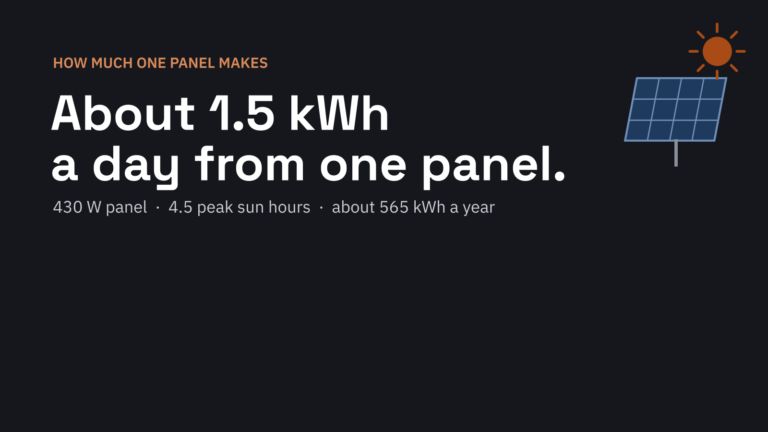
On a clean, single-face roof with no shade, the gain largely disappears and the string inverter’s slightly higher peak efficiency can make up the difference. One trade-off works the other way: microinverters are often paired with panels rated above their AC output, so on the brightest hours a little energy is “clipped.” Berkeley Lab data show microinverter systems are typically designed with higher panel-to-inverter ratios than string systems. The annual loss from clipping is usually small, but it is worth asking your installer for the modeled figure. To see what a single panel should produce on your roof, use our guide to how many kWh a solar panel produces.
Rapid shutdown: why plain string inverters are rare on US roofs
Since the 2017 edition of the National Electrical Code, section 690.12 requires rooftop solar to drop to 80 volts or less within 30 seconds inside the array boundary when the system is shut off. The rule protects firefighters from live DC wiring on a roof. Microinverters and optimizers meet it by design. A string inverter without them needs a listed shutdown device at each panel, such as a Tigo TS4 unit, plus a transmitter near the inverter.
This is a big reason panel-level electronics now dominate US rooftops. It also means “string inverter” quotes in the US are really string-inverter-plus-shutdown-device quotes. Ground-mounted arrays away from the house are generally outside this rule, which is one reason string inverters remain the default there. Your local inspector applies the code edition your state has adopted, so ask the installer which one is in force.
Reliability, heat and repairs
The two designs fail differently. A string inverter is a single point of failure: when it stops, production goes to zero until it is repaired, which can take days or weeks. It is also easy to reach, so the repair is quick once the part arrives. Microinverters live on a hot roof, but each one handles only a few hundred watts, and when one fails you lose one panel’s output, often without noticing until the app flags it.
The catch is access. Replacing a microinverter or optimizer means a roof visit, and sometimes lifting a panel off its rails. If the warranty covers the part but not the labor, a single swap can cost a few hundred dollars. Ask who pays for labor before you sign, and whether your installer will still be around to honor it. Routine checks are covered in our solar panel maintenance guide.
Adding a battery: DC-coupled vs AC-coupled
This is where the choice matters more than it used to. Berkeley Lab reports that 37% of new US residential solar systems in 2025 came with storage, up from 25% in 2024.
- Hybrid string inverter (DC-coupled). One inverter handles both the panels and the battery. Solar charges the battery directly as DC, so energy is converted once on the way in. This is usually the cheapest and most efficient setup when solar and battery are installed together.
- Microinverters (AC-coupled). The panels already produce AC, so the battery has its own inverter. Energy that goes into the battery is converted DC to AC, AC to DC, then back to AC. Each step costs a percent or two, so the round trip ends up a few percent lower. The upside: you can add a battery years later without touching the solar side. Enphase’s own batteries, and the Tesla Powerwall 3 in AC-coupled mode, work this way.
For most homes the efficiency gap is small in dollars; what matters more is price and backup design. Our guides to Enphase battery cost, Tesla Powerwall 3 cost and solar batteries compare the real quotes.
One microinverter-only feature is worth knowing: Enphase IQ8 microinverters can form a small island grid during a daytime outage with no battery at all (“Sunlight Backup”). It needs extra control hardware, runs only a few chosen circuits, and stops when the sun goes down or clouds roll in. It is a useful extra, not a replacement for a home battery backup.
Monitoring and expansion
Microinverter and optimizer systems report each panel’s output, so a cracked panel, a failed unit or a new patch of shade shows up as one weak tile in the app. A plain string inverter only reports totals per string, which makes small faults harder to spot.
Adding panels later is also easier with microinverters: each new panel brings its own inverter, within the limits of the AC branch circuit and your utility interconnection. With a string inverter, extra panels must fit the inverter’s capacity and the string voltage limits, and a bigger addition often means a second inverter. Small balcony and plug-in kits use microinverters for the same reason; see our guide to plug-in solar panels.
Which one fits your roof?
| Your situation | Usually the better fit |
|---|---|
| One roof face, no shade, lowest upfront price matters most | String inverter |
| Ground-mounted array away from the house | String inverter |
| Large battery installed at the same time as the panels | Hybrid string inverter (with optimizers if there is shade) |
| Partial shade, or three or more roof faces | Microinverters or optimizers |
| Small system, or you plan to add panels in stages | Microinverters |
| Existing solar, battery to be added years later | Microinverters with an AC-coupled battery |
| You want some daytime power in outages without a battery | Enphase IQ8 microinverters |
Whichever you choose, ask each installer for a production estimate that models shade on your actual roof, the warranty terms for both parts and labor, and the price of the rapid shutdown hardware. Comparing quotes on those three points tells you more than the inverter brand on the cover page. If you are still sizing the system, start with how many solar panels you need.
FAQ
Are microinverters more efficient than string inverters?
Not on paper. A good string inverter has a slightly higher peak efficiency. Microinverters come out ahead in real output only when panels are shaded, face different directions or age unevenly, because each panel is tracked on its own.
Do microinverters fail more often because they are on the roof?
Individual units do fail, and a system has many of them, but each failure only takes out one panel. Leading brands back them with 25-year warranties. The bigger practical issue is the cost of a roof visit when one needs replacing.
Can I mix microinverters and a string inverter?
Yes. Some homes add a microinverter array on a shaded or separate roof face next to an existing string system. Both feed AC into the main panel, but they report to different apps and the total solar capacity still has to fit your service panel and utility limits.
Are power optimizers better than microinverters?
They solve the same shade and monitoring problems. Optimizers pair well with a hybrid inverter and a DC-coupled battery; microinverters avoid a single central point of failure and make expansion simpler. Price and installer experience usually decide it.
Sources
- Lawrence Berkeley National Laboratory: U.S. Distributed Solar and Storage, 2025 Data Update
- Lawrence Berkeley National Laboratory: U.S. Distributed Solar and Storage, 2026 Data Update
- Lawrence Berkeley National Laboratory: Tracking the Sun, 2024 Edition, Executive Summary
- Boston Solar: String Inverters vs. Microinverters (2026)
- NuWatt Energy: Inverter types comparison 2026
- pv magazine USA: Important code requirements for PV systems (NEC 690.12)
- SurgePV: Rapid shutdown (NEC 690.12) explained
- EnergySage: AC vs. DC solar battery coupling
- Enphase: Sunlight Backup with IQ8 Microinverters