Solar Inverter Replacement Cost: What You’ll Pay in 2026

Solar inverter replacement cost is the one big repair most solar owners should expect. Panels can run for 25 years or more, but a central string inverter usually wears out somewhere between year 10 and year 15. Replacing one typically costs $1,500 to $3,000 installed, with $2,000 to $2,500 typical for a 7 to 8 kW system. A single failed microinverter costs a few hundred dollars to swap, and is often covered by a 25-year warranty. This guide breaks down the price by inverter type, explains what warranties really cover, and helps you decide whether to replace like for like or upgrade.
Solar inverter replacement cost by type
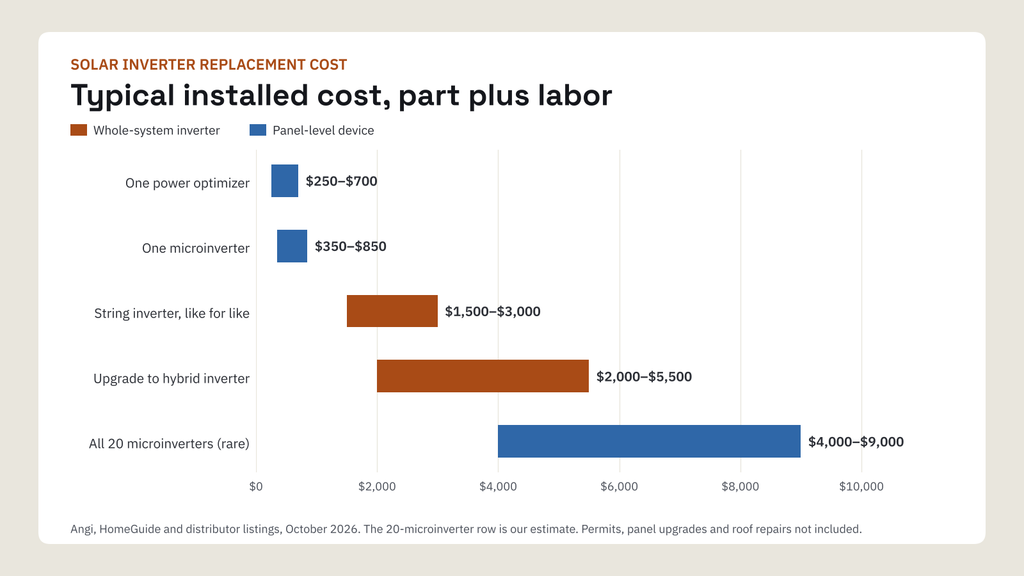
The figures below combine national cost surveys with October 2026 distributor prices. “Installed” includes the part, an electrician or solar technician, and basic commissioning. Permits, panel upgrades and roof repairs are extra.
| What you replace | Part | Labor | Typical installed cost |
|---|---|---|---|
| String inverter, like for like (5 to 10 kW) | $800–$2,700 | $200–$500 | $1,500–$3,000 |
| One microinverter | $150–$350 | $200–$500 | $350–$850 |
| One power optimizer | $50–$200 | $200–$500 | $250–$700 |
| String inverter upgraded to a hybrid (battery-ready) inverter | $1,000–$5,000 | $300–$800 | $2,000–$5,500 |
| All microinverters on a 20-panel roof | $3,000–$7,000 | $1,000–$2,000 | $4,000–$9,000 |
For a sense of hardware prices: a SolarEdge 7.6 kW HD-Wave string inverter (SE7600H) listed at about $2,330 to $2,730 at one US distributor in October 2026, and an Enphase IQ8MC microinverter at about $155 to $215 per unit. Installers buy at lower prices and add a markup, so a quote close to these numbers for the part is normal.
What drives the price
- Size. String inverters are priced by kW. Inverter hardware runs about $0.15 to $0.24 per watt, so a 10 kW unit costs more than a 6 kW one.
- Brand compatibility. A SolarEdge inverter only works with SolarEdge optimizers. If your system has optimizers, you are effectively locked to that brand unless you replace the optimizers too.
- Location. A string inverter usually hangs on a garage or exterior wall, which makes the job quick. Microinverters and optimizers sit under the panels, so every replacement is a roof job, and some panels have to be lifted off.
- Code updates. A new inverter has to meet the electrical code in force today, not the code from when your system was installed. Rules on rapid shutdown and grid support can require extra hardware on older systems.
- Who does the work. Solar technicians and electricians charge roughly $50 to $100 an hour. Many installers charge a flat service-call fee of a few hundred dollars before any parts.
String inverter vs microinverter: what each costs over 25 years
The choice between a string inverter and microinverters is usually made when the system is installed, but it decides what you will spend later. A string inverter is cheaper up front and easy to reach. Microinverters cost more at installation but rarely need a planned replacement.
| String inverter | String + optimizers | Microinverters | |
|---|---|---|---|
| Typical lifespan | 10–15 years | Inverter 10–15 years; optimizers about 25 | 20–25 years |
| Standard warranty | 5–12 years | Inverter 12 years (extendable); optimizers 25 | Up to 25 years |
| Where it sits | Wall, ground level | Wall + under each panel | Under each panel |
| Expected replacements in 25 years | Usually one | Usually one inverter | Occasional single units |
| Effect of one failure | Whole system stops | Whole system stops if the inverter fails | Only that panel stops |
| Shade tolerance | Low | High | High |
| Planned replacement cost | $1,500–$3,000 once | $1,500–$3,000 once | Mostly covered by warranty |
Over 25 years, the two often come out closer than the sticker prices suggest. A microinverter system can cost $1,500 or more extra at installation, which is about the price of the string inverter replacement it avoids. The difference is risk: with microinverters, a failure costs you one panel’s output; with a string inverter, it costs you everything until the repair is done.
What the warranty covers, and what it does not
Inverter warranties are product warranties: the manufacturer sends a replacement part. Whether the labor to install it is covered depends on the brand, on whether your installer is still in business, and on the fine print.
- String inverters: 5 to 12 years is standard. SolarEdge home inverters come with a 12-year warranty, which can be extended for a fee.
- Microinverters: Enphase IQ8 units carry a limited warranty of up to 25 years.
- Labor: Some manufacturers pay installers a fixed amount for warranty labor, which may not cover a roof visit in full. Expect to pay something for a service call even when the part is free.
- Orphaned systems: If the company that installed your system has closed, you can still claim the manufacturer warranty, but you will need another installer to do the work, and they will charge for it.
Signs your inverter is failing
- The monitoring app shows zero or much lower production on a sunny day.
- A red or orange status light, or an error code on the inverter’s screen.
- Your electricity bill jumps without a change in use or rates.
- Loud buzzing, a burning smell or visible heat damage. Turn the system off using the shutdown procedure on the label and call a professional.
Before you call an installer
Many “failures” are not the inverter at all. Ten minutes of checks can save a service-call fee:
- Check the solar breaker in your main panel and the AC disconnect next to the inverter. Reset a tripped breaker once; if it trips again, stop and call.
- Restart the system using the shutdown and startup steps printed on the inverter label, then wait 5 to 10 minutes for it to reconnect to the grid.
- If only the app shows zero, check the inverter’s own screen or lights. A lost Wi-Fi connection stops monitoring, not production.
- Write down the error code, model and serial number, and take a photo of the label.
- Find your installation date. The warranty usually starts then, not on the purchase date.
Our solar panel maintenance guide covers the routine checks between visits.
What a dead inverter costs you while you wait
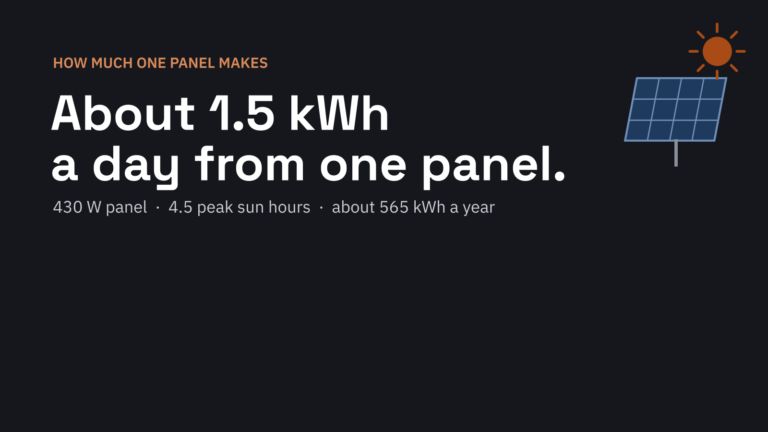
When a string inverter fails, the whole array stops producing. An 8 kW system in an average US location makes about 29 kWh a day (8 × 4.5 peak sun hours × 0.8). At about 18.3 cents per kWh, that is about $5 a day, or roughly $110 if parts and scheduling take three weeks. In sunny states with high electricity prices, such as California, it can be two or three times that. Our guide to how many kWh a solar panel produces has output figures by state.
With microinverters, a single failure costs only that panel’s output, about 1.5 kWh a day. It is usually worth waiting to bundle a warranty repair with other work.
Replace like for like, or upgrade?
An inverter replacement is a natural moment to rethink the system. The main options:
- Same type, same size. The cheapest and fastest choice. Pick this if you are happy with the system and have no plans for a battery.
- Hybrid inverter. A hybrid inverter connects both panels and a battery. It costs more now but makes adding a solar battery later much cheaper.
- Battery with a built-in solar inverter. The Tesla Powerwall 3 includes a solar inverter that accepts up to 20 kW of panels. If your string inverter dies and you wanted backup power anyway, one product can replace the inverter and add storage. It costs far more than a like-for-like swap, so it only makes sense if you want the battery.
- Switch to microinverters. Possible, but it means working on every panel, so it usually costs several thousand dollars more than a string replacement. It pays off mainly on shaded or multi-direction roofs.
Batteries such as Enphase IQ batteries work with Enphase microinverter systems, and Enphase now sells versions that can back up homes with other brands of panels. See our home battery backup guide to size one.
How to get a fair price
- Call your original installer first; they may have records of your system and warranty access.
- Get at least two quotes that list the exact inverter model, labor, permit fees and any code-required extras separately.
- Ask whether the new inverter’s warranty starts on the replacement date, and how long the installer guarantees their own workmanship.
- If your system is 10 years old or more, ask for a check of wiring, connectors and mounting during the same visit.
Even with one replacement of $2,000 to $3,000, most systems still pay for themselves. Our solar panel payback period calculator and how long solar panels last guide show how an inverter replacement fits into the 25-year math.
FAQ
How long does a solar inverter last?
String inverters usually last 10 to 15 years. Microinverters and power optimizers are rated for 20 to 25 years. Heat shortens inverter life, so units in shaded, ventilated spots tend to last longer.
Can I replace a solar inverter myself?
It is not recommended. Inverters handle high-voltage DC from the panels, which stays live whenever the sun is up, and most utilities and building departments require a licensed installer and sometimes a permit. A DIY install can also void the warranty.
Does a replacement inverter qualify for a tax credit?
Not in 2026. The federal 30% residential clean energy credit ended for property placed in service after December 31, 2025. Some state or utility programs may help; check before you buy.
Should I replace all my microinverters if one fails?
No. Microinverters fail individually, so replace only the failed unit, ideally under warranty. Replacing all of them only makes sense if many are failing, or if you are rebuilding the system anyway.