Cerium: Uses, Cerium Oxide and Why It Is So Cheap

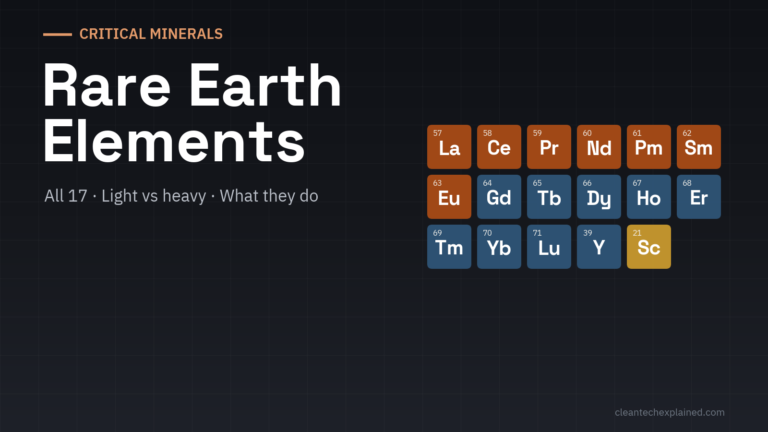
Cerium (chemical symbol Ce, atomic number 58) is the most abundant of the rare earth elements, and the one the industry has the hardest time selling. It makes up roughly half of the rare earth content in the ores that are mined for magnet metals, so every new mine produces far more cerium than the market can absorb. You have probably used it without knowing: cerium oxide polishes almost every lens and phone screen, cleans car exhaust, and lights the flint in a cigarette lighter. This guide explains what cerium is, what it is used for, how cerium oxide polishing works, and why cerium is cheap when other rare earths are not.
Short answer: Cerium is a soft, silvery light rare earth metal and the most common lanthanide in the Earth’s crust, at about 68 parts per million. Its main uses are cerium oxide (CeO2) for polishing glass, catalytic converters and other catalysts, glass additives that block UV light and remove color, lighter flints, and alloys. Because cerium is about half of typical rare earth ore, it is produced in surplus and sells for only a few dollars per kilogram.
Key takeaways
- It is not rare. Cerium is about as common in the crust as copper and is the 25th most abundant element.
- Cerium oxide is the useful form. Its ability to switch between two oxidation states makes it a fine glass polish and an oxygen buffer in catalytic converters.
- It is a by-product. Mines are built for neodymium and praseodymium. Cerium comes along whether anyone wants it or not.
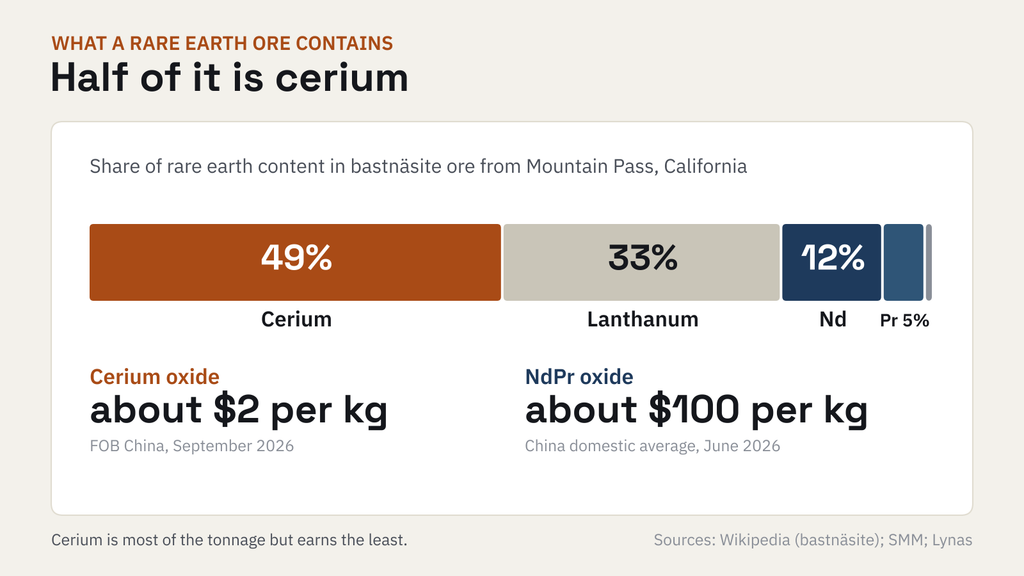
- It is cheap. Cerium oxide traded at about $2 per kilogram in September 2026, against about $100 for NdPr oxide.
- Industry is looking for new uses. Cheaper cerium-containing magnets and aluminum-cerium alloys are the two biggest bets.
What is cerium?
Cerium is one of the 17 rare earth elements and the second member of the lanthanide series, between lanthanum and praseodymium. It is a soft, ductile, silvery metal that tarnishes quickly in air. Cerium metal is reactive enough that shavings can ignite by themselves at 65 to 80 °C, which is the property that makes it useful in lighter flints.
| Property | Value |
|---|---|
| Symbol | Ce |
| Atomic number | 58 |
| Atomic weight | 140.12 |
| Group | Lanthanide, light rare earth |
| Density | About 6.77 g/cm³ |
| Melting point | 795 °C |
| Crustal abundance | About 68 ppm, the most of any rare earth |
| Common oxidation states | +3 and +4 |
| Main oxide | Cerium dioxide (CeO2), a pale yellow-white powder |
| Discovered | 1803, Berzelius and Hisinger in Sweden, and independently Klaproth in Germany |
One property sets cerium apart from the other lanthanides. Most of them are stable only in the +3 state. Cerium is also stable as Ce4+, and it moves easily between the two. That switching is behind almost everything cerium is used for: it lets cerium oxide take up oxygen and give it back, and it lets cerium attack the surface of glass during polishing.
How cerium was discovered
Cerium was the first rare earth from the light group to be identified. In 1803 Jöns Jacob Berzelius and Wilhelm Hisinger isolated a new oxide from a heavy mineral found at Bastnäs in Sweden. Martin Heinrich Klaproth found the same oxide independently in Germany in the same year. Berzelius named the element after Ceres, the dwarf planet discovered two years earlier.
What they called “ceria” was not pure. Over the following decades chemists pulled lanthanum, didymium (later split into praseodymium and neodymium) and other elements out of it. The metal itself was first isolated by William Francis Hillebrand in 1875.
What is cerium used for?
Glass polishing
Cerium oxide is the standard powder for polishing glass to an optical finish. Camera and eyeglass lenses, telescope mirrors, phone and TV screens, and hard disk platters are all polished with it, and fine grades are used in semiconductor manufacturing. A separate section below explains how it works and how to use it on household glass.
Catalytic converters and catalysts
Car exhaust catalysts need a steady supply of oxygen to burn carbon monoxide and unburned fuel, but an engine’s exhaust swings between oxygen-rich and oxygen-poor many times a second. Cerium oxide acts as a buffer. It releases oxygen when the exhaust runs rich and absorbs it when the exhaust runs lean, keeping the precious metal catalyst working. Cerium-based catalysts are also used in self-cleaning ovens and in diesel particulate filters, and the US Geological Survey reports that catalysts are the leading use of rare earths in the United States.
Glass additives
Small amounts of cerium oxide added to molten glass do two jobs. Cerium oxidizes green iron impurities to a nearly colorless form, so the glass comes out clearer. It also absorbs ultraviolet light, which is why cerium is added to the glass of some bottles, windows and protective covers, including the cover glass of solar panels and spacecraft.
Lighter flints and mischmetal
Mischmetal is a mixed rare earth alloy of about 50% cerium and 25% lanthanum, with the rest other light rare earths. Alloyed with iron, it becomes ferrocerium, the material in lighter flints and the “ferro rods” used by campers. Scraping it shears off tiny particles that ignite in air and throw sparks. Mischmetal is also added to steel and other alloys to remove oxygen and sulfur.
Other uses
- White LEDs. Most white LEDs combine a blue chip with a yellow phosphor made of cerium-doped yttrium aluminum garnet (Ce:YAG).
- Welding electrodes. Ceria-doped tungsten electrodes replace older ones containing radioactive thorium.
- Pigments. Cerium sulfide is a red pigment used as a less toxic alternative to cadmium reds.
- Chemistry and medicine. Ceric ammonium nitrate is a standard laboratory oxidant, and cerium nitrate is used in some burn treatments.
- Gas mantles. Carl Auer von Welsbach’s gas mantle of the 1890s glowed bright white thanks to a thoria-ceria mixture, one of the first commercial uses of a rare earth.
How cerium oxide polishes glass
Cerium oxide is not simply a fine sand. It is a chemical-mechanical polish. Mixed with water and rubbed on glass, the particles react with the silica surface and form a thin, softened layer that the rubbing then wipes away. Because the chemical reaction does much of the work, cerium oxide removes material evenly and leaves a smoother finish than harder abrasives such as aluminum oxide or diamond paste, which cut by scratching.
Powders are sold in different particle sizes and purities.
- Particle size. Fine powders of about 0.5 to 2 microns give the highest gloss. Coarser powders of 2 to 4 microns remove scratches faster but can leave haze. Car glass work typically uses 1 to 3 microns.
- Purity. Optical grades of 99% CeO2 or more are used for lenses and precision optics. Grades of 60 to 95% are used for car glass, mirrors and general repair.
Can cerium oxide remove scratches from a windshield?
It can remove light scratches, wiper marks and haze. A simple test is to run a fingernail across the scratch. If the nail does not catch, cerium oxide can usually polish it out. If it catches, the scratch is probably too deep, and polishing it away would remove enough glass to distort the view. That is a job for a professional or a replacement.
If you try it yourself:
- Clean the glass and mask off paint, trim and rubber seals.
- Mix the powder with water into a creamy paste. A starting point is about two parts powder to one part water.
- Use a felt pad on a drill or polisher at low speed, not wool or foam.
- Keep the surface wet and the pad moving. Glass that gets hot from friction can warp or crack.
- Work a small area at a time, rinse, and check your progress often. Do not keep polishing one spot.
Avoid tinted or coated glass unless the coating maker says it is safe, and wear a dust mask when handling dry powder.
Where cerium comes from
Cerium is recovered with the other light rare earths from bastnäsite and monazite, the same minerals mined for neodymium and praseodymium. In both, cerium is the largest component. In bastnäsite from Mountain Pass, California, it makes up about half of the rare earth content.
Cerium is also the easiest rare earth to separate. Because it can be oxidized to Ce4+, which behaves differently from the trivalent rare earths, many plants roast the ore so that cerium turns into insoluble cerium dioxide and stays behind while the other elements are dissolved. Removing cerium early cuts the volume that has to pass through the expensive separation steps for neodymium and praseodymium.
Most cerium comes from China, which accounted for about 270,000 of the world’s 390,000 tonnes of mined rare earth oxide in 2025, according to the USGS. Other producers include the United States, Australia, Myanmar and Thailand. Cerium is on the US critical minerals list along with the other rare earths, though its own supply is not a concern. It was not among the seven rare earths China placed under export licensing in April 2025. Our critical minerals guide explains the lists.
Why cerium is cheap: the balance problem
Rare earths come out of the ground in fixed proportions, but the market does not want them in those proportions. Demand is driven by neodymium magnets for motors, wind turbines and electronics. To get one tonne of neodymium and praseodymium from typical ore, a mine also has to produce several tonnes of cerium and lanthanum. Analysts call this the balance problem.
The result is a lasting surplus. Researchers at Idaho National Laboratory cite estimates of about 60,000 tonnes of cerium produced worldwide in 2018, with about 6,800 tonnes more than the market used. Some producers simply leave cerium in their waste. Prices show it:
- The USGS gives an average of $1.71 per kilogram for 99.5% cerium oxide in 2025, and $1.03 to $1.54 in the three years before.
- Shanghai Metals Market data put cerium oxide at about $2.01 per kilogram free on board in China, and cerium metal at about $3.75, at the end of September 2026.
- For comparison, NdPr oxide averaged about $100 per kilogram in China in June 2026.
The exception was 2011, when China cut export quotas and cerium prices briefly jumped more than tenfold before collapsing again.
New uses for surplus cerium
The industry is trying to turn cerium from a cost into a product.
- Cerium in magnets. Chinese magnet makers replace part of the neodymium in NdFeB magnets with cerium. The magnets are weaker and less heat resistant, so they go into speakers, e-bike motors and industrial motors rather than EV traction motors. Adamas Intelligence estimated that magnets accounted for 18% of global cerium oxide consumption in 2023, up from 5% in 2017.
- Aluminum-cerium alloys. Adding 6 to 16% cerium makes aluminum easier to cast and stronger at high temperatures. These alloys are being tested in pistons, turbochargers and cylinder heads, and could use large volumes of cerium if they catch on.
Both matter for the clean energy transition. Each new mine built outside China to supply magnet metals also produces cerium, and finding buyers for it improves the economics of those projects.
Is cerium dangerous?
Cerium has low to moderate toxicity and no known role in the human body. Cerium oxide powder is not considered highly hazardous, but fine dust should not be breathed, and some studies link long-term inhalation of rare earth dusts to lung damage. Wear a dust mask when mixing polishing powder. Cerium metal is a fire hazard: shavings and powder can ignite in air, and burning cerium must be smothered with a class D extinguisher, not water, because it reacts with water to release hydrogen.
Frequently asked questions
What is cerium used for?
Mainly glass polishing, catalytic converters and other catalysts, glass that blocks UV light, lighter flints, alloys and the phosphor in white LEDs.
What is cerium oxide?
Cerium oxide, or cerium dioxide (CeO2), is the stable oxide of cerium, a pale yellow-white powder. It is the form in which most cerium is sold and used.
Is cerium a rare earth element?
Yes. It is a lanthanide and a light rare earth, and it is the most abundant of all the rare earths.
Is cerium rare?
No. At about 68 parts per million in the Earth’s crust, it is about as common as copper.
Why is cerium so cheap?
Because it is produced as a by-product of mining for neodymium and praseodymium, and it makes up about half of the ore. Supply consistently exceeds demand.
Is cerium radioactive?
No. Natural cerium is made of stable isotopes. Its ores, especially monazite, can contain radioactive thorium, which is removed during processing.
What is cerium named after?
Ceres, the dwarf planet in the asteroid belt, which was discovered in 1801, two years before the element.
Sources
- US Geological Survey, Mineral Commodity Summaries 2026: Rare Earths, February 2026
- Idaho National Laboratory, Severson, Sibal and Nguyen, Impacts of Aluminum-Cerium Alloy Deployment on Different Cerium Commodities, 2024
- Adamas Intelligence, Cerium NdFeB magnets: gift or a curse?, October 2024
- Rare Earth Mining, Cerium price (Shanghai Metals Market data, September 2026)
- Lynas Rare Earths, Results for the year ending 30 June 2026 (NdPr price), August 2026
- FindLight, Cerium oxide polishing powder for glass and crystal, September 2025
- GT Glass, How to use cerium oxide for glass polishing
- Wikipedia, Cerium and Bastnäsite (properties, history and ore composition, with primary references)
Featured image and diagram: original graphics by CleanTech Explained. This article is general information, not safety, investment or purchasing advice.