Alnico Magnets Explained: Grades, Strength and Heat Limits

Alnico magnets were the strongest permanent magnets in the world for about four decades, until rare earth magnets arrived in the 1970s. They are no longer the strongest, but they have not gone away. Alnico still does two things better than any other common magnet: it survives extreme heat, and its field barely drifts as the temperature changes. It also contains no rare earth elements, which has put it back on the research agenda.
This guide explains what alnico is, how the grades differ, how it compares with neodymium, samarium cobalt and ferrite, and why its real weakness is not strength but how easily it can be demagnetized.
Short answer
Alnico magnets are iron alloys containing aluminum (Al), nickel (Ni) and cobalt (Co), usually with some copper and titanium. They are rare-earth-free, usable up to roughly 450–550 °C depending on grade, and have the most temperature-stable field of any common magnet. Their energy product is modest (about 1.4 to 10.5 MGOe) and their coercivity is low, so they must be designed carefully to avoid demagnetization.
Key takeaways
- Rare-earth-free, but not free of critical minerals. Common grades contain 13% to 38% cobalt by weight.
- Best heat performance of any common magnet. Maximum service temperature is 450–550 °C, and the field changes only about 0.02% per °C.
- High field, weak grip. Alnico 5 has a remanence close to that of neodymium magnets, but only a small fraction of their resistance to demagnetization.
- Two grade families. The Alnico 5 family gives the most field; the Alnico 8 family resists demagnetization better. Alnico 9 is the strongest commercial grade.
- Still widely used in sensors, instruments, microwave tubes, guitar pickups and holding magnets.
What are alnico magnets?
Alnico is a family of iron-based alloys named after three of its ingredients: aluminum, nickel and cobalt. Most grades also contain a few percent copper, and the higher-coercivity grades add titanium. Iron makes up the balance, typically a third to a half of the alloy.
Unlike neodymium magnets and samarium cobalt magnets, alnico contains no rare earth elements. Unlike ferrite magnets, it is a metal rather than a ceramic, so it conducts electricity and can be cast into shape like other alloys.
A short history
Alnico development began in 1931, when the Japanese metallurgist Tokushichi Mishima found that an alloy of iron, nickel and aluminum had a coercivity of about 400 oersteds, double that of the best magnet steels of the time. Cobalt, copper and titanium additions followed, along with heat treatment in a magnetic field, and by the 1940s alnico had replaced magnet steel in loudspeakers, motors and instruments. Arnold Magnetic Technologies has produced alnico in Marengo, Illinois, since 1938.
Alnico remained the strongest permanent magnet material until samarium cobalt was developed in the late 1960s and 1970s. Cheap ferrite then took most of the low-cost market, and neodymium took the high-performance one. Alnico kept the applications where heat and stability matter most.
How alnico magnets work
Alnico gets its magnetism in an unusual way. In rare earth magnets, resistance to demagnetization comes from the crystal structure itself. In alnico, it comes from shape.
During heat treatment, the alloy separates into two phases through a process called spinodal decomposition: tiny, strongly magnetic rods rich in iron and cobalt, embedded in a weakly magnetic matrix rich in aluminum and nickel. The rods are only tens of nanometers across. Because each rod is long and thin, it strongly prefers to be magnetized along its length, and that preference is what makes alnico a permanent magnet. Without the heat treatment, alnico’s coercivity is only about 10 oersteds, which is comparable to plain iron.
In the stronger grades, the alloy is cooled from about 1,093 °C (2,000 °F) inside a magnetic field. The field makes the rods grow in one direction, producing an anisotropic magnet with much higher output along that axis. Grades made without the field are isotropic: weaker, but magnetizable in any direction.
Shape anisotropy is weaker than the crystal anisotropy of rare earth magnets. That is the root of alnico’s main limitation, low coercivity.
Alnico grades explained
Alnico grades are traditionally numbered using the system of the Magnetic Materials Producers Association (MMPA). The numbers are labels, not a strength scale: Alnico 8 is not stronger than Alnico 5 in every respect. The grades fall into three groups.
- Isotropic grades (Alnico 1, 2, 3). Low output and low cobalt. Alnico 3 contains no cobalt at all.
- The Alnico 5 family (5, 5DG, 5-7, 6). High remanence and the best field per dollar. Alnico 5 is the most widely used grade.
- The Alnico 8 family (8, 8HC, 9). More cobalt and added titanium give two to three times the coercivity of Alnico 5, at the cost of some remanence. Alnico 9 is a premium, grain-oriented version with the highest energy product.
| Grade (cast) | Cobalt | Energy product (MGOe) | Remanence Br (gauss) | Intrinsic coercivity Hci (Oe) |
|---|---|---|---|---|
| Alnico 2 | 13% | 1.7 | 7,500 | 580 |
| Alnico 3 | 0% | 1.35 | 7,000 | 500 |
| Alnico 5 | 24% | 5.5 | 12,800 | 640 |
| Alnico 5-7 | 24% | 7.5 | 13,500 | 740 |
| Alnico 6 | 24% | 3.9 | 10,500 | 800 |
| Alnico 8 | 35% | 5.3 | 8,200 | 1,860 |
| Alnico 8HC | 38% | 5.0 | 7,200 | 2,170 |
| Alnico 9 | 35% | 9.0 | 10,600 | 1,500 |
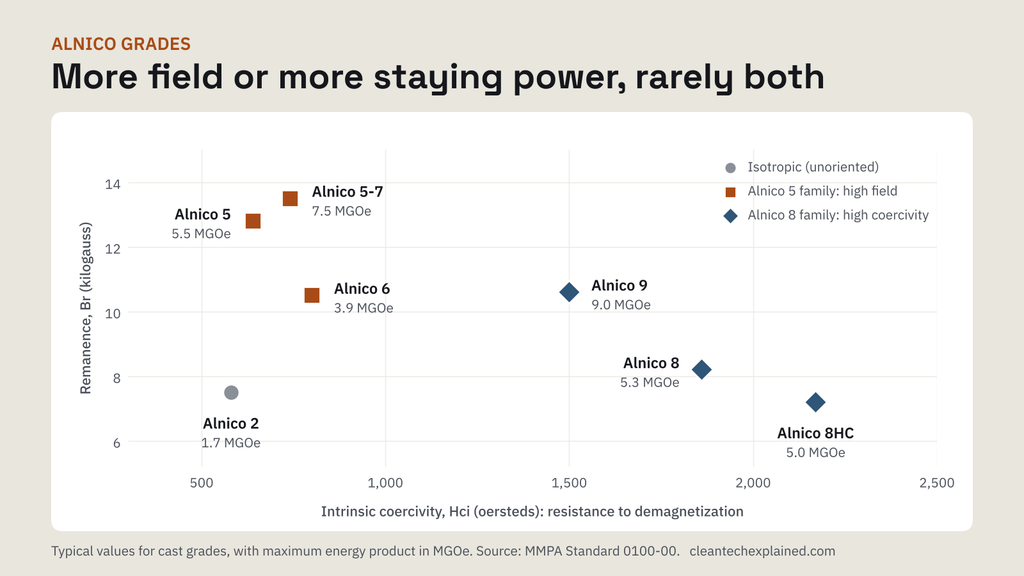
The pattern in the table is the central trade-off of alnico. Grades with the highest remanence have the lowest coercivity, and the reverse. Alnico 9 comes closest to having both, which is why it costs more.
Cast vs sintered alnico
Most alnico magnets are cast: the alloy is melted in an induction furnace and poured into sand molds. Casting suits large parts and complex shapes, with magnets ranging from under 28 grams to more than 36 kg.
Sintered alnico is pressed from metal powder and sintered at about 1,260 °C in hydrogen. It suits small parts made in large volumes, holds tighter tolerances and is mechanically stronger. The price is magnetic output: sintered Alnico 5 reaches about 3.9 MGOe against 5.5 for the cast version.
Either way, alnico is hard and brittle. It cannot be drilled or machined conventionally, so finished surfaces are ground.
How strong are alnico magnets?
Magnet strength is usually summarized by the maximum energy product, measured in megagauss-oersteds (MGOe). On that measure alnico is modest: commercial grades run from about 1.4 to 10.5 MGOe. That is in the same range as ferrite at the low end and well below rare earth magnets.
| Magnet type | Energy product (MGOe) | Max operating temperature | Rare earths? |
|---|---|---|---|
| Ferrite (ceramic) | 3.3–4.8 | about 250 °C | No |
| Alnico | 1.4–10.5 | 450–550 °C | No |
| Samarium cobalt | 16–32 | 250–350 °C | Yes |
| Neodymium (NdFeB) | up to 55 | 80–220 °C | Yes |
The energy product hides something important, though. Alnico’s remanence, the field it retains after magnetizing, is high. Alnico 5 reaches about 12,800 gauss, which is close to a neodymium magnet and roughly three times a ferrite magnet. In a well-designed magnetic circuit, alnico delivers a strong field.
The catch: low coercivity
Coercivity is a magnet’s resistance to being demagnetized. Alnico 5 has an intrinsic coercivity of about 640 oersteds. Neodymium magnets start at about 12,000 oersteds. That gap, not the field strength, is why alnico lost most motor applications.
Low coercivity has practical consequences:
- Shape matters. A short, flat alnico magnet partly demagnetizes itself. Alnico needs to be long relative to its cross-section, which is why it appears as bars, rods and horseshoes. The horseshoe shape is simply a long bar bent so both poles face the same way.
- Magnetize after assembly. Manufacturers recommend magnetizing alnico once it is installed in its final circuit, because removing it from the circuit can weaken it.
- Keep it away from opposing fields. Storing alnico magnets in repelling positions, or near stronger neodymium magnets, can weaken them.
The good news is that this loss is recoverable. A weakened alnico magnet can be remagnetized to full strength, because the alloy itself has not changed.
Alnico magnets and heat
Heat is where alnico is unmatched. Three numbers explain why.
- Curie temperature: 810–860 °C. This is the point where magnetism disappears entirely, and it is the highest of any common permanent magnet.
- Maximum service temperature: 450–550 °C. The MMPA standard lists 450 °C for Alnico 2, 525 °C for Alnico 5 and 6, and 550 °C for the Alnico 8 family. For comparison, the best samarium cobalt grades stop at about 350 °C and standard neodymium at 80 °C.
- Temperature coefficient: about −0.02% per °C. A magnet’s field falls slightly as it warms. Alnico’s field changes less than that of any other commercial magnet material, so a 100 °C rise costs only about 2% of the field, and it returns on cooling.
There is one hard limit. Arnold notes that above about 538 °C (1,000 °F) a metallurgical change takes place that reduces magnetic strength rapidly, and this damage cannot be recovered by remagnetizing. The exact limit depends on the grade and the magnet’s shape, so the manufacturer’s data sheet is the reference for any design.
Alnico also resists corrosion well and normally needs no protective coating, unlike neodymium.
What are alnico magnets used for?
Alnico is chosen where stability and temperature matter more than size and weight.
- Sensors. Hall-effect and magnetoresistive sensors in vehicles and electronics need a field that stays constant from a cold start to a hot engine bay.
- Measuring instruments. Meters and gauges depend on a field that does not drift.
- Microwave tubes. Magnetrons and traveling-wave tube amplifiers, used in radar and communications, have long relied on alnico.
- Guitar pickups and loudspeakers. Alnico 2, 3 and 5 are the classic pickup magnets, and many players prefer their sound to ceramic magnets.
- Holding and separator magnets, especially in hot processes.
- Education. The red horseshoe and bar magnets used in classrooms are usually alnico.
- Motors, generators and actuators in specialist and legacy designs.
Alnico vs neodymium, samarium cobalt and ferrite
Alnico vs neodymium. Neodymium is five to ten times stronger by energy product and far harder to demagnetize, so it wins wherever space and weight are tight, including nearly all EV traction motors. Alnico wins above about 200 °C, where even the most heat-resistant neodymium grades give out, and in applications that need a stable field.
Alnico vs samarium cobalt. Samarium cobalt is the usual high-temperature choice because it combines heat resistance with high strength and high coercivity. Alnico goes hotter still and is more temperature-stable, and it needs no samarium, whose supply is concentrated in China.
Alnico vs ferrite. Ferrite is far cheaper and harder to demagnetize, so it dominates low-cost motors and speakers. Alnico offers roughly three times the remanence, much better temperature stability and a metal body that tolerates heat that would crack or weaken ferrite’s field.
Is alnico a rare earth magnet alternative?
Alnico is the oldest of the rare earth magnet alternatives, and researchers have been trying to modernize it. The appeal is clear: no rare earths, high remanence and excellent heat tolerance. The obstacle is coercivity.
Work at the U.S. Department of Energy’s Ames National Laboratory, with Arnold Magnetic Technologies as an industrial partner, showed that the obstacle can be moved. Using powder processing and refined heat treatment, the team reported coercivity above 2,700 oersteds, compared with about 2,170 for commercial Alnico 8HC, and energy products of 6.0 to 6.3 MGOe in lower-cobalt alloys. Their calculations put the theoretical ceiling for alnico at roughly 17 to 21 MGOe, about double today’s best grade, if the iron-cobalt rods can be made finer than 20 nanometers and better aligned.
That would still be well short of neodymium, so alnico is not a drop-in replacement in a compact EV motor. Its more likely roles are narrower:
- Variable-flux “memory” motors. Here alnico’s weakness becomes a feature. Because it is easy to remagnetize, a short current pulse can raise or lower the magnet’s strength while the motor runs, improving efficiency at high speed.
- Motors redesigned around weaker magnets, as covered in our guide to rare earth free electric motors.
Newer candidates such as iron nitride and tetrataenite aim at the same gap between ferrite and rare earth magnets, without the cobalt.
The cobalt problem
Alnico avoids rare earths but depends on cobalt, which sits on most critical minerals lists. Alnico 5 is about 24% cobalt by weight and Alnico 8 about 35%.
Roughly two-thirds to three-quarters of the world’s mined cobalt comes from the Democratic Republic of the Congo. The country banned cobalt exports from February to October 2025 and then introduced export quotas that run through 2027. Prices reacted sharply: cobalt reached nearly $58,000 per tonne in the first quarter of 2026, more than triple the level of a year earlier, before falling back to about $39,000 per tonne by the end of September 2026.
Swings like that feed directly into the price of alnico, and they are one reason researchers are working on lower-cobalt grades.
FAQ
Are alnico magnets rare earth magnets?
No. Alnico magnets are made of iron, aluminum, nickel and cobalt, with small amounts of copper and titanium. None of these are rare earth elements. Cobalt is, however, classed as a critical mineral.
Are alnico magnets stronger than neodymium?
No. The strongest alnico grade reaches about 9 to 10.5 MGOe, while neodymium magnets reach up to 55 MGOe. Alnico is also much easier to demagnetize. It outperforms neodymium only at high temperature and in field stability.
What is the difference between Alnico 5 and Alnico 8?
Alnico 5 has higher remanence (about 12,800 gauss) and is the most economical grade, but its coercivity is low. Alnico 8 contains more cobalt plus titanium, giving nearly three times the coercivity at a lower remanence (about 8,200 gauss). Alnico 8 suits short magnets and applications exposed to demagnetizing fields.
Do alnico magnets lose their strength over time?
Left alone in a sensible shape, alnico is very stable. It loses strength mainly through exposure to opposing magnetic fields, mechanical shock, or being removed from its magnetic circuit. Unless it has been overheated, it can be remagnetized to full strength.
What is the maximum temperature for alnico magnets?
Maximum service temperatures are about 450 °C for Alnico 2, 525 °C for Alnico 5 and 6, and 550 °C for the Alnico 8 family. Above roughly 538 °C the alloy’s structure starts to change permanently, so designs should follow the manufacturer’s limit for the specific grade.
Why do alnico magnets come in horseshoe shapes?
Because alnico demagnetizes itself if it is short and wide, it needs a long magnetic path. A horseshoe is a long bar bent so that both poles sit side by side, which gives strong holding force while protecting the magnet. A steel “keeper” across the poles protects it further in storage.
Sources
- MMPA Standard 0100-00: Standard Specifications for Permanent Magnet Materials
- Arnold Magnetic Technologies: Cast Alnico Permanent Magnets catalog
- Arnold Magnetic Technologies: Alnico Magnets
- Wikipedia: Alnico
- Cui et al., “Current progress and future challenges in rare-earth-free permanent magnets,” Acta Materialia (2018)
- U.S. Department of Energy: Development of Radically Enhanced alnico Magnets (2018 review)
- Arnold Magnetic Technologies: Ames Lab partnership on enhanced alnico magnets
- IEEE Spectrum: How to Build EV Motors Without Rare Earth Elements
- Yang et al., “A variable-mode stator consequent pole memory machine,” AIP Advances (2018)
- Fastmarkets: DRC may reduce cobalt quota if market needs rebalancing
- Ecofin Agency: Cobalt prices drop 31% in third quarter despite DR Congo export quotas
This article is general information, not engineering or purchasing advice. Always check the manufacturer’s data sheet for the specific grade.