Portable Power Station Guide: What Size Do You Need?

A portable power station is a large rechargeable battery with built-in outlets. You charge it from the wall, a car or solar panels, and it runs your devices anywhere: camping, in a van, on a job site, or at home during a power outage. Unlike a gas generator, it is silent, produces no fumes and can be used indoors. This guide explains which specifications actually matter, how to work out the size you need, and how to charge one with solar.
Short answer: Pick a power station by two numbers. Capacity in watt-hours (Wh) tells you how long it can run. Output in watts (W) tells you what it can run. For phones, laptops and lights, 300–500 Wh is enough. For a fridge during an outage, look at 1,000–2,000 Wh. For longer home backup, choose an expandable model of 3,000 Wh or more. Choose LiFePO4 (LFP) batteries for the longest life.
Key takeaways
- Capacity (Wh) sets runtime; continuous output (W) sets which appliances it can power at all.
- Runtime in hours ≈ capacity in Wh × 0.85 ÷ appliance watts. The 0.85 allows for inverter losses.
- LiFePO4 power stations last thousands of cycles, several times longer than older nickel-based models.
- Solar input wattage decides how fast you can recharge from panels: more watts, fewer hours.
- A power station is not a whole-home backup system, but it covers essentials at a fraction of the cost of a home battery.
What is a portable power station?
Inside every portable power station are four main parts: a lithium-ion battery pack, a battery management system (BMS) that protects it, an inverter that turns the battery’s DC power into household AC power, and a charge controller that handles input from the wall, a car or solar panels. Sellers often call the combination of a power station and solar panels a “solar generator”, although it is really a battery, not a generator. For whole-home options, compare a generator vs battery backup.
The specs that matter
Capacity (Wh)
Capacity is the amount of energy stored, in watt-hours. A 1,000 Wh unit can, in theory, supply 100 watts for 10 hours. In practice you get a little less because of conversion losses (see the runtime formula below).
Continuous output (W)
This is the maximum power the inverter can supply continuously. If an appliance draws more than this, the power station shuts off. A 600 W unit can run a fridge, but not a 1,500 W kettle or space heater.
Surge output (W)
Motors and compressors, such as those in fridges, pumps and power tools, draw several times their running power for a moment when they start. The surge rating tells you whether the power station can handle that kick. Fridges often need a surge of three or more times their running watts.
Battery chemistry
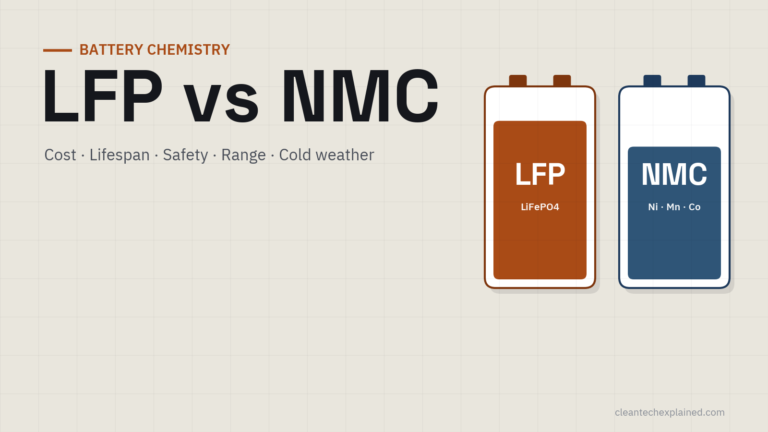
Most current models use LiFePO4 (lithium iron phosphate). It typically lasts 3,000 cycles or more and is very resistant to overheating. Older and some ultra-light models use nickel-based lithium-ion (NMC), which is lighter but often rated for far fewer cycles. For anything you will use regularly, choose LiFePO4. Our LiFePO4 battery guide explains why.
Inverter type
Look for a pure sine wave inverter. It produces power as clean as the grid and is safe for sensitive electronics, medical devices and motors. Almost all reputable brands now use one.
Charging inputs
- AC (wall) charging: Many models can now recharge from empty to full in one to two hours.
- Solar input: Check the maximum solar watts and the allowed voltage range (Voc). These decide how many panels you can connect and how fast you can recharge.
- Car charging: Useful on road trips, but slow, typically around 100–120 W from a 12 V socket.
UPS or EPS function
Some power stations can sit between the wall and your devices and switch over automatically during an outage. Check the switchover time: around 10–30 milliseconds is fine for most electronics, but sensitive equipment such as desktop computers may need a true UPS with zero switchover time.
Expandability, ports and weight
Larger models accept extra battery packs to increase capacity later. Count the AC outlets and USB-C ports you need, and check the weight: 1,000 Wh LiFePO4 units typically weigh 10–15 kg (22–33 lb).
How to calculate runtime
Use this simple formula:
Runtime (hours) ≈ Capacity (Wh) × 0.85 ÷ Appliance power (W)
The 0.85 factor allows for inverter losses and the small reserve most units keep. For example, a 1,000 Wh power station running a 60 W laptop and router lasts about 1,000 × 0.85 ÷ 60 ≈ 14 hours.
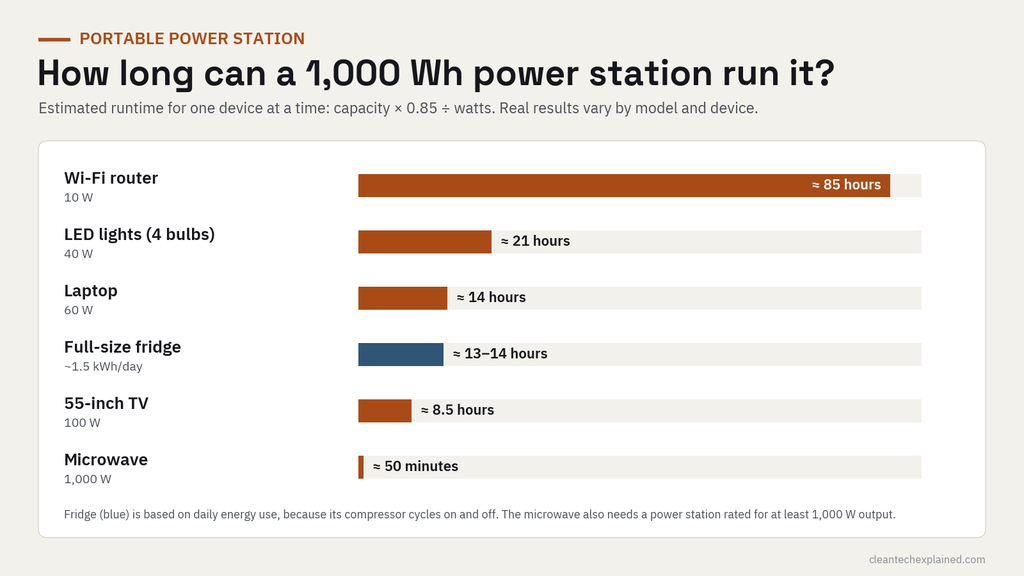
Appliances that cycle on and off, such as fridges, need a different approach: use their daily energy use in Wh, not their rated watts. Our fridge runtime calculator handles this for you.
What size do you need?
| Capacity | Typical output | Good for |
|---|---|---|
| 200–500 Wh | 300–600 W | Phones, laptops, cameras, LED lights, CPAP for a night or two (check the device’s DC option), day trips |
| 500–1,000 Wh | 600–1,200 W | Weekend camping, a small fridge for most of a day, home office during short outages |
| 1,000–2,000 Wh | 1,200–2,400 W | A full-size fridge for a day or more, essentials during outages, van life, some power tools |
| 2,000–4,000 Wh | 2,400–3,600 W | Multiple appliances, longer outages, microwave or kettle for short periods, RVs |
| 4,000 Wh+ (expandable) | 3,600 W+, some 240 V | Multi-day backup of essential circuits, sometimes connected to the home through a transfer switch |
Three steps to size yours:
- List the devices you want to run at the same time and add up their watts. Your power station’s continuous output must exceed this total.
- Check the starting surge of anything with a motor or compressor against the surge rating.
- Estimate the energy each device uses over the time you need it (watts × hours, or daily Wh for a fridge), add them up, and divide by 0.85 to get the capacity you need.
Charging a power station with solar panels
A rough rule for recharge time:
Hours of good sun ≈ Capacity (Wh) ÷ (Solar panel watts × 0.7)
The 0.7 factor covers real-world losses from panel angle, heat, clouds and charging. A 1,000 Wh unit with 200 W of panels needs about 1,000 ÷ 140 ≈ 7 hours of good sun. With 400 W of panels, it needs about 3.5 hours, if the power station accepts that much solar input.
- Never exceed the power station’s maximum solar input voltage (Voc). Connecting panels in series raises the voltage; check the manual before wiring.
- Folding portable panels are convenient for camping. Rigid panels are cheaper per watt for a fixed setup at home.
- Planning a permanent rooftop system instead? Start with our solar panel calculator.
- Want solar that lowers your electricity bill every day instead? Look at plug-in solar panels, which feed power straight into your home through an outlet.
Power station vs generator vs home battery
| Portable power station | Gas generator | Home solar battery | |
|---|---|---|---|
| Indoor use | Yes | Never (carbon monoxide) | Yes, installed |
| Noise | Silent | Loud | Silent |
| Runtime | Limited by capacity, extendable with solar | Days, as long as fuel lasts | Limited by capacity, recharged by rooftop solar |
| Whole-home backup | No (essentials only) | Possible with large units | Yes, with enough capacity |
| Installation | None | None, or transfer switch for home use | Professional installation |
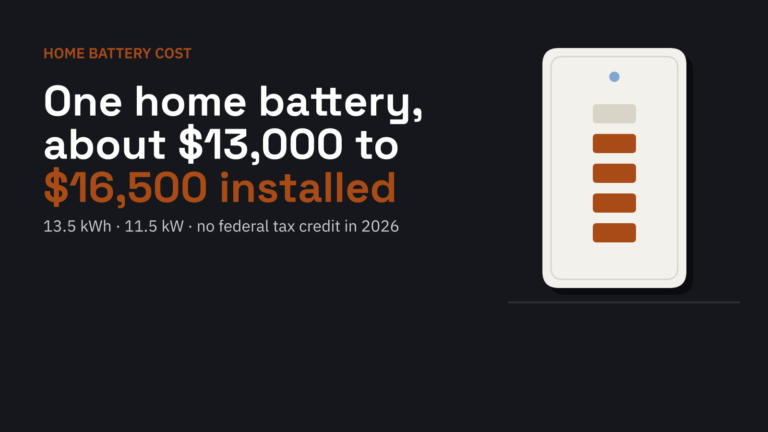
| Typical cost | Lowest for essentials | Low upfront, ongoing fuel | Highest |
If you want backup for your whole home or want to cut your electricity bill every day, a permanently installed battery is the better tool. See our solar battery guide for costs and sizing.
Safety and care tips
- Choose a model certified to recognized safety standards. In North America, look for UL 2743, the standard for portable power packs, plus FCC compliance.
- Keep it ventilated and away from heat sources, and don’t block its cooling fans.
- Avoid charging LiFePO4 models below freezing unless the manufacturer says the unit has battery heating.
- For storage, leave it at around 50–60% charge and top it up every few months.
- Flying? US airline rules generally allow lithium batteries up to 100 Wh in carry-on bags, 101–160 Wh only with airline approval, and nothing larger. Most power stations are far over these limits.
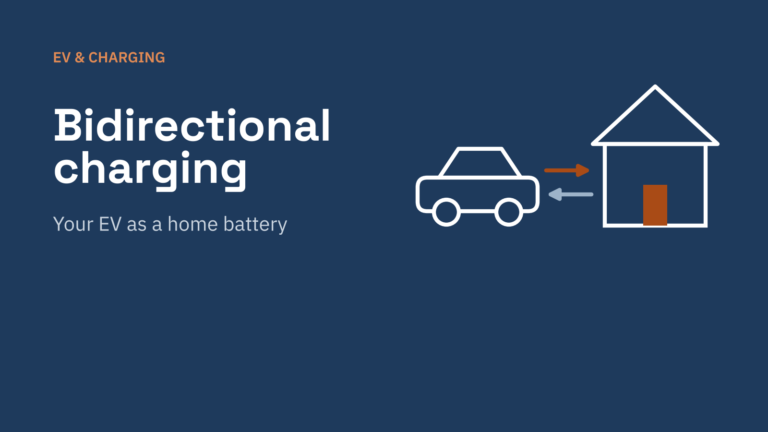
- Using the car to power your home adds some cycles; see bidirectional charging.
Frequently asked questions
What size portable power station do I need to run a fridge?
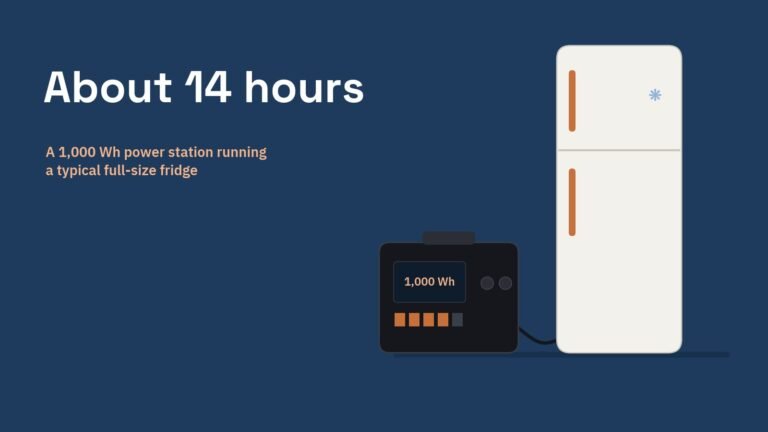
For a typical full-size fridge using 1–2 kWh per day, a 1,000–2,000 Wh power station with at least 1,000 W of output, plus enough surge capacity, will run it for most of a day or longer. Use our fridge runtime calculator for your own numbers.
Can a portable power station power a house?
Not the whole house. Even large models are best for essentials: fridge, lights, Wi-Fi, phones and a few small appliances. Some expandable systems can connect to a home circuit panel through a transfer switch for essential circuits.
Is a solar generator the same as a portable power station?
Yes, in practice. “Solar generator” is a marketing term for a portable power station sold with solar panels.
How long does a portable power station last?
LiFePO4 models are typically rated for 3,000 or more full cycles to about 80% capacity, which means many years of regular use. Older nickel-based models are often rated for far fewer cycles.
Can I use a power station while it is charging?
Most current models support pass-through charging, so you can power devices while the unit charges. Check the manual, as some limit output while charging.
Sources
- Federal Aviation Administration, PackSafe: Lithium Batteries
- UL Standards & Engagement, UL 2743: Standard for Portable Power Packs
- US Consumer Product Safety Commission, Portable Generator Safety (carbon monoxide risk)
Featured image and diagrams: original graphics by CleanTech Explained.