Rare Earth Magnet Recycling: How It Works and Who Is Doing It

Every electric car, wind turbine and hard drive contains rare earth magnets, and almost none of them are recycled when the product reaches the end of its life. That is starting to change. In the past two years, the first commercial magnet recycling plants have opened in the United Kingdom and the United States, and more are under construction in France, Germany and Texas. This guide explains how rare earth magnet recycling works, why it has been so difficult, and how much it can realistically contribute to supply.
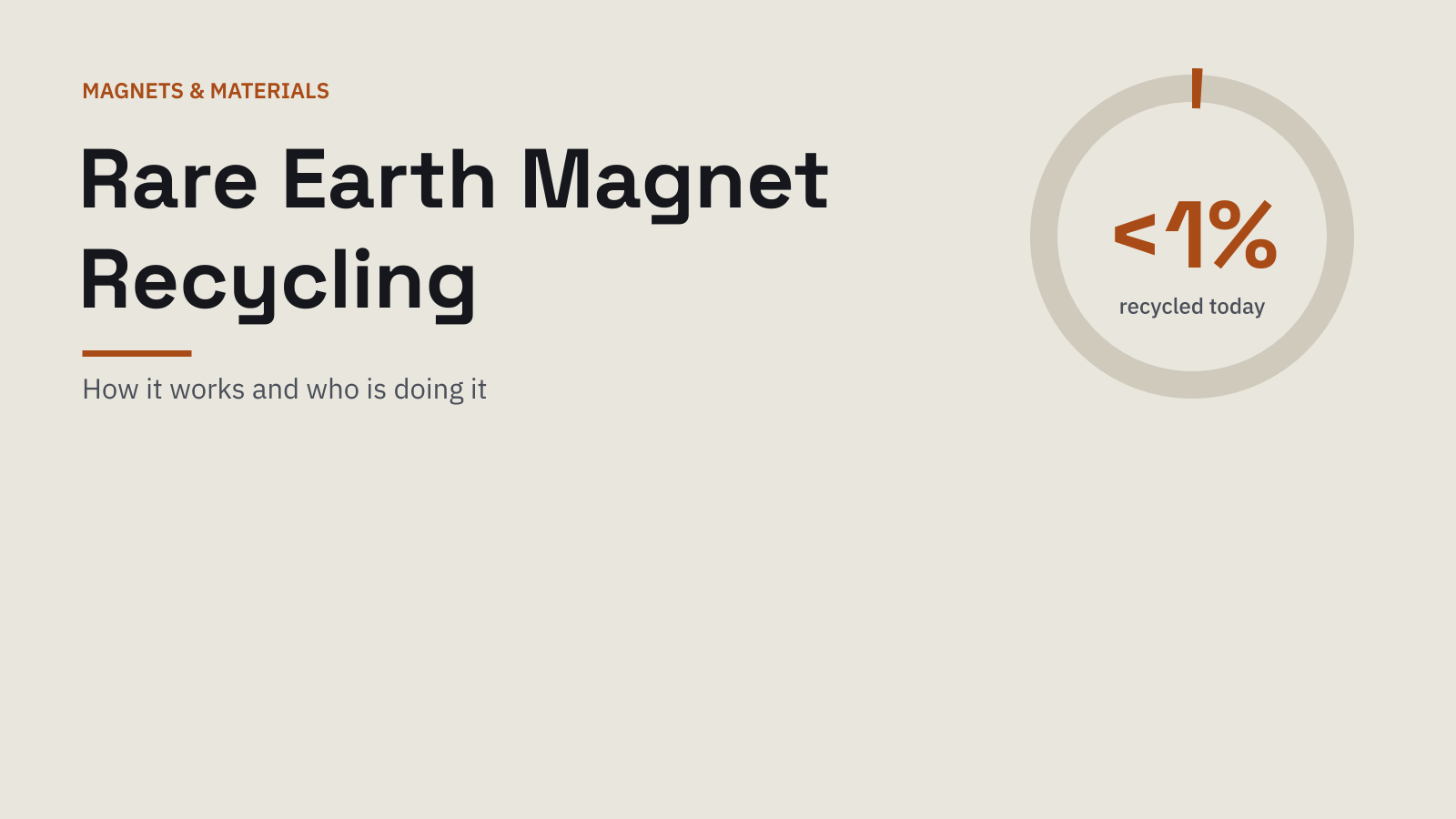
Short answer: Rare earth magnets can be recycled, either by turning old magnets directly into new ones (short-loop recycling) or by dissolving them and recovering pure rare earth oxides (long-loop recycling). Today less than 1% of rare earths are recycled, mainly because magnets are small, glued deep inside products and hard to collect. New plants will raise that figure, but recycling will supplement mining for many years rather than replace it.
Key takeaways
- Less than 1% of the rare earths used in Europe are recycled, and the global picture is similar.
- The main obstacle is collection and dismantling, not chemistry. Most magnets are shredded along with the product and lost in steel scrap.
- Short-loop recycling keeps the magnet alloy intact and uses far less energy. Long-loop recycling handles dirty, mixed scrap and produces pure oxides.
- Factory scrap is the main feedstock today. Large volumes of end-of-life EV motors and wind turbine generators will not arrive until the 2030s.
- The EU wants recycling to cover 25% of its annual consumption of each strategic raw material by 2030. For rare earths, that is a very long way from where things stand.
Why recycle rare earth magnets?
A neodymium magnet is roughly 30% rare earth by weight, mostly neodymium and praseodymium, with small amounts of dysprosium and terbium in high-temperature grades. That is a far higher concentration than any ore. A scrapped magnet is, in effect, a very rich and already refined deposit.
There are three reasons recycling matters:
- Supply security. China dominates rare earth refining and magnet production and has used export controls on several rare earth elements. Scrap that is already in Europe or North America is a domestic source.
- Heavy rare earths. Dysprosium and terbium are the scarcest magnet ingredients. Old magnets from motors contain them, so recycling returns exactly the elements that are hardest to mine.
- Environmental impact. Mining and separating rare earths uses large amounts of energy, acid and water. Recycling avoids most of the mining stage, and short-loop methods avoid most of the chemistry as well.
Why so little is recycled today
The chemistry of magnet recycling has been understood for decades. The practical problems are elsewhere.
Magnets are small and scattered
A hard drive holds only a few grams of magnet. A phone speaker or vibration motor holds less than a gram. One analyst estimate puts the number of end-of-life devices containing magnets in the EU at about 1.1 billion by 2030, with an average of only around 30 grams of magnet in each. Collecting and opening that many products for so little material is rarely worth it.
They are hard to get out
Magnets are glued or embedded inside rotors, coated with nickel or epoxy, and stuck fast to nearby steel. Most electronic waste goes through a shredder. Sintered magnets are brittle, so they shatter into powder that clings to the steel scrap and ends up in a steel furnace, where the rare earths are lost in the slag.
Compositions vary
There are dozens of magnet grades with different amounts of dysprosium, terbium, cobalt and other additives. A recycler who receives a mixed batch does not know exactly what is in it. That matters most for short-loop recycling, where the new magnet inherits the chemistry of the old ones.
The economics are fragile
Rare earth prices swing widely, and a recycling plant needs a steady stream of scrap to run. An EU-funded pilot project estimated that a plant would need to process at least 1,000 tonnes of magnets a year to be economically viable. Securing that much feedstock is the main challenge for every recycler today.
How rare earth magnet recycling works
There are three main routes. They are complementary rather than competing, and most large projects use more than one.
1. Direct reuse
Large magnets, such as those in wind turbine generators or industrial motors, can sometimes be removed, tested, re-machined and used again. This is the cheapest route, but it only works when the magnets are large, undamaged and of a known grade.
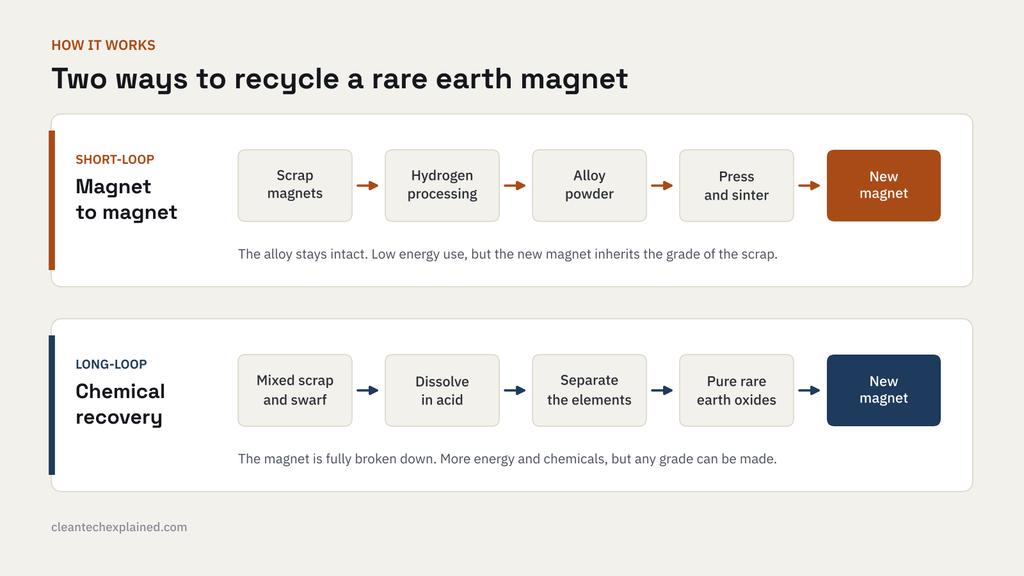
2. Short-loop recycling (magnet to magnet)
Short-loop recycling keeps the magnet alloy as an alloy. The best-known method is hydrogen processing. Scrap containing magnets is exposed to hydrogen gas, which the neodymium-rich material absorbs. The magnet swells, cracks and crumbles into a demagnetized powder, while coatings peel off and the steel around it is left intact. The powder is sieved out, milled, pressed in a magnetic field and sintered into new magnets, usually with some fresh material added to restore performance.
Because the rare earths are never separated from the iron and boron, this route skips most of the energy and chemicals of primary production. HyProMag, the company commercializing the process developed at the University of Birmingham, estimates that it uses 88% less energy than making a sintered magnet from mined material.
The limitation is that the output depends on the input. Mixed or contaminated scrap gives a lower-grade magnet, and oxygen picked up during the magnet’s first life reduces performance unless it is corrected.
3. Long-loop recycling (chemical recovery)
Long-loop recycling breaks the magnet down completely. The scrap is dissolved in acid, and the rare earths are separated from iron and from each other, usually by solvent extraction, the same technique used on mined ore. The result is pure rare earth oxides that can go into any new magnet, of any grade.
This route copes with dirty, oxidized and mixed scrap, including the grinding sludge (swarf) from magnet factories. It uses more energy and chemicals than short-loop recycling, but still avoids mining, and it is the only way to recover dysprosium and terbium as separate products.
| Short-loop | Long-loop | |
|---|---|---|
| Output | Magnet alloy powder or new magnets | Separated rare earth oxides |
| Best feedstock | Clean magnets of known grade | Mixed, dirty or oxidized scrap and swarf |
| Energy and chemicals | Low | Higher |
| Control over final grade | Limited by the scrap | Full |
| Examples | HyProMag, Noveon Magnetics | Carester, Cyclic Materials, Ionic Rare Earths, MP Materials |
Where the scrap comes from
- Manufacturing scrap. Cutting and grinding magnets to shape wastes a significant share of the material. This swarf is clean, concentrated and available now, which is why most recyclers start with it.
- Hard disk drives. Data centers retire drives in large, uniform batches, and each drive has magnets in a known position. This is the most practical end-of-life source today.
- Electric vehicle motors. A typical EV contains about 1 to 2 kg of rare earth magnets. Volumes are small for now because most EVs are still on the road, but they will grow quickly in the 2030s. (Some EVs have no magnets to recover: see our list of EVs without rare earth magnets.)
- Wind turbines. Direct-drive offshore turbines can contain hundreds of kilograms of magnets per megawatt. They are easy to identify and remove, but turbines last 20 to 25 years, so most have not yet been retired.
- Appliances and other motors. Air conditioner compressors, e-bike motors, power tools, MRI machines and speakers all contain magnets, in smaller amounts.
Who is recycling rare earth magnets?
These are the most advanced projects outside China as of October 2026. Dates and capacities are company targets and may change.
HyProMag (United Kingdom, Germany, United States)
HyProMag, owned by Mkango Resources, uses the hydrogen process described above. Its plant at Tyseley Energy Park in Birmingham produced its first recycled alloy in mid-2025 and was officially opened in January 2026. By April 2026 it had produced 9.2 tonnes of recycled NdFeB alloy powder, and Siemens had shown a servomotor rotor built with its recycled magnets. A second plant is being built in Germany, and a US joint venture plans a facility near Dallas-Fort Worth, Texas, with magnet finishing targeted for the first half of 2027 and the recycling section for 2028.
Cyclic Materials (Canada, United States)
Cyclic Materials runs a hub-and-spoke model. “Spoke” plants mechanically separate magnets from end-of-life products, and “hub” plants refine the magnet concentrate into mixed rare earth oxides. Its first commercial spoke opened in Mesa, Arizona, in September 2026, with capacity to process up to 25,000 tonnes of magnet-bearing products a year. Its hub is in Kingston, Ontario, and a combined campus in South Carolina is planned for 2028.
MP Materials and Apple (United States)
In July 2025, Apple and MP Materials announced a $500 million agreement under which MP is building a recycling line at its Mountain Pass site in California. The recovered material will be made into magnets at MP’s factory in Fort Worth, Texas, with shipments to Apple expected to begin in 2027.
Carester (France)
Carester’s Caremag plant in Lacq, in south-west France, is designed to recycle 2,000 tonnes of magnets a year and refine 5,000 tonnes of mined concentrate, with commissioning scheduled for late 2026. It is expected to become one of the largest producers of separated dysprosium and terbium outside China.
Noveon Magnetics (United States)
Noveon, based in San Marcos, Texas, makes sintered magnets using its own magnet-to-magnet process and is one of the few companies already producing recycled-content magnets in the US. In January 2026 it announced a recycling partnership with LG Electronics and Kangwon Energy.
Ionic Rare Earths (United Kingdom, United States)
Ionic Rare Earths operates a demonstration plant in Belfast that processes about 30 tonnes of scrap magnets a year into separated oxides. It is working with US Strategic Metals on a commercial recycling facility in Missouri.
China and Japan have recycled magnet factory scrap for many years, mostly inside the magnet companies themselves. Chinese recyclers handle far larger volumes than any plant listed here.
How much can recycling supply?
Less than many headlines suggest, at least this decade. The reason is timing. Magnets going into EVs and wind turbines today will stay in service for 10 to 25 years, while demand is growing every year. Even if every retired magnet were recovered, the scrap available in 2030 would reflect the much smaller market of the 2010s.
A Reuters analysis of announced European projects found that together they would cover only a single-digit percentage of EU rare earth demand by 2030. Recycling becomes far more significant after 2035, when the first large wave of EVs and offshore turbines reaches the end of its life.
For that reason, recycling is one part of the answer alongside new mines, new refineries and rare earth magnet alternatives.
What governments are doing
The EU’s Critical Raw Materials Act sets a benchmark that recycling should cover at least 25% of the EU’s annual consumption of each strategic raw material by 2030. It also requires products such as EVs, wind turbines, heat pumps and washing machines to carry a label showing whether they contain permanent magnets and what type, so recyclers can find and identify them. In December 2025 the European Commission proposed extending the labels to more products and introducing minimum recycled content for magnets from 2031.
In the United States, support has come mainly through federal grants, loans and defense funding for individual recycling and magnet plants. Rare earths are on the US critical minerals list, which makes these projects eligible for such programs.
Frequently asked questions
Can rare earth magnets be recycled?
Yes. They can be reprocessed directly into new magnets or dissolved to recover pure rare earth oxides. Both methods are now running at commercial or near-commercial scale.
What percentage of rare earth magnets are recycled?
Less than 1% of rare earths are recovered from end-of-life products. Most recycling today uses scrap from magnet factories rather than old products.
Are recycled magnets as strong as new ones?
They can be. Magnets made from chemically recovered oxides are identical to those made from mined material. Short-loop recycled magnets can match standard commercial grades when the scrap is well sorted and blended with some fresh alloy.
What is magnet-to-magnet recycling?
It is another name for short-loop recycling: old magnets are turned into powder and re-sintered into new magnets without separating the individual elements.
How do I recycle old magnets or hard drives?
Take the whole device to a certified electronics recycler or a municipal e-waste collection point. Do not put strong magnets in household recycling bins, where they can damage sorting equipment. Whether the magnets themselves are recovered depends on the recycler, but supply chains for magnet recovery are growing.
Will recycling end the need for rare earth mining?
Not in the foreseeable future. Demand is growing faster than old products are retired, so recycled material can only cover a fraction of what is needed.
Sources
- US Geological Survey: Rare Earths Statistics and Information
- Regulation (EU) 2024/1252, Critical Raw Materials Act
- European Commission CORDIS: Recycling high-tech products to boost competitiveness
- Reuters: Recycling to kick in as long-term solution to EU rare earths challenge
- Mkango Resources: Rare Earth Recycling (HyProMag)
- Physics World: How a technique for recycling rare-earth permanent magnets could transform the green economy
- Engineering News: Cyclic Materials starts commercial operation of rare earths recovery facility in Arizona
- MP Materials and Apple: $500 million partnership announcement
- Fastmarkets: Caremag raises €216 million to build rare earths plant in France
- Recycling Today: Noveon Magnetics launches rare earth magnet recycling initiative
- European Recycling Platform: Commission proposes new circularity rules for magnets