How Long Do Solar Panels Last? Lifespan and Degradation Explained

Solar panels do not wear out on a schedule. They have no moving parts, and they do not stop working when the warranty ends. What they do is lose a little output every year. So the useful question is less “how long do solar panels last” and more “how much power will they still make in year 25, 30 or 40?” This guide gives the numbers from long-term field studies, explains what warranties really promise, and covers the parts of a solar system that fail sooner than the panels do.
Short answer: Most solar panels last 25 to 30 years or longer. They lose roughly 0.5% of their output each year, so a typical panel still produces about 88% of its original power after 25 years and about 86% after 30. Current warranties guarantee 80 to 92% of rated output after 25 to 30 years. The inverter usually fails first: string inverters last about 10 to 15 years.
Key takeaways
- Expect 25 to 30 years as a minimum. US solar developers now plan on about 32 years of useful life, up from about 21 years in 2007.
- Degradation is slow. The long-run median is about 0.5% a year for panels. Whole systems in the field lose a bit more, about 0.75% a year.
- Heat speeds it up. Systems in hot climates lose output almost twice as fast as those in cool climates.
- The warranty is a floor, not a lifespan. Panels keep working after it expires, only with no guarantee.
- Budget for an inverter. A string inverter will probably need replacing once during the life of the panels.
How long do solar panels last?
The industry’s working figure is 25 to 30 years, because that is how long manufacturers are willing to guarantee output. Real-world evidence suggests the panels themselves often go further.
- Project owners plan for more than 30 years. A Berkeley Lab survey of US solar professionals found that the assumed useful life of utility-scale projects rose from about 21.5 years in 2007 to about 32.5 years in 2019.
- Thirty-year-old panels still work. Panels installed in 1992 at the Phébus 1 plant in France were tested after 31 years and still delivered an average of 79.5% of their original power, a loss of 0.66% a year.
A panel reaches the end of its life when one of three things happens: it fails outright, it becomes unsafe, or its output drops low enough that replacing it makes financial sense. For a sound panel on a home roof, the third point can be decades away.
Solar panel degradation: the numbers
The degradation rate is the percentage of output a panel loses each year. Two large studies from the US National Renewable Energy Laboratory (NREL) give the best benchmarks.
- About 0.5% a year for panels. NREL’s review of more than 2,000 measured degradation rates from 32 countries found a median of 0.5% a year. The average was higher, 0.8%, because a minority of panels degrade much faster than the rest.
- About 0.75% a year for whole systems. A later NREL study tracked nearly 2,500 commercial and utility-scale sites, almost 8 gigawatts in total, from 2008 to 2022. The median performance loss was 0.75% a year. That figure includes everything in the system, such as wiring, connectors and soiling, not only the panels. Nine out of ten systems lost less than 2% a year.
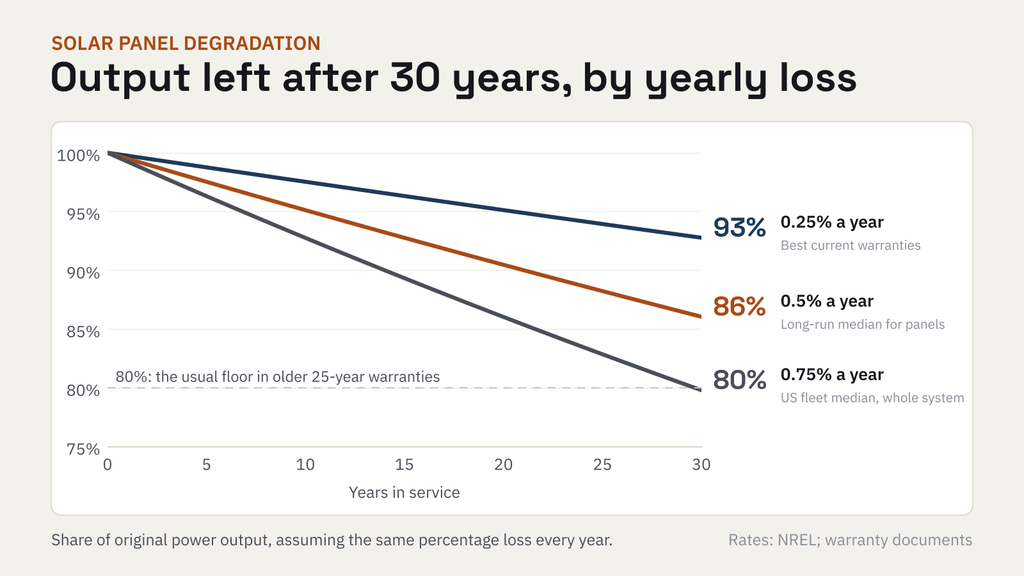
The table shows what those rates mean over time, assuming the same percentage loss every year.
| Yearly loss | After 10 years | After 20 years | After 25 years | After 30 years | After 40 years |
|---|---|---|---|---|---|
| 0.25% | 97.5% | 95.1% | 93.9% | 92.8% | 90.5% |
| 0.4% | 96.1% | 92.3% | 90.5% | 88.7% | 85.2% |
| 0.5% | 95.1% | 90.5% | 88.2% | 86.0% | 81.8% |
| 0.75% | 92.7% | 86.0% | 82.8% | 79.8% | 74.0% |
| 1.0% | 90.4% | 81.8% | 77.8% | 74.0% | 66.9% |
Here is a worked example. A home system that produces 11,000 kWh in its first year and loses 0.5% a year will produce about 9,750 kWh in year 25. Over those 25 years it delivers about 259,000 kWh, roughly 94% of what it would have made with no degradation at all. The loss is real, but it is small next to the difference between a shaded roof and a sunny one.
The first year is different
New panels lose more in their first months of sunlight than in any later year. This early drop, called light-induced degradation, is typically around 1% for current N-type panels and 2 to 3% for older P-type panels. Warranties account for it with a separate first-year allowance, then a steady yearly rate after that.
What makes solar panels degrade?
A solar panel is a sandwich: glass on top, silicon cells sealed in a plastic encapsulant, a backsheet or second sheet of glass behind, and an aluminum frame around the edge. Most degradation comes from that package aging, not from the silicon itself.
- Heat cycling. Panels expand in the day and contract at night. Over thousands of cycles this fatigues the solder joints and the thin metal ribbons that connect the cells.
- Ultraviolet light. UV slowly discolors the encapsulant and can damage the cell surface.
- Moisture. Water vapor that works its way in corrodes the cell contacts and can cause layers to separate, known as delamination.
- Microcracks. Hail, wind, snow load and rough handling can crack cells. Small cracks may do nothing for years and then cut off part of a cell.
- Voltage stress. In high-voltage strings, current can leak between the cells and the frame. This is called potential-induced degradation.
- Hot spots. A shaded or damaged cell can heat up and age the materials around it.
Climate matters
Heat is the biggest outside factor. In NREL’s fleet study, systems in hot climates lost a median of 0.88% a year, against 0.48% in cool climates. The same study found that extreme weather usually causes short outages and no lasting harm, but hail larger than 25 mm, winds above 90 km/h and snow deeper than one meter were linked to faster long-term losses.
What solar panel warranties cover
A solar panel comes with two separate warranties, and they are easy to confuse.
- The product warranty covers defects in materials and workmanship, such as a failed junction box or a delaminating panel. It runs 12 to 25 years for most panels.
- The performance warranty guarantees that output will not fall below a stated level. It runs 25 to 30 years.
The terms have improved as the industry has moved from P-type to N-type cells. These are typical figures from manufacturer warranty documents in early 2026.
| Panel type | Product warranty | Performance warranty | Guaranteed yearly loss | Guaranteed output at the end |
|---|---|---|---|---|
| Older P-type (PERC) | 12 to 25 years | 25 years | 0.54 to 0.65% | 80 to 83% |
| Mainstream N-type (TOPCon) | 25 years | 30 years | About 0.4% | About 87% at 30 years |
| Premium (heterojunction, back-contact) | 25 years | 25 years | 0.25% | 92% at 25 years |
| Longest on the market (Maxeon) | 40 years | 40 years | 0.25% | 88.3% at 40 years |
Three cautions apply.
- A warranty is only as good as the company behind it. Solar manufacturers and installers do go out of business. SunPower’s 2024 bankruptcy left many owners unsure who would honor their coverage.
- Labor is often excluded. Many warranties supply a replacement panel but not the cost of taking the old one off the roof and fitting the new one. Check the installer’s own workmanship warranty, which commonly runs 10 years or more.
- Lab results are mixed. In the 2026 reliability scorecard from the test lab Kiwa PVEL, 87% of manufacturers had at least one model fail a stress test, a record. Breakage under mechanical load and hail was the most common problem. The lab links this to cost-cutting such as thinner frames and encapsulants. Brand and model still matter.
The inverter usually fails first
The panels are the most durable part of a solar system. The inverter, which converts the panels’ direct current into household alternating current, is full of power electronics that run hot, and it wears out sooner. The solar risk firm kWh Analytics has reported that about 80% of solar system failures happen at the inverter.
| Component | Typical life | Typical warranty |
|---|---|---|
| Solar panels | 25 to 30 years or more | 25 to 30 years (performance) |
| String inverter | 10 to 15 years | 5 to 12 years, often extendable |
| Microinverters | 20 to 25 years | 20 to 25 years |
| DC power optimizers | 20 to 25 years | 20 to 25 years |
| Home battery | 10 to 15 years | 10 to 15 years |
Replacing an inverter costs roughly $350 to $3,500 including labor, depending on its type and size. A household with a string inverter should plan for one replacement over the life of the panels. If you are adding storage, our solar battery guide explains why batteries are on a shorter clock than panels as well.
How to make solar panels last longer
- Choose the installer as carefully as the panel. Many early failures trace back to installation: cracked cells from stepping on panels, loose connectors and poor roof sealing.
- Watch your production. Most systems come with a monitoring app. A sudden drop, or one panel lagging behind its neighbors, is the earliest sign of a fault and the easiest to claim under warranty.
- Leave airflow under the panels. Panels that run cooler age more slowly, so standard mounting with a gap above the roof is better than panels fitted flush.
- Clean only when it pays. Rain does most of the work. In dry or dusty areas an occasional rinse with plain water helps. Avoid pressure washers and abrasive tools.
- Get a professional inspection every few years. A check of wiring, mounts and connectors typically costs $200 to $300.
- Keep the paperwork. Save the warranty documents, serial numbers and the installer’s contract. You will need them for any claim.
What happens when solar panels wear out?
Old panels rarely die. They are usually retired when a roof is replaced, when the inverter fails and the owner decides to upgrade everything, or when newer panels would produce far more from the same space. Today’s 400 to 450 watt panels make that tempting, as our guide to how many solar panels you need shows.
Disposal is the weak point. Only about 10% of retired panels in the United States are recycled, compared with about 85% in the European Union, where producers must pay for recycling. NREL has estimated that recycling a panel costs $15 to $45, against $1 to $5 for landfill. The best recycling plants now recover around 95% of a panel’s value in aluminum, glass, copper, silver and silicon. The US Environmental Protection Agency expects up to one million tons of panel waste in the country by 2030.
Frequently asked questions
How long do solar panels last on a house?
Typically 25 to 30 years or more. They will still produce power after that, at roughly 80 to 90% of their original output.
Do solar panels stop working after 25 years?
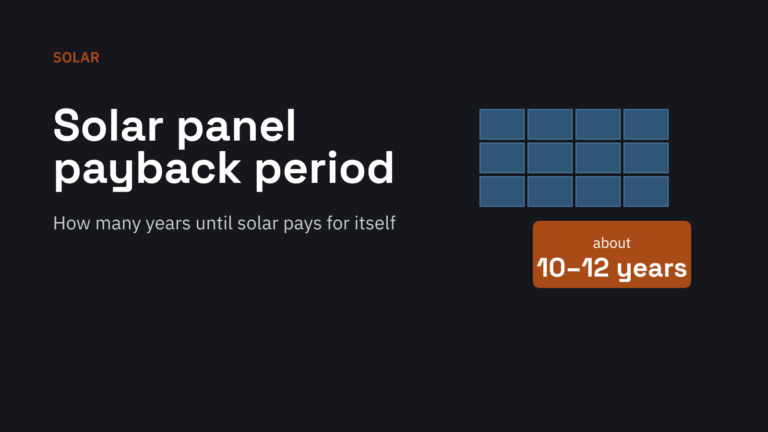
No. Twenty-five years is when most performance warranties end, not when the panels fail. Panels tested after 31 years in France still delivered about 80% of their original power. A long lifespan matters most once the system has paid for itself; see our solar panel payback period guide.
What is a normal solar panel degradation rate?
About 0.5% a year for the panels themselves. Anything consistently well above 1% a year suggests a problem worth investigating.
How often do solar panels need to be replaced?
For most homes, once every 30 years or so, and often only because the roof needs work. The inverter is replaced more often, about every 10 to 15 years for a string inverter.
Do solar panels last longer in cold climates?
They degrade more slowly. NREL found a median loss of 0.48% a year in cool climates against 0.88% in hot ones. Heavy snow and large hail can work in the other direction.
Can you mix new solar panels with old ones?
Yes, but it takes care. With a string inverter, the weakest panels limit the others in the same string, so new panels are best put on a separate string or fitted with microinverters or optimizers.
Do solar panels need maintenance?
Very little. Check the monitoring app regularly, keep the panels free of heavy dirt and shade, and have the system inspected every few years.
Sources
- NREL, Jordan, Wohlgemuth and Kurtz, Technology and Climate Trends in PV Module Degradation, 2012
- pv magazine USA, NREL says long-term degradation of 8 GW of U.S. solar matches expectations, January 2024
- Berkeley Lab, New study finds increase in expected useful life and decrease in operating expenses for utility-scale PV, June 2020
- pv magazine, Solar modules deployed in France in 1992 still provide 79.5% of original output power, June 2024
- SurgePV, Solar panel warranty comparison (manufacturer warranty documents, first quarter 2026)
- pv magazine, Kiwa PVEL’s 2026 module reliability scorecard reveals high failure rates, May 2026
- pv magazine USA, How long do residential solar inverters last?, August 2025
- SolarReviews, Solar inverter cost: 2026 price guide
- Earth911, Recycling solar panels in 2026, June 2026
Featured image and diagram: original graphics by CleanTech Explained. This article is general information, not financial or installation advice.