Bonded Magnets Explained: How Bonded NdFeB Compares With Sintered Magnets

Bonded magnets are permanent magnets made by mixing magnet powder with a plastic or resin binder and pressing or molding the mix into shape. The most common type, bonded NdFeB, reaches about 4 to 12 MGOe, roughly a fifth to a third of a sintered neodymium magnet, but it can be molded into thin rings, complex shapes and multi-pole rotors that sintered magnets cannot easily match. This guide explains how bonded magnets are made, how strong and heat resistant they are, and where they make more sense than sintered magnets. It also includes measurements from melt-spun magnet powder the author worked with in a university lab.
How a bonded magnet is made
A sintered magnet is a dense block of magnetic alloy, pressed and fused at about 1,050 °C, then cut and ground to size. A bonded magnet skips the high-temperature step. Fine magnet powder is coated with a binder and shaped near room temperature or at plastic-molding temperatures, so the part comes out of the tool at, or very close to, its final shape. There are four main routes:
- Compression bonding. Powder mixed with a few percent of epoxy is pressed in a die and cured. It packs the most magnet powder into the part, so it gives the strongest bonded magnets. Shapes are limited to rings, discs and blocks.
- Injection molding. Powder is compounded with a thermoplastic such as nylon 6, nylon 12 or PPS and injected into a mold, like any plastic part. It allows complex shapes, inserts and molding directly onto a shaft, with tight tolerances, but more binder means lower strength.
- Extrusion. The compound is pushed through a die to make long strips or tubes.
- Calendering. Powder in rubber is rolled into flexible sheets. Most flexible magnets, including fridge magnets, are made this way, usually with cheap ferrite powder rather than NdFeB.
Bonded magnets can be made from ferrite, NdFeB, samarium cobalt or samarium iron nitride powder, and from blends of them. This guide focuses on bonded NdFeB, the most widely used high-performance type.
Where the powder comes from
Bonded NdFeB grew out of the same discovery as the neodymium magnet itself. In the early 1980s, John Croat’s team at General Motors made Nd2Fe14B by spraying the molten alloy onto a fast-spinning wheel, freezing it in a fraction of a second into thin ribbons. This melt spinning gives grains only a few tens of nanometers across, which makes the crushed flakes strongly magnetic without any further alignment. GM opened a plant for the powder in Anderson, Indiana, in 1986 under the name Magnequench.
GM sold Magnequench in 1995 to a consortium that included two Chinese state-linked companies, and production later moved out of the US. Today the business is part of Neo Performance Materials, with powder plants in Tianjin and Chuzhou in China and in Korat, Thailand. Its MQP powders are the standard feedstock for isotropic bonded NdFeB magnets worldwide.
Melt-spun powder is isotropic: each flake’s grains point in random directions, so the magnet can be magnetized in any direction, including complex multi-pole patterns, but it gives up a large part of the possible strength. Anisotropic bonded powder, made mainly by the HDDR (hydrogenation, disproportionation, desorption, recombination) process, has grains aligned inside each particle and is pressed in a magnetic field. Aichi Steel’s MAGFINE powder reaches about 35 to 41 MGOe as loose powder and about 16 to 23 MGOe in compression-bonded magnets, roughly twice an isotropic bonded magnet, without using dysprosium.
One powder, three kinds of magnet: notes from the lab
During his master’s research at Pukyong National University in South Korea in 2017, the author worked with Magnequench MQU-F, a melt-spun powder with the composition Nd13.6Fe73.6Co6.6Ga0.6B5.6. It belongs to the same family as the powders used for bonded magnets, and it shows clearly why isotropic powder is useful and where it hits a ceiling.
Measured as loose flakes in a vibrating sample magnetometer, the powder had a saturation magnetization of 8.81 kG and a remanence of 6.67 kG. For randomly oriented grains, simple theory predicts that the remanence should be only half the saturation value. This powder kept about 76%. The reason is its nanometer-scale grains: neighboring grains are so small and so tightly coupled that they pull each other’s magnetization toward a common direction. This “remanence enhancement” is what makes melt-spun isotropic powder strong enough to be worth bonding.
The same powder can be made into three different magnets:
- Bonded: mixed with a binder and molded. The magnet keeps the powder’s isotropic character, but the binder dilutes it, so it ends up with less remanence than the powder itself.
- Hot-pressed: in the lab, 3.2 g of powder was pressed at 670 °C into a fully dense disc. It has no binder, but it is still isotropic, so its remanence stays in the same range as the powder’s.
- Die-upset (hot-deformed): the hot-pressed disc was squeezed at 735 °C to a quarter of its height in about a minute. The grains turned and aligned, and the remanence rose to 12.3 kG, with a maximum energy product of 35.6 MGOe and a coercivity of 13.1 kOe.
That jump, from an isotropic 6.7 kG to an aligned 12.3 kG, is the gap between a typical bonded magnet and a high-grade dense magnet. Our neodymium magnets guide shows the samples and what went wrong along the way. Industry uses the same family of powders: Magnequench sells MQP powders for bonded magnets and MQU powders for fully dense, hot-deformed magnets.
How strong are bonded magnets?
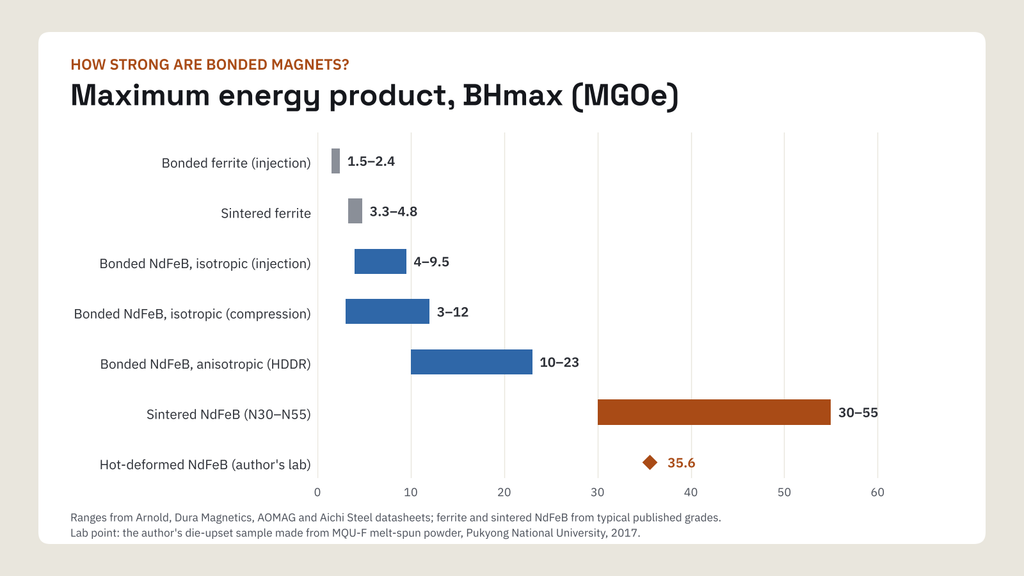
| Magnet type | Binder | BHmax (MGOe) | Max temperature | Typical use |
|---|---|---|---|---|
| Bonded ferrite, injection molded | Nylon 6, PPS | 1.5–2.4 | Up to about 180 °C | Low-cost sensors, small motors |
| Bonded NdFeB, isotropic, injection molded | Nylon, PPS | 4–9.5 | About 120–180 °C | Sensor rings, small motors with molded-in shafts |
| Bonded NdFeB, isotropic, compression | Epoxy | 3–12 | Up to about 165 °C | Brushless DC motors, stepper motors, spindle motors |
| Bonded NdFeB, anisotropic (HDDR) | Epoxy, nylon 12, PPS | 10–23 | Up to about 150 °C | Compact, high-efficiency motors |
| Sintered NdFeB, for comparison | None | 30–55 | 80–230 °C by grade | EV motors, wind turbines |
Bonded NdFeB sits in a useful middle ground. It is two to five times stronger than ferrite, so a bonded NdFeB rotor can be much smaller than a ferrite one. It is clearly weaker than sintered NdFeB, so it is rarely used where the highest power density matters, such as EV traction motors.
Heat and corrosion limits
Two things set the temperature limit of a bonded magnet: the binder and the magnet powder.
- The binder. Nylon 12 melts above about 170 °C and is not recommended above 150 °C. PPS and nylon 6 compounds have been tested at 180 °C. Epoxy compression-bonded magnets are typically rated up to about 165 °C.
- The powder. Even with a heat-resistant binder, the highest-energy NdFeB grades start to lose magnetization irreversibly above about 120 °C. Grades with higher coercivity trade some strength for more heat tolerance.
NdFeB powder rusts easily, and a bonded magnet’s surface is full of exposed particles. Compression-bonded NdFeB magnets are therefore usually given an epoxy coating after pressing. In injection-molded magnets, the plastic itself surrounds most particles and gives some protection.
Sintered NdFeB handles more heat when the grade allows it, up to about 230 °C for the highest grades. Those grades need dysprosium or terbium. For hot applications where heavy rare earths are a problem, samarium cobalt is the usual alternative.
Bonded vs sintered: when each makes sense
| Bonded NdFeB | Sintered NdFeB | |
|---|---|---|
| Strength | Moderate (4–23 MGOe) | Highest (30–55 MGOe) |
| Shapes | Thin rings, complex shapes, molded onto parts | Blocks, arcs and rings cut and ground from larger pieces |
| Tolerances | Tight as molded (about ±0.003 in per in for injection) | Needs grinding |
| Magnetization patterns | Isotropic grades can be magnetized with many poles in any direction | Fixed by the alignment direction set during pressing |
| Brittleness | Less brittle; plastic grades can take some mechanical load | Brittle; chips easily |
| Eddy current loss | Lower, since particles are separated by binder | Higher; large magnets are often segmented |
| Heavy rare earths | Usually none | Often needed for high-temperature grades |
In practice, bonded NdFeB wins in small, precise, high-volume parts: brushless DC motors in fans, pumps, office equipment and appliances, stepper motors, hard disk drive spindle motors, and position sensors and encoder rings in cars. Sintered NdFeB wins wherever size and power matter most, such as EV traction motors, wind turbine generators and industrial servo motors.
Bonded magnets and the rare earth supply chain
Bonded NdFeB uses less rare earth per part than sintered NdFeB, because the magnets are smaller and are often made for low-power jobs. Isotropic melt-spun powders get their coercivity from tiny grains rather than from heavy rare earths, so they usually contain no dysprosium or terbium. The magnets avoid the elements under China’s tightest export licensing, but they still contain neodymium and praseodymium, and most of the powder is produced in China and Thailand.
Bonded magnets are also where many rare-earth-free materials compete first. Iron nitride, for example, is aimed at jobs that bonded NdFeB and ferrite do today. See our guides to iron nitride magnets, rare earth magnet alternatives and China’s rare earth export controls.
FAQ
Are fridge magnets bonded magnets?
Yes. Flexible fridge magnets are bonded magnets, usually ferrite powder in a rubber or vinyl sheet. They are magnetized in narrow stripes of alternating poles, which is why they stick firmly on one side and barely on the other.
Are bonded magnets magnetized before or after molding?
Usually after. Isotropic bonded magnets are molded unmagnetized, often already assembled onto a shaft or into a housing, and then magnetized with a fixture that sets the pole pattern. Anisotropic grades are aligned by a magnetic field during pressing or molding and magnetized afterward.
Can bonded magnets be machined?
Compression-bonded magnets can be machined to some extent, and some suppliers sell them for customers to finish themselves. Injection-molded magnets are normally used as molded, since the point of the process is to avoid machining.
Sources
- Arnold Magnetic Technologies: Injection molded magnets
- Dura Magnetics: Bonded NdFeB magnets
- AOMAG: Compression and injection bonded NdFeB magnets
- Aichi Steel: MAGFINE anisotropic NdFeB bonded magnet powder catalog (PDF)
- Neo Performance Materials: Magnequench bonded magnetic powders
- Mainrich International: Sintered vs bonded NdFeB magnets (April 2026)
- Wikipedia: Magnequench
- Lab measurements: the author’s own samples, Pukyong National University, 2017