How to Demagnetize a Magnet: What Works on Each Type of Magnet

Most guides on how to demagnetize a magnet list the same four tricks: heat it, hit it, zap it with alternating current, or rub it with another magnet. All four work on something. None of them works on everything. A trick that wipes a magnetized screwdriver in two seconds will do nothing to a neodymium magnet, and the only reliable way to kill a neodymium magnet would ruin a steel tool. This guide explains what demagnetizing actually does inside the material, which method works on which kind of magnet, and how to do the most common job, demagnetizing a steel tool, properly. It draws on measurements the author made on NdFeB magnets in a university magnet lab.
Short answer: To demagnetize a magnet, you have to scramble the aligned magnetic regions inside it. You can do that by heating it past its Curie temperature, by exposing it to an alternating magnetic field that slowly fades to zero, or, for weak magnets only, by a strong opposing field or repeated hard knocks. Steel tools and old alnico magnets demagnetize easily with a cheap tool demagnetizer. Ferrite magnets need heat of about 450 °C. Neodymium and samarium cobalt magnets resist anything you can do at home except heat, which also destroys their coating and can crack them, so in practice they are not worth demagnetizing.
Key takeaways
- Coercivity decides everything. It is a magnet’s resistance to being demagnetized. Steel tools have almost none; neodymium magnets have hundreds of times more.
- Heat works on every magnet, but the temperature needed ranges from about 310 °C for standard neodymium to about 900 °C for alnico.
- A fading alternating field is the clean method for steel tools, watch parts and weak magnets. That is how a tool demagnetizer works.
- Dropping or hammering is mostly a myth for modern magnets. It works on magnetized steel and somewhat on alnico. A neodymium magnet chips before it loses meaningful strength.
- You rarely need to demagnetize a strong magnet. For disposal or recycling, store it safely and keep it whole.
What demagnetizing actually does
Inside any magnetic material, the magnetization is organized into small regions called domains. In each domain, the atomic magnetic moments point the same way. In an unmagnetized piece of iron, the domains point in random directions and cancel out. Magnetizing the material lines most of them up. Demagnetizing means getting them back to a random state, or at least far enough from aligned that the external field disappears.
How hard that is depends on one property: coercivity, the reverse magnetic field needed to bring the magnetization back to zero. In soft steel, domain walls move easily, so a weak field or a knock rearranges them. In a modern permanent magnet, the material is engineered to stop that from happening. In a sintered neodymium magnet, each grain is a few microns across and walled off by a thin nonmagnetic layer, so a reversed domain cannot spread from one grain to the next. In the die-upset NdFeB magnets the author made at Pukyong National University, the grains were thin plates only 30 to 80 nanometers thick, and it took a reverse field of about 13 to 14 kOe to demagnetize them, tens of thousands of times stronger than the Earth’s magnetic field.
That gives three ways in:
- Heat. Above the Curie temperature, thermal agitation destroys the alignment completely. Below it, heat lowers the coercivity until even the magnet’s own internal field can start flipping grains.
- A field stronger than the coercivity. A reverse field larger than the coercivity flips the magnetization. If the field alternates and fades away gradually, the domains end up in a random state.
- Mechanical shock. Impacts can help domain walls jump past the defects that pin them. This only matters in materials with low coercivity.
Which method works on which magnet
| Material | Typical coercivity | Curie temperature | What actually works |
|---|---|---|---|
| Magnetized steel tool (screwdriver, tweezers, drill bit) | Very low, well under 0.1 kOe | About 770 °C (iron) | Tool demagnetizer; a few hard knocks; heat ruins the temper |
| Alnico | About 0.5 to 2 kOe | About 860 to 900 °C | Strong opposing field, even from a neodymium magnet; AC demagnetizer; heat |
| Ferrite (ceramic) and fridge magnets | About 2 to 4 kOe | About 450 °C | Heat; very strong pulsed field |
| Sintered NdFeB (neodymium) | About 12 to 35 kOe | About 310 to 400 °C | Heat above the Curie temperature; industrial pulse demagnetizer |
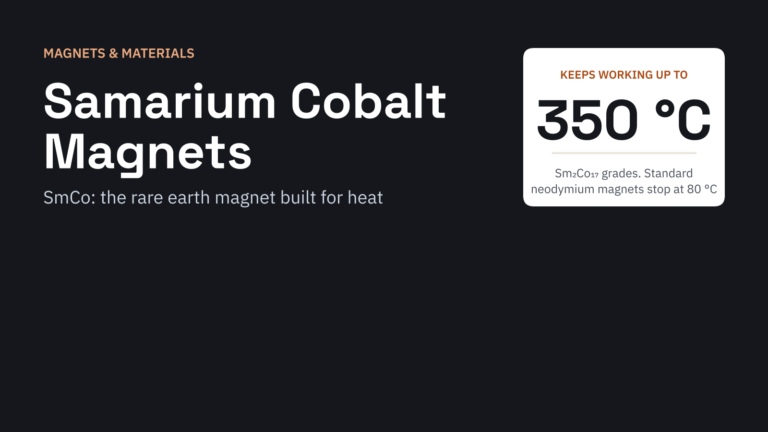
| Samarium cobalt | About 15 to 30 kOe or more | About 700 to 800 °C | Furnace heat; industrial equipment |
The table explains most of the confusion online. Alnico was the common permanent magnet for decades, and steel was used before that, so older advice about hammering and stroking magnets was written for materials with low coercivity. Ferrite, neodymium and samarium cobalt were designed precisely to resist those things.
Method 1: heat it past the Curie temperature
Heat is the one method that works on every magnet. Every magnetic material has a Curie temperature above which it cannot hold any magnetization at all. Heat a magnet past that point and let it cool without a field around it, and it comes back unmagnetized.
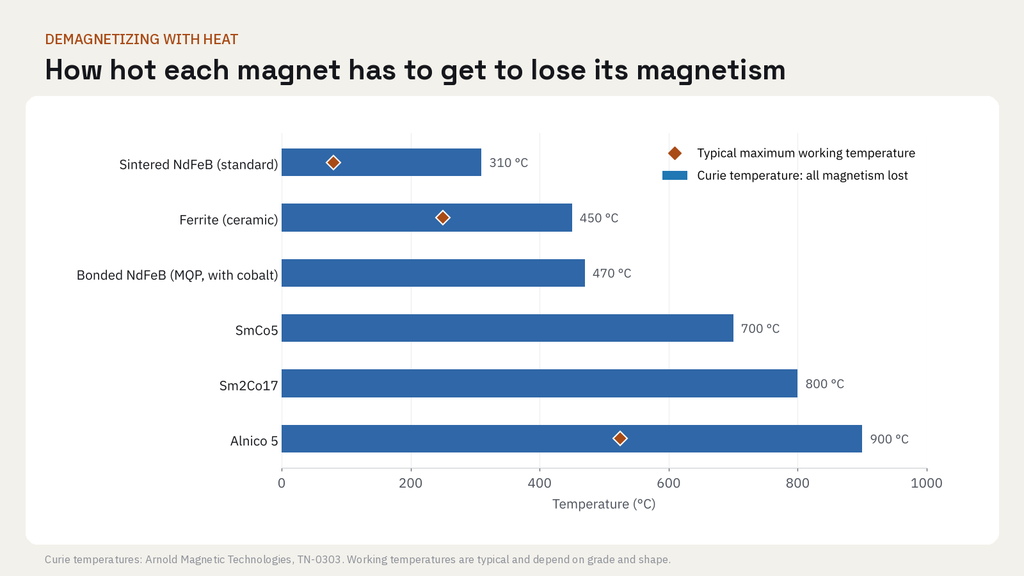
You do not have to reach the Curie temperature to lose strength. As a neodymium magnet warms, its coercivity falls quickly. In the author’s lab measurements, a die-upset NdFeB magnet with no dysprosium had a coercivity of 12.9 kOe at room temperature and only 4.1 kOe at 150 °C, while its remanence barely changed. Once coercivity falls below the magnet’s own internal demagnetizing field, grains start to flip and the loss becomes permanent. That is why standard N-grade magnets are rated for only about 80 °C, far below their Curie temperature of about 310 °C. The same alloy with 6.6% cobalt in it lost all its magnetism at about 410 °C in the author’s thermomagnetic test, which shows how much composition matters.
In practice, heating a magnet to demagnetize it has costs:
- Coatings burn and fume. Neodymium magnets are usually nickel plated or epoxy coated. Epoxy decomposes well below the Curie temperature.
- The magnet itself degrades. NdFeB oxidizes quickly when hot and can crack from thermal stress. Once heated past its Curie point in air, it is usually not worth remagnetizing.
- Kitchen ovens are not hot enough for most magnets and should not be used anyway. Ferrite needs about 450 °C and alnico about 900 °C, which means a kiln or furnace.
- Steel tools lose their hardness. Heating a screwdriver to red heat removes the magnetism and the temper together.
Method 2: an alternating field that fades to zero
This is the clean, controlled way to demagnetize anything with low coercivity, and it is how every tool demagnetizer, degausser and industrial demagnetizing tunnel works. A coil driven by alternating current produces a field that flips direction many times a second. The object is exposed to a strong alternating field and then the field is reduced gradually to zero, either by turning the current down or by moving the object slowly away from the coil.
Each flip drives the domains back and forth. As the field shrinks, each swing magnetizes the material a little less than the one before, so it spirals down to a state with no net magnetization. The fading is essential. If the field is switched off suddenly, or the object is pulled out quickly, the material is left magnetized in whichever direction the last strong swing pointed.
The limit is field strength. The peak field has to exceed the coercivity of the material. Small tool demagnetizers easily handle steel and can weaken alnico. Nothing that plugs into a wall outlet at home comes close to the 12 kOe or more needed to touch a neodymium magnet. Magnet makers use capacitor-discharge pulse systems for that.
Method 3: a strong opposing magnet
Holding a strong magnet against a weaker one with like poles facing applies a reverse field. If that field is larger than the weaker magnet’s coercivity, it flips some or all of its magnetization. This works well when the two materials are very different: a small neodymium magnet can partly demagnetize an alnico magnet, which is why guitar technicians warn against storing neodymium magnets next to alnico pickups.
It does not work well between similar magnets. One neodymium magnet cannot demagnetize another of the same grade, because the field it produces at the surface, roughly 3 to 6 kG, is well below the coercivity of the other magnet. A single pass also tends to remagnetize the weaker magnet in a new direction rather than leave it unmagnetized. To end up near zero, the opposing field has to be applied in alternating, shrinking steps, which is what Method 2 does automatically. Even an N52, the strongest magnet in the world you can easily buy, cannot fully erase another N52 this way.
Method 4: hammering or dropping it
Repeated blows do demagnetize magnetized steel, which is why the method appears in so many school textbooks. They also weaken alnico a little. On a modern ferrite, neodymium or samarium cobalt magnet, the effect is negligible. These materials are brittle, so the magnet chips or shatters long before an impact flips enough grains to matter. A broken neodymium magnet also sheds sharp fragments and loses its corrosion coating at the break.
How to demagnetize a screwdriver or other steel tool
This is the job most people actually have. Screwdrivers, tweezers, scissors and drill bits pick up magnetism from magnetic tool holders, magnetic bit drivers or contact with strong magnets. The fix takes a few seconds:
- Use a tool magnetizer-demagnetizer block. These small plastic blocks contain permanent magnets arranged with alternating poles. Pass the tool slowly through the slot marked for demagnetizing. Moving the tool through the alternating poles and away from the block gives it a fading alternating field.
- Or use an electric demagnetizer. Switch it on, hold the tool against the pad, then draw it away slowly and smoothly. Keep the power on until the tool is 20 to 30 centimeters away, then switch off.
- Test it. Touch the tip to a small screw or a paper clip. If it still picks it up, repeat more slowly.
Without either tool, a few sharp knocks on a hard surface will reduce the magnetism of a steel tool, but rarely remove it completely. A demagnetizer block is cheap and does the job properly. Do not heat a tool to demagnetize it unless you are prepared to re-harden it.
Can you demagnetize a neodymium magnet?
Only with heat, in practice. A standard neodymium magnet loses all its magnetism above about 310 °C, and grades with cobalt or heavy rare earths hold on to about 350 to 400 °C. At home that means a kiln or a furnace, an oxidized and probably cracked magnet, and fumes from the coating. It is rarely worth it.
People usually want to demagnetize neodymium magnets for one of three reasons, and each has a better answer:
- To dispose of them safely. Wrap them in tape or store them stuck to a steel plate so they cannot snap together, and keep them away from children. Small magnets are dangerous if swallowed.
- To recycle them. Leave them as they are. Recyclers handle magnetized scrap routinely, and hydrogen-based recycling breaks the magnets into powder anyway. See our guide to rare earth magnet recycling.
- To ship them. Ship them in their original packaging with steel keepers or spacers. Shipping rules limit the stray field outside the package, not the magnet itself.
How to keep a magnet from demagnetizing
The same physics in reverse:
- Stay below the rated working temperature. About 80 °C for standard neodymium, higher for H, SH, UH and EH grades. A thin magnet in open air demagnetizes at a lower temperature than a thick one mounted on steel.
- Keep alnico away from strong magnets and store it with a steel keeper across the poles.
- Protect the coating. A neodymium magnet with a chipped coating can corrode from the inside, which costs strength faster than any field.
- Do not machine or grind magnets yourself. The heat from cutting demagnetizes the edges, and NdFeB grinding dust is flammable.
Frequently asked questions
Can you demagnetize a magnet with another magnet?
Only if the other magnet is much stronger relative to the first magnet’s coercivity. A neodymium magnet can weaken alnico or magnetized steel. It cannot meaningfully demagnetize another neodymium magnet or a samarium cobalt magnet.
Does dropping a magnet demagnetize it?
Not a modern one. Dropping weakens magnetized steel and sometimes alnico. Ferrite, neodymium and samarium cobalt magnets keep their magnetism, but they can chip or break.
At what temperature does a neodymium magnet lose its magnetism?
Standard grades start to lose strength permanently above about 80 °C and lose all magnetism at the Curie temperature, about 310 °C. High-temperature grades with dysprosium, terbium or cobalt survive up to about 200 to 230 °C in use and have Curie temperatures of about 350 to 400 °C.
Can a demagnetized magnet be remagnetized?
Yes, if the material itself is undamaged. Magnet makers magnetize parts with a short, very strong pulse from a coil, typically at least two to three times the coercivity. Alnico and steel can be remagnetized with a strong permanent magnet. A neodymium magnet that was heated past its Curie point in air is usually too oxidized to be worth the effort.
Will a magnet erase a hard drive?
Not a household magnet. Hard drive platters are made of high-coercivity material, and the drive already holds two strong neodymium magnets of its own. Wiping a drive magnetically takes an industrial degausser. For personal data, a secure erase or physically destroying the platters is more reliable.
Does a microwave demagnetize a magnet?
No, and it is a bad idea to try. A microwave does not reach the Curie temperature of any common magnet, and metal inside it can cause sparks and damage the oven.
Sources
- Arnold Magnetic Technologies: Reversible temperature coefficients and Curie temperatures of permanent magnet materials (TN-0303)
- Radial Magnets: Magnet temperature derating, coefficients and Curie temperatures by grade
- Radial Magnets: Magnet demagnetization guide
- Charged EVs: A closer look at rare earth permanent magnets
- Elliott Sound Products: How a demagnetiser works
- Science.ca Ask a Scientist: Do magnets lose strength when dropped?
- Apex Magnets: Magnet safety (heat, machining and flammable dust)
- K&J Magnetics: Neodymium magnet safety
- Lab measurements: the author’s own samples, Pukyong National University, 2017–2018 (VSM, thermomagnetic analysis)
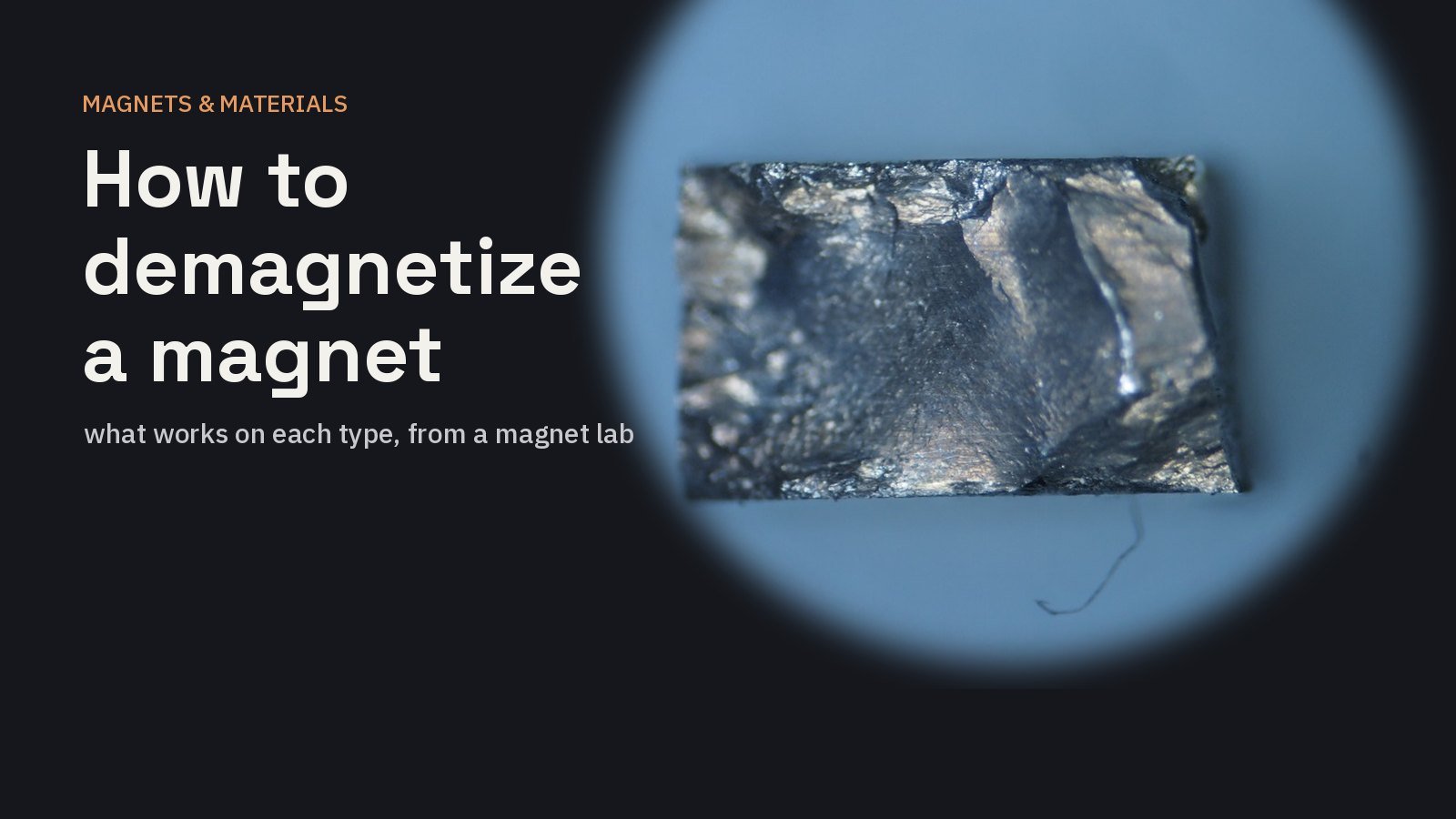
Featured image: the author’s die-upset NdFeB sample under a stereo microscope. Diagram: original graphic by CleanTech Explained. This article reflects the author’s personal views and publicly available information as of November 2026. It is general information, not engineering or safety advice.