How Long Will a Power Station Run a Fridge?

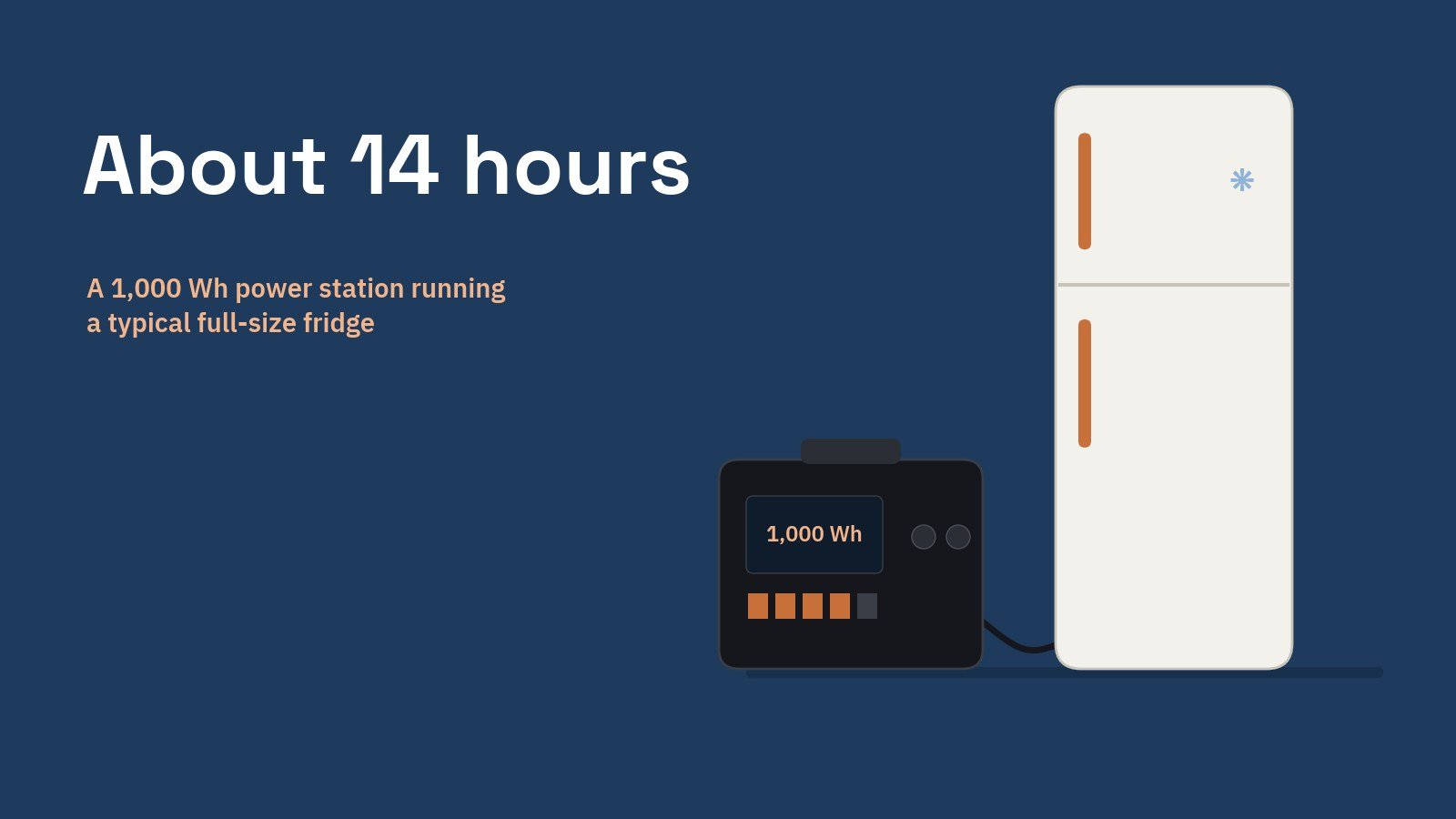
How long will a power station run a fridge? For a typical modern full-size refrigerator, a 1,000 Wh portable power station will keep it running for roughly 12 to 16 hours, and a 2,000 Wh unit for about a full day. The exact answer depends on how much energy your fridge uses, which is often far less than the wattage printed on its label.
This guide gives you a simple formula, a runtime table for common power station sizes, and practical tips to stretch your battery during a power outage. See our comparison of LFP vs NMC batteries. New to power stations? Start with our portable power station guide.
Last reviewed: September 2026.
Quick answer
- Mini fridge: a 500 Wh power station can run it for about 20 hours; a 1,000 Wh unit for close to two days.
- Modern full-size fridge: expect about 7 hours from 500 Wh, 14 hours from 1,000 Wh and 27 hours from 2,000 Wh.
- Older or very large fridge: runtime can be roughly half of those figures.
- Your power station must also handle the fridge’s startup surge, which can briefly reach 600 to 1,500 watts or more.
Fridge runtime calculator
Enter your power station’s capacity and your fridge’s daily energy use to estimate how long it will keep running.
About 14 hours
of continuous running from a full charge
- Usable energy
- 850 Wh
- Average load
- 63 W
- Full charges needed per day
- 1.8
Check that your power station’s surge (peak) rating exceeds your fridge’s startup surge, often 600 to 1,500 W for full-size fridges. Estimates assume normal use; hot weather and frequent door opening shorten runtime.
Why your fridge uses less power than its label suggests
Many people look at a fridge's nameplate, see a figure like 500 or 700 watts, and assume it uses that much all the time. It does not. That number is a maximum, not an average.
A fridge's compressor cycles on and off to hold the temperature steady. Most modern full-size refrigerators draw about 100 to 250 watts while the compressor is running, then almost nothing while it rests. Averaged over a full day, a typical new fridge uses about 0.8 to 1.6 kWh.

For sizing a power station, the number that matters is daily energy use in kWh, not the nameplate wattage.
Step 1: Find your fridge's daily energy use
There are two easy ways to find it.
Check the EnergyGuide label. In the US, most fridges have a yellow EnergyGuide label showing estimated yearly energy use in kWh. Divide it by 365. A fridge rated at 500 kWh per year uses about 1.37 kWh per day.
Measure it. A plug-in energy meter placed between the fridge and the wall socket shows actual consumption. Leave it for at least 24 hours, ideally a few days, to capture normal cycling.
If you have neither, use these typical ranges:
| Fridge type | Typical daily use |
|---|---|
| Mini fridge | 0.3–0.8 kWh |
| Modern ENERGY STAR full-size fridge | 1.0–1.3 kWh |
| Typical full-size fridge | 1.3–1.8 kWh |
| Older or large side-by-side fridge | 2.0–3.0 kWh or more |
Step 2: Use the runtime formula
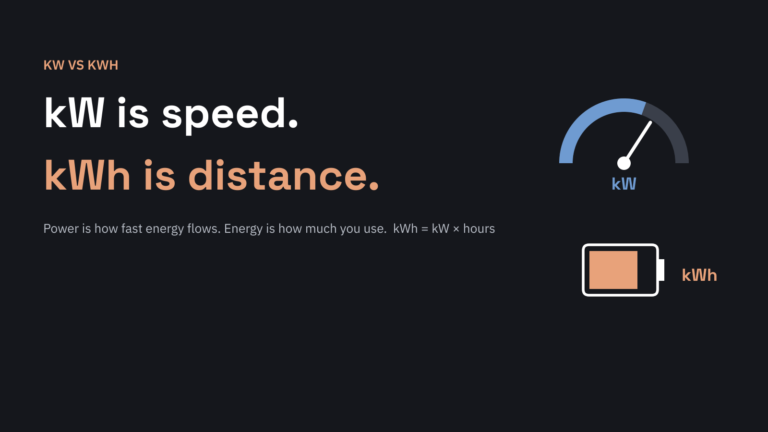
Runtime (hours) = Power station capacity (Wh) × 0.85 ÷ Fridge's average watts
To get your fridge's average watts, multiply its daily use in kWh by 1,000 and divide by 24. For example, 1.5 kWh per day equals about 62 watts on average.
The 0.85 accounts for real-world losses. A power station converts its battery's DC power to AC through an inverter, which wastes some energy as heat, and many units also keep a small reserve. Real efficiency is usually somewhere between 80 and 90 percent.
Example: a 1,000 Wh power station running a fridge that uses 1.5 kWh per day.
1,000 × 0.85 = 850 usable watt-hours
850 ÷ 62 = about 14 hours
Runtime table
Estimated runtime using the formula above:
| Power station capacity | Mini fridge (0.5 kWh/day) | ENERGY STAR full-size (1.2 kWh/day) | Typical full-size (1.5 kWh/day) | Older or large (2.5 kWh/day) |
|---|---|---|---|---|
| 500 Wh | about 20 hours | about 8 hours | about 7 hours | about 4 hours |
| 1,000 Wh | about 41 hours | about 17 hours | about 14 hours | about 8 hours |
| 2,000 Wh | about 3.4 days | about 34 hours | about 27 hours | about 16 hours |
| 3,600 Wh | about 6 days | about 2.5 days | about 2 days | about 29 hours |
These are estimates. Hot weather, frequent door opening and a nearly empty fridge will all shorten runtime.
Step 3: Check the power station can start your fridge
Capacity tells you how long a power station can run your fridge. Output power tells you whether it can run it at all.
When a fridge's compressor starts, it briefly draws a surge of power, often several times its running wattage, for a second or two. Newer fridges typically surge to around 600 to 1,500 watts, and older models can go higher.
Look for two figures on the power station:
- Continuous (rated) output: should comfortably exceed your fridge's running watts. For most fridges, 1,000 W or more gives a healthy margin.
- Surge (peak) output: must exceed your fridge's startup surge.
Also choose a power station with a pure sine wave inverter. Compressor motors run best, and more quietly, on a clean AC waveform. Most reputable modern power stations use one.
Do you need to run the fridge all the time?
Not necessarily. According to US food safety guidance, a closed refrigerator keeps food safe for up to 4 hours during a power outage, and a full freezer holds a safe temperature for about 48 hours, or about 24 hours if half full.
That means you can run the fridge in cycles to stretch a smaller power station. For example, run it for an hour or two to bring the temperature back down, then switch it off for a few hours while keeping the door closed. Use a fridge thermometer and keep the inside at or below 40 °F (4 °C). Discard perishable food that has been above that temperature for more than 2 hours.
Tips to make your power station last longer
- Keep the door closed. Every opening lets cold air out and makes the compressor work harder.
- Keep the fridge full. A full fridge holds its temperature better than an empty one. Fill gaps with bottles of water.
- Do not set it colder than needed. Around 37 °F (3 °C) for the fridge is enough.
- Pre-chill before an expected outage. Turn the temperature down slightly a few hours before a storm.
- Keep the fridge out of the heat. A fridge in a hot garage uses much more energy than one in a cool kitchen.
- Unplug other devices. Only power what you truly need from the station.
- Recharge with solar. Adding solar panels lets you top up the power station during the day, which can extend runtime for as long as the sun shines.
How big a power station do you need for a fridge?
As a rule of thumb for a typical modern full-size fridge:
- 500–1,000 Wh: short outages of a few hours, or running the fridge in cycles
- 1,000–2,000 Wh: overnight to a full day of continuous running
- 2,000 Wh or more, or a unit with solar charging: multi-day outages
If you also want to run lights, phones, a router or medical devices, add their energy use to your calculation.
Frequently asked questions
Can a 1,000 Wh power station run a fridge?
Yes, as long as its surge rating can handle your fridge's startup. For a typical modern full-size fridge, a 1,000 Wh unit will run it for roughly 12 to 16 hours of continuous operation.
Can a 500 W power station run a fridge?
A power station with 500 W of continuous output may run a small or efficient fridge, but it may not handle the startup surge of a full-size model. Check the fridge's surge requirement and the station's peak output rating before relying on it.
How many watts does a fridge use?
A modern full-size fridge typically draws 100 to 250 watts while its compressor runs, but uses only about 0.8 to 1.6 kWh over a full day because the compressor cycles on and off.
How long can a fridge stay off without power?
A closed refrigerator keeps food safe for up to 4 hours. A full freezer stays safe for about 48 hours, or about 24 hours if half full, as long as the doors stay closed. For whole home battery backup or longer, a permanently installed solar battery may make more sense than a portable power station.
Will solar panels keep a fridge running?
Solar panels can recharge a power station during the day. With enough panel capacity and sunshine, a fridge can run through an extended outage, although cloudy days reduce solar output.
Sources
- FoodSafety.gov, Food Safety During Power Outage: https://www.foodsafety.gov/food-safety-charts/food-safety-during-power-outage
- US Food and Drug Administration, Food and Water Safety During Power Outages and Floods: https://www.fda.gov/food/buy-store-serve-safe-food/food-and-water-safety-during-power-outages-and-floods
- NRG Clean Power, How Many Watts Does a Refrigerator Use?: https://nrgcleanpower.com/learning-center/how-many-watts-does-a-refrigerator-use/
- Off-Grid Daily Life, How Much Power Does a Refrigerator Need: https://offgriddailylife.com/refrigerator-power-needs/