What Are Critical Minerals? The Complete List

Critical minerals are raw materials that are essential to a country’s economy or national security and whose supply is at risk of disruption. Governments publish a critical minerals list to decide which materials deserve priority for investment, permitting, stockpiling and trade policy. Many of these minerals, from lithium and nickel to copper and rare earths, are the building blocks of clean energy technology.
This guide explains what makes a mineral critical, gives you the complete US list of 60 critical minerals, shows how the lists of the European Union, Australia, Canada, India and China differ, and explains which minerals matter most for solar panels, batteries, EVs and wind turbines.
Key takeaways
- A mineral is “critical” when it is economically important and its supply is vulnerable to disruption, not simply because it is rare.
- The US critical minerals list was expanded to 60 minerals in November 2025, adding copper, silver, uranium, silicon and six others.
- The EU’s Critical Raw Materials Act lists 34 critical raw materials, of which 17 are designated strategic.
- Australia lists 31 critical minerals, Canada 34 and India 30. China names strategic minerals instead and uses export controls on the ones it dominates.
- Clean energy depends heavily on critical minerals, especially lithium, nickel, cobalt, graphite, copper, silicon, silver and the rare earths used in magnets.
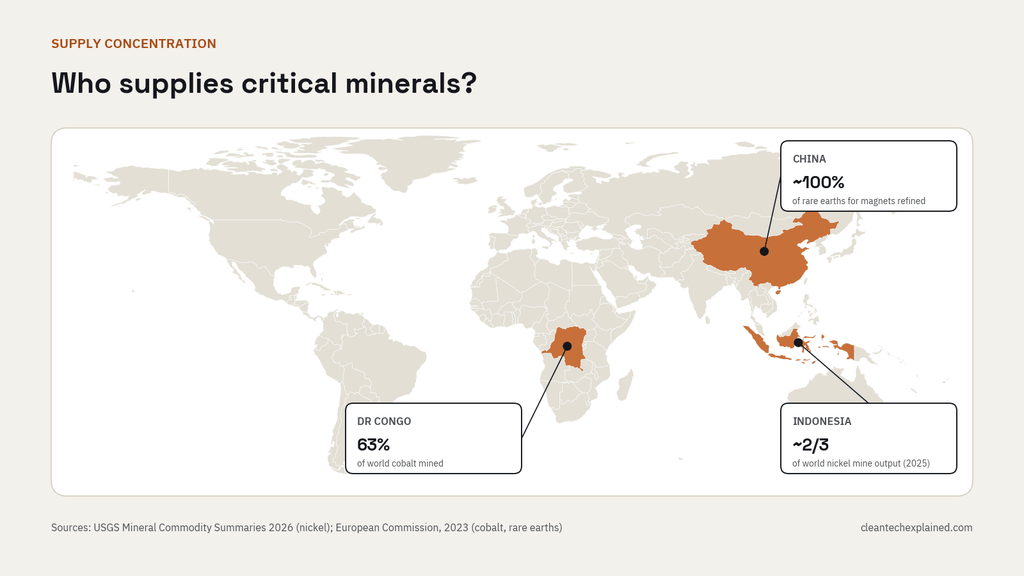
- Supply is highly concentrated. Indonesia mines around two-thirds of the world’s nickel, and China dominates the refining of many critical minerals.
What makes a mineral “critical”?
A mineral’s place on a critical minerals list depends on two questions:
- How important is it? The mineral must be essential to manufacturing, energy, defense or other key parts of the economy, and hard to substitute.
- How risky is its supply? Supply is considered risky when production or processing is concentrated in a few countries, when those countries may restrict exports, or when demand is growing faster than new supply.
A common mineral can be critical if its supply chain is vulnerable, and a rare one may not be critical if it is easy to replace. Lists change over time as technology, demand and geopolitics shift.
The US critical minerals list (2025)
The US Geological Survey (USGS) maintains the US list under the Energy Act of 2020, which requires it to be reviewed at least every three years. The final 2025 list, published in November 2025, contains 60 minerals: all 50 from the 2022 list plus 10 new additions.
The 10 minerals added in 2025
Boron, copper, lead, metallurgical coal, phosphate, potash, rhenium, silicon, silver and uranium.
Copper’s addition was especially significant. It is essential for wiring, power grids, electric motors and data centers, and it had never appeared on a USGS critical minerals list before.
The complete list of 60 US critical minerals
| Group | Minerals |
|---|---|
| Rare earth elements (16) | cerium, dysprosium, erbium, europium, gadolinium, holmium, lanthanum, lutetium, neodymium, praseodymium, samarium, scandium, terbium, thulium, ytterbium, yttrium |
| Platinum group metals (5) | Iridium, palladium, platinum, rhodium, ruthenium |
| Battery and energy minerals (7) | Cobalt, graphite, lithium, manganese, nickel, uranium, vanadium |
| Base and structural metals (10) | Aluminum, chromium, copper, lead, magnesium, tin, titanium, tungsten, zinc, zirconium |
| Technology and specialty elements (17) | Antimony, arsenic, beryllium, bismuth, boron, cesium, gallium, germanium, hafnium, indium, niobium, rhenium, rubidium, silicon, silver, tantalum, tellurium |
| Industrial and agricultural minerals (5) | Barite, fluorspar, metallurgical coal, phosphate, potash |
The grouping above is ours, to make the list easier to read. The official list is alphabetical.
The EU critical raw materials list (Critical Raw Materials Act)
The European Union’s Critical Raw Materials Act, in force since 2024, identifies 34 critical raw materials. Seventeen of them are also designated strategic raw materials because they are crucial for green, digital, defense and space technologies and face potential supply shortages. Strategic raw materials include lithium, cobalt, nickel, copper, natural graphite and the rare earth elements used in permanent magnets.
The act also sets non-binding benchmarks for 2030. For each strategic raw material, the EU aims to:
- Mine at least 10% of its annual consumption within the EU
- Process at least 40% within the EU
- Recycle at least 25% of its needs
- Rely on no single non-EU country for more than 65% of its supply
Unlike the US list, the EU list uses broader groupings in some cases, such as heavy and light rare earth elements and platinum group metals, and it specifies grades, such as battery-grade lithium and nickel.
Critical minerals lists by country
Every list reflects the industries and supply risks of the country that wrote it, so the numbers differ. A mineral-rich exporter such as Australia or Canada lists what it can supply to partners, while an importer such as the EU or India lists what it fears losing.
| Country or region | Name of list | Minerals | Latest version |
|---|---|---|---|
| United States | Critical Minerals List | 60 | 2025 |
| European Union | Critical raw materials | 34 (17 strategic) | 2024 |
| Canada | Critical Minerals List | 34 | 2024 |
| Australia | Critical Minerals List | 31 | 2024 |
| India | Critical minerals | 30 | 2023 |
| China | Strategic minerals | 24 | 2016 |
Australia’s critical minerals list
Australia’s Critical Minerals List contains 31 minerals. It was expanded in 2023, when fluorine, molybdenum, arsenic, selenium and tellurium were added, and again in February 2024, when nickel joined after a price collapse forced Australian mines to close. The government reviews the list at least every three years. A separate Strategic Materials List covers materials such as copper, aluminium, tin and zinc, which matter for the energy transition but whose supply chains are not yet considered vulnerable.
Australia matters to other countries’ lists because it is one of the world’s largest producers of lithium and a growing source of rare earths outside China.
Canada’s critical minerals list
Canada’s list grew from 31 to 34 minerals in June 2024, when high-purity iron, phosphorus and silicon metal were added. Canada reviews its list every three years.
India’s critical minerals list
India published its first list of 30 critical minerals in 2023. It includes lithium, cobalt, nickel, graphite and rare earth elements, reflecting the country’s dependence on imports for battery and electronics manufacturing.
China’s strategic minerals and export controls
China does not publish a critical minerals list in the same way. Its National Mineral Resources Plan for 2016–2020 named 24 strategic minerals, a group that mixes energy resources such as oil, gas, coal and uranium with metals such as copper, nickel, lithium, cobalt, tungsten and rare earths.
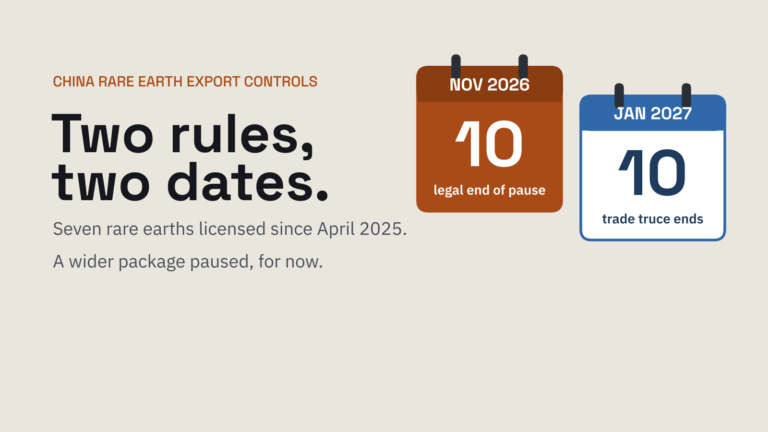
In practice, China’s export controls show which minerals it treats as strategic. Since 2023 it has introduced licensing or restrictions on gallium, germanium, graphite, antimony, tungsten and seven medium and heavy rare earth elements, including dysprosium and terbium. Some of the measures announced in 2025 are suspended until November 2026, but the April 2025 controls on those seven rare earths remain in force.
Why critical minerals matter for clean energy
Clean energy technologies generally need more minerals than the fossil fuel systems they replace. Here are the most important ones:
| Mineral | Main clean energy uses |
|---|---|
| Lithium | Lithium-ion batteries for EVs and home storage |
| Nickel | High-energy battery cathodes (NMC and NCA chemistries) |
| Cobalt | Battery cathodes, although newer chemistries use less |
| Graphite | Battery anodes |
| Manganese | Battery cathodes and steel |
| Copper | Wiring, electric motors, power grids, solar and wind installations |
| Neodymium, praseodymium, dysprosium, terbium | Permanent magnets in EV motors and wind turbines |
| Silicon | Solar cells |
| Silver | Solar cell contacts and electronics |
| Gallium and germanium | Power electronics, semiconductors and some solar technologies |
| Platinum group metals | Fuel cells and hydrogen electrolyzers |
| Vanadium | Vanadium flow batteries for grid storage |
| Uranium | Nuclear power |
Some technologies can switch between minerals. Lithium iron phosphate (LFP) batteries avoid nickel and cobalt, and some EV motors avoid rare earth magnets entirely. But substitution usually involves trade-offs in cost, weight or performance, which is why supply security remains a priority.
Where critical minerals come from
The biggest risk with critical minerals is concentration. For many materials, a single country dominates either mining or processing:
- Rare earths: China dominates refining. When the EU proposed its Critical Raw Materials Act, the European Commission noted that 100% of the rare earths used for permanent magnets globally were refined in China. China’s export controls on rare earths since 2025 have shown how quickly this can affect manufacturers worldwide.
- Cobalt: Most cobalt is mined in the Democratic Republic of Congo, while much of it is refined in China.
- Nickel: Indonesia has become the world’s dominant producer, as explained below.
Cobalt also goes into magnets, including samarium cobalt and alnico magnets.
Because processing is often more concentrated than mining, diversifying refining capacity is a central goal of both US and EU policy.
Indonesia and nickel: a critical minerals giant
Indonesia is the clearest example of how quickly the critical minerals map can change. According to the US Geological Survey, global nickel mine production rose to about 3.9 million tons in 2025, and Indonesia’s output grew by around 13% as new operations ramped up. At roughly 2.6 million tons, Indonesia now supplies around two-thirds of the world’s mined nickel.
Much of that growth followed Indonesia’s 2020 ban on exports of unprocessed nickel ore, which pushed investment into domestic smelters and refineries, many backed by Chinese companies. Indonesia now produces not only nickel pig iron for stainless steel but increasingly battery-grade intermediates used in EV batteries.
The rapid expansion has costs. Much of Indonesia’s nickel processing runs on coal power, and the World Resources Institute estimates that each ton of Indonesian nickel produced releases an average of 93 tons of CO2 equivalent. Deforestation, water pollution and community impacts around mining and industrial parks are also concerns. How Indonesia manages these impacts will shape whether its nickel is accepted as part of clean energy supply chains in markets with strict sustainability rules.
Can recycling solve the critical minerals problem?
Recycling helps, but it cannot meet demand on its own for many years. Batteries, magnets and solar panels often stay in service for 10 to 25 years, so the volume of material available for recycling lags behind today’s rapidly growing demand. Recycling is still essential in the long term, which is why the EU set a 25% recycling benchmark and why companies are building battery and magnet recycling plants. For magnets specifically, see our guide to rare earth magnet alternatives, which covers recycling alongside new materials.
Frequently asked questions
How many critical minerals are there?
The US critical minerals list contains 60 minerals as of the final 2025 update. The EU lists 34 critical raw materials, 17 of which are strategic. Canada lists 34, Australia 31 and India 30. The numbers differ because each list reflects that country’s own industries and risks.
Is copper a critical mineral?
Yes. Copper was added to the US critical minerals list in 2025, and it is also a strategic raw material under the EU’s Critical Raw Materials Act.
Are rare earths the same as critical minerals?
No. Rare earth elements are one group within the broader critical minerals list. The US list includes 16 rare earth elements alongside dozens of other minerals such as lithium, nickel, copper and graphite.
Which country has the most critical minerals?
No single country dominates all of them. China leads in refining many critical minerals, including rare earths. Indonesia dominates nickel mining, the Democratic Republic of Congo dominates cobalt mining, and Australia and Chile are major lithium producers.
Why is uranium on the critical minerals list?
Uranium was added to the US list in 2025. It fuels nuclear power plants, and its supply chain, especially enrichment, is concentrated in a few countries.
Sources
- US Department of the Interior, Final 2025 List of Critical Minerals: https://www.doi.gov/pressreleases/interior-department-releases-final-2025-list-critical-minerals
- USGS, Interior Department releases final 2025 List of Critical Minerals: https://www.usgs.gov/news/science-snippet/interior-department-releases-final-2025-list-critical-minerals
- Brownstein, Critical Update: USGS Expands Mineral List: https://www.bhfs.com/insight/critical-update-usgs-expands-mineral-list/
- IEA Policy Database, Final List of Critical Minerals 2025: https://www.iea.org/policies/31799-final-list-of-critical-minerals-2025
- European Parliament Think Tank, Implementing the EU’s Critical Raw Materials Act: https://epthinktank.eu/2024/11/20/implementing-the-eus-critical-raw-materials-act/
- European Commission, Critical Raw Materials Act factsheet: https://ec.europa.eu/commission/presscorner/api/files/attachment/874736/Factsheet_GD_European%20Critical%20Raw%20Materials%20Act%20.pdf.pdf
- Parliament of Australia, Critical minerals in Australia: https://www.aph.gov.au/About_Parliament/Parliamentary_departments/Parliamentary_Library/Research/Policy_Briefs/2025-26/Criticalminerals
- Australian Government, Updates to Australia’s Critical Minerals List: https://www.industry.gov.au/news/updates-australias-critical-minerals-list
- Government of Canada, Updated Critical Minerals List (2024): https://www.canada.ca/en/natural-resources-canada/news/2024/06/government-of-canada-releases-updated-critical-minerals-list.html
- S&P Global, India adopts critical mineral list (2023): https://www.spglobal.com/market-intelligence/en/news-insights/articles/2023/6/india-adopts-critical-mineral-list-as-newest-mineral-security-partnership-member-76332697
- IEA Policy Database, China’s National Plan for Mineral Resources (2016-2020): https://www.iea.org/policies/15519-national-plan-for-mineral-resources-2016-2020