Bidirectional Charging Explained: V2H, V2G and What It Costs

An electric car carries a battery five to ten times bigger than a typical home battery. Bidirectional charging lets that energy flow back out of the car, to run your appliances, your whole house during a blackout, or even the grid. After years of pilots, it is finally a real option for a growing list of EVs in 2026. This guide explains how bidirectional charging works, the difference between V2L, V2H and V2G, which cars support it, what the equipment costs and whether it is worth it for you.
Short answer: Bidirectional charging means power can flow both into and out of an EV’s battery. The simplest form, vehicle-to-load (V2L), uses outlets on the car. Vehicle-to-home (V2H) needs a special charger plus equipment that safely disconnects your home from the grid, and in the US typically costs $4,000–$10,000 or more installed. A mid-size EV can keep a home’s essentials running for three to six days. Vehicle-to-grid (V2G), selling power back to the utility, is still limited to a few pilot programs.
Key takeaways
- There are three levels: V2L (outlets on the car), V2H (powering your house) and V2G (sending power to the grid).
- About 14 of roughly 70 EV models sold in the US offered bidirectional charging in early 2026. Home-backup options now include GM’s Ultium EVs, the Ford F-150 Lightning, the Kia EV9 and Tesla’s Cybertruck, Model 3 and Model Y.
- Most V2H systems deliver 9.6–12 kW, enough to run most of a house, but not everything at once.
- Hardware alone runs from about $3,900 to $8,100, before installation and any panel upgrade.
- Occasional backup use adds little battery wear. Daily cycling for the grid adds more, so check what your automaker’s warranty allows.
V2L, V2H and V2G: what they mean
| Type | What it powers | What you need | Typical power |
|---|---|---|---|
| V2L (vehicle-to-load) | Tools, appliances, a camping trip, a fridge by extension cord | Nothing extra; outlets on the car or a plug-in adapter | About 3.6 kW on many cars; up to 9.6 kW on some trucks |
| V2H (vehicle-to-home) | Your home’s circuits during an outage, or at peak-price hours | Bidirectional charger, transfer equipment, professional installation | About 9.6–12 kW |
| V2G (vehicle-to-grid) | The electric grid; you are paid for the energy or capacity | V2H equipment plus a utility agreement and interconnection approval | Similar to V2H |
You will also see V2X, a catch-all term for any of these. And some automakers use their own names, such as Ford’s Intelligent Backup Power and Tesla’s Powershare.
How vehicle-to-home works
An EV battery stores direct current (DC). Your home runs on alternating current (AC). So every V2H system needs an inverter to convert the car’s DC into household AC. There are two designs:
- Inverter outside the car. The car sends DC to a bidirectional DC charger or a separate inverter on the wall. GM’s V2H Enablement Kit and the Wallbox Quasar 2 used with the Kia EV9 work this way.
- Inverter inside the car. The car’s own electronics produce AC and send it out through the charging cable. Tesla’s Powershare works this way, which is why its home equipment is simpler.
Either way, the system also needs a way to disconnect the house from the grid during an outage, usually an automatic transfer switch or a home energy hub. This “islanding” is a safety requirement: without it, power from your car could flow back into the street wiring and endanger line workers. It is also why V2H must be installed by a licensed electrician and, in many places, approved by your utility.
When the grid fails, the hub opens the connection, the car starts supplying the house, and most systems let you set a minimum charge to keep for driving. When power returns, the system reconnects and the car can recharge.
Which EVs support bidirectional charging?
According to Bloomberg data cited by Axios, about 14 of roughly 70 EV models on sale in the US offered bidirectional charging in early 2026, and around 630,000 such vehicles were on the road. These are the main home-backup options:
| Vehicle | Home equipment needed | Hardware price | Backup power |
|---|---|---|---|
| Ford F-150 Lightning | Ford Charge Station Pro + Home Integration System | $3,895 for the Home Integration System, plus the charger | 9.6 kW |
| GM Ultium EVs (Chevrolet Silverado EV, Blazer EV, Equinox EV; GMC Sierra EV, Hummer EV; Cadillac Lyriq, Optiq, Vistiq, Escalade IQ) | GM Energy V2H Bundle: PowerShift charger + V2H Enablement Kit (home hub, inverter, start-up battery) | $8,098 list ($1,999 charger + $6,299 kit) | 9.6 kW |
| Kia EV9 | Wallbox Quasar 2 + power recovery unit and grid disconnect switch | $6,440 bundle | About 12 kW |
| Tesla Cybertruck | Universal Wall Connector + Powershare Gateway | Varies; check Tesla | 11.5 kW |
| Tesla Model 3 and Model Y (ordered from October 1, 2026) | Powerwall 3 + Wall Connector | Powerwall 3 required | 11.5 kW |
A few notes:
- GM offers V2H on almost all of its Ultium-based EVs and announced a monthly lease option for the equipment in February 2026, with pricing depending on the home and local incentives.
- Tesla added Powershare home backup to new Model 3 and Model Y orders in October 2026, but only together with a Powerwall 3; the car extends the Powerwall’s backup rather than replacing it. Selling power to the grid is not available on these models.
- Kia opened EV9 pre-orders for the Quasar 2 in seven states in 2025, with a wider rollout promised.
- Nissan Leaf models with a CHAdeMO port can work with Fermata Energy bidirectional chargers, mostly in commercial and utility projects.
- More brands, including Volvo, Polestar and Rivian, have announced or begun V2H programs. Check the automaker’s own site for your exact model year and trim: support often depends on software and the charging port.
How long can an EV power a house?
It depends on the size of the battery, how much charge you keep for driving and how much power the house draws. An average US home uses roughly 30 kWh a day. During an outage, most people cut back to essentials, such as the fridge, lights, internet, a furnace fan or well pump and phone charging, which can be closer to 10 kWh a day.
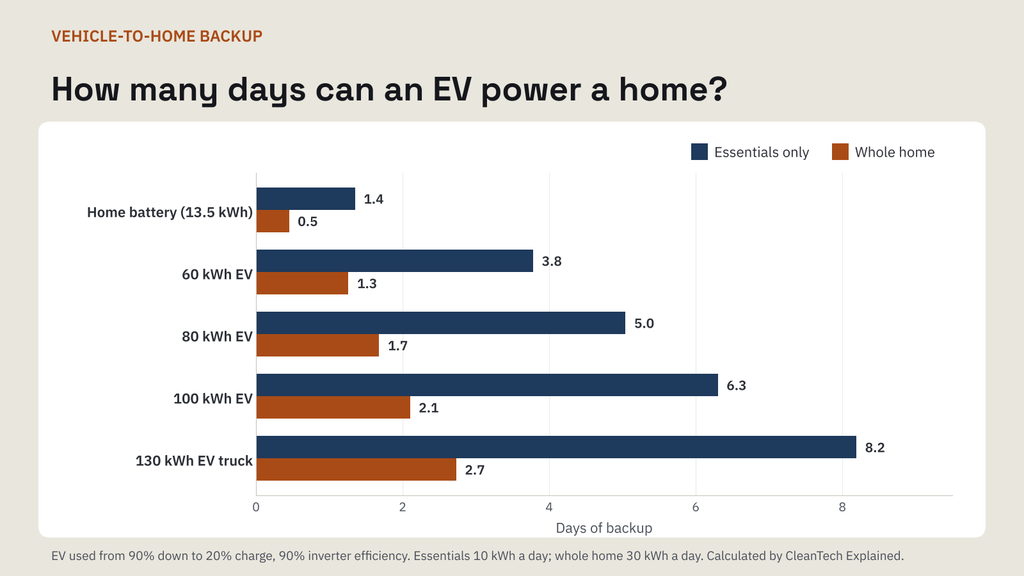
The chart assumes you start at 90% charge, stop at 20% to keep some driving range, and lose about 10% in the inverter. On those assumptions:
- A 60 kWh EV gives about 1.3 days of normal use, or nearly 4 days of essentials.
- A 100 kWh EV gives about 2 days of normal use, or 6 days of essentials.
- A big 130 kWh electric truck gives nearly 3 days of normal use, or 8 days of essentials.
- A typical 13.5 kWh home battery covers about half a day of normal use.
Power output is the other limit. At 9.6–12 kW, a V2H system can run most household loads together, but a central air conditioner, an electric range and an electric dryer all at once may exceed it. Installers usually set up a backup panel or load management for this reason.
Our home battery backup guide explains how to size backup in more detail, and if you only need a few appliances, a portable power station charged from the car’s V2L outlets is a much cheaper route.
What does bidirectional charging cost?
Hardware prices for complete home-backup systems in 2026 range from about $3,900 (Ford’s Home Integration System, plus its charger) to about $8,100 (GM’s V2H bundle). On top of that come:
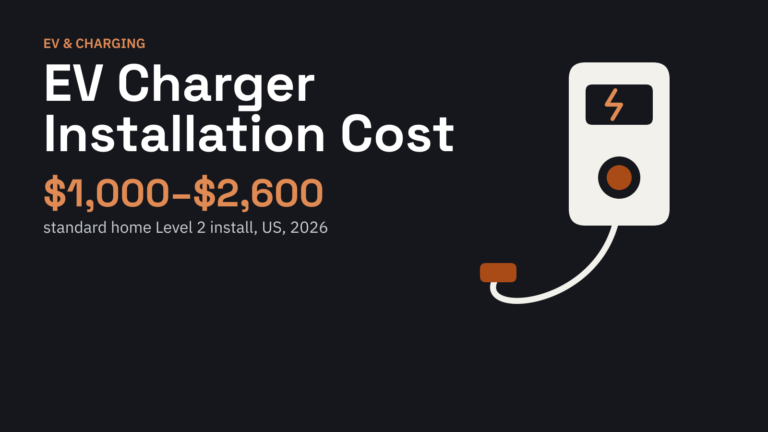
- Installation: usually more than a standard Level 2 charger, because of the transfer equipment and backup wiring. Our EV charger installation cost guide covers the basic labor and permit costs.
- Panel upgrades: older homes with 100 A service may need an upgrade, which can add a few thousand dollars.
- Permits and utility approval: interconnection review can take weeks or months.
Industry estimates for a complete residential system have often been quoted at $5,000 to $20,000, depending on the home. A 2023 study by the Smart Electric Power Alliance found the price premium of a bidirectional charger over a one-way charger was about $8,500 to $9,000, though bundled systems have since come down. The federal tax credit for home chargers has also ended for equipment placed in service after June 30, 2026, so check state and utility rebates instead.
V2H or a home battery?
| EV with V2H | Home battery | |
|---|---|---|
| Storage | 60–130+ kWh, shared with driving | Usually 10–15 kWh per unit |
| Available when the car is away | No | Yes |
| Switchover during an outage | Automatic with the right hub; a brief interruption is common | Usually seamless |
| Works with solar | Depends on system | Yes, standard |
| Typical cost | About $4,000–$10,000+ if you already own a compatible EV | About $10,000–$15,000+ installed |
For people who already own a compatible EV and mostly want outage protection, V2H can provide far more stored energy per dollar than a home battery. If the car is often away when outages happen, or you want daily solar self-consumption, a solar battery may still be the better fit. Some owners do both.
Vehicle-to-grid: can you earn money?
In theory, millions of plugged-in EVs could help the grid on hot summer evenings, and owners could be paid for it. In practice, residential V2G programs in the US are still rare. Utilities need interconnection rules, metering and payment structures for small exporters, and the US Department of Energy notes that incentive programs for vehicles are not yet widely in place. Pacific Gas and Electric in California has offered incentives of up to $4,500 in a V2X pilot run with GM Energy. Most other utilities have nothing yet, or only programs for school buses and fleets.
Even where V2G is possible, earnings depend on how often you are called on and how much you are paid per event. For now, treat V2G income as a possible bonus, not a reason to buy the equipment.
Does bidirectional charging wear out the battery?
Using your car for backup a few times a year adds very little wear. Powering a house for three days at 30 kWh a day uses about 90 kWh, roughly one full charge cycle of a large battery; modern packs are rated for well over a thousand. As the Smart Electric Power Alliance put it, degradation should be minimal if owners only take part in a dozen or so peak events a year.
Daily use is different. Running your house from the car every evening could double the energy that flows through the battery each year compared with driving alone. That is more cycles, and more heat, which speeds up aging. Our guide to how long EV batteries last explains what drives battery wear.
The warranty matters here. Automakers that sell their own V2H equipment generally support its use, but terms differ: some limit how often or how much energy can be exported, and some cover only their approved chargers. Read your battery warranty before signing up for any grid program.
Is vehicle-to-home worth it?
V2H makes the most sense if:
- you already own, or plan to buy, a supported EV;
- you live where outages are common or long, such as storm or wildfire regions;
- the car is usually at home overnight and on weekends;
- your utility offers time-of-use rates or a V2G program you can join.
It makes less sense if your car is away from home most of the day, you rarely lose power, or you rent and cannot install equipment. In those cases, the car’s V2L outlets and a few extension cords, or a portable power station, may cover what you need for a fraction of the price.
Frequently asked questions
What is bidirectional charging?
Bidirectional charging lets electricity flow both into an EV’s battery and back out of it, so the car can power devices, a home or the grid instead of only taking power.
Can any EV power a house?
No. The car must support bidirectional charging, and you need compatible home equipment. Many EVs only offer V2L outlets, which can run appliances by extension cord but not your home’s circuits.
Is V2L the same as V2H?
No. V2L uses outlets on the car to run individual devices. V2H connects the car to your home’s electrical panel through a bidirectional charger and transfer equipment, so it can power your circuits during an outage.
Do I need solar panels for vehicle-to-home?
No. V2H works without solar; you charge the car from the grid as usual. Solar can recharge the car during a long outage, but only if your system is designed to work while the grid is down.
Is it legal to connect my EV to my house?
Yes, with approved equipment installed by a licensed electrician, and with any permits and utility approval your area requires. Never connect a car to your home through a homemade cable or a “suicide cord”: it can kill utility workers and start fires.
Does Tesla support vehicle-to-home?
Yes, through Powershare. The Cybertruck supports it with a Powershare Gateway, and new Model 3 and Model Y vehicles ordered from October 1, 2026 support it alongside a Powerwall 3.
Sources
- Axios, GM announces lease program for powering your home with your EV, February 19, 2026
- GM Energy, GM Energy V2H Bundle (components, power output, compatible vehicles)
- Electrek, Tesla Model 3 and Model Y can finally power your home, years after rivals, October 6, 2026
- Tesla, Powershare
- InsideEVs, Ford F-150 Lightning Home Integration System to cost $3,895
- Green Car Reports, Kia EV9 will power your house for $6,440, March 2025
- EnergySage, Bidirectional EV chargers (SEPA cost estimates, PG&E pilot, DOE)
Featured image and diagram: original graphics by CleanTech Explained. Backup times in the diagram are our own estimates; actual results depend on your home, weather and equipment.