Dysprosium: Uses, Supply and the Push for Dy-Free Magnets

Dysprosium (chemical symbol Dy, atomic number 66) is a heavy rare earth element that most people have never heard of, yet it sits inside the motor of almost every electric car and many wind turbines. A small amount of Dy lets a neodymium magnet keep its strength at high temperatures. That one job has made dysprosium one of the most strategically sensitive materials in the clean energy supply chain. This guide explains what it does, where it comes from, and how the industry is working toward Dy-free magnets. It also includes a diffusion experiment and measurements from magnets the author made in a university lab.
Short answer: Dysprosium is added to neodymium-iron-boron (NdFeB) magnets so they resist demagnetization when hot. Nearly all of it is mined and refined in China, and exports have required a license since April 2025. Magnet makers have already cut Dy use sharply with a technique called grain boundary diffusion, and a few now sell magnets for vehicle motors that contain no dysprosium at all.
Key takeaways
- Dy is a heavy rare earth. Its main use is raising the heat resistance of NdFeB magnets in EV motors and wind turbines.
- China produces roughly 90% of the world’s dysprosium and almost all of the refined supply.
- Lynas became the first company outside China to produce separated dysprosium oxide commercially, in May 2025.
- Grain boundary diffusion puts Dy only where it is needed, which cuts the amount per magnet substantially.
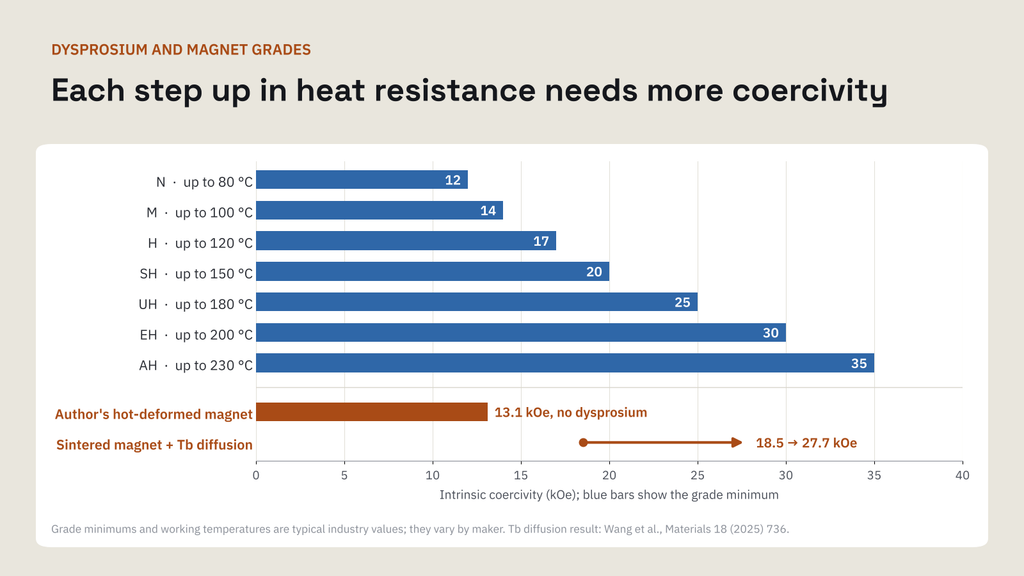
- In the author’s own lab work, a hot-deformed magnet with no dysprosium reached 13.1 kOe of coercivity: enough for an N grade, but well short of the 20 kOe or more a hot-running EV motor typically needs.
- Dy-free magnets exist today, made with finer grain structures. They have been used in hybrid vehicle motors since 2016.
What is dysprosium?
Dysprosium is a soft, silvery metal in the lanthanide series, one of the 17 rare earth elements. It was identified in 1886 by the French chemist Paul-Émile Lecoq de Boisbaudran. Its name comes from the Greek dysprositos, meaning “hard to get”, which has turned out to be accurate in more ways than one.
Dy belongs to the heavy rare earths, a group that is far scarcer in the Earth’s crust than light rare earths such as neodymium. It never occurs as a pure metal. It has to be separated from other rare earths through long chemical processing.
What is dysprosium used for?
By far the largest use is in permanent magnets. Smaller uses include:
- Magnetostrictive alloys such as Terfenol-D, which change shape in a magnetic field and are used in sonar and precision actuators.
- Nuclear reactor control rods, because Dy absorbs neutrons well.
- Specialty lighting, where dysprosium compounds help produce intense white light.
These uses are small next to magnets. When people talk about dysprosium demand, they are talking about motors and generators.
Why magnets need dysprosium
NdFeB magnets are the strongest permanent magnets available. Their weakness is heat. As temperature rises, a magnet’s coercivity falls. Coercivity is its resistance to being demagnetized. An EV traction motor runs at roughly 150 to 200 °C, and at those temperatures a plain NdFeB magnet can lose its magnetization permanently.
Adding Dy solves this. When dysprosium replaces some of the neodymium in the magnet’s crystal structure, the material holds its magnetic direction much more firmly, so coercivity stays high even when hot.
There is a cost beyond the price of the metal. Dy atoms align their magnetism against the iron atoms rather than with them, so every bit of dysprosium added makes the magnet slightly weaker overall. Engineers therefore want as little Dy as they can get away with. Terbium (Tb) does the same job even more effectively, but it is rarer and more expensive. Above about 200 °C, designers often switch to samarium cobalt magnets, which need no dysprosium at all.
How much Dy a magnet needs depends on how hot it runs. Magnets in headphones or hard drives need none. Magnets in EV motors and direct-drive wind turbines have traditionally needed the most.
Where dysprosium comes from
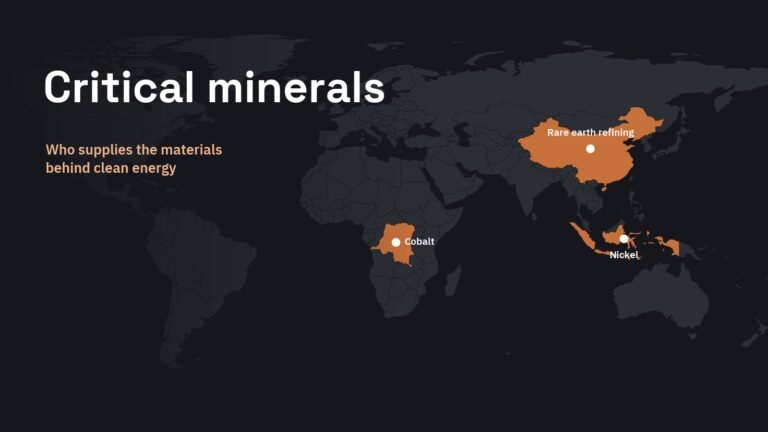
China accounts for roughly 90% of global dysprosium production. Most of it comes from ionic clay deposits in the southern provinces of Jiangxi and Fujian. Industry analysts estimate that China also controls 98 to 99% of the separated heavy rare earths, including Dy and Tb. Total world output is only around 2,000 tonnes a year, tiny compared with most industrial metals.
Alternatives are starting to appear. In May 2025, Lynas Rare Earths announced the first commercial production of separated dysprosium oxide outside China, at its plant in Kuantan, Malaysia, followed by terbium a month later. Volumes are still small, and analysts expect supply from outside China to cover only a fraction of Western demand for years to come.
Why supply is fragile
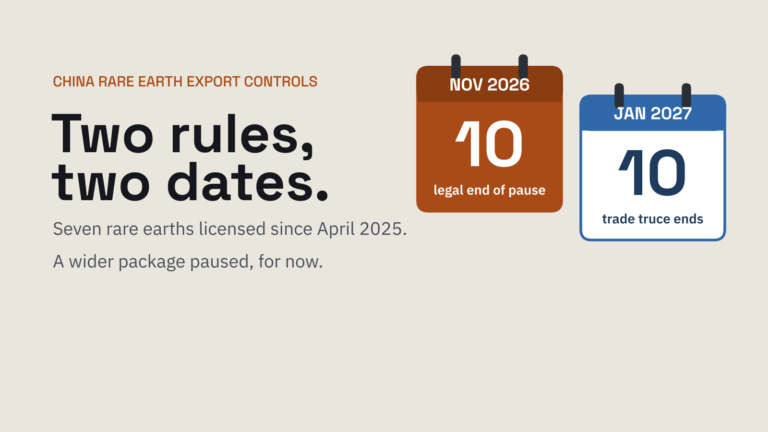
In April 2025, China introduced export licensing for seven medium and heavy rare earths, including dysprosium. Those controls remain in force. A broader set of restrictions announced in October 2025 is suspended until November 10, 2026.
The effect shows up in prices. Inside China, dysprosium metal cost about $230 per kilogram at the end of September 2026, according to Shanghai Metals Market data. Outside China the price is many times higher: Benchmark Mineral Intelligence put dysprosium oxide delivered to Europe at about $3,500 per kilogram in September 2026, roughly 16 times the Chinese domestic price and two and a half times its level three months earlier. Buyers outside China are paying for access as much as for the material, and some cannot get it at any price.
This is why Dy appears on almost every critical minerals list, and why reducing it has become a priority for carmakers.
How the industry is cutting dysprosium use
Grain boundary diffusion
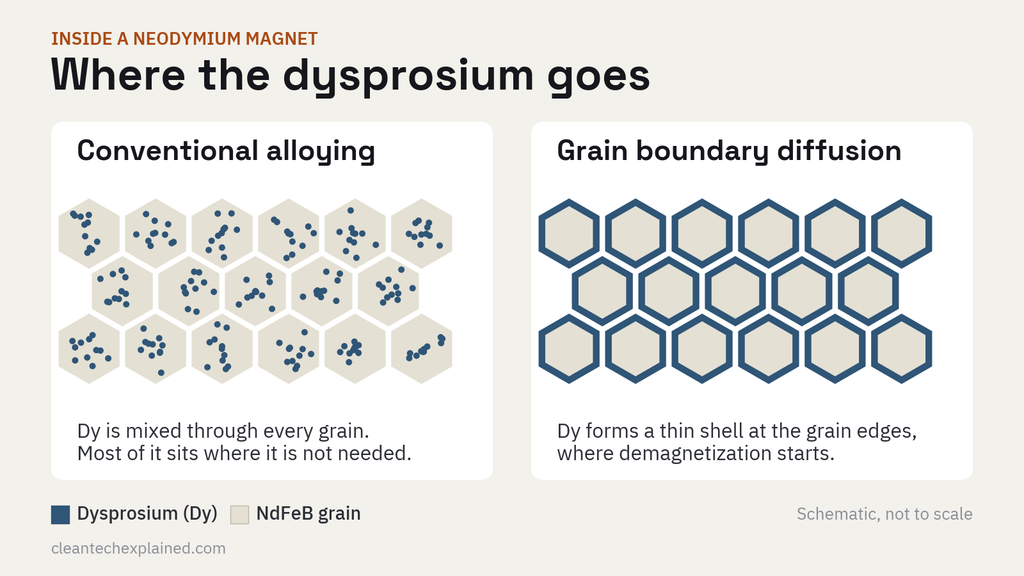
A sintered magnet is made of microscopic grains. Demagnetization starts at the edges of those grains, not in the middle. In a conventional magnet, Dy is mixed through the whole alloy, so most of it sits in the grain interiors where it does little good.
Grain boundary diffusion (GBD) fixes that. A Dy-rich coating is applied to a finished magnet, which is then heated so the dysprosium travels inward along the grain boundaries. Each grain ends up with a thin Dy-rich shell and a Dy-free core. The magnet gets the heat resistance it needs with far less dysprosium, and it keeps more of its strength. GBD is now standard for high-grade magnets. Its main limit is depth: the process works best on thin magnets.
Finer grains
Smaller grains resist demagnetization better, even without Dy. Hot-deformed magnets, made by pressing and deforming magnet powder at around 800 °C, have grains roughly ten times finer than those in ordinary sintered magnets. Daido Steel and Honda used this approach to put a magnet with no heavy rare earths into the drive motor of the Honda Freed hybrid in 2016.
Cheaper diffusion materials
Researchers are replacing part of the Dy in diffusion coatings with abundant elements such as cerium, copper and aluminum. Some laboratory magnets have reached the coercivity needed for demanding applications using diffusion alloys that contain no heavy rare earths.
Better motor design
A magnet that runs cooler needs less Dy. Improved rotor cooling and magnet shapes that reduce demagnetizing stress let engineers specify lower grades. Honda redesigned its motor around its Dy-free magnet for exactly this reason.
Avoiding magnets altogether
The most complete answer is a motor with no permanent magnets. BMW and Renault already do this. See our guide to rare earth free electric motors and the list of EVs without rare earth magnets.
Dysprosium in the lab: a diffusion test and a Dy-free magnet
The author of this guide is a materials engineer who studied rare earth magnets at Pukyong National University in South Korea. Two pieces of that work bear directly on dysprosium: an experiment comparing how different rare earths diffuse into the same magnet alloy, and a magnet made with no heavy rare earths at all.
Setting up a grain boundary diffusion test
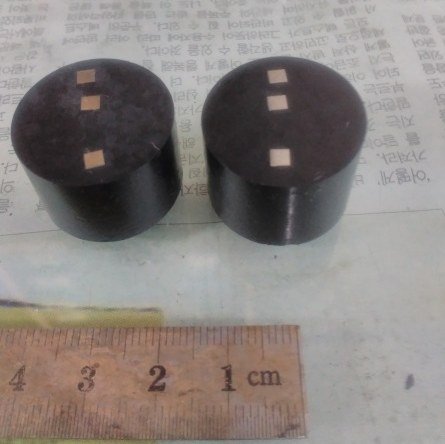
The experiment started with a cast ingot of Nd15.2Fe77.4B7.4. It was annealed at 1,050 °C for six hours so its grains would grow large enough to follow under a microscope, then cut into six pieces of 3 × 3 × 5 mm.
One piece was left bare as a reference. Each of the other five was coated on a polished face with a different rare earth fluoride powder, settled from a suspension in alcohol: dysprosium (DyF3), terbium (TbF3), praseodymium (PrF3), cerium (CeF3) and lanthanum (LaF3). All six were heated at 800 °C for six hours so the coatings could diffuse inward. The samples were then cut, mounted and polished for a scanning electron microscope (SEM) and an electron probe microanalyzer (EPMA), which maps where each element ends up.
The comparison is the point. Dysprosium and terbium raise a grain’s resistance to demagnetization, praseodymium behaves much like neodymium, and cerium and lanthanum lower it. Putting all five on the same alloy, at the same temperature and for the same time, shows how far each one travels along the grain boundaries, and whether it stays in the boundary or moves into the outer edge of each grain, which is where a heavy rare earth does its work.
Published results show what a successful diffusion achieves. In a 2025 study, diffusing terbium-based alloys into a sintered NdFeB magnet raised its coercivity from 18.5 to 27.7 kOe, an increase of about 49%, while remanence stayed at about 13.3 kG. In grade terms, that takes a magnet from roughly the H level to the UH level without making it weaker. Our guide to terbium covers why Tb is even more effective than Dy.
A magnet with no dysprosium, made by hot deformation
The second piece of work used a commercial rapidly quenched powder, Magnequench MQU-F (Nd13.6Fe73.6Co6.6Ga0.6B5.6), which contains no dysprosium or terbium. The powder was hot pressed at 670 °C and then die-upset at 735 °C, squeezing the disc to a quarter of its height in about a minute. Deforming the magnet this way lines up its fine grains, the same principle behind the Daido and Honda magnet described above.
The finished magnet reached a remanence of 12.3 kG, a coercivity of 13.1 kOe and a maximum energy product of 35.6 MGOe. The starting powder had a higher coercivity, about 20 kOe; deforming it traded some of that for a much stronger, aligned magnet. Our guide to neodymium magnets describes how it was made.
That is a respectable magnet, but its coercivity tells the dysprosium story. At 13.1 kOe it meets the minimum for an N grade, rated to about 80 °C. A traction motor running at 150 to 200 °C typically needs an SH grade or higher, with at least 20 kOe. Closing that gap without heavy rare earths, through finer grains and grain boundary engineering, is what Daido, Proterial and others have spent the past decade working on. The cobalt in the alloy helps in a different way: it raised the Curie temperature from about 312 °C for plain Nd2Fe14B to about 410 °C, but a higher Curie temperature on its own does not stop a magnet from demagnetizing in a hot motor.
Who makes Dy-free magnets?
- Daido Steel and Honda: hot-deformed NdFeB magnets with no heavy rare earths, in production for hybrid motors since 2016.
- Proterial (formerly Hitachi Metals): announced two heavy rare earth free NdFeB magnets for EV motors in July 2025, with sample shipments under way and a more heat-resistant version planned to follow.
- Tesla: said in 2023 that it had cut heavy rare earth use per vehicle by 25%.
A caution: “Dy-free” does not mean rare earth free. These magnets still contain neodymium and praseodymium. They remove the scarcest ingredient, not the whole dependency. For magnets that avoid rare earths entirely, see rare earth magnet alternatives and iron nitride magnets.
What comes next
Dysprosium demand per magnet is falling, while the number of magnets being made is rising quickly. Which trend wins will depend on how fast Dy-free grades reach the hottest-running motors, and on how quickly supply outside China grows. For now, Dy remains the tightest bottleneck in the magnet supply chain.
Frequently asked questions
What is dysprosium used for?
Mainly to improve the heat resistance of neodymium magnets in electric vehicle motors and wind turbines. Smaller amounts go into magnetostrictive alloys, nuclear control rods and specialty lighting.
What does Dy stand for?
Dy is the chemical symbol for dysprosium, element 66 on the periodic table.
Why is dysprosium so expensive?
It is scarce, difficult to separate from other rare earths, and produced almost entirely in one country. Export licensing since 2025 has split the market in two: in September 2026, dysprosium oxide delivered to Europe cost about 16 times the price inside China.
Can magnets be made without dysprosium?
Yes. Magnets with very fine grain structures can reach the required heat resistance without Dy. They have been used in hybrid vehicle motors since 2016 and are now being offered for EV motors.
What is grain boundary diffusion?
It is a way of adding dysprosium or terbium to a finished sintered magnet. The magnet is coated with the heavy rare earth, as a metal, fluoride or alloy, and heated so the element travels inward along the grain boundaries. Each grain ends up with a thin Dy- or Tb-rich shell, which raises coercivity with far less heavy rare earth than mixing it through the whole alloy.
Is a Dy-free magnet rare earth free?
No. A Dy-free NdFeB magnet still contains light rare earths such as neodymium and praseodymium. It only removes the heavy rare earths.
Which countries produce dysprosium?
China produces about 90% of it. Lynas began commercial production of separated dysprosium oxide in Malaysia in 2025, and other projects are in development.
Sources
- Rare Earth Exchanges: Lynas produces first separated dysprosium oxide outside China
- Rare Earth Mining News: Dysprosium price today (SMM data, September 2026)
- Benchmark Mineral Intelligence: Ex-china heavy rare earths continue to surge, Q3 2026 Rare Earths Price Review
- Daido Steel: Hybrid vehicle motor magnet free of heavy rare earth elements
- Nikkei Asia: EV magnets by Proterial do not need heavy rare earth metals
- Materials (2023): High-performance hot-deformed Nd-Fe-B magnets without heavy rare earth elements
- Materials (2024): Reducing heavy rare earth diffusion sources in sintered Nd-Fe-B magnets
- AIP Advances (2023): High-coercivity heavy rare earth free NdFeB sintered magnets
- Wang et al., Materials (2025): Grain boundary diffusion of Tb and multi-component alloys in Nd-Fe-B magnets
- e-Magnets UK: Grades of neodymium magnets (coercivity and working temperature by suffix)
- Lab work: the author’s own samples and experiments, Pukyong National University
This article reflects the author’s personal views and publicly available information as of October 2026. It is not investment advice.