Neodymium: Uses, Properties, Price and Where It Comes From

Neodymium is the metal that made modern electric motors small. Alloyed with iron and boron, it forms the strongest permanent magnets ever produced, and those magnets now sit in electric cars, wind turbines, phones, hard drives and almost every compact motor you own. It also colors glass purple, powers some of the world’s most energetic lasers and protects the eyes of glassblowers. This guide covers what neodymium is, what it is used for, where it comes from, what it costs and why governments now treat it as a strategic material.
Short answer: Neodymium (Nd, element 60) is a soft, silvery rare earth metal that tarnishes quickly in air. It is not actually rare: it is about as common in the Earth’s crust as copper or nickel. Its main use, by far, is in neodymium iron boron (NdFeB) magnets. China mines about 61% of the world’s rare earths and refines about 84% of its neodymium-praseodymium oxide, which is why neodymium supply has become a policy issue in the US, Europe and Japan.
Key takeaways
- Neodymium is element 60, a light rare earth metal with a density of about 7.0 g/cm³ and a melting point of about 1,020 °C.
- Carl Auer von Welsbach separated it in Vienna in 1885 from “didymium”, which turned out to be two elements. The name means “new twin”.
- Most neodymium goes into NdFeB magnets. It is sold together with praseodymium as NdPr, and NdFeB magnets account for about 97% of NdPr demand.
- Other uses include Nd:YAG and Nd:glass lasers, purple and color-changing glass, and didymium glasses for welders and glassblowers.
- China supplies about 84% of the world’s NdPr oxide. Production outside China is growing but is expected to stay well below demand for several years.
- At the end of September 2026, neodymium metal traded at about $141/kg and NdPr oxide at about $97/kg in China. Prices are close to double their mid-2025 level.
What is neodymium?
Neodymium is the fourth member of the lanthanide series, sitting between praseodymium and promethium in the periodic table. It is one of the 17 rare earth elements and belongs to the light rare earths, the group that also includes lanthanum, cerium and praseodymium.
The pure metal is bright and silvery but does not stay that way. It oxidizes quickly in air, and the oxide flakes off and exposes fresh metal underneath, so a centimeter-sized lump can corrode right through in about a year. Laboratory samples are kept under oil or in sealed glass. Its compounds are strongly colored, usually lilac, pink or violet, and some of them change color depending on the light source.
| Property | Value |
|---|---|
| Symbol and atomic number | Nd, 60 |
| Atomic weight | 144.24 |
| Group | Lanthanide (light rare earth) |
| Density | About 7.0 g/cm³ |
| Melting point | About 1,020 °C (sources give 1,016 to 1,024 °C) |
| Boiling point | 3,074 °C |
| Usual oxidation state | +3 |
| Abundance in Earth’s crust | About 41 ppm, similar to lanthanum |
| Magnetism of the pure metal | Paramagnetic at room temperature; antiferromagnetic only below 20 K (−253 °C) |
| Natural isotopes | Seven: five stable, two with extremely long half-lives |
One point surprises many people. Pure neodymium is not a strong magnet. At room temperature it is only weakly magnetic, like most rare earth metals. The strength of a neodymium magnet comes from the compound Nd2Fe14B, where neodymium atoms lock the magnetization of the surrounding iron atoms in one direction. The iron supplies most of the magnetism; the neodymium makes it hard to remove.
A short history: the “new twin”
Neodymium’s story starts with a mistake. In 1841 the Swedish chemist Carl Gustaf Mosander separated a substance from cerium ore that he believed was a new element and named didymium, from the Greek word for twin, because it seemed inseparable from lanthanum. For more than four decades didymium appeared in chemistry textbooks as an element.
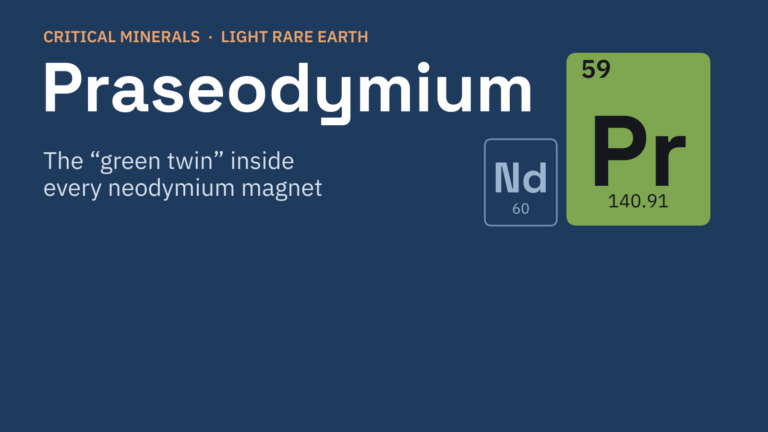
In 1885 Carl Auer von Welsbach, working in Vienna, showed through repeated fractional crystallization and spectroscopy that didymium was really two elements. He named them praseodymium, the “green twin”, after its green salts, and neodymium, the “new twin”. Reasonably pure neodymium metal was not produced until 1925, and high-purity material only became available after the ion-exchange and solvent-extraction methods developed in the 1940s and 1950s.
What is neodymium used for?
Permanent magnets
This is the use that matters most. According to S&P Global, NdFeB magnets account for about 97% of all NdPr demand. In 2025 the world consumed about 108,000 tonnes of NdPr oxide, and the biggest end uses were small motors and consumer electronics (47%), hybrid and electric vehicles (25%) and wind turbine generators (10%). Robotics took only about 4%, but it is the fastest-growing segment.
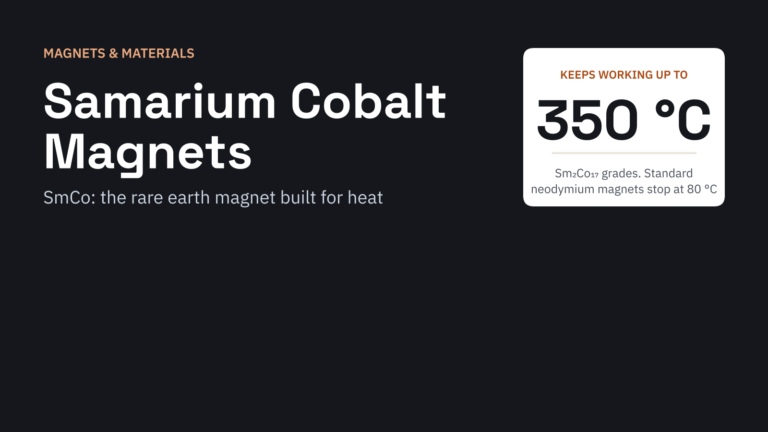
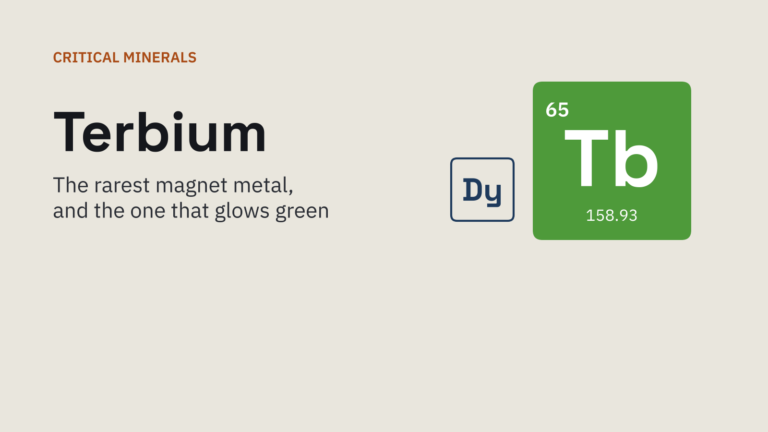
A sintered neodymium magnet is typically 29 to 32% rare earths by weight, mostly neodymium with a quarter or so of praseodymium, plus dysprosium or terbium in grades that must survive high temperatures. Our guide to neodymium magnets explains how they are made, how to read grades such as N42SH and where their limits are.
Lasers
Neodymium ions are one of the most useful laser materials ever found. A neodymium-doped crystal was among the very first working lasers in 1961, and in 1964 Bell Labs researchers demonstrated neodymium in yttrium aluminum garnet, the Nd:YAG laser. Nd:YAG lasers emit infrared light at 1,064 nanometers and are used for cutting and welding metal, engraving, tattoo removal and several kinds of eye and skin surgery.
Neodymium-doped glass can be made in very large pieces, which is why it is used in the giant laser systems built for inertial confinement fusion research. At the other end of the scale, the common green laser pointer usually starts with a neodymium-doped crystal whose infrared output is frequency-doubled to green.
Glass and ceramics
The first commercial use of purified neodymium was coloring glass, beginning with the Moser glassworks in Bohemia in 1927. Neodymium glass looks lavender in daylight and pale blue under fluorescent lamps, because its very sharp absorption bands interact with the narrow emission lines of the light source.
The same sharp bands make didymium glass, a mixture of neodymium and praseodymium, ideal for safety glasses used by glassblowers and some welders. It filters out the intense yellow-orange glare from sodium at 589 nm, so the worker can see the hot glass itself. Neodymium is also used in small amounts to cancel the green tint that iron impurities give to glass, in some light bulbs to produce whiter light, and in astronomy filters that block streetlight glare.
Other uses
- Catalysts: neodymium compounds are used to make certain synthetic rubbers.
- Electron microscopy: neodymium acetate can replace uranyl acetate, a radioactive and toxic stain.
- Geology: the slow decay of samarium-147 into neodymium-143 is used to date rocks and meteorites.
- Alloys: classical mischmetal, used in lighter flints, contains about 18% neodymium.
How much neodymium is in an EV or a wind turbine?
Less than many people assume. Most electric car motors use one to two kilograms of NdFeB magnet. With roughly 30% rare earths in the magnet and about three-quarters of that being neodymium, a typical EV contains in the region of 0.2 to 0.5 kg of neodymium. A hybrid uses less, and a car with an induction or rare-earth-free motor uses none in its drive unit.
Wind turbines are a different scale. Direct-drive turbines with permanent magnet generators use roughly 600 to 850 kg of NdFeB per megawatt of capacity, which works out to about 150 kg of neodymium per megawatt. A large offshore turbine can therefore carry more than a tonne of neodymium. Turbines with gearboxes and conventional generators use much less or none.
Where neodymium comes from
Neodymium is never found as a free metal. It occurs together with the other light rare earths in minerals such as bastnäsite and monazite, where it usually makes up 10 to 18% of the rare earth content. Lanthanum and cerium are far more plentiful in the same ores, which is part of why cerium is so cheap: every tonne of neodymium mined brings several tonnes of cerium with it.
Getting from ore to metal takes several steps. The ore is concentrated and cracked with acid or heat, the mixed rare earths are separated by solvent extraction, often in hundreds of mixer-settler stages, and the separated oxide is reduced to metal by molten-salt electrolysis. Because neodymium and praseodymium are so similar and are used together, many refineries do not split them at all and sell a mixed NdPr oxide, usually about 75% neodymium and 25% praseodymium.

China’s control increases at each step. S&P Global puts its share at about 35% of rare earth reserves, 61% of mine production and 84% of NdPr oxide production in 2025. China also accounts for about 86% of the NdPr that goes into first use, mostly magnet making, although many of those magnets are later exported inside finished products.
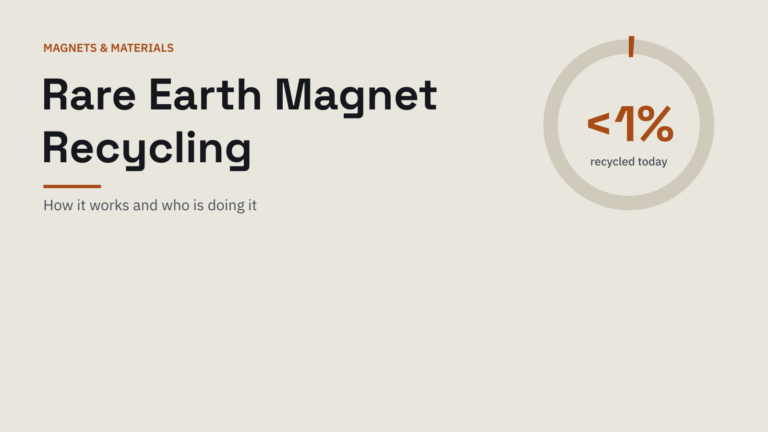
Outside China, the main producers today are Lynas Rare Earths, which mines in Australia and refines in Malaysia, and MP Materials at Mountain Pass, California. S&P Global expects ex-China NdPr oxide production of only about 12,000 tonnes in 2026, roughly 32,000 tonnes short of ex-China demand, rising to about 46,000 tonnes by 2030 as more than 20 projects come online. Recycling also matters: S&P estimates it already supplies around a third of global NdPr, mostly from scrap generated during magnet manufacturing in China. Our guide to rare earth magnet recycling covers that side of the supply chain.
Neodymium price
Neodymium is not traded on an open exchange like copper. Prices are assessed by agencies such as Shanghai Metals Market (SMM), Fastmarkets and Platts, and most published figures are Chinese domestic prices. Buyers outside China usually pay a premium.
| Benchmark | Price | Date |
|---|---|---|
| Neodymium metal, China domestic (SMM) | About $141/kg | 30 Sep 2026 |
| NdPr alloy, China domestic (SMM) | About $133/kg | 30 Sep 2026 |
| NdPr oxide, China (SMM) | About $97/kg | 30 Sep 2026 |
| NdPr oxide (Platts, via S&P Global) | About $74/kg → $120/kg | Dec 2025 → mid-2026 |
| US price floor, MP Materials agreement | $110/kg NdPr | Since July 2025 |
Two things stand out. First, prices have risen sharply: NdPr oxide in China was around $55/kg in mid-2025 and since spring 2026 has traded mostly between about $90 and $120/kg, depending on the benchmark. Second, the US government’s agreement with MP Materials guarantees a floor of $110/kg, which is now above the Chinese spot price. That gap is deliberate. Western producers have higher costs, and S&P Global estimates that a long-run price of about $75 to $80/kg is needed to keep most planned non-Chinese supply viable.
Metal costs more than oxide because it requires an extra electrolysis step, and the Chinese domestic prices above include value-added tax. Small retail quantities of pure neodymium sold to collectors or laboratories cost far more per kilogram than these industrial benchmarks.
Export controls and supply risk
Neodymium itself is not one of the seven medium and heavy rare earths that China placed under export licensing in April 2025. However, that April package also covered permanent magnets containing those elements, and many NdFeB magnets contain dysprosium or terbium, so neodymium magnets were caught up in the disruption. Some US carmakers briefly halted production lines as a result. A broader package announced in October 2025 has been suspended until 10 November 2026, and China added further controls on certain rare earth exports to Japan in early 2026.
In response, the G7 committed in June 2026 to cutting dependence on any single supplier to below 60% of rare earth and magnet imports by 2030. Neodymium appears on the critical minerals lists of the US, the EU and most other major economies; see our critical minerals list for how those lists compare. Carmakers are also reducing their exposure, either by using less neodymium per motor or by switching to designs that avoid permanent magnets. Our guide to rare earth magnet alternatives covers the options.
Is neodymium dangerous?
The metal and its compounds have low to moderate toxicity, though this has not been studied in depth. The dust and soluble salts irritate the eyes, skin and airways, and fine neodymium powder is combustible. None of this matters much for ordinary consumers, because neodymium in products is locked inside alloys or glass.
The real everyday hazard is the magnets. Strong neodymium magnets can snap together hard enough to pinch skin or shatter, and swallowing more than one small magnet can cause serious internal injuries, particularly in children. People with pacemakers should keep large magnets away from their chest.
Frequently asked questions
Is neodymium a rare earth element?
Yes. It is one of the 17 rare earth elements and one of the light rare earths. Despite the name, it is not rare: it is about as abundant in the Earth’s crust as copper, nickel or cobalt.
Is neodymium magnetic?
Only weakly. Pure neodymium is paramagnetic at room temperature. Neodymium magnets are strong because neodymium combines with iron and boron in the compound Nd2Fe14B, which holds the iron’s magnetization in place.
Is neodymium radioactive?
Not in any practical sense. Natural neodymium contains two isotopes, neodymium-144 and neodymium-150, that decay with half-lives of more than a thousand trillion years. Their radioactivity is far too weak to measure without specialist equipment and poses no health risk.
What is the difference between neodymium and NdPr?
NdPr is a mixture of neodymium and praseodymium, usually in a 75:25 ratio, sold as oxide or metal. Magnet makers can use it directly, so refiners save the cost of fully separating the two elements. It is the main benchmark for magnet rare earth prices.
Which country produces the most neodymium?
China, by a wide margin. It mines about 61% of the world’s rare earths and produces about 84% of its NdPr oxide. The largest producers outside China are Lynas (Australia and Malaysia) and MP Materials (United States).
Can neodymium be recycled?
Yes. Scrap from magnet manufacturing is already recycled on a large scale, mostly in China. Recovering neodymium from old motors and hard drives is harder, mainly because of the cost of collecting and dismantling them, but several plants in Europe, the US and Japan are now doing it.
What does neodymium look like?
A bright silvery metal when freshly cut. It tarnishes within hours to days in air, turning dull and eventually flaking. Its compounds are usually lilac, pink or violet.
Sources
- Royal Society of Chemistry, Neodymium: element information, properties and uses
- Wikipedia, Neodymium (properties, isotopes, history and applications, with primary references)
- S&P Global, NdPr Market Report, August 2026
- Rare Earth Mining News, Neodymium price (SMM benchmarks, 30 September 2026)
- Critical Minerals News, Rare earth price: NdPr (SMM oxide benchmark, 30 September 2026)
- Encyclopedia (MDPI), Rare earth elements in wind turbines (NdFeB per megawatt)
Featured image and diagram: original graphics by CleanTech Explained. This article reflects the author’s personal views and publicly available information as of October 2026. It is general information, not investment or purchasing advice.