Rare Earth Magnet Alternatives: The Complete Guide

Rare earth magnet alternatives have moved from a niche research topic to a boardroom priority. Neodymium magnets power most electric vehicle motors, many wind turbines and countless smaller devices, and the supply chain behind them runs overwhelmingly through China. Since 2025, export controls have turned that dependence into a daily business risk.
This guide covers every serious option for replacing or reducing rare earth magnets: alternative magnet materials, smarter ways to use less rare earth, recycling, and electric motors that need no permanent magnets at all. For each one, we explain how it works, how mature it is and where it makes sense, without the hype. It also includes measurements from magnets the author made in a university lab.
Key takeaways
- There is no drop-in replacement for neodymium (NdFeB) magnets yet. Every alternative trades away some strength, temperature performance, size or cost.
- The most practical options today are motor designs that avoid permanent magnets, heavy-rare-earth-free neodymium magnets, recycling and ferrite-based designs.
- Iron nitride is the most advanced new rare-earth-free magnet material, with commercial-scale production planned in the United States from 2027.
- Materials such as tetrataenite, MnBi and MnAl have promising properties but remain in research.
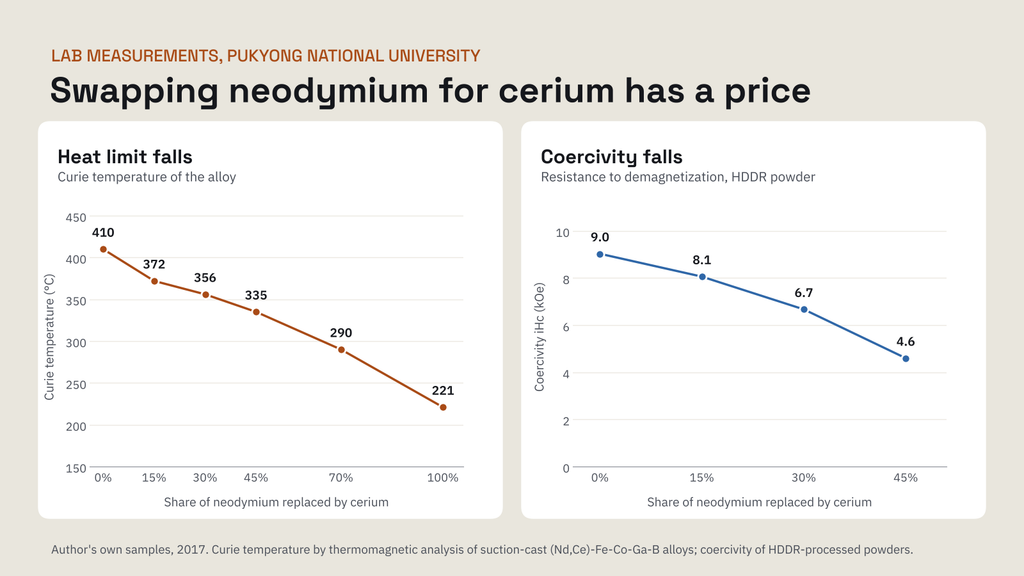
- Swapping part of the neodymium for cheap cerium cuts cost, but the author’s own lab samples show the price: lower heat resistance and lower coercivity at every step.
- Samarium-cobalt magnets are not an escape route: samarium is itself a rare earth and is subject to Chinese export controls.
Why the world needs rare earth magnet alternatives
What rare earth magnets do
Permanent magnets turn electricity into motion and motion into electricity. The strongest commercial type, neodymium-iron-boron (NdFeB), packs far more magnetic energy into a small volume than any other mass-produced magnet. That is why it dominates EV traction motors, wind turbine generators, hard drives, speakers, drones, robots and industrial motors.
Neodymium magnets have one weakness: they lose strength as they heat up. Motors in cars and industrial machines run hot, so manufacturers add heavy rare earth elements, mainly dysprosium and terbium, to keep the magnets stable at high temperatures. These heavy rare earths are scarcer, more expensive and even more concentrated in supply than neodymium.
The supply problem
Roughly 90% of powerful permanent magnets are made in China, and China also dominates rare earth refining and separation. In April 2025, China introduced export licensing for seven medium and heavy rare earth elements, including dysprosium, terbium, samarium and yttrium, and for magnet materials that contain them. A broader package announced in October 2025 was suspended until January 2027, but the April controls remain in force. Shipments have resumed, yet they have been volatile from month to month, with some countries receiving more stable supply than others.
For manufacturers, the lesson is clear. Even when magnets are available, their price and delivery can change with a policy announcement. That is the business case for alternatives. See our complete guide to rare earth free electric motors. Some lower-cost grades replace part of the neodymium with cerium; see our guide to cerium magnets.
Three ways to reduce rare earth dependence
Every approach falls into one of three strategies:
- Replace the magnet material with one that contains no rare earths, such as ferrite, iron nitride or, in the future, tetrataenite.
- Use less rare earth, or use it again, through heavy-rare-earth-free neodymium magnets and recycling.
- Redesign the motor so it needs weaker magnets or no permanent magnets at all.
In practice, most companies combine all three.
Rare earth magnet alternatives compared
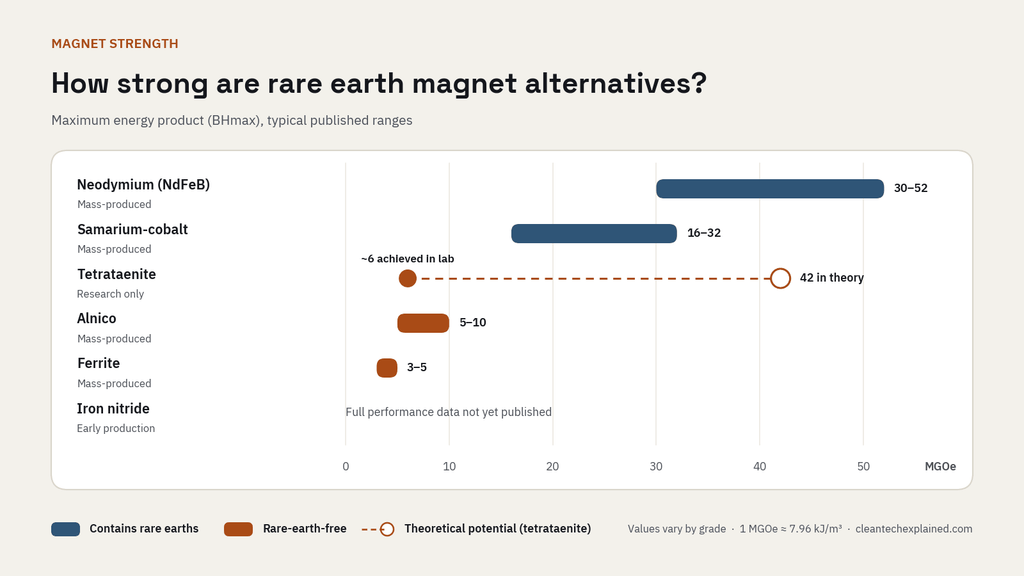
| Option | Contains rare earths? | Typical strength (BHmax) | Maturity | Best suited to |
|---|---|---|---|---|
| Neodymium (NdFeB), for reference | Yes | 30–52 MGOe | Mass-produced | EV motors, wind, electronics |
| Ferrite | No | 3–5 MGOe | Mass-produced | Low-cost motors, speakers, appliances |
| Alnico | No | 5–10 MGOe | Mass-produced | Sensors, instruments, high temperatures |
| Samarium-cobalt | Yes (samarium) | 16–32 MGOe | Mass-produced | Aerospace, defense, very high temperatures |
| Heavy-rare-earth-free NdFeB | Neodymium only | Close to standard NdFeB | Commercial in some uses | EV and hybrid motors |
| Recycled NdFeB | Yes, recovered | Similar to new NdFeB | Scaling up | Same uses as NdFeB |
| Iron nitride | No | Full data not yet public | Early commercial | Electronics, speakers, industrial motors |
| Tetrataenite | No | 42 MGOe in theory, about 6 MGOe achieved | Research | Long-term candidate |
| MnBi and MnAl | No | Moderate | Research and pilot | Mid-range motors, in the future |
| Magnet-free motors | No | Not applicable | Mass-produced | EVs, industrial drives |
Strength ranges are typical published values and vary by grade.
Alternative magnet materials
Ferrite magnets
Ferrite magnets, made mostly from iron oxide with strontium or barium, are the world’s most common permanent magnets by weight. They are cheap, resistant to corrosion and made from abundant raw materials.
Their drawback is strength. A ferrite magnet stores only about a tenth of the magnetic energy of a neodymium magnet, so a motor that swaps directly from NdFeB to ferrite must become larger and heavier to deliver the same power. Engineers work around this with clever rotor designs, such as ferrite-assisted synchronous reluctance motors, which combine modest ferrite magnets with a rotor shape that produces extra torque on its own.
Ferrite is the most practical rare-earth-free magnet for cost-sensitive products where size and weight matter less, such as appliances, fans, pumps and many speakers.
Alnico magnets
Alnico magnets are made from aluminum, nickel and cobalt with iron. They handle very high temperatures well and were the strongest magnets available before rare earth magnets arrived. However, they are easily demagnetized and contain cobalt, another critical mineral. Today they are used mainly in sensors, instruments, guitar pickups and specialist high-temperature equipment rather than as a mainstream replacement for NdFeB.
Iron nitride magnets
Iron nitride magnets are made from iron and nitrogen, two of the most abundant materials on Earth. The phase behind them, Fe16N2, has very high magnetization, which is why it has attracted researchers for decades.
Niron Magnetics, a Minnesota company, is currently the leading developer of bulk iron nitride magnets. It opened a commercial pilot plant in Minneapolis in 2024 and is building a plant in Sartell, Minnesota, designed to produce 1,500 tons of magnets a year once fully operational in 2027. In 2026 it began site selection for a second plant with capacity of up to 10,000 tons a year, which the company says would represent about 1–2% of the global permanent magnet market. Early applications include loudspeakers and consumer electronics.
Some caution is warranted. Industry observers have pointed out that full magnetic property data, including demagnetization curves and high-temperature performance, have not been published in detail. Until those are available and independently verified, iron nitride is best viewed as the most promising new material to watch rather than a proven substitute for high-performance neodymium magnets.
Tetrataenite
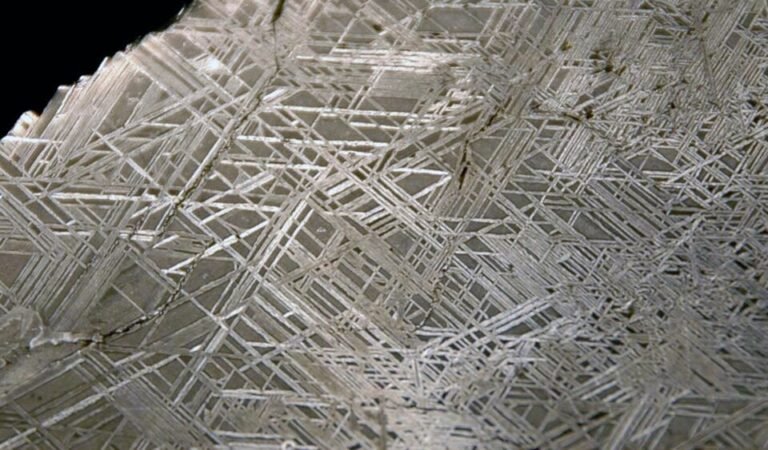
Tetrataenite is an ordered iron-nickel alloy found naturally in meteorites. In theory, it could reach a maximum energy product of about 42 MGOe, within the range of commercial neodymium magnets, using only iron and nickel. In practice, it is extremely hard to make, because the ordered structure is stable only below about 320 °C, where atoms barely move. The best synthetic samples reach about 6 MGOe.
A 2022 report claiming tetrataenite could be cast in seconds by adding phosphorus was retracted in December 2024 after follow-up work showed the data had been misinterpreted. Read our full guide to tetrataenite for the details.
Manganese-based magnets: MnBi and MnAl
Manganese-bismuth (MnBi) and manganese-aluminum (MnAl) magnets contain no rare earths and sit between ferrite and neodymium in performance. MnBi has an unusual advantage: its resistance to demagnetization increases as temperature rises, the opposite of neodymium magnets, which makes it interesting for hot motor environments. Its weaknesses are bismuth supply and cost, and difficulty achieving high magnetization in bulk magnets. MnAl uses cheap ingredients but struggles with the stability of its magnetic phase.
Both remain mostly in research and pilot development. They are realistic long-term options for mid-range motors rather than near-term replacements.
Samarium-cobalt: an alternative, but not rare-earth-free
Samarium-cobalt (SmCo) magnets are sometimes listed as an alternative to neodymium. They perform exceptionally well at high temperatures and resist corrosion, which is why they are used in aerospace and defense. But samarium is a rare earth element, cobalt is a critical mineral, and samarium is among the elements covered by China’s 2025 export licensing. SmCo can reduce reliance on neodymium and dysprosium, but it does not remove rare earth risk.
Using less rare earth: better neodymium magnets and recycling
Heavy-rare-earth-free neodymium magnets
The most vulnerable part of the supply chain is not neodymium but the heavy rare earths, dysprosium and terbium, added for heat resistance. Reducing or eliminating them keeps most of the performance of NdFeB while removing the scarcest inputs.
Two main techniques make this possible. Grain boundary diffusion places small amounts of dysprosium or terbium only at the edges of the magnet’s crystal grains, where they matter most, cutting the total amount needed. Fine-grained magnets go further. In 2016, Daido Steel and Honda put into production a hot-deformed neodymium magnet containing no heavy rare earths at all, first used in the drive motor of the Honda Freed hybrid. Its much finer crystal structure provides the heat resistance that dysprosium normally supplies, and Honda redesigned the rotor to make the most of it.
This approach does not remove dependence on neodymium, but it targets the elements with the tightest supply.
Recycling rare earth magnets
Every magnet already in use is a potential source of rare earths. Recycling is scaling up quickly:
- Cyclic Materials opened a commercial-scale magnet recycling plant in Mesa, Arizona, in 2026, processing end-of-life products such as motors and electronics without manual disassembly.
- MP Materials agreed in 2025 to supply Apple with magnets made from 100% recycled feedstock, with shipments targeted for 2027.
- Noveon Magnetics in Texas makes magnets from recycled material and in 2026 launched a closed-loop program with LG Electronics to turn magnets from old LG products into new ones.
- HyProMag, which uses a hydrogen-based process to recover magnet material, reported its first commercial sales in 2026.
Recycling will not meet all demand, because many magnets stay in service for a decade or more and collection is difficult. But it reduces the need for newly mined rare earths and shortens supply chains.
What the lab bench shows about using less rare earth
Cutting rare earth content is easier to describe than to do. As a graduate student at Pukyong National University in South Korea, the author of this guide spent 2017 making neodymium-type magnets, including samples in which part of the neodymium was replaced by cerium, the cheapest and most abundant rare earth. The measurements below come from those samples. They show why every “use less rare earth” strategy comes with trade-offs.
A magnet with no heavy rare earths, made by hot pressing
The starting point was a commercial melt-spun powder of neodymium, iron, cobalt, gallium and boron, with no dysprosium or terbium. Hot pressing it at about 670 °C and then squeezing it to a quarter of its height at about 735 °C, a step called die-upsetting, lined up its crystal grains. Remanence rose from about 6.7 to 12.3 kG, and the maximum energy product reached about 35.6 MGOe. This is the same family of hot-deformed magnets that Honda and Daido Steel took into production. Our guide to neodymium magnets shows the samples and the full results.
Cerium lowers the heat limit
Cerium is attractive because its oxide costs a few dollars a kilogram, against roughly $100 for neodymium-praseodymium oxide (see our guide to cerium). But it weakens the magnetic phase. In alloys made to the same cobalt-containing recipe, the Curie temperature, the point where a magnet loses its magnetism, fell from about 410 °C with no cerium to 335 °C when 45% of the neodymium was replaced, and to 221 °C when all of it was. A lower Curie temperature generally means more strength lost at motor operating temperatures.
Coercivity falls too
Coercivity, a magnet’s resistance to being demagnetized, dropped in the same way. Powders made by the HDDR process (hydrogenation, disproportionation, desorption and recombination) fell from about 9.0 kOe with no cerium to 4.6 kOe with 45% cerium. That is the main reason cerium grades go into lower-temperature products such as appliance and pump motors rather than EV traction motors.
Blending works better than alloying
One way around the trade-off is to keep cerium out of some of the grains. In a 2019 paper, the author and colleagues mixed a standard neodymium powder with a cerium-rich HDDR powder in equal parts and die-upset the blend. The hybrid magnet reached 19.8 MGOe and 6.8 kOe, against 11.6 MGOe and 3.9 kOe for a single alloy with the same overall composition. Our guide to cerium magnets explains why the hybrid holds up better.
What went wrong, and why it matters for scale-up
Not every batch worked. One HDDR batch oxidized during processing. Long high-energy milling, 48 hours in a steel jar, cut the coercivity of a neodymium powder to under 0.5 kOe and contaminated it with iron from the balls and jar. Rare earth powders are reactive and easy to damage, which is one reason new magnet materials take years to move from a promising lab result to a factory.
Redesigning the motor: electric motors without rare earth magnets
The most proven way to avoid rare earth magnets is to build motors that do not need permanent magnets at all. Several designs are already on the road and in factories.
Externally excited synchronous motors (EESM)
In an EESM, the rotor carries copper windings that are energized with a small current, creating the magnetic field that permanent magnets would normally provide. Because the field can be adjusted, the motor can run efficiently at high speed and light load.
Renault has sold EESM-powered cars since the Zoe in 2012 and is developing a third-generation, 200 kW version. BMW has used EESMs since 2018, and its latest Neue Klasse models, starting with the iX3, pair an EESM on the rear axle with an induction motor on the front axle, so neither motor needs rare earth permanent magnets. The trade-offs are extra complexity, the need to transfer power to the spinning rotor, and some additional losses in the rotor windings.
For a full comparison of motor designs that avoid rare earths altogether, see our guide to rare earth free electric motors.
Induction motors
Induction motors, also called asynchronous motors, create the rotor’s magnetic field by induction from the stator. They are robust, cheap and entirely free of magnets, and they power much of the world’s industrial machinery. In EVs they are less efficient than permanent magnet motors at typical driving loads, so they are often used as secondary motors that can freewheel with little drag when not needed.
Reluctance motors
Switched reluctance and synchronous reluctance motors produce torque from the shape of a steel rotor, with no magnets or rotor windings. They are simple and rugged. Switched reluctance motors have historically been noisy and harder to control, while synchronous reluctance motors are increasingly common in efficient industrial drives. Adding modest ferrite magnets creates the ferrite-assisted designs mentioned earlier, which narrow the performance gap with rare earth motors.
How to choose: rare earth alternatives by application
Electric vehicles. Magnet-free EESM and induction motors are proven today. Heavy-rare-earth-free NdFeB suits manufacturers staying with permanent magnet motors. Iron nitride and MnBi are future options.
Wind turbines. Many turbines use direct-drive generators with large NdFeB magnets, while geared designs with conventional generators need far fewer or none. The choice depends on turbine size, maintenance access and cost.
Consumer electronics and speakers. Ferrite remains the standard for cost-sensitive products, and iron nitride is entering speakers and electronics. Recycled NdFeB suits products where size is critical.
Industrial motors. Induction and synchronous reluctance motors already dominate many industrial uses, and ferrite-assisted designs improve efficiency further.
Robotics and drones. These applications need compact, lightweight motors, which keeps NdFeB hard to replace. Recycled and heavy-rare-earth-free magnets are the most realistic near-term options.
The outlook: what will actually change
No single material will replace neodymium magnets soon. The rare earth dependence of clean energy will instead shrink through many parallel changes: more EVs with magnet-free motors, less dysprosium and terbium per magnet, growing recycling capacity, ferrite in cost-driven products and, if production and performance data hold up, a meaningful share for iron nitride later this decade.
The developments worth watching in the next few years are the start of full production at Niron’s Sartell plant, the outcome of China’s suspended export controls after January 2027, and whether independent data confirm the performance of new rare-earth-free materials. We will update this guide as those stories develop.
Frequently asked questions
What is the best alternative to rare earth magnets?
It depends on the application. For EVs, magnet-free motors such as EESM and induction motors are the most proven option today. For products where cost matters more than size, ferrite is the standard choice. For applications that need neodymium-level performance, heavy-rare-earth-free and recycled NdFeB are the most practical ways to reduce risk.
Is there a magnet as strong as neodymium without rare earths?
Not yet in mass production. Tetrataenite could rival neodymium in theory, but it cannot yet be made in bulk. Iron nitride is the most advanced rare-earth-free material entering production, but full independent performance data are not yet public.
Do any electric cars avoid rare earth magnets?
Yes. BMW’s Neue Klasse models use an externally excited synchronous motor at the rear and an induction motor at the front, neither of which needs rare earth permanent magnets. Renault has also used externally excited synchronous motors since 2012.
Is samarium-cobalt a rare-earth-free magnet?
No. Samarium is a rare earth element, and it is among the elements covered by China’s export licensing since 2025. Samarium-cobalt magnets avoid neodymium and dysprosium but not rare earths in general.
Can rare earth magnets be recycled?
Yes. Several companies now recover magnet material from end-of-life motors and electronics and turn it into new magnets. Recycling is growing fast but will supply only part of future demand for many years.
Can cerium replace neodymium in magnets?
Partly. Commercial cerium-containing grades replace a share of the neodymium to cut cost. In the author’s lab samples, replacing 45% of the neodymium with cerium lowered the Curie temperature from about 410 °C to 335 °C and roughly halved coercivity, so cerium grades suit lower-temperature uses such as appliance and pump motors.
Sources
- CSIS, “Rare Earth Export Restrictions One Year Later” (2026): https://www.csis.org/analysis/rare-earth-export-restrictions-one-year-later
- China Briefing, “China’s Rare Earth Export Controls”: https://www.china-briefing.com/news/chinas-rare-earth-export-controls-impacts-on-businesses/
- Niron Magnetics, pilot plant announcement (2024): https://www.businesswire.com/news/home/20241010091386/en/Niron-Magnetics-Opens-the-Worlds-First-Manufacturing-Facility-for-Powerful-Rare-Earth-Free-Permanent-Magnets
- Wood, Niron Magnetics Sartell plant: https://www.woodgroup.com/news/niron-iron-nitride-permanent-magnet-plant
- Niron Magnetics, second plant site selection (2026): https://nironmagnetics.com/niron-magnetics-advances-u-s-permanent-magnet-manufacturing-plans/
- SDM Magnetics, “Iron Nitride Magnets: A Realistic Perspective”: https://sdmmagnets.com/iron-nitride-magnets/
- Honda, heavy-rare-earth-free neodymium magnet (2016): https://global.honda/en/newsroom/news/2016/4160712eng.html
- Renault Group, electric motors without rare earths: https://www.renaultgroup.com/en/magazine/energy-and-motorization/all-about-electric-motors-with-no-rare-earths/
- BMW Group, the new BMW iX3: https://www.press.bmwgroup.com/united-kingdom/article/detail/T0452406EN_GB/the-start-of-a-new-era-the-new-bmw-ix3?language=en_GB
- Noveon Magnetics, closed-loop recycling with LG Electronics (2026): https://www.prnewswire.com/news-releases/noveon-magnetics-kangwon-energy-and-lg-electronics-launch-closed-loop-rare-earth-magnet-recycling-initiative-302654272.html
- Tech Times, Cyclic Materials recycling plant (2026): https://www.techtimes.com/articles/327250/20260910/us-opens-first-commercial-rare-earth-magnet-recycling-plant-china-controls-still-bite.htm
- Djuanda et al., “Magnetic performance of (Nd,Ce)-Fe-B-type die-upset hybrid magnet composed of melt-spun and HDDR-treated materials,” Journal of Magnetics (2019): https://doi.org/10.4283/JMAG.2019.24.4.616
- Lab measurements: the author’s own samples, Pukyong National University, 2017
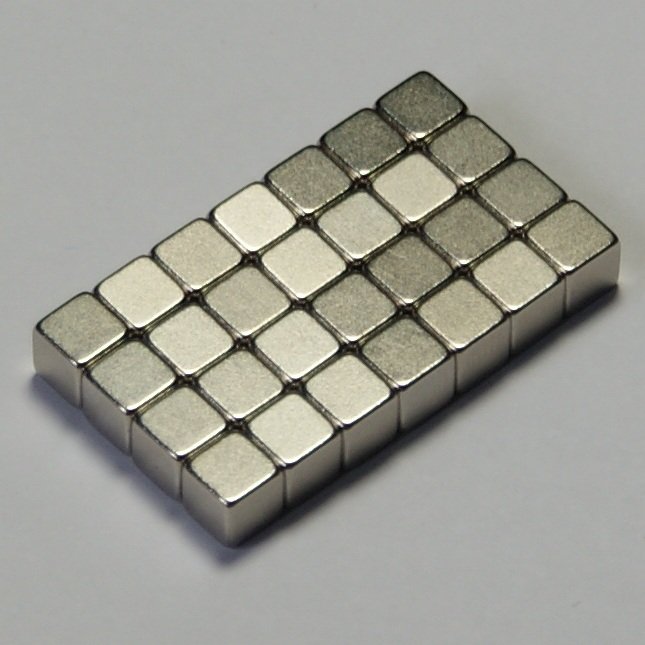
Featured image: Neodymium magnet cubes from Chemical Elements – A Virtual Museum (images-of-elements.com), CC BY 3.0, via Wikimedia Commons.